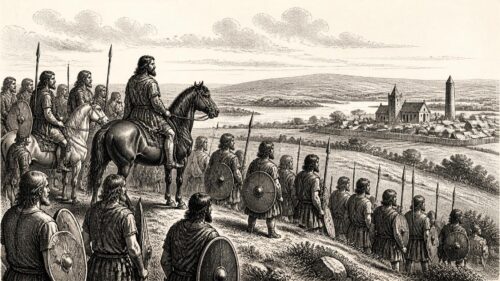
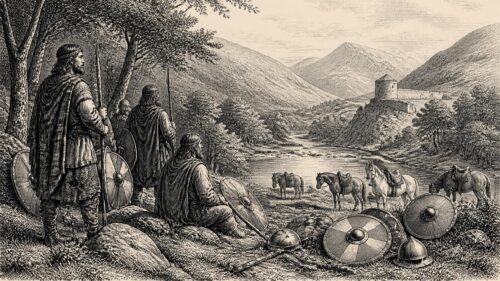
Boirenn and the Uí Ruairc966 CE
Annals for 966 record a major defeat of the Uí Ruairc alliance at Boirenn in north Clare by Comaltán Ua Cléirigh and Máel Sechnaill son of Arcda, with Taichlech Ua Gadhra among the dead. Fergal Ua Ruairc, king of Connacht, was killed by Domnall of Brega, exposing unstable regional kingship. Leinster also suffered disputed royal losses, while Armagh lost both Patrick’s successor Muiredach and its bishop, Cathasach. Conflicting chronicles complicate dating of Domnall Ua Néill’s campaigns against Leinster and Dublin. The records portray fragmented Ireland, where dynastic warfare, church offices, cattle wealth, famine’s shadow, and Dublin’s trade shaped political power.
Dateline
The surviving Irish annals make 966 a year of unusually clear political consequence in the west and north, but they also demand caution. Their entries preserve deaths, a battle and the fall of a Connacht king; yet the chroniclers did not all arrange events under the same year. The Annals of Ulster and Chronicon Scotorum, the closest guides for this article, place a defeat of the Uí Ruairc in 966 in Boirenn of Corcu Mruad, modern north Clare. A much later compilation, the Annals of the Four Masters, puts the same encounter two years earlier and gives a different casualty total. Such disagreements are not a reason to discard the evidence. They are a reason to separate what the records firmly associate with 966 from events whose exact calendar placement remains uncertain.
A Defeat in Boirenn
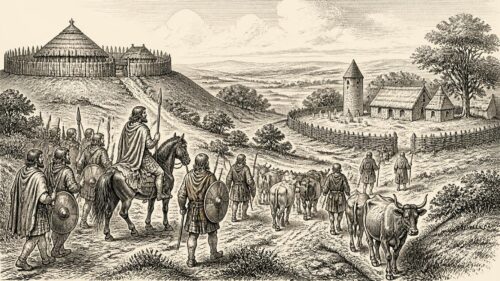
The central event recorded under 966 in Chronicon Scotorum was a defeat inflicted on the Uí Ruairc in Boirenn, within the territory of Corcu Mruad. The victors were Comaltán Ua Cléirigh and Máel Sechnaill son of Arcda. Comaltán was lord of Uí Fhiachrach Aidhne, a kingdom centred in what is now south Galway, while his ally belonged to another Connacht political grouping. Their opponents were members or followers of the powerful Uí Ruairc, whose interests extended across Connacht and Bréifne. The entry names Taichlech Ua Gadhra, king of Luigne, among the dead.
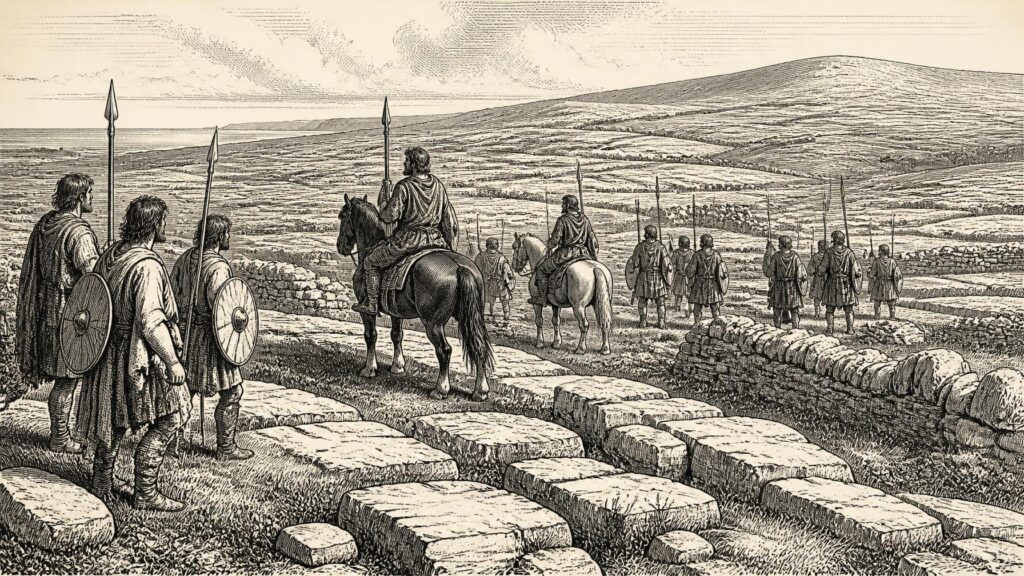
Boirenn was no accidental backdrop. Its limestone uplands, thin soils, enclosed valleys and routes between the Shannon plain and the Atlantic made it a distinctive frontier zone between Connacht and north Munster. Control of such country mattered less because it was densely cultivated than because it connected kingdoms, grazing lands, churches and coastal approaches. A military force moving there had to manage water, fodder, narrow passages and the difficult transport of supplies. The annals offer no tactical account, so it would be wrong to imagine a set-piece battle in detail. Nevertheless, the selection of Boirenn shows that political struggle in 966 reached beyond the better documented royal centres of Tara, Dublin and Cashel.
Chronicon Scotorum says that four thousand men fell, including Taichlech. That is an annalistic figure, not a modern body count: medieval chroniclers could use large totals to signal the scale and seriousness of a disaster, and the number cannot be independently checked. The Four Masters, compiling much later, gives the same broad result but reports seven hundred dead and places it in 964. What can safely be said is that a major reverse befell the Uí Ruairc alliance in the middle years of the decade, and that the annalistic tradition closely connects it with the calendar year 966.
Connacht’s Unsettled Kingship
The Boirenn defeat was followed in the same 966 entries by another blow to Uí Ruairc authority. Fergal Ua Ruairc, styled king of Connacht in Chronicon Scotorum, was killed by Domnall son of Congalach, king of Brega. The Annals of Ulster also records Fergal’s killing under 966. The sources do not explicitly say that Domnall’s action was a direct consequence of Boirenn, and the two events should not be turned into a single campaign without evidence. Their proximity in the record does, however, reveal how vulnerable Connacht’s leading dynasty was at this moment: it faced defeat in the west and the killing of its king by a ruler from Brega to the east.
Irish kingship was not a fixed territorial office inherited automatically by the eldest son. It rested on descent, military following, negotiated superiority and the ability to take or protect hostages, cattle and church interests. A king’s death could therefore open a contest rather than settle one. Fergal was remembered in Chronicon Scotorum as “Nabcodon of the Gaels”, an honorific suggesting renown, but prestige did not ensure security. In 966 the political map was made up not of a united state but of overlapping provincial, regional and local lordships. Connacht itself contained several competing dynasties, including Uí Fhiachrach Aidhne, the Uí Ruairc and the rulers of Luigne.
Comaltán Ua Cléirigh’s place among the victors is especially revealing. His Uí Fhiachrach Aidhne lay south of the principal Uí Ruairc sphere, and victory in Boirenn gave its ruler a place in events of province-wide importance. The annals do not say that Comaltán became king of Connacht in 966, nor should later dominance be read backwards into this year. But his recorded intervention demonstrates that Connacht’s balance of power was not decided solely by the dynasty holding its kingship at any one time.
Domnall Ua Néill and Leinster
Beyond Connacht, Domnall Ua Néill of Cenél nEógain remained the pre-eminent northern king. The Annals of the Four Masters calls 966 his twelfth year, reflecting its reckoning of his rule over Tara. He had already shown his capacity to exact submission: the Annals of Ulster records that in the preceding annal-year he entered Connacht, plundered it and took hostages from Ua Ruairc. That earlier expedition provides immediate context for Fergal’s death, but it must not be confused with the events firmly entered under 966.
The Four Masters attributes a much larger expedition to Domnall in its annal for 966: he supposedly crossed Leinster from the Barrow to the sea, seized a great cattle-prey and besieged the foreigners of Dublin and the Leinstermen for two months. Yet Chronicon Scotorum dates that same campaigning to 968. This is precisely the kind of chronological conflict that matters in a year-by-year history. The expedition belongs to the political world of the later 960s and demonstrates Domnall’s pressure on Leinster and Dublin, but cannot responsibly be presented as certainly occurring in calendar year 966.
What is beyond doubt is that Leinster was experiencing acute dynastic instability around this point. The annals preserve the deaths or deaths by wounds of leading Leinster figures, but disagree over names and dates. The Annals of Inisfallen places the death of Cellach son of Faelán, king of Leinster, in its 966 entry, whereas the Annals of Ulster names Faelán as king of Leinster under the same year; Chronicon Scotorum records Cellach’s death in 966. The Four Masters also says that Máelmórda son of Finn, a royal heir of Leinster, was mortally wounded. These variations make the succession hard to reconstruct, but they agree on the larger truth: royal Leinster was weakened by the loss of senior men just as Domnall’s northern power bore down upon it.
Churches and Successions
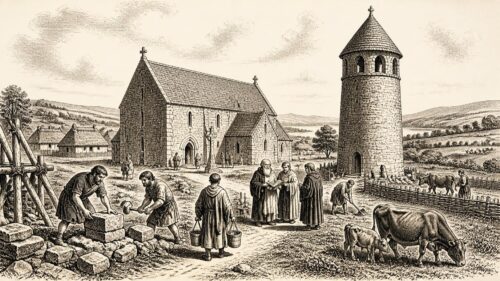
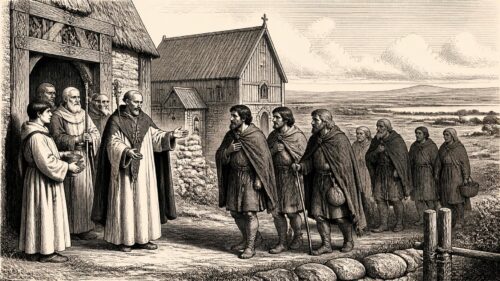
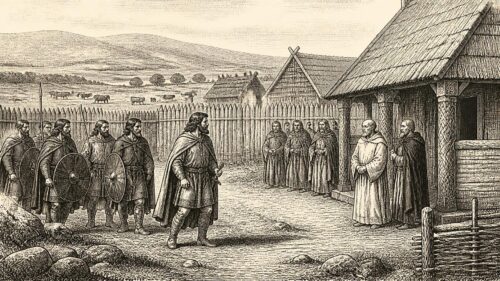
The obituary notices for 966 give a second map of Ireland: one formed by churches, scholarly communities and the estates attached to them. Muiredach son of Fergus, successor of Patrick at Armagh, died after seven years in office according to Chronicon Scotorum. Cathasach son of Murchad, bishop of Armagh, also died. The coincidence is significant. Armagh’s authority rested upon its claim to Patrick’s inheritance, but its leading offices were not simply interchangeable. A comarba, or successor, held the rights and prestige associated with a founding saint; a bishop possessed sacramental and pastoral standing. Their separate obituaries show an institution whose spiritual, legal and economic functions could be distributed among different people.
In the tenth century Armagh was also entering the long period in which the office of Patrick’s successor was controlled by Clann Sínaig. The change of abbot recorded shortly before 966 brought Dub dá Leithe into office after Muiredach. Later reformers criticised hereditary or lay control of major ecclesiastical offices, but it would be misleading to describe such arrangements merely as decay. Churches were major landholders and centres of literacy, hospitality, law and political negotiation. Their leaders needed to defend property, maintain client networks and deal with kings as well as direct worship.
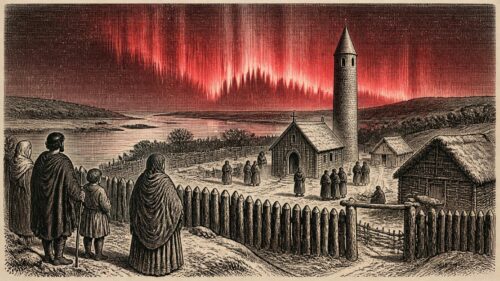
The Four Masters gives further notices of ecclesiastical deaths: Cellach Ua Banáin, successor of Comgall; Muiredach, successor of Cainnech; Erc Ua Súailen, bishop or abbot of Tallaght; and Connmach, successor of Ultán and priest of Kells. Whether every obituary belongs precisely in 966 is affected by the same annalistic shifts, but together they illuminate a country sustained by influential local religious houses. Bangor’s tradition of Comgall, Aghaboe’s of Cainnech, Tallaght’s learned community and Kells’s Columban inheritance were not remote monasteries outside society. They connected regional populations to inherited saints, landed resources and manuscript culture.
People, Cattle and Coastal Towns
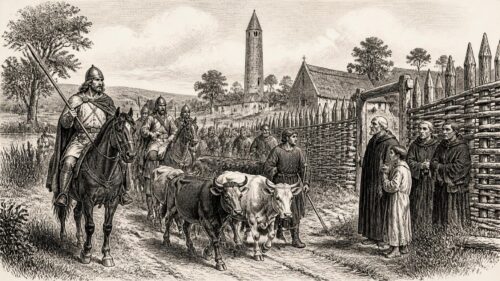
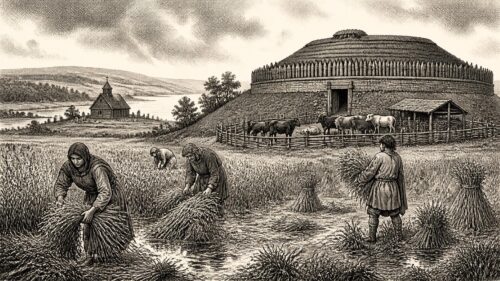
The record for 966 is overwhelmingly concerned with elites, yet its language points towards the ordinary labour underpinning their power. Kings required food-renders, cattle, transport, craftsmen and armed followers; churches likewise drew income from land and dependent communities. Cattle were movable wealth, a source of dairy produce, hides and status, and the principal form of compensation or plunder in much of Gaelic Ireland. The large raid attributed by one chronicle to Domnall illustrates this wider economic logic, even if its exact date is disputed.
The previous annal-year had brought a terrible famine, described in the Annals of Ulster in stark terms. There is no safe evidence that famine continued through 966, and it should not be asserted. Still, the recent memory of scarcity forms a sombre background to a year in which armed groups competed for livestock, resources and political obedience. For rural households, the difference between a royal hosting, a cattle-drive and a secure season could be severe.
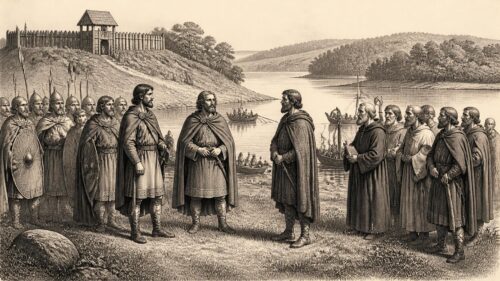
Dublin’s “foreigners” also remained essential to Irish politics. This term chiefly meant the Norse-Gaelic rulers and inhabitants of the port settlement at Áth Cliath/Dubhlinn, not an isolated external force. Dublin was a fortified riverine town tied into Irish, British and Scandinavian sea routes. Archaeology and surviving weights, silver and craft evidence show that trade in bullion and goods joined its economy to inland Ireland. Thus any pressure on Dublin affected both military strategy and access to exchange networks. In 966, even where the exact dating of a siege is uncertain, no Irish king could ignore the political and commercial weight of the settlement on the Liffey.
A Year Seen Through Fragments
966 was not a year of national unity or a straightforward march towards a later Irish kingdom. It was a year in which regional forces collided: Comaltán Ua Cléirigh and Máel Sechnaill son of Arcda defeated the Uí Ruairc in Boirenn; Fergal Ua Ruairc, king of Connacht, was killed; Leinster’s ruling house was unsettled; and Armagh lost both Patrick’s successor and its bishop. The annals preserve these facts in compressed, sometimes conflicting form. Read carefully, they reveal an Ireland of formidable local rulers, influential churches, vulnerable successions and interconnected coastal towns—an island whose politics were shaped as much by the limestone country of Boirenn and the estates of saints as by the ambitions of kings claiming Tara.
Primary Sources
- The Annals of Ulster, Year U966
- Chronicon Scotorum, Annal CS966
- Annals of the Four Masters, Annal M966
- Annals of Inisfallen, Annal AI966
- The Annals of Ulster, Year U965
- Chronicon Scotorum
- The Annals of Ulster
- Annals of the Four Masters
- Annals of Inisfallen
- List of Published Texts at CELT
- Exploring the Irish Annals
- Ecclesiastical Settlement in Ireland in the Early Medieval Period
- Cormac
- St Patrick
- The Archaeology of Early Christianity in the North of Ireland, Volume 2
- The Practice of Irish Kingship
- Kells Monastic Site
- Irish School of Illumination, c. 650–1100
- Viking Age
- Viking Traders and Craftsmen
- Viking Dublin
- How to Use Monastic Ireland