Stormont and Phoenix Park1932 CE
In 1932 Fianna Fáil, led by Éamon de Valera, replaced Cumann na nGaedheal through constitutional politics, marking peaceful anti-Treaty accession to Free State power. The government challenged Treaty symbols, introduced oath-removal legislation, and withheld land annuities, provoking Britain’s tariffs and the Economic War. Dublin’s International Eucharistic Congress displayed Catholic confidence, while de Valera enhanced standing at the League of Nations and Irish athletes won Olympic gold. In Northern Ireland, Stormont’s opening embodied unionist permanence. Simultaneously, Belfast outdoor-relief protests briefly united Catholic and Protestant workers against depression, securing improved payments amid police repression. Partition, hardship, sovereignty and divergent cultures remained unresolved.
Dateline
In 1932 Ireland displayed sharply contrasting public faces. In the Irish Free State, a general election brought Éamon de Valera and Fianna Fáil into office, proving that a government rooted in the anti-Treaty side of the Civil War could take power through parliamentary means. Dublin then became the setting for the Thirty-first International Eucharistic Congress, an immense assertion of Catholic devotion and national visibility. In Northern Ireland, the newly completed Parliament Buildings at Stormont gave unionist government an imposing permanent home, even as depression and unemployment produced a remarkable, if brief, moment of cross-community working-class protest in Belfast. The year did not settle Ireland’s constitutional divisions; it made them more visible, more institutional and more deeply connected to everyday economic life.
An Electoral Transfer of Power
The Irish Free State general election of 16 February was a landmark in the state’s short history. Cumann na nGaedheal, led by W. T. Cosgrave, had governed since 1922 and had built the administrative machinery of the Free State amid the aftermath of revolution and civil war. Fianna Fáil, founded by de Valera only six years earlier after his break with abstentionist Sinn Féin, campaigned on a programme of constitutional revision, economic protection and resistance to payments which it argued should not continue to Britain.
Fianna Fáil emerged as the largest party but did not command an outright majority. On 9 March the Dáil elected de Valera President of the Executive Council by 81 votes to 68, with Labour and independent support supplementing Fianna Fáil’s own strength. The change was politically profound. Men who had opposed the 1921 Treaty and, in many cases, the Free State created under it were now assuming responsibility for the same state’s institutions. Yet the transfer occurred through election, parliamentary vote and formal appointment, not armed confrontation. That fact mattered greatly in a society where the Civil War was still within living memory.
De Valera also took the External Affairs portfolio, keeping close personal control over Anglo-Irish relations. His ministry included Seán Lemass at Industry and Commerce, Frank Aiken at Defence, Seán T. O’Kelly at Local Government and Public Health, and Seán MacEntee at Finance. The new administration moved rapidly to signal a different political atmosphere. Political prisoners were released, the military tribunal established under the preceding government was suspended, and the order declaring the IRA illegal was allowed to lapse. These measures did not erase political violence or mistrust, but they indicated that the government wished to draw former republican opponents into a less exceptional political order.
The Treaty Question Returns
Fianna Fáil’s first major constitutional objective was the removal of the oath required of Oireachtas members. Under the 1922 constitutional settlement, deputies and senators had to make a declaration containing fidelity to King George V in connection with Ireland’s membership of the British Commonwealth. The oath had been among the most bitterly disputed provisions of the Treaty and had helped to divide Irish nationalists a decade earlier.
On 20 April, the government introduced the Constitution (Removal of Oath) Bill. Debate in the Dáil was therefore firmly a development of 1932, but it is important not to project its final outcome back into this year. Supporters presented the measure as fulfilment of an election pledge and an assertion of domestic constitutional authority. Opponents argued that it violated the Treaty and endangered Ireland’s relationship with Britain. The Bill passed through the Dáil in May and was considered by the Seanad, which adopted amendments; the disagreement between the two Houses meant that the measure was not enacted in 1932. The oath was only removed from law in May 1933.
The controversy was accompanied by a revealing dispute over the office of governor-general. James McNeill, who represented the Crown in the Free State, had sought to avoid embarrassing the incoming government. Relations nevertheless deteriorated. On 23 April, ministers Seán T. O’Kelly and Frank Aiken conspicuously left a reception at the French legation when McNeill and his wife arrived. McNeill requested an apology and did not receive one. The incident was more than a matter of manners: it demonstrated the new government’s determination to diminish symbols of the Treaty connection, while also exposing the strain placed on individuals occupying offices that Fianna Fáil wished ultimately to transform or remove.
Annuities and the Economic War
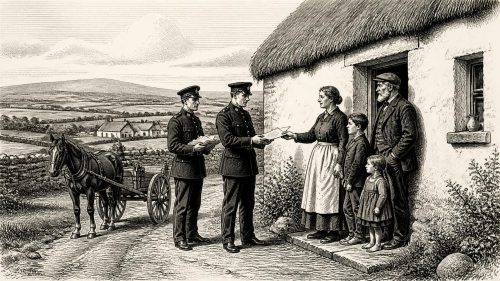
The most immediate collision with Britain concerned land annuities. These were payments arising from earlier land-purchase schemes through which Irish tenant farmers had acquired holdings from landlords. De Valera’s government maintained that the Free State should retain rather than transmit the money to the British Exchequer. The issue combined historical grievance, legal argument and the practical appeal of keeping funds within an economy already suffering in the worldwide depression.
The government withheld the payment due on 1 July. Britain responded with the Irish Free State (Special Duties) Act, dated 12 July, imposing duties on imports from the Free State to recover the disputed sum. Dublin retaliated with tariffs on British goods. The resulting Anglo-Irish tariff conflict became known as the Economic War. Its full consequences would unfold over several years, but its beginning belongs unmistakably to 1932.
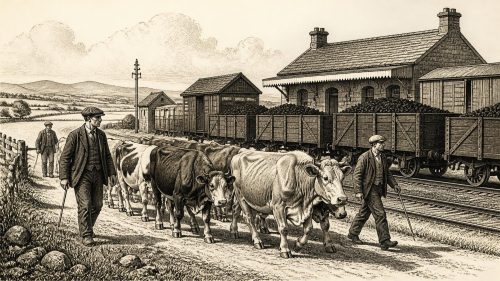
The exchange was especially serious because the Free State’s economy remained heavily agricultural and dependent on the British market. Cattle and other farm exports were central to rural incomes, while households and businesses also relied on imported British manufactures and fuel. Protection offered the prospect of encouraging domestic production, a policy strongly associated with Lemass’s department; it also risked higher prices and damage to export farmers. Orders made in July applied or altered duties on goods including pork products, coal, sugar, cement, electrical equipment and cheesemaking machinery. Thus a constitutional quarrel reached the farmyard, shop counter, factory and kitchen.
A Catholic Capital on Display
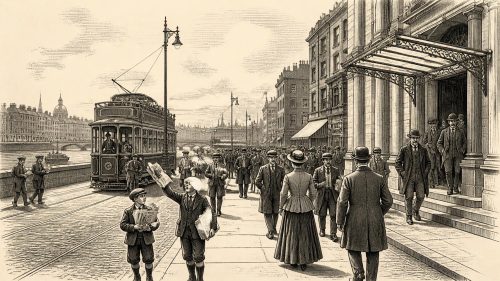
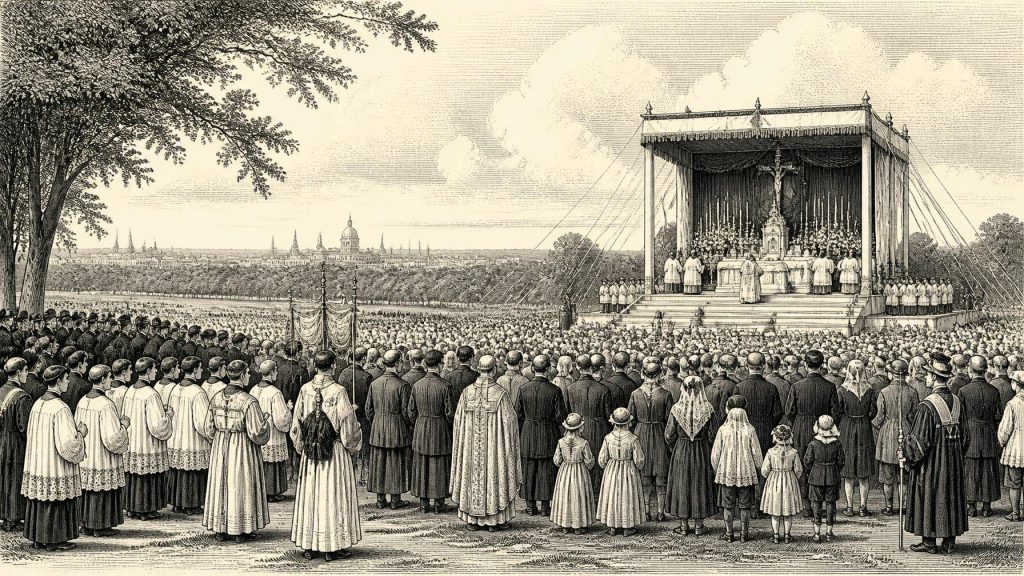
From 22 to 26 June, Dublin hosted the Thirty-first International Eucharistic Congress. The event was not simply a sequence of religious services. It required extensive organisation, accommodation, transport, ceremonial preparation and the reception of overseas visitors. Contemporary archival records preserve preparations for the great altar in Phoenix Park, delegations arriving through ports and railway stations, choir rehearsals and souvenir publications. They convey a city remade temporarily for pilgrimage and spectacle.
The congress placed Catholic Ireland before an international audience at a moment when the state’s new government was still establishing its authority. Cardinal Lorenzo Lauri attended as papal legate, while de Valera, ministers, civic leaders, bishops, clergy, religious orders and lay organisations occupied highly visible roles. The culminating outdoor ceremonies in Phoenix Park drew a vast congregation. Exact crowd totals repeated in later accounts should be treated cautiously, but there is no doubt that the congress was among the largest public gatherings seen in independent Ireland to that date.
Its importance was social as well as devotional. Processions, music, uniforms, banners, voluntary labour and carefully marshalled crowds made Catholic affiliation publicly collective. For many participants, the occasion joined faith, family and national pride. For the Free State, it demonstrated an ability to host an international event on a grand scale. It also strengthened the impression that public Catholic culture and state ceremony could stand closely together, even though the government itself was navigating contentious constitutional and economic questions.
International Standing and Sporting Success
De Valera’s Dublin policies did not prevent him from making use of the Free State’s international position. In July, cabinet agreed that the state should accept the presidency, by rotation, of sessions of the League of Nations Council. As Minister for External Affairs, de Valera travelled to Geneva and on 26 September opened the Thirteenth Assembly. His address dealt with disarmament, economic distress and the pressure facing the League in an unsettled world. For a state still constitutionally linked to the Commonwealth but increasingly intent on independent action, this was a significant demonstration of diplomatic standing.
Irish visibility also came through sport. At the Los Angeles Olympic Games, Bob Tisdall won the 400-metre hurdles and Dr Pat O’Callaghan retained his hammer title, both competing for Ireland. The two gold medals, won on the same afternoon, offered a rare international success during a year otherwise dominated by depression, tariffs and constitutional argument. Ireland also entered competitors in the Olympic arts competitions, a reminder that international representation in the early 1930s could encompass painting and architecture as well as athletics.
Stormont and Belfast’s Unemployed
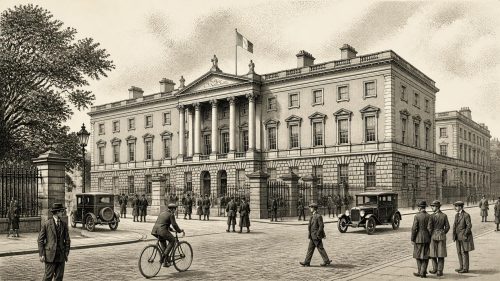
Northern Ireland’s political landscape acquired its most enduring architectural symbol on 16 November, when the Prince of Wales formally opened Parliament Buildings at Stormont on behalf of King George V. Designed by Arnold Thornely in a monumental classical style, the Portland-stone building stood above Belfast at the end of the new processional avenue. It had been constructed to house the institutions created after partition, and the Northern Ireland parliament began meeting there later that month. Its scale and setting projected permanence, authority and unionist confidence.
Yet the grandeur of Stormont contrasted sharply with conditions in Belfast’s working-class districts. Depression brought unemployment, wage pressure and severe hardship. During the autumn, workers employed on outdoor-relief schemes protested against inadequate payments and conditions. A strike began on 3 October and demonstrations gathered support across Catholic and Protestant areas. The movement was striking precisely because material need briefly produced cooperation across the sectarian divisions that usually structured Belfast politics.
The Northern Ireland authorities banned marches and used the Special Powers Act against planned demonstrations. Clashes followed in east Belfast, the Falls and the Shankill. Police action was particularly severe in the Falls district, where firearms were used; a week-long curfew was imposed, and a planned Custom House meeting was prohibited. The protest did secure increases in relief payments, but its cross-community unity did not endure. Still, the Outdoor Relief disturbances showed that class, hunger and unemployment could temporarily challenge the political boundaries on which Northern Ireland had been built.
By year’s end, then, Ireland contained two highly public political settings: Phoenix Park, where Catholic devotion and Free State confidence had been performed before international visitors, and Stormont, where Northern Ireland’s institutions had received a permanent monumental home. Between them lay tariffs, disputed sovereignty, poverty and unresolved partition. The events of 1932 did not produce a settled island. They revealed how decisively its people were beginning to live under different governments, different political symbols and increasingly divergent economic pressures.
Primary Sources
- History of Government
- Seventh Dáil
- De Valera, Éamon (‘Dev’) | Dictionary of Irish Biography
- Constitution (Removal of Oath) Bill, 1932—Second Stage (Resumed), Dáil Éireann, 28 April 1932
- Constitution (Removal of Oath) Bill, 1932—Report, Dáil Éireann, 19 May 1932
- Constitution (Removal of Oath) Bill, 1932, as passed by Seanad Éireann
- Ireland Through the Decades
- McNeill, James | Dictionary of Irish Biography
- Timeline of Events, 1919–69
- Volume 3: Documents on Irish Foreign Policy, 1926–1932
- League of Nations: Cabinet Minutes, 26 July 1932
- Opening Address by Eamon de Valera to the Thirteenth Assembly of the League of Nations, 26 September 1932
- Irish Free State (Special Duties) Act 1932
- When Dev Defaulted: The Land Annuities Dispute, 1926–38
- On Show to the World: The Eucharistic Congress, 1932
- Eucharistic Congress Record, Dublin, June, 1932
- Independent Newspapers (Ireland) Photographic Collection: 31st International Eucharistic Congress
- Murphy Family Papers: Descriptive Catalogue
- Parliament Buildings and Sustainability
- Parliament Buildings Facts
- Chronology of Key Events, 1800 to 1967
- Northern Ireland: 1921–1998
- From Riots to Rights: Nationalist Parades in the North of Ireland
- Los Angeles 1932
- Bob Tisdall Profile
- Irish Athletics History at the Olympics