Derryvree’s Buried Mosses30568 BCE
30,568 BCE is a modern label within a broad Late Pleistocene range, not a date for a recorded event. At Derryvree, County Fermanagh, buried freshwater silts beneath glacial till, radiocarbon dated broadly to Marine Isotope Stage 3, preserve mosses, sedges and other tundra vegetation. They show that some Irish areas remained ice-free, cold, seasonal and periglacial before later ice-sheet expansion. Cave fauna, including reindeer, giant deer and hyaena, indicates varied animal life, though bones span different periods. A possibly cut-marked Castlepook reindeer bone suggests brief human visits, not settlement. Evidence supports wetlands and animals, but no society, economy or institutions.
Dateline
30,568 BCE is a modern chronological label, not a date that can be matched to a recorded Irish event, ruler, settlement or season. It falls roughly 32,500 years before 1950, in the later part of the Pleistocene and within Marine Isotope Stage 3, a long and climatically unstable interval of the last Ice Age. Neither written history nor archaeological dating can resolve Ireland’s past to this individual calendar year. The responsible approach is therefore to place it within calibrated ranges and to ask what physical evidence can reveal about Ireland at approximately this time.
A Date Within a Range
The most relevant local evidence comes from Derryvree, near Maguiresbridge in County Fermanagh. In 1969 a road cutting exposed a drumlin made of two substantial layers of till, the sediment left by glaciers. Between them lay fine sands and organic silts from freshwater conditions. The deposit, known by its laboratory number Birm-166, produced a conventional radiocarbon determination of 30,500 years BP, with a substantial uncertainty. Subsequent discussions using calibrated chronology place the deposit broadly within about 36,900–31,700 calibrated years BP. Thus 30,568 BCE sits inside a wide dating envelope for that buried landscape, not at a pinpoint moment within it.
This distinction matters. Radiocarbon years are not identical to calendar years, and beyond thirty millennia calibration has broad margins. The Derryvree material records sediment and biological remains accumulated over time; it cannot tell us what happened on one day, or even in one human lifetime. Yet it is exceptionally valuable because it preserves evidence from a period for which Ireland has very few surviving terrestrial records. It demonstrates that part of the north of the island supported open land and freshwater habitats before being overridden by later ice.
Not Yet the Glacial Maximum
Ireland around this time was in the Last Glacial Period, but it should not be imagined as uniformly buried beneath the great ice sheet familiar from maps of the Last Glacial Maximum. The fullest expansion of the British–Irish Ice Sheet came later, principally after about 27,000 years ago and with maximum ice volume around 23,000 years ago. Reconstructions of its earlier growth remain debated, because later glaciers reworked or destroyed much of the evidence. Still, the Derryvree sequence, deposits at Greenagho near Belcoo, and wider evidence from western and southern Ireland indicate that extensive areas were ice-free during parts of Marine Isotope Stage 3.
That did not make Ireland hospitable in any modern sense. The climate was cold, strongly seasonal and periglacial: ground repeatedly froze and thawed, while frost, meltwater and wind reshaped exposed soil and sediment. Conditions altered over centuries and millennia as North Atlantic climate shifted between colder stadials and relatively milder interstadials. The designation 30,568 BCE should therefore evoke an unstable Ice-Age threshold, not a fixed climatic snapshot. Some districts may have been close to advancing ice or affected by meltwater, while others retained tundra, pools and marshy ground.
The Freshwater World at Derryvree
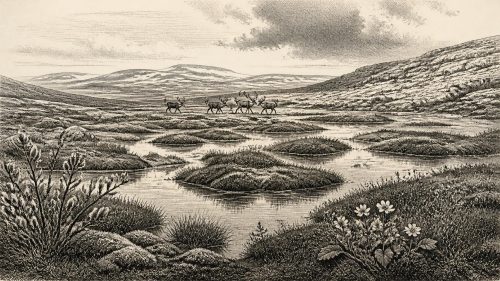
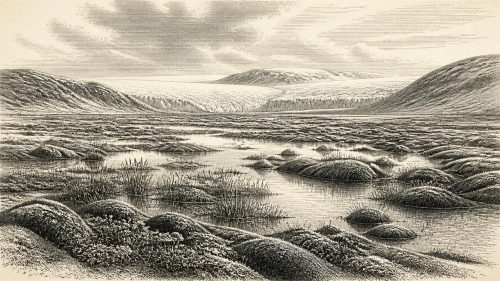
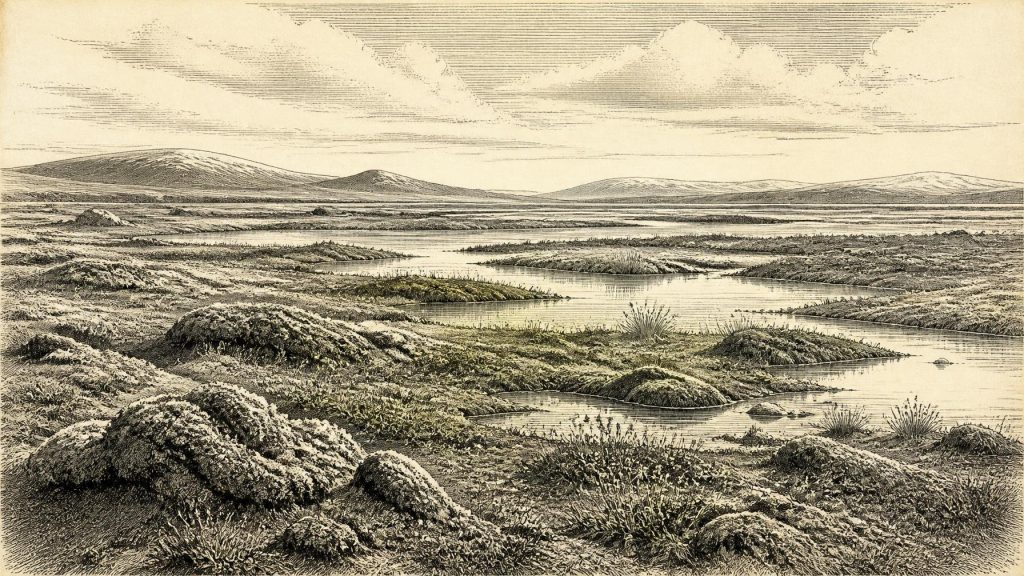
Derryvree offers the clearest Irish window onto that world. Its organic silts and fine sands held plant and animal remains described as having a full-glacial character. The assemblage indicates open tundra vegetation under periglacial conditions rather than woodland. Mosses were especially important in the preserved record; pollen of herbaceous plants and plant macrofossils point to low, treeless cover around wet ground. The original investigators interpreted a landscape of muskeg-like vegetation, shallow freshwater and exposed mineral surfaces. Later summaries also identify sedges and cold-adapted or alpine-arctic plants among the implications of the deposit.
Such evidence supports a modest but vivid reconstruction. In favourable hollows there were pools, saturated margins and moss-rich ground; on better-drained patches, sparse herbs and dwarf vegetation endured wind, frost and short growing seasons. The terrain was not an unbroken white waste. Summer thaw allowed plants to flower, insects to breed and water to remain open in places, even though the annual rhythm was harsh. Equally, Derryvree was a particular basin in what is now south Fermanagh. Its sediments cannot be treated as a complete map of conditions in Cork, Connacht, Leinster or every part of Ulster.
Animals in a Changing Island
Cave deposits, especially those of Castlepook Cave near Doneraile in north County Cork, supply a second kind of evidence: bones of Ice-Age mammals. Reassessment of radiocarbon dates from Castlepook has shown that parts of its fauna are older than once thought and belong to Marine Isotope Stage 3. Reindeer, giant deer and spotted hyaena are among the animals central to discussion of this pre-maximum fauna; the wider Irish Quaternary record also demonstrates that a varied mammalian community reached Ireland between at least about 45,000 and 20,000 years ago.
But this is not a licence to populate an illustration of 30,568 BCE with every species ever recovered from an Irish cave. Cave assemblages often combine bones accumulated at different times and through different processes: carnivores, water, gravity, excavators and collectors may all have moved material. Castlepook’s old excavations removed much of its original sedimentary context, and a modern investigation found only limited surviving Pleistocene deposits. A mammal bone dated within a broad range establishes that an animal, or its remains, was present in Ireland during that range; it does not prove that all the cave’s species shared one valley in the same year.
Nevertheless, the fauna changes the scale on which Ireland must be understood. The island was not biologically empty. Its open landscapes could sustain large herbivores and their predators during suitable phases, while limestone caves and fissures later became repositories for bones. Reindeer are particularly plausible symbols of cold, open country, but their presence in the Irish record should be framed as regional and chronological evidence, not as a secure sighting at Derryvree on this nominal date.
The Human Question
Human evidence is much thinner and requires the greatest caution. A reindeer femur from Castlepook Cave has been publicly reported as bearing a deep mark interpreted as a stone-tool cut and as dating to roughly 33,000 years ago. If that interpretation is upheld, it would indicate human activity in Ireland during the Upper Palaeolithic, far earlier than the formerly accepted record of post-glacial settlement. It would not, however, reveal a named people, a permanent colony or an organised community in 30,568 BCE.
The object came from an early twentieth-century cave collection, not from a modern excavation of an intact occupation floor with hearths, tools and animal bones in secure association. Its significance is real precisely because it is so unusual, but its limitations are equally real. No securely dated camp, dwelling, burial, lithic workshop, monument or stratified tool assemblage is presently known in Ireland from this approximate period. The evidence permits the possibility of brief visits by mobile Upper Palaeolithic hunter-gatherers; it does not establish continuous settlement.
Any visitors would have needed detailed practical knowledge: where to find fuel and stone, how to cross difficult ground, how animals moved through an open landscape, and how to avoid exposure during sudden weather changes. These are reasonable inferences from survival in north-west European Ice-Age environments, rather than direct observations of an Irish group. There is no basis for identifying their language, ancestry, belief system, artistic practice or social organisation. Nor is there evidence for chiefs, territories, diplomacy, warfare or formal political institutions.
No Economy to Reconstruct
For the same reason, economy and trade must not be forced into the narrative. Ireland has yielded no contemporary evidence for farming, herding, metalworking, exchange networks, boats, markets or managed landscapes at this date. If people were present, subsistence would almost certainly have depended on foraging, hunting and the opportunistic use of animal and plant resources, but even that is a general model, not a documented Irish menu. The possible worked reindeer bone suggests carcass processing, not a settled economy.
Religion and learning likewise leave no demonstrable trace. There are no graves, shrines, carved objects, paintings or symbols securely attributable to this phase in Ireland. The landscape itself was the enduring force: expanding ice would later scour, bury and rearrange land surfaces, while lowered sea levels changed coastlines and routes across the region. What may look on a modern map like a familiar island was part of a wider, changing north-west European environmental system, with shorelines and passages unlike those of today.
What the Evidence Can Say
Ireland around 30,568 BCE was therefore neither a historical nation nor an archaeological blank. It was a cold, dynamic place whose story survives in a small number of sediments, fossils and contested traces. Derryvree’s buried freshwater bed is the strongest local anchor: it records an ice-free tundra wetland before later glaciation sealed it beneath till. Castlepook shows that large Ice-Age animals occupied southern Ireland in the broader period and preserves a provocative, still context-limited hint of human butchery.
Those fragments are enough to replace older assumptions of an entirely frozen or lifeless Ireland, but not enough to invent a prehistoric society. The year is best understood as lying within a broad interval when open tundra, freshwater hollows, cold-adapted vegetation and mobile animals existed in at least some Irish regions, while the ice sheet that would later transform the island was building towards its maximum. At this depth in time, intellectual honesty is part of the history: the most important achievement is to distinguish what the ground preserves from what imagination would like to add.
Primary Sources
- Middle Midlandian Freshwater Series at Derryvree, Maguiresbridge, County Fermanagh, Northern Ireland
- Middle Midlandian Freshwater Series at Derryvree, Maguiresbridge, County Fermanagh, Northern Ireland
- Middle Midlandian Interstadial Deposits at Greenagho, Near Belcoo, County Fermanagh, Northern Ireland
- Trimlines, Blockfields and the Vertical Extent of the Last Ice Sheet in Southern Ireland
- A Reconsideration of the Radiocarbon Dating of the Marine Isotope Stage 3 Fauna from Southern Ireland
- The Irish Quaternary Fauna Project
- New Insights on the Fauna of Ireland's Younger Dryas and Early Holocene from Alice & Gwendoline Cave
- 2022:564 – Castlepook Cave, Castlepook South, Cork
- Growth and Retreat of the Last British–Irish Ice Sheet, 31,000 to 15,000 Years Ago: the BRITICE-CHRONO Reconstruction
- Timing, Pace and Controls on Ice Sheet Retreat: an Introduction to the BRITICE-CHRONO Transect Reconstructions of the British-Irish Ice Sheet
- The Timing and Magnitude of the British–Irish Ice Sheet Between Marine Isotope Stages 5d and 2
- Radiocarbon Constraints on the Age of the Maximum Advance of the British–Irish Ice Sheet in the Celtic Sea
- Maximum Extent and Dynamic Behaviour of the Last British–Irish Ice Sheet West of Ireland
- Last Glacial Maximum Cirque Glaciation in Ireland and Implications for Reconstructions of the Irish Ice Sheet
- Palaeoecology
- Figure 6.— The Subdivision of the Quaternary Period in Ireland
- Prehistoric Details
- Ice Age Ireland: Cool Fossils!
- Guide to the National Museum of Ireland: Natural History
- The IntCal20 Northern Hemisphere Radiocarbon Age Calibration Curve (0–55 cal kBP)
- IntCal Publications
- Could Brown Bears (Ursus arctos) Have Survived in Ireland During the Last Glacial Maximum?
- Stoats (Mustela erminea) Provide Evidence of Natural Overland Colonization of Ireland
- What Was on the Menu in Prehistoric Ireland?