Awbeg Reindeer Corridor30569 BCE
30,569 BCE denotes a broad Late Pleistocene interval rather than a datable Irish event. During Marine Isotope Stage 3, Ireland experienced cold, variable conditions before the Last Glacial Maximum. Derryvree deposits in Fermanagh indicate treeless wetlands supporting cold-adapted vegetation, while Castlepook Cave above County Cork’s Awbeg valley preserves remains of reindeer, mammoth, giant deer, predators and other fauna. These animals demonstrate intermittent terrestrial access, not permanent routes or populations. A marked reindeer bone may record human butchery about 33,000 years ago, but remains unconfirmed and cannot prove settlement. Later glaciation erased evidence, leaving environmental and animal archives as the record.
Dateline
30,569 BCE is a useful modern label, not a date at which Irish archaeology can identify a single happening. There was no written calendar in Ireland, no named community, ruler or battle, and no excavated settlement that can be placed in this individual year. In calendar terms it falls about 32,500 years before AD 1950, within the Late Pleistocene and broadly Marine Isotope Stage 3. The responsible history is therefore one of ranges, deposits and probabilities: a changing Ice Age landscape in which animals certainly moved through parts of Ireland, while the possibility of a very early human visit remains important but unproven in the fuller sense of an established occupation.
Time Measured in Ranges
Even apparently precise prehistoric numbers need translating with care. Radiocarbon laboratories report years “before present”, conventionally before AD 1950; those measurements must then be calibrated against changing atmospheric carbon levels to estimate calendar ages. At more than 30,000 years ago, the resulting ranges are necessarily broad. A date expressed as 30,569 BCE should therefore not be confused with an anniversary or a securely dated event. It identifies a position within a long climatic interval, not a moment that can be isolated in the archaeological record.
Ireland at this point was part of north-western Europe’s last glacial cycle, but it was not simply a white, uniform ice sheet. The British–Irish Ice Sheet was building during the later part of this period and reached its principal maximum considerably later, broadly between about 27,000 and 21,000 years ago. Ice margins advanced and retreated unevenly, responding both to climate and to the internal behaviour of the ice sheet. Around the nominal date, some landscapes may have been open, cold and habitable for specialised animals, while other areas were already becoming less accessible as ice and periglacial conditions intensified.
An Open, Cold Country
The strongest Irish environmental evidence comes not from a single panorama but from scattered archives: cave bones in the south, buried organic deposits in the north, glacial sediments and the landforms left by later ice. At Derryvree near Maguiresbridge in County Fermanagh, organic silts trapped between tills preserved mosses, plant remains, pollen and insects. A radiocarbon determination from this sequence, BIRM-166, produced an age of 30,500 radiocarbon years BP. It should not be treated as the exact date of the nominal year here: radiocarbon and calendar years differ, and the deposit represents accumulated sediment rather than one day or season. Nevertheless, it offers a valuable view of the kind of cold-stage environment that could occur in Ireland during this wider part of the glacial cycle.
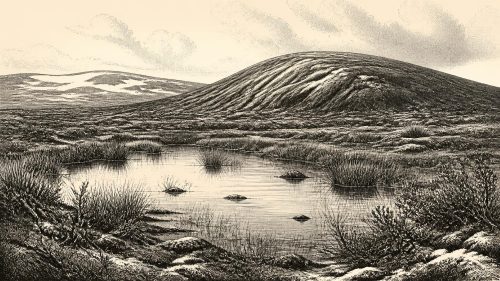
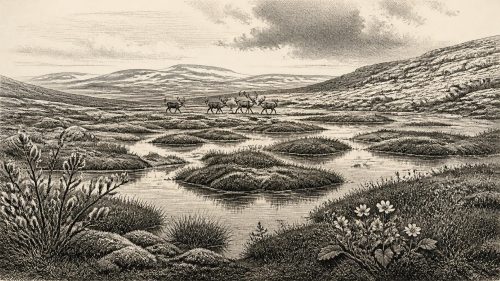
The Derryvree evidence indicates freshwater and wet ground without forest: a treeless, tundra-like or muskeg mosaic of shallow water, sedges, mosses and low-growing plants. Finds including bogbean, dwarf willow, mountain-avens and other cold-adapted taxa show that sheltered basins could support living vegetation even in severe conditions. Such evidence is direct testimony to local plants and water conditions. The wider image of open ground, frost-affected soils, sparse cover and strong seasonality is an interpretation, but one supported by comparable pollen, insect and plant records in Ireland and Britain.
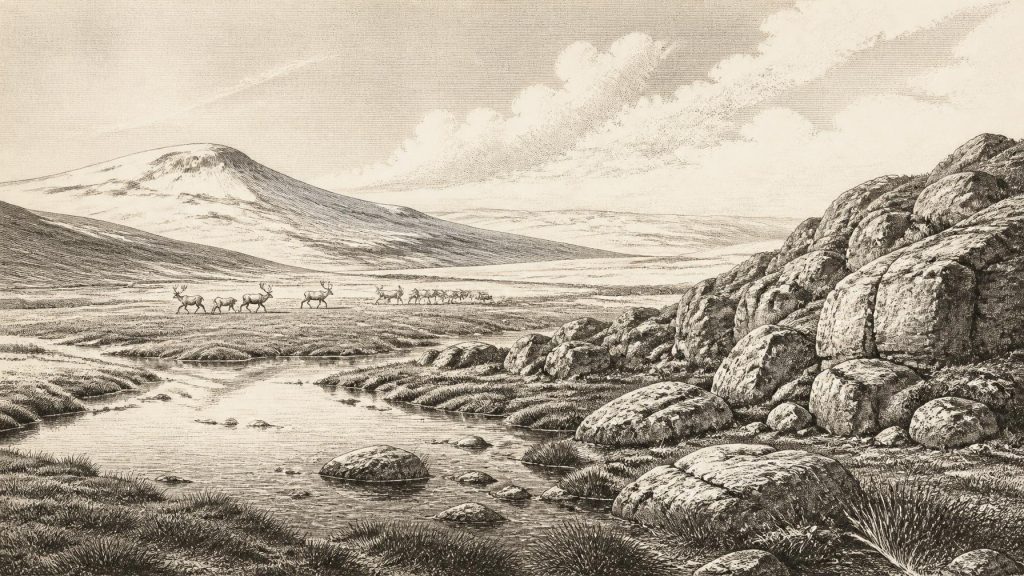
That landscape should not be imagined as empty. Its ecological productivity was concentrated in particular places: wet hollows, stream margins, exposed grazing grounds and limestone shelters. Summers may have brought a brief burst of growth; winters were long, dark and demanding. In this setting, the availability of water and forage mattered more than modern county boundaries. The Ireland of this period was not a familiar green island of woods and enclosed fields, but a changing northern habitat whose viable corridors could open and close as climate, snow cover and ice margins changed.
Castlepook and the Animal Record
The most revealing evidence for southern Ireland comes from Castlepook Cave, near Doneraile in north County Cork, above the Awbeg valley. Excavations undertaken mainly in the early twentieth century recovered a remarkable assemblage of Ice Age animal remains. Subsequent reassessment and redating have shown how difficult such old collections are to interpret: bones had been accumulated by carnivores, natural deaths, water movement and excavation methods that did not record context to modern standards. Yet the cave remains one of Ireland’s most significant windows onto the pre-Last Glacial Maximum fauna.
Its assemblage includes animals associated with cold, open environments and their predators: reindeer, woolly mammoth, giant deer, brown bear, wolf, fox, hare and spotted hyaena. Not every species need have occupied the cave’s immediate surroundings at the same time, and a list of bones is not a photograph of a single ecosystem. The revised radiocarbon programme is particularly important because improved pretreatment has shown that some older determinations from Irish cave bone samples were too young. It places important parts of the Castlepook fauna within Marine Isotope Stage 3 and suggests that species such as giant deer and spotted hyaena had disappeared locally before the later glacial maximum.
For around 30,569 BCE, reindeer offer the most evocative and useful guide. Herds were mobile, able to exploit seasonal patches of forage and to cover large distances. Their presence demonstrates that routes into Ireland existed for large terrestrial mammals during portions of the period. It does not demonstrate a permanent land bridge, a continuous animal population, or an easy passage at every climatic stage. Lower sea levels altered coastlines, but Ireland’s separation from Britain and the practical means of crossing water remain major questions. Routes were environmental opportunities, not permanent highways.
A Possible Human Trace
A reindeer femur from Castlepook has been reported as bearing a deep mark interpreted as having been made by a sharp stone tool while fresh tissue was being removed. Public reporting has associated the specimen with an age of roughly 33,000 years ago. If the modification is confirmed as a human butchery mark and securely linked to that broad age, it would be Ireland’s earliest known evidence for human handling of an animal, tens of millennia earlier than the long-established post-glacial record.
That conditional language matters. A single marked bone is not an excavated campsite. It cannot establish a resident population, family group, language, cultural identity, hunting territory or duration of stay. Cave assemblages are especially difficult because tooth scores, trampling, sediment abrasion, breakage and later movement can complicate the recognition of marks on bone. Recent fieldwork at Castlepook has sought surviving deposits and new, well-recorded material precisely because the older collections need this archaeological context. The most defensible conclusion is modest but striking: people may have entered Ireland during this colder phase of the Late Pleistocene and processed a reindeer there; the evidence does not yet show that they settled the island.
Society Beyond Recovery
No evidence presently supports political institutions, warfare, diplomacy, trade networks, ritual practice, art, language or formal learning in Ireland at this date. Nor is there evidence for houses, hearths, tools in secure context, graves, boats or a repeated seasonal camp. It would be misleading to import the well-documented Upper Palaeolithic societies of France, Iberia or central Europe and describe them as Irish. Those regions demonstrate what some contemporary hunter-gatherers elsewhere could do; they do not fill the Irish evidential gap.
If humans did visit, the practical aim may have been food, hides, bone or access to a moving herd. That is a reasonable inference from a possible butchery mark, not a demonstrated economy. Likewise, the co-occurrence of reindeer and predators suggests risk and competition around carcasses, but no evidence records a hunt, a conflict or a negotiated route. Ireland’s human story here is thus one of possible fleeting presence within a much clearer animal and environmental history.
Ice, Erasure and Survival
The later growth of the British–Irish Ice Sheet helps explain why the record is so fragmentary. Glaciers eroded older surfaces, redeposited sediments and sealed or destroyed many traces that might once have existed. Caves and buried wetland layers survive as exceptional archives rather than normal samples of the ancient landscape. Their value lies partly in their incompleteness: each forces a distinction between what has actually been found and what can responsibly be inferred.
For Ireland around 30,569 BCE, the central development was neither political nor cultural but environmental. In an increasingly unstable Ice Age world, open habitats, freshwater pockets and animal movements briefly made parts of the island ecologically available. Castlepook’s bones and Fermanagh’s buried wetlands preserve different fragments of that world. Together they reveal an Ireland poised before the greatest expansion of the last ice: cold, regionally varied, inhabited by large mammals and predators, and perhaps touched by people whose presence remains an important question rather than an established chapter of settlement.
Primary Sources
- A Reconsideration of the Radiocarbon Dating of the Marine Isotope Stage 3 Fauna from Southern Ireland
- The Irish Quaternary Fauna Project
- Extent and Timing of the Last Glacial Maximum (LGM) in Britain and Ireland: A Review
- Late Pleistocene Chronostratigraphy and Ice Sheet Limits, Southern Ireland
- The Timing and Magnitude of the British–Irish Ice Sheet Between Marine Isotope Stages 5d and 2
- Dimensions and Chronology of the Last Ice Sheet in Western Ireland
- The Colonization of Ireland: A Human Ecology Perspective
- New Insights on the Fauna of Ireland’s Youngest Caves
- The IntCal20 Northern Hemisphere Radiocarbon Age Calibration Curve (0–55 cal kBP)
- IntCal20 Issue
- Radiocarbon Dating and Chronological Modelling
- IntCal History
- Irish Pleistocene Biostratigraphy
- Palaeoecology: Field Guide to the Quaternary of Northern Ireland
- The Subdivision of the Quaternary Period in Ireland
- Menyanthes trifoliata
- 2022:564 – Castlepook Cave, Castlepook South, Cork
- Archaeology Research Excavation Grant 2022: Castlepook Cave Final Report
- Archaeological Heritage of County Cork
- Our Ancient Landscapes: Hunter-Gatherers in Ireland
- Occurrence of Mammalia Relicts at Castlepook Cave
- Mammoth Cave, County Cork
- Independent Tephrochronological Evidence for Rapid and Synchronous Oceanic and Atmospheric Temperature Rises Over the Greenland Stadial-Interstadial Transitions Between ca. 32 and 40 ka b2k