The Derryvree Waterline30588 BCE
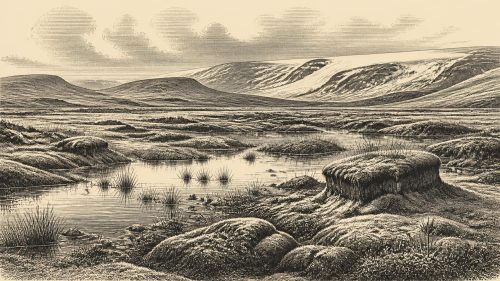
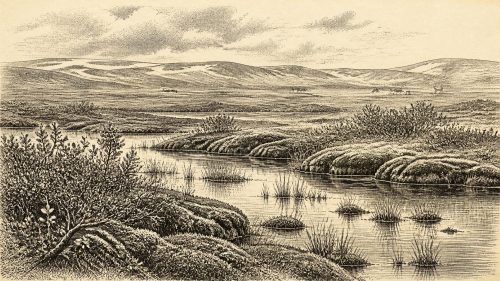
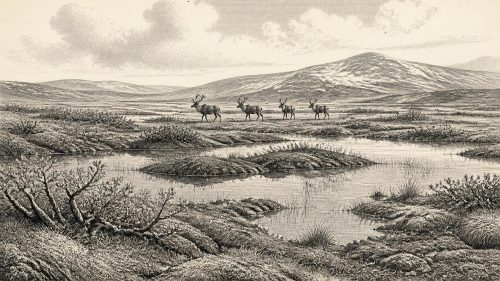
Thirty thousand five hundred and eighty-eight BCE is not a recoverable Irish historical year, but falls within the broad calibrated range of Derryvree’s Middle Midlandian freshwater deposit in County Fermanagh. Exposed in 1969, the deposit lies between glacial tills, recording a treeless, cold wetland of pools, mosses, sedges and dwarf shrubs during an interval without local ice. Plant and beetle remains indicate a functioning but severe environment amid unstable Ice Age conditions. Lower sea levels altered surrounding lands, yet human access remains unknown. Cave fauna attests cold-stage animals, while a cut-marked Castlepook reindeer bone offers inconclusive evidence of human activity.

Dateline
30,588 BCE is a modern calendar label, not a year that can be recovered from Ireland’s Late Pleistocene record. No inhabitants of the island left writing, a calendar, a named polity or an event that can be assigned to this point. The number corresponds roughly to 32,538 years before AD 1950, the conventional reference point used in radiocarbon chronology, but even that conversion should not suggest precision. For this remote period, archaeology works with deposits, fossils and broad probability ranges. The responsible subject is therefore an Ice Age landscape changing over centuries and millennia, not an Irish annual chronicle.
The closest important evidence comes from Derryvree, near Maguiresbridge in County Fermanagh. There, a buried freshwater deposit provides an unusually valuable glimpse of Ireland during the Middle Midlandian, the Irish regional term for part of the last glacial cycle. A radiocarbon determination from the organic sediment was reported as about 30,500 radiocarbon years before present, with a substantial uncertainty. Modern calibration places the relevant deposit broadly at c. 36,900–31,700 calibrated years BP, approximately 34,950–29,750 BCE. The nominal date of 30,588 BCE falls within that long range, but cannot be attached to a particular season, animal, pool or generation.
A Wetland Between Ice Advances
Derryvree was exposed during road works in 1969, when a cutting through a drumlin revealed a striking sequence. A lower till — the unsorted clay, stones and debris laid down by glacier ice — was overlain by freshwater silts, fine sands and organic-rich sediment, which in turn lay beneath another thick till. The sequence establishes an order, not an exact timetable: glacier ice had occupied the locality; an interval followed in which water and vegetation accumulated sediment; then ice returned or advanced over the site, sealing the deposit. Later glaciation and erosion destroyed or obscured much of Ireland’s older landscape, making this inter-till archive particularly important.
The freshwater horizon does not prove that all of Ireland was simultaneously ice-free. It records conditions in one Fermanagh basin, and Ireland’s uplands, western coasts, lowlands and shallow seas could have differed markedly. Nor should the word “interstadial” be taken to mean a benign warm phase. The original investigators described a cold, treeless muskeg-like environment: waterlogged ground with pools, mosses, sedges and low vegetation. It was an interval without local glacier cover, not a return to woodland or anything resembling the later agricultural landscape.
At this depth in time, radiocarbon calibration has wide margins because atmospheric carbon-14 varied and the underlying chronological record becomes less fine-grained. The Derryvree result is consequently best treated as a date range. Its importance lies not in making 30,588 BCE uniquely knowable, but in demonstrating that a freshwater ecosystem survived in Fermanagh during a fluctuating cold stage between episodes of glaciation. The upper till records the fragility of that episode: the landscape was not fixed, and the wetland was eventually buried beneath renewed ice-related deposits.
Cold-Stage Life
Plant and insect remains give the deposit its unusual historical value. They show that the basin supported freshwater and wet ground, while the vegetation around it was open and cold-adapted. Mosses, sedges, dwarf willow, mountain-avens, bogbean and lesser clubmoss have all been associated with the assemblage. Each taxon was preserved through the special conditions of this small basin, so the list is not a census of every plant growing across Ireland at one moment. Even so, taken together, the evidence strongly supports a treeless mosaic of shallow water, wet margins and exposed periglacial ground.
This was not a lifeless white wilderness. Short growing seasons could sustain plant communities in sheltered or waterlogged places, and those plants in turn supported invertebrates and visiting animals. Fossil beetles are especially informative because they respond closely to ground moisture, vegetation structure and seasonal temperature. Their presence helps confirm that Derryvree was a functioning wetland ecosystem. Yet neither beetles nor pollen can yield a daily temperature or annual rainfall total for the modern date 30,588 BCE. They provide environmental tendencies: severe winters, cool summers, limited tree growth and a landscape vulnerable to freeze-thaw processes.
The wider climatic framework was Marine Isotope Stage 3, a long and unstable part of the last Ice Age. Greenland ice-core records show abrupt climatic shifts on millennial scales, but they are not a weather diary for Fermanagh. Likewise, modern maps of the British–Irish Ice Sheet should not be projected backwards as if every Irish valley had one identical history. Recent research shows that ice growth, flow and maximum extent differed between regions. Around this date, the larger expansion towards the Last Glacial Maximum was still developing; its fullest extent across Ireland and the surrounding shelf came later.
An Altered Island
Sea level was far lower than it is today, and the shorelines, estuaries and shallow seas surrounding Ireland were consequently very different. That fact matters for animal movement and any possible human travel, but it does not establish a simple land bridge or a continuously passable route. Ice margins, channels, rivers, marshes, seasonal weather and changing coastlines all shaped access. The evidence presently available cannot reconstruct a journey to Ireland at 30,588 BCE, much less regular contacts, trade or a network of communities.
There is equally no basis for describing fields, herds, houses, pottery, boats, textiles or food stores. Farming lay many millennia in the future. The productive processes visible at Derryvree were natural: sediment carried into water, vegetation growing in marshy ground, organic matter accumulating, and ice later remoulding the land. A wetland able to support animal life should not be mistaken for a human economy. No securely dated settlement, hearth, stone-tool assemblage or burial from Ireland belongs to this precise horizon.
For the same reason, political affairs, diplomacy, warfare, named leaders, religions and formal learning cannot responsibly be supplied for this date. There is no evidence for an Irish people in the cultural or national sense, and “Ireland”, “Fermanagh” and “Cork” are modern geographical names rather than Ice Age identities. Absence of evidence does not make the past empty; it defines the scale at which it can be discussed. Here that scale is environmental and palaeontological rather than social or political.
Caves, Animals and Caution
Animal remains from Irish caves show that the island or its changing landmass was used by a varied cold-stage fauna at different times. Castlepook Cave, near Doneraile in County Cork, is especially significant. Its historic collections include remains attributed to woolly mammoth, reindeer, giant deer, brown bear, wolf, Arctic fox, hare, lemmings and spotted hyena. Such an assemblage evokes open, cold habitats rather than forest. It also demonstrates that Ireland’s Ice Age fauna was more varied than the later island fauna familiar from historical times.
But cave bone collections require careful handling. Many Castlepook specimens came from early excavations, when recording standards were unlike those now expected, while cave sediments can be disturbed by carnivores, water, collapse and later digging. A bone assemblage may span thousands of years. It cannot safely be converted into a single coexisting animal community, nor can every cave bone be called hunting waste. Spotted hyenas, for example, could carry carcass parts into caves; other remains may represent natural deaths or material moved after deposition. Taphonomy — the study of what happened to remains after death — is essential before historical conclusions are drawn.
The cave is also central to the unresolved question of very early people in Ireland. A reindeer femur from Castlepook’s older collection has been publicised as bearing a mark made by a sharp implement and as being approximately 33,000 years old. If detailed analysis ultimately confirms that the mark is a contemporary stone-tool cut mark, it would be powerful evidence that people processed an animal in Ireland during the broader Middle Midlandian. It would still show an episode of activity, however, not a permanent settlement, population size, cultural identity or seasonal round.
At present, the evidence does not permit certainty. The specimen’s old and disturbed context prevents it from carrying the evidential weight of an undisturbed campsite with tools, hearths and securely associated dates. Renewed work at Castlepook has sought intact Pleistocene deposits precisely because such contexts may test the claim. Until then, it is better to call the femur a potentially important indication of human activity than to populate Ireland with imagined hunters or to borrow well-documented Upper Palaeolithic societies from France, Iberia or central Europe.
What This Date Can Tell Us
Ireland around 30,588 BCE is best understood through the Derryvree waterline: a rare buried record of freshwater life during a severe, unstable cold stage. It establishes that a Fermanagh locality supported an open wetland between glacial episodes; its plants and insects reveal a cold but living environment, while cave faunas demonstrate the wider presence of large mammals and carnivores at differing times. It does not provide a year-specific event, a known community or an Irish political history. That restraint is not a weakness. It is what allows the deep past to be reconstructed from the evidence that genuinely survives.
Primary Sources
- A Middle Midlandian Freshwater Series at Derryvree, Maguiresbridge, County Fermanagh, Northern Ireland
- Quaternary Deposits and Glacial Stratigraphy in Ireland
- The Geology of Ireland, Chapter 15: Cenozoic: Tertiary and Quaternary
- Irish Pleistocene Biostratigraphy
- The Irish Quaternary Fauna Project
- Dimensions and Chronology of the Last Ice Sheet in Western Ireland
- Trimlines, Blockfields and the Vertical Extent of the Last Ice Sheet in Southern Ireland
- Timing and Pace of Ice-Sheet Withdrawal Across the Marine–Terrestrial Transition West of Ireland During the Last Glaciation
- The Deglaciation of the Western Sector of the Irish Ice Sheet From the Inner Continental Shelf to Its Terrestrial Margin
- Maximum Extent and Readvance Dynamics of the Irish Sea Ice Stream and Irish Sea Glacier Since the Last Glacial Maximum
- The Glacial Stratigraphy of the Sperrin Mountains and Its Relation to the Glacial Stratigraphy of North-West Ireland
- The IntCal20 Northern Hemisphere Radiocarbon Age Calibration Curve (0–55 cal kBP)
- NGRIP High Resolution δ18O Over Warming Events, 10–60 ka
- Quaternary Geology of Ireland
- The Geological Heritage of County Leitrim
- Irish Quaternary Association: References and Recommended Reading
- The Subdivision of the Quaternary Period in Ireland
- New Insights on the Fauna of Ireland’s Younger Dryas and Early Holocene From Alice and Gwendoline Cave
- Castlepook Cave, Castlepook South: Excavation Report 2022
- Spotted Hyena Skull, Mammoth Cave, Castlepook, County Cork