Hyena Hall Assemblage30534 BCE
About 30,534 BCE is a modern label rather than a precise prehistoric Irish date. Ireland, during later Marine Isotope Stage 3, experienced a cold, changing environment before maximum glaciation, with regionally varied ice-free ground, wetlands and altered coastlines. Derryvree, County Fermanagh, preserves organic sediments indicating treeless periglacial freshwater vegetation between glacial advances. Castlepook Cave, County Cork, contains extensive, chronologically mixed remains of mammoth, reindeer, giant deer, bears, hyaenas and later cold-adapted fauna. Human occupation remains unproven: possible butchery marks require confirmation, and no secure artefacts, settlements or social evidence survive. Glaciation later obscured much earlier landscape evidence across Ireland broadly.
Dateline
Modern calendar-year precision is not available for prehistoric Ireland at this depth of time. “30,534 BCE” is therefore a useful modern label, not a date at which an Irish event can be placed. It equates roughly to 32,483 years before AD 1950, the conventional reference point for radiocarbon chronology, but a radiocarbon determination is not itself a calendar age. The most relevant Irish evidence belongs broadly to the later part of Marine Isotope Stage 3, before the fullest expansion of the last British–Irish Ice Sheet. It consists chiefly of buried sediments, fossil plants, animal bones and changing landforms, rather than settlements, written records or securely dated human artefacts.
A Landscape in Transition
At this broad horizon Ireland was entering a decisive climatic transition. It was not yet simply the ice-covered island often imagined under the phrase “Ice Age”. Reconstructions indicate that north-central Ireland retained ice-free ground until at least about 34,000 calibrated years before present, while the larger Irish ice sheet was beginning to build and extend during the succeeding millennia. The exact pattern varied sharply between regions: upland ice, local glaciers, exposed ground, lakes, wetlands and lowland corridors did not necessarily change together. Later expansion would transform the island profoundly, but that later outcome should not be projected wholesale onto every part of Ireland around 30,534 BCE.
Sea level was substantially lower than today, altering coastlines and the extent of land and shallow sea around Ireland. Yet lower sea level does not prove a simple, continuous land bridge at any particular moment, nor does the presence of an animal establish the route it used. Ice, estuaries, channels, changing shorelines and seasonally difficult terrain mattered as much as the headline fall in sea level. The responsible conclusion is that Ireland was intermittently connected to wider north-west European ecological systems, allowing animals to arrive when conditions permitted; the exact geography of a human journey at this particular modern year cannot be recovered.
Derryvree’s Buried Wetland
The strongest environmental window near this chronological label lies at Derryvree in County Fermanagh, close to Maguiresbridge. There, road cutting exposed organic-rich silts and sands trapped between two layers of glacial till. The sequence is important because it records an interval when freshwater sediment and plant material accumulated after one episode of ice and before another advance sealed the deposit. A conventional radiocarbon age of about 30,500 ± 1,200 radiocarbon years BP has been reported for the organic silts. A published calibration places it broadly around 36,900–31,700 calibrated years BP: an interval that includes the notional year under discussion, but is far too wide to identify a single season, generation or event.
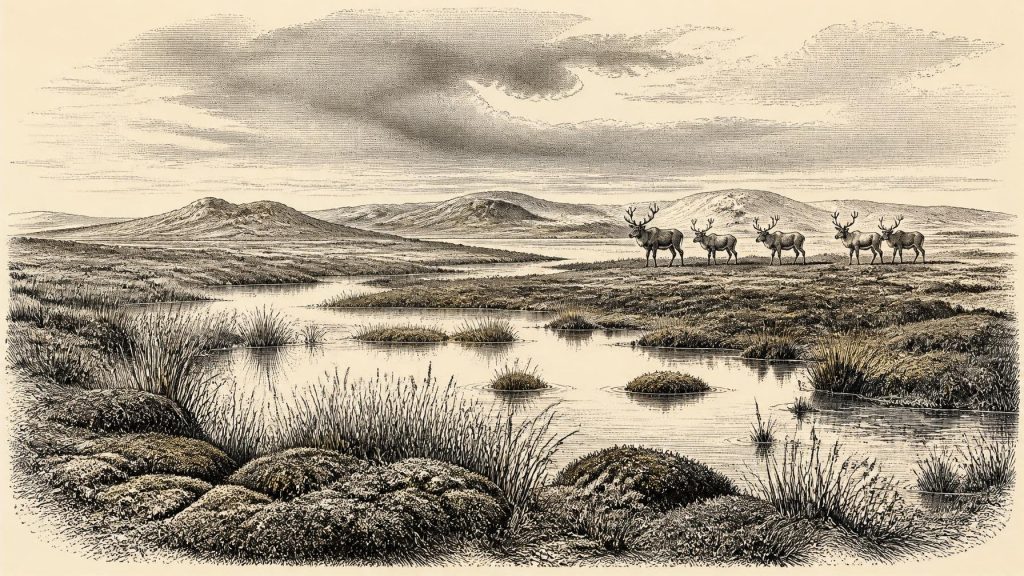
The plant and sediment evidence has been interpreted as a cold, open, treeless wetland or muskeg landscape. Mosses, sedges and other hardy wet-ground vegetation, alongside freshwater indicators, suggest pools and saturated margins set within a periglacial environment. This was not a forested Ireland, nor necessarily a featureless desert of snow. It was a varied country in which water could persist in summer, soils could remain frozen or waterlogged for long periods, and vegetation was constrained by cold, wind and a short growing season. Derryvree supplies direct evidence for one locality, however; it cannot stand in for every valley, coast and upland across the island.
Castlepook and the Animal World
For large animals, the leading Irish archive is Castlepook Cave near Doneraile in north County Cork, also known historically as Mammoth Cave. Its passages include Hyena Hall, Elephant Hall and the Gallery of Aged Carnivores: names bestowed by earlier investigators that hint at the extraordinary fossil assemblage. More than 2,000 bones are recorded from the cave’s surviving collections and excavated deposits. Direct dates from individual specimens range widely, from roughly 45,700 to 19,950 years BP, so Castlepook must be read as a long-lived repository rather than a snapshot of one year.
The assemblage documents a changing Pleistocene fauna that included woolly mammoth, reindeer, giant deer, brown bear and spotted hyaena; later material includes lemmings, Arctic fox and wolf. These animals support an image of open habitats capable of sustaining grazing and browsing herbivores, pursued or scavenged by formidable carnivores. But a cave bone collection is not a census. Carnivores may have dragged carcass parts underground; animals may have died in natural traps; water may have moved bones; and early twentieth-century excavation removed much of the original context. Species with different dates may be represented together in a museum drawer despite never having met at the cave entrance.
Spotted hyaena is especially revealing. Its presence demonstrates that Ireland’s animal communities included a large social predator or scavenger whose bone-accumulating behaviour can complicate archaeological interpretation. Hyaena teeth, coprolites, breakage patterns and prey remains can resemble the debris of a humanly used place unless examined closely. Castlepook’s value lies partly in that caution: it preserves one of Ireland’s richest records of life before the Last Glacial Maximum, while repeatedly reminding researchers that caves mix natural and cultural processes.
The Human Question
There is no secure basis for describing a settled Irish population, a camp, a family group or a hunting expedition in 30,534 BCE. Nor can archaeology presently identify a language, ethnicity, political community or named tradition on the island at this date. The National Museum of Ireland continues to state that clear evidence for a Palaeolithic human presence in Ireland has not yet emerged. That judgement reflects the demanding standard required: an artefact or modified bone must be securely contextualised, convincingly human-made and independently dated.
There is nevertheless an important, unresolved possibility. Zooarchaeologist Ruth Carden’s examination of old Castlepook material identified bones with marks argued to be consistent with stone-tool butchery, including a reindeer femur publicised as evidence of very early human activity. If the interpretation and dating are confirmed, it would show brief Upper Palaeolithic human access to Ireland long before the island’s better established post-glacial settlement. It would still not establish permanent occupation. The 2022 Castlepook excavation found surviving sediments and faunal material, but no cultural artefacts; some charcoal and hazelnut shell proved modern, illustrating precisely why fresh, stratified evidence is essential.
Society Without a Social Record
Accordingly, conventional headings such as political affairs, diplomacy and warfare have no evidential content here. There are no Irish rulers, territories, alliances, fortifications or battle sites known from this period. Equally, there are no demonstrated houses, hearths, graves, ornaments, art panels, ritual deposits or tool-making floors that would permit a confident account of everyday life, religion, learning, economy or trade. Continental Europe certainly possessed Upper Palaeolithic communities with sophisticated technologies and symbolic cultures, but those broader comparisons are context, not evidence that the same practices occurred in Ireland.
The most defensible economic picture is ecological rather than social. If people did reach Ireland during this cold phase, they would have moved through a landscape whose usable resources were seasonal and precarious: large game and smaller animals, freshwater, fuel where woody vegetation was scarce, and stone suitable for tools. This is an inference from environmental conditions and from the needs of mobile hunter-gatherers elsewhere, not an excavated Irish subsistence system. The fossil record proves that animal life existed; it does not prove that humans hunted any particular species, exchanged goods, or maintained regular routes across the Irish Sea basin.
What This Year Can Mean
The historical significance of 30,534 BCE is therefore not a year-specific occurrence but a position within a fragile interval of evidence. Derryvree preserves an ice-free freshwater landscape later buried by ice. Castlepook preserves the remains of mammals that ranged through parts of Ireland before the Last Glacial Maximum, together with the tantalising but unconfirmed possibility of early human butchery. Subsequent glaciation eroded, redeposited and concealed much of the older landscape, helping to explain why the record is so sparse. Around this notional date, Ireland was not yet a historical society in the documentary sense; it was a cold, environmentally dynamic place whose surviving traces are mostly sediments and bones.
Primary Sources
- The Irish Quaternary Fauna Project
- Castlepook Cave: County Geological Site Report
- Growth and Retreat of the Last British–Irish Ice Sheet, 31,000 to 15,000 Years Ago: The BRITICE-CHRONO Reconstruction
- Trimlines, Blockfields and the Vertical Extent of the Last Ice Sheet in Southern Ireland
- The Deglaciation of the Western Sector of the Irish Ice Sheet from the Inner Continental Shelf to Its Terrestrial Margin
- Post-Glacial Relative Sea-Level Observations from Ireland and Their Role in Glacial Rebound Modelling
- Figure 6: The Subdivision of the Quaternary Period in Ireland
- Prehistoric Details
- Ice Age Ireland: Cool Fossils! Timeline
- Spotted Hyena Skull
- Archaeology Research Excavation Grant 2022: Castlepook Cave
- 2022:564 – Castlepook Cave, Castlepook South, Cork
- New Insights on the Fauna of Ireland's Younger Dryas and Early Holocene from Alice & Gwendoline Cave
- Archaeological Excavations at Killuragh Cave, Co. Limerick
- Dimensions and Chronology of the Last Ice Sheet in Western Ireland
- Stratigraphic and Palaeo-Geomorphological Evidence for the Glacial-Deglacial History of the Last British-Irish Ice Sheet in the North-Western Irish Sea
- Soils of County Waterford
- Irish Pleistocene Biostratigraphy
- The Stratigraphic Position and Age of the Gortian
- Ireland's Palaeolithic Archaeology – Fleeting Footprints in a Frozen Land
- Classroom Activity: Ice Age Ireland – Cool Fossils
- Guide to the National Museum of Ireland