Archived: 8 October 2026
Abstract
Labelled 30,118 BCE, this horizon represents an uncertain Late Pleistocene interval, not a precise Irish date. During Marine Isotope Stage 3, Ireland contained shifting ice, periglacial terrain, wetlands and open grazing country as the British–Irish Ice Sheet expanded towards its later maximum. Derryvree sediments indicate local ice-free freshwater environments, while Castlepook Cave preserves cold-adapted fauna including mammoth, reindeer, giant deer, hyaena and wolf. An incised reindeer femur may indicate early human butchery, but its insecure context and lack of associated tools prevent firm conclusions. Later glaciation destroyed much evidence, requiring cautious interpretations based on dated deposits, animal remains and landforms.
Read Article

Archived: 24 September 2026
Abstract
30,774 BCE is a modern label within later Marine Isotope Stage 3, not a date recoverable in Irish history. Derryvree, County Fermanagh, preserves evidence of an ice-free interval: cold, treeless freshwater wetlands with tundra vegetation, later buried by glacial deposits. Castlepook Cave, County Cork, contains Pleistocene remains of mammoths, reindeer, giant deer, bears, wolves, lemmings and hyaenas, indicating changing cold-steppe ecosystems. Cave materials accumulated over long periods and cannot represent one moment. A possibly tool-marked reindeer femur may indicate transient Upper Palaeolithic activity, but remains unconfirmed. Lower seas enabled uncertain dispersal routes; no secure evidence supports settlement, institutions or exchange.
Read Article
Archived: 23 September 2026
Abstract
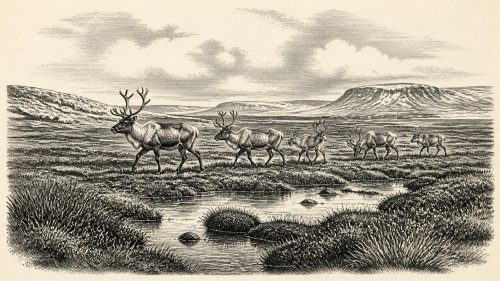
Around 30,826 BCE, Ireland formed part of an unstable MIS 3 Pleistocene environment, not a precisely datable historical year. Derryvree deposits in Fermanagh preserve evidence of cold, open tundra-steppe wetlands, while Castlepook Cave in Cork yielded diverse pre-Last Glacial Maximum fauna, including mammoth, reindeer, giant deer, hyaena and Arctic fox. Cave deposits were disturbed, limiting interpretation. A marked reindeer femur may indicate Upper Palaeolithic butchery and a brief human incursion, but proves neither settlement nor regular occupation. No social, economic or political structures are recoverable. Episodic warming, advancing ice and shifting habitats shaped an intermittently habitable island dominated by animals.
Read Article

Archived: 20 September 2026
Abstract
Around 33,000 years ago, Ireland experienced severe, changing Late Pleistocene conditions as ice expanded towards the last glacial maximum. Castlepook Cave, County Cork, preserves Ireland’s richest pre-glacial-maximum vertebrate archive, although disturbed, mixed deposits prevent precise reconstruction. Its fauna includes mammoth, giant deer, reindeer, brown bear and spotted hyaena, indicating open, cold grassland or tundra-like environments supporting grazers, predators and scavengers. Reassessed radiocarbon dates place important remains in Marine Isotope Stage 3. A possibly cut-marked reindeer bone may suggest human activity, but remains unconfirmed. No secure evidence demonstrates resident humans, settlement, farming, trade or organised society in Ireland at this time.
Read Article
Archived: 16 September 2026
Abstract
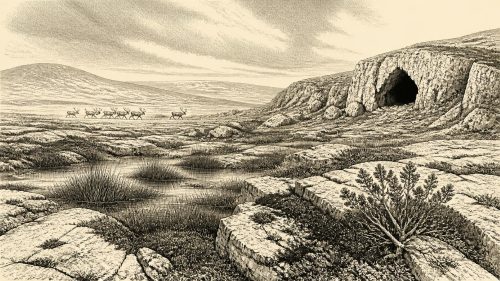
31,586 BCE is only a filing label for a broad, uncertain interval during Marine Isotope Stage 3, when Ireland was cold, treeless and approaching glaciation. Wetlands at Derryvree indicate sedge-rich, muskeg-like habitats amid open ground, ponds and seasonal freezing. Castlepook Cave in County Cork preserves mixed animal remains accumulated over many episodes, including reindeer, mammoth, giant deer, bear, hyaena, wolf, Arctic fox and lemmings. A marked reindeer femur may indicate human butchery, but cannot prove settlement or continuity. No evidence supports farming, institutions or culture. The record instead reveals a changing tundra-like landscape, rich in mammals and possible human visits.
Read Article

Archived: 14 September 2026
Abstract
Circa 31,755 BCE, Ireland lay within the volatile later Marine Isotope Stage 3 of the last Ice Age, as the British–Irish Ice Sheet expanded unevenly. Much of the island’s contemporary environment remains uncertain, later glaciation having erased or disturbed evidence. Castlepook Cave, County Cork, preserves Ireland’s richest relevant vertebrate assemblage, including reindeer, mammoth, giant deer, predators and lemmings, indicating cold, open habitats. Its mixed, imperfectly dated deposits document a long faunal sequence, not a single community. A possibly cut-marked reindeer bone suggests but cannot prove early human visitation. No secure evidence establishes settlement, culture or events in this nominal year.
Read Article

Archived: 14 September 2026
Abstract
Around 33,700 calibrated years before present, Ireland lay within the unstable Late Pleistocene, as ice advanced towards the Last Glacial Maximum. Open grasslands, shrubs and bare ground supported grazing animals, while lower sea levels altered coastlines without proving migration routes. Castlepook Cave, County Cork, preserves Ireland’s richest pre-maximum vertebrate archive, including mammoth, reindeer, giant deer, bear and hyaena, though its disturbed bones represent episodes. A 33,000-year-old reindeer femur bears a possible stone-tool cut mark, suggesting but not confirming an early human visit. No occupation evidence establishes settlement, hunting practices or continuity. It chiefly records environmental change and unresolved human presence.
Read Article

Archived: 10 September 2026
Abstract
Thirty-one thousand, eight hundred and twenty-eight BCE is a modern label approximating early MIS 3, not a precisely datable Irish event. Ireland’s unstable Late Pleistocene environment included intermittently ice-free, cold open habitats. Derryvree sediments in Fermanagh record wet tundra-like vegetation, while Castlepook Cave in Cork preserves diverse fauna, including mammoth, reindeer, giant deer and predators, although cave deposits are chronologically mixed. A cut-marked reindeer femur may indicate Palaeolithic butchery, but remains unconfirmed evidence of human visitation rather than settlement. No contemporary Irish camps, artefacts, institutions or cultural practices are securely known. These records reveal ecological complexity while leaving visitation unresolved.
Read Article

Archived: 10 September 2026
Abstract
Around 31,855 BCE, Ireland formed a variable Late Pleistocene, Marine Isotope Stage 3 landscape rather than a uniformly ice-covered island. Derryvree sediments in Fermanagh record an ice-free, treeless, wet tundra of grasses, sedges, herbs, juniper, mosses and beetles, later overridden by glaciers. Castlepook Cave in Cork preserves bones accumulated over long periods, including mammoth, giant deer, reindeer, bear, wolf and hyaena, demonstrating wider European faunal connections but not coexisting assemblages. A possibly cut-marked reindeer bone suggests early human activity, yet settlement remains unproven. Lower sea levels aided animal dispersal, while evidence for trade, agriculture, politics, ritual or continuous occupation absent.
Read Article

Archived: 9 September 2026
Abstract
31,885 BCE is a modern calendar equivalent, not a precisely datable Irish event, and belongs to fluctuating cold conditions of Marine Isotope Stage 3. Ireland’s advancing glaciers, exposed terrain and low sea levels created a changing landscape without a continental land route. Castlepook Cave in County Cork preserves Late Pleistocene remains including reindeer, mammoth, giant deer, hyaena and Arctic fox, indicating cold open habitats. A reindeer femur bearing possible stone-tool marks may suggest a human visit around 33,000 years ago, but disturbance, carnivore damage and absent finds prevent confirmation. No evidence establishes settlement, farming or continuous population; further work required.
Read Article
Archived: 9 September 2026
Abstract
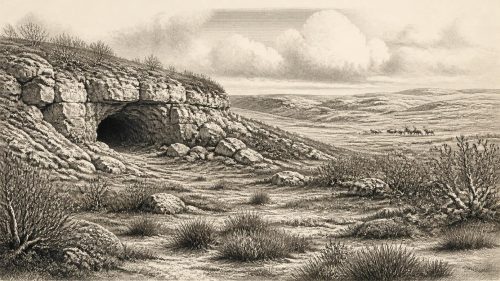
31,886 BCE is an imprecise modern label for a fluctuating MIS 3 Ice Age interval around 34,000 calibrated years ago, not a recorded Irish date. Ireland lacked known settlement, states and documentary history, but supported changing cold-adapted fauna. Castlepook Cave, County Cork, particularly Elephant Hall, preserves bones accumulated over millennia, including mammoth, reindeer, giant deer, bears, hyaenas and smaller mammals. Pollen and insect records indicate open, harsh, patchy landscapes. A reportedly cut-marked reindeer femur may signal Upper Palaeolithic butchery, yet remains unconfirmed and cannot demonstrate settlement. Later ice-sheet expansion destroyed or buried evidence, leaving ecological history clearer than human history.
Read Article

Archived: 9 September 2026
Abstract
Around 31,905 BCE, Ireland was a variable Late Pleistocene landscape, not a place with recoverable annual history. Derryvree, County Fermanagh, preserves freshwater deposits indicating treeless, periglacial tundra during MIS 3, although dates remain broad and local. Castlepook Cave in County Cork yielded mammoth, reindeer, giant deer, bear, wolf, Arctic fox, hyaena and lemming remains, demonstrating links with north-west European cold-stage fauna. Redating complicates earlier conclusions. A cut-marked reindeer bone may indicate brief Upper Palaeolithic butchery, but no secure occupation evidence exists. These fragments suggest occasional human visitation, not continuous settlement, before later glaciation and post-glacial colonisation in the archaeological record.
Read Article

Archived: 9 September 2026
Abstract
About 33,900 calendar years before 1950, Ireland’s history is reconstructed from cave deposits rather than dated events. Castlepook Cave, County Cork, preserves a mixed Late Pleistocene bone archive accumulated over millennia, containing mammoth, reindeer, giant deer, bears, hyaenas, wolves, Arctic foxes and lemmings. These remains indicate cold, open MIS 3 environments and functioning food webs, not a single community. A marked reindeer femur, dated roughly 33,000 years ago, may record human butchery, but cannot prove settlement, identity or continuity. Approaching the Last Glacial Maximum, advancing ice transformed landscapes and obscured earlier evidence. Further excavation and dating may clarify human presence.
Read Article