Hyenahall’s Long Bone Archive30497 BCE
Around 30,497 BCE, Ireland was a cold, changing later-Pleistocene landscape during Marine Isotope Stage 3. Derryvree in County Fermanagh preserves freshwater silts between glacial tills, radiocarbon-dated to about 30,500 BP, indicating a temporary ice-free wetland amid open tundra and periglacial conditions. The site demonstrates regional contrasts during dynamic ice-sheet advance and retreat, not uniformly ice-covered Ireland. Castlepook Cave in County Cork accumulated bones over millennia, documenting mammoth, giant deer, reindeer, bear and spotted hyaena. Its deposits require careful taphonomic interpretation; they do not prove hunting or occupation. A possibly cut-marked reindeer bone suggests human visitation, but permanent settlement remains unproven.
Dateline
The label 30,497 BCE is a useful point on a modern chronological scale, not a year for which Ireland preserves an annual historical record. No named event, ruler, community or exact calendar day can responsibly be assigned to it. The evidence is instead geological and palaeontological, dated in broad intervals and affected by the uncertainties of radiocarbon calibration, glacial disturbance and redeposition. Around this point in the later Pleistocene, during Marine Isotope Stage 3, Ireland lay within a cold and changing north-west European world, before the fullest expansion of the last British–Irish Ice Sheet.
The nearest important Irish environmental archive is Derryvree, near Maguiresbridge in County Fermanagh. There, a road cutting exposed organic silts and fine sands trapped between two substantial sheets of glacial till in a drumlin. The deposit produced the conventional radiocarbon determination BIRM-166: 30,500 years BP, with an uncertainty of +1,170/−1,030 years. This is not an exact equivalent of 30,497 BCE, and the conventional radiocarbon measurement must not be read as a calendar date. Nevertheless, its calibrated age falls within the broader middle part of the last glacial period and makes Derryvree the best direct Irish environmental evidence for the world broadly relevant to this date.
A Landscape Between Ice Advances
Derryvree’s position between two tills is its great importance. Till is debris laid down directly by glacier ice: clay, stones and larger fragments mixed without the sorting produced by ordinary rivers. The freshwater sediments show that, for a time, local ice did not cover this part of Fermanagh. Water accumulated, fine sediment settled and organic material survived. Later ice advanced across the district, sealing the older wetland beneath another layer of glacial debris. The sequence therefore records change rather than a single, timeless “Ice Age” landscape.
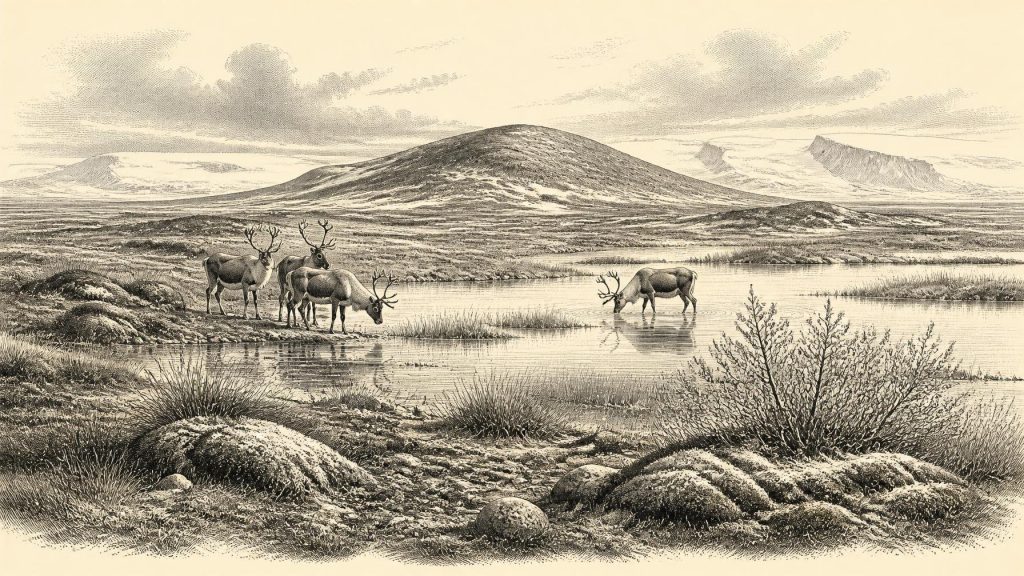
The fossils within the Derryvree silts indicate open tundra vegetation and a periglacial climate: ground and water shaped by intense cold and seasonal freezing, rather than a forested Irish countryside. The evidence supports a freshwater setting with wet margins amid exposed country. It does not license a detailed reconstruction of every hill, nor prove that all Ireland was simultaneously ice-free. A small basin in Fermanagh could preserve open water and wetland plants while ice occupied other catchments, uplands or coasts. This regional unevenness is essential. The British–Irish Ice Sheet developed through advances, thinning and retreats; it was not a single fixed white cover descending uniformly over the island.
Recent ice-sheet research strengthens that caution. It identifies dynamic glaciation before the Last Glacial Maximum as well as the far more securely mapped expansion after about 31,000 years ago. At the scale of this article’s date, evidence permits an Ireland of sharp environmental contrasts: areas of cold, exposed ground; local freshwater habitats; glaciers and ice margins in some regions; and landscapes repeatedly remodelled by meltwater, frost and advancing ice. The later maximum ice volume, around 23,000 years before present, still lay in the future. Yet climatic deterioration and ice growth were already defining the possibilities of life.
Freshwater Life in Cold Country
Derryvree is not an archaeological settlement, but it offers unusually vivid evidence for the ecological foundations on which any animal or human movement depended. Its organic silts preserve a flora and fauna of “full glacial aspect”. In plain terms, the waterbody and its margins supported life adapted to a severe, largely treeless environment. Mosses, wetland plants and aquatic organisms were part of a local food web; sediment, standing water and short growing seasons governed its rhythm. Summer growth could be productive without implying a mild climate or a long pastoral-looking season.
Such places mattered disproportionately. A shallow pool, sedge-fringed margin or slow channel concentrates plants, invertebrates and drinking water in an otherwise exposed terrain. Herbivores could browse or graze nearby, and carnivores could follow them. This is an ecological inference from the sediments and from comparable cold-stage environments, not proof that a particular species stood at Derryvree in 30,497 BCE. The responsible picture is a mosaic: wet ground and freshwater within wider open tundra, continually vulnerable to frost disturbance, altered drainage and renewed glaciation.
There was no Irish agriculture, no managed field system and no settled village economy. The economics of the landscape were ecological rather than human: plants converting brief-season sunlight into growth; grazing and browsing animals moving through open country; predators and scavengers exploiting carcasses; and ice redirecting water and stripping soil. “Trade” and organised exchange are similarly beyond the evidence. Ireland’s later historical categories—territory, diplomacy, taxation, kingship and warfare—have no demonstrable place here.
Castlepook and the Mammal Record
For larger animals, Castlepook Cave near Doneraile in north County Cork is the central Irish archive. Its passages include chambers long known as Hyenahall and Elephant Hall, names bestowed by modern investigators but apt reminders of its remarkable fossil assemblage. Excavations recovered more than 2,000 bones, and direct dates on individual remains span a very long interval, roughly 45,700 to 19,950 years before present. The cave is thus not a photograph of one moment. It is a repository accumulated across many millennia, disturbed in places by water and used by animals in different episodes.
Its fauna nevertheless establishes what kinds of large mammals reached Ice Age Ireland before the Last Glacial Maximum: woolly mammoth, giant deer, reindeer, brown bear and spotted hyaena, alongside later cold-adapted records including lemmings, Arctic fox and wolf. These remains show that Ireland was not biologically empty during the broader period. They do not show that every listed animal shared the same valley, season or generation. Nor should the famous giant deer automatically be imagined as a symbol of a permanent Irish herd: fossils demonstrate occurrence, while the timing, density and duration of populations remain harder questions.
Hyaena bones and other evidence make Castlepook especially important for understanding how deposits formed. A cave may contain prey dragged in by carnivores, animals that died naturally, bones moved by water and material introduced by excavation or earlier disturbance. Therefore, mammoth or reindeer bones are not automatically evidence of hunting, and a cave chamber is not automatically a human home. Taphonomy—the study of what happened to remains between death, burial and excavation—is as important here as the species list itself.
The Human Question
The possibility of people in Ireland during this cold period must be treated with particular restraint. A reindeer femur from Castlepook has been reported as bearing a mark consistent with cutting by a sharp stone tool; public heritage material places it broadly around 31,000 BCE, while discussions commonly describe a radiocarbon age of about 33,000 years. If that interpretation survives further scrutiny, it may record the butchery of a reindeer by a visitor or small hunting party and would push evidence of human activity in Ireland far back into the Palaeolithic.
But this one modified bone cannot carry more historical weight than it possesses. It does not establish a permanent population, a camp at Castlepook, a route followed across every season, a language, kin group, ritual or political community. Nor does it prove that people were present in precisely 30,497 BCE. The National Museum of Ireland continues to state that clear evidence for Palaeolithic human presence has not yet emerged, reflecting the distinction between a compelling individual claim and a securely demonstrated pattern of occupation. The most accurate conclusion is that brief human visitation remains possible, perhaps increasingly plausible, but is not yet the basis for a full human history of Ireland at this date.
If people did reach the island, their material world would have been perishable and mobile: stone cutting edges, clothing and equipment of hide, wood, sinew and fibre, and knowledge of animal behaviour, weather and safe movement through a cold landscape. This is a reasonable comparison with Upper Palaeolithic lifeways elsewhere in north-west Europe, not evidence for a recovered Irish toolkit or campsite. No Irish art, burial, dwelling, hearth or formal shrine can presently be assigned to this period. Religion, learning and culture therefore cannot be described in specifically Irish terms. Silence in the record is not proof of their absence; it is a limit on what can be claimed.
Coasts, Corridors and Uncertainty
Sea level was substantially lower globally during the last glacial period, but the geography around Ireland was complicated by ice loading, changing coastlines and shifting marine margins. It is unsafe to imagine the modern island simply enlarged by a fixed land bridge. Connections to Britain and the wider European landmass changed through time, while ice, rivers, coastal plains and water barriers controlled movement. Any animals or people reaching Ireland did so through opportunities that were temporary, regional and environmentally demanding.
Thus the most important development around 30,497 BCE was not a political event but the making of a future archaeological landscape. Freshwater silts accumulated at Derryvree; mammal remains accumulated in limestone passages at Castlepook; and expanding or returning ice later buried, mixed, preserved and destroyed evidence. Those processes explain why this remote Irish past is known through a wetland beneath a drumlin and bones in a cave. They also require humility. The evidence securely reveals a cold, changing Ireland inhabited at least intermittently by Ice Age fauna. Beyond that, every reconstruction must keep fact, probability and speculation clearly apart.
Primary Sources
- A Middle Midlandian Freshwater Series at Derryvree, Maguiresbridge, County Fermanagh, Northern Ireland
- Middle Midlandian Freshwater Series at Derryvree, Maguiresbridge, County Fermanagh, Northern Ireland
- Castlepook Cave, County Geological Site Report CK032
- The Irish Quaternary Fauna Project
- Growth and Retreat of the Last British–Irish Ice Sheet, 31 000 to 15 000 Years Ago: The BRITICE-CHRONO Reconstruction
- The Timing and Magnitude of the British–Irish Ice Sheet Between Marine Isotope Stages 5d and 2: Implications for Glacio-Isostatic Adjustment, High Relative Sea Levels and ‘Giant Erratic’ Emplacement
- Radiocarbon Constraints on the Age of the Maximum Advance of the British–Irish Ice Sheet in the Celtic Sea
- Maximum Extent and Dynamic Behaviour of the Last British–Irish Ice Sheet West of Ireland
- Stratigraphic and Palaeo-Geomorphological Evidence for the Glacial-Deglacial History of the Last British-Irish Ice Sheet in the North-Western Irish Sea
- New Data for the Last Glacial Maximum in Great Britain and Ireland
- Prehistoric Details: Mell Flint Flake
- Heritage Artefacts of County Cork
- New Insights on the Fauna of Ireland’s Younger Dryas and Early Holocene from Alice & Gwendoline Cave
- Ireland’s Palaeolithic Archaeology – Fleeting Footprints in a Frozen Land
- What Was on the Menu in Prehistoric Ireland?
- Pleistocene Vertebrates in the British Isles
- Occurrence of Mammalia Relicts at Site Castlepook Cave
- Mammoth Cave (Castlepook Cave), County Cork
- The Colonization of Ireland: A Human Ecology Perspective
- Anthropogenic Changes to the Holocene Nitrogen Cycle in Ireland
- IntCal20 Northern Hemisphere Radiocarbon Age Calibration Curve (0–55 cal kBP)
- A Framework for the Timing of Abrupt Climatic Changes During the Last Glacial Period Based on Three Synchronized Greenland Ice-Core Records