Carden’s Deep Femoral Mark30449 BCE
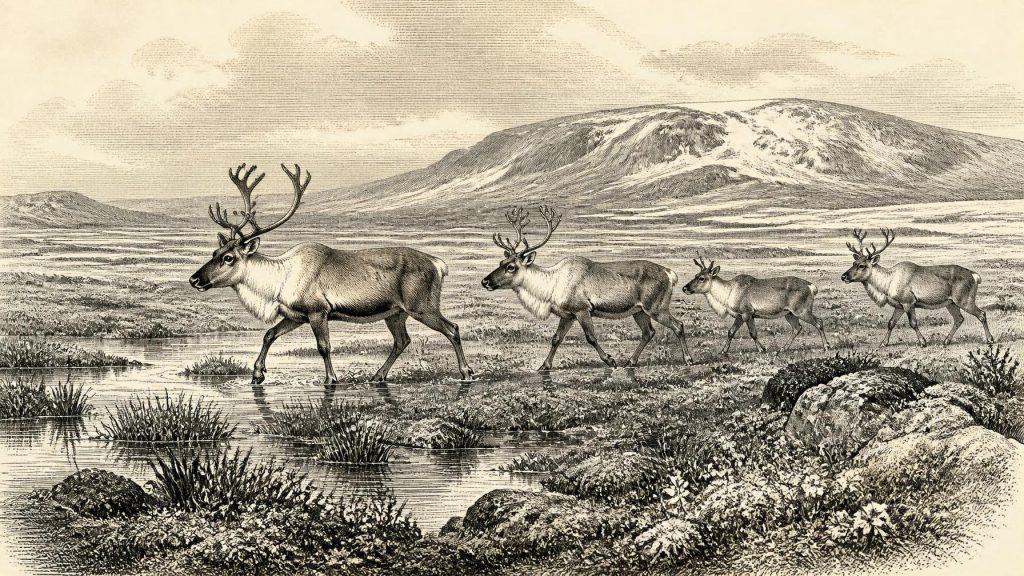
Around 30,449 BCE, Ireland has no historical record, and the date can only be placed within broad Late Pleistocene environmental chronologies. Derryvree, County Fermanagh, preserves freshwater sediments between glacial tills, dated broadly to 34,950–29,750 BCE. Its plants, insects and sediments indicate cold, open tundra with productive wetlands during an interstadial interval. Changing ice, low seas and terrain shaped movement but prove no route. At Castlepook Cave, County Cork, a reindeer femur possibly bears a stone-tool cut mark, suggesting human activity around 33,000 years ago. However, no settlement, tools or social evidence confirms occupation; farming, trade and political identities remain undocumented.
Dateline
30,449 BCE is a modern chronological label, not a year that can be recovered from an Irish record of events. Nobody in Ireland left writing, a calendar, a named settlement or a datable political act from this depth of time. Indeed, modern calendar-year precision is unavailable. The number falls about 32,400 years before AD 1950, the conventional radiocarbon ‘present’, but radiocarbon ages and calendar ages are not interchangeable. For Ireland, the most relevant evidence is dated in broad calibrated ranges and describes environmental intervals lasting centuries or millennia rather than a single season, generation or year.
The appropriate setting is the Late Pleistocene, during Marine Isotope Stage 3, in the long climatic deterioration before the Last Glacial Maximum. Ireland was not yet the uniformly ice-dominated landscape of the later maximum, but neither was it a familiar green island. Ice margins shifted over long timescales, drainage systems changed, and areas capable of supporting freshwater life could later be overridden by glacier ice. The physical evidence is sparse partly because succeeding glaciation eroded, rearranged and buried so much of the earlier landscape.
A Date Within a Wide Window
The best direct environmental guide is the Derryvree deposit near Maguiresbridge in County Fermanagh. Roadworks in 1969 cut through a drumlin and exposed freshwater silts and fine sands sealed between two distinct sheets of glacial till. The lower till showed that ice had already occupied the area; the upper till demonstrated that ice later returned or overran the site. Between them, however, organic sediment accumulated in a freshwater setting. Its principal radiocarbon determination, BIRM-166, was 30,500 radiocarbon years before present, with a substantial uncertainty of plus 1,170 and minus 1,030 years.
Later discussion has expressed that measurement as a broad calibrated interval of roughly 36,900–31,700 cal BP, approximately 34,950–29,750 BCE. The nominal year 30,449 BCE lies within that span, but it cannot be attached to an individual layer in the section, still less to a particular pool, animal or human action. Derryvree is consequently not an annal for 30,449 BCE. It is a rare, securely ordered archive which shows that an interval of freshwater and tundra life occurred in this part of Fermanagh between phases of glaciation.
Wet Ground Between the Tills
Derryvree corrects the tempting image of an unbroken white wilderness. The flora and fauna recovered from its organic beds indicate open tundra vegetation and a periglacial climate: intensely cold conditions in which freezing and thawing shaped the ground. Yet the deposit also records water. Freshwater mosses and sedges, together with aquatic and waterside plants, show that shallow, wet habitats persisted locally. Fossil evidence includes bogbean, a plant of wet ground and pools, and alternate water-milfoil, an aquatic plant. Such species do not imply mild weather or woodland; they indicate that cold, seasonally productive water margins existed amid a largely treeless terrain.
The surrounding land was probably a mosaic rather than one uniform habitat: gravelly or exposed ground, sedge-rich wet places, shallow water, low-growing herbs and mosses, with snow cover and frozen soils varying through the year. Dwarf shrubs and arctic-alpine plants could exploit brief summers. Insects of northern, cold-climate affinity reinforce the interpretation. This was an ecological community able to function under severe constraints, not an empty place. It also reminds us that ‘Ireland’ should not be treated as a single climatic zone. A small Fermanagh basin cannot provide a precise map for every coast, upland or southern limestone cave.
Ice, Land and Changing Connections
At the scale of north-west Europe, Ireland lay at the western edge of a changing world of ice, lowered sea levels and exposed continental shelves. The later growth of the British–Irish Ice Sheet was approaching, although its advance was not a simple, simultaneous event across every region. Modern reconstructions, based on landforms, sediment sequences and extensive dating programmes, show an ice sheet that developed dynamically between about 31,000 and 15,000 years ago. Its largest later extent belongs to a different phase from the Derryvree freshwater interval. This distinction matters: the presence of an inter-till wetland in Fermanagh is evidence against assuming that all of Ireland was covered by ice at the same moment.
Sea levels were much lower than today, so the geography of the Irish Sea basin differed greatly from the modern map. But low sea level alone does not prove an easy, open route for people or animals at any particular time. Ice, marshy ground, river systems, weather and the changing position of shorelines all affected movement. It is responsible to say that Ireland formed part of a wider north-west European environmental zone in which animals and, potentially, highly mobile people could move during favourable episodes. It is not responsible to draw a route, specify a crossing date or claim a permanent land bridge for 30,449 BCE.
Castlepook’s Reindeer Question
The most striking possible human trace relevant to this era comes from Castlepook Cave, also called Mammoth Cave, near Doneraile in north County Cork. Antiquarian excavations there recovered a rich but difficult collection of Pleistocene animal remains. The cave fauna includes cold- and open-country species, among them reindeer, horse, mountain hare, arctic fox, lemmings, wolf, brown bear, giant deer, woolly mammoth and spotted hyaena. These remains were not necessarily all deposited together, and a cave is not a straightforward settlement site: carnivores, water, roof collapse, excavation methods and later disturbance can mix its contents.
One reindeer femur has attracted particular attention because its deep surface mark has been interpreted by palaeozoologist Ruth Carden as a cut or chop made by a sharp stone tool during carcass processing. The bone has been publicly associated with an age of roughly 33,000 years ago, close enough to make it highly relevant to this broader period. If the interpretation is sustained, it would show that a person used a tool on a reindeer carcass in Ireland during the Upper Palaeolithic, vastly earlier than the island’s long-established post-glacial settlement record.
The limits of that conclusion are as important as its promise. The marked femur is not a sealed camp floor with a hearth, stone-tool scatter, dwelling, burial or human remains. Recent work at Castlepook has sought surviving Pleistocene deposits, but the 2022 excavation recovered no cultural artefacts. Nor does a marked bone establish whether people killed the animal, processed it at the cave, followed a herd, stayed overnight or revisited the locality. The bone’s age is the date of the animal’s death, not proof that every event imagined around it happened immediately afterwards. It is therefore best treated as suggestive and potentially transformative evidence, not as proof of a settled Irish population.
Society Without a Political Record
No named people, languages, kin groups, territories, rulers or political institutions can be identified for Ireland around this date. There is no evidence for borders, diplomacy, organised warfare, tribute, law or leadership. Terms such as Gaelic, Celtic or tribal belong to vastly later historical frameworks and should not be projected backwards into the Late Pleistocene. The same restraint applies to religion and culture: no Irish shrine, grave, image, musical instrument, teaching tradition or symbolic object of this age has been securely connected to people.
If humans did reach Ireland intermittently, they would have been hunter-gatherers operating in small, mobile groups, as were Upper Palaeolithic communities elsewhere in Europe. That is a comparative interpretation, not a demonstrated Irish social structure. The Castlepook femur, if humanly modified, could imply practical knowledge of stone tools and animal anatomy. Cutting a carcass might yield meat, marrow, hide, sinew and bone. Yet the evidence does not reveal who performed the work, how it was shared, whether the animal was hunted or scavenged, or how long any visitors remained.
Economy, Exchange and Everyday Life
There is no evidence for farming, herding, pottery, metallurgy, permanent villages or Irish trade networks at 30,449 BCE. Any human subsistence would have depended on opportunistic hunting, scavenging, gathering and movement through a demanding seasonal landscape. Reindeer would have been an important potential resource where herds occurred, but the Irish record cannot demonstrate regular hunting or a specialised reindeer economy. Nor can it identify exchange with Britain or continental Europe. A stone tool inferred from a cut mark is not the same as a recovered tool, and no securely associated Upper Palaeolithic lithic assemblage has yet been excavated in Ireland.
The strongest story for this date is thus environmental resilience and archaeological uncertainty. Derryvree preserves the tangible traces of a cold wetland—plants, insects, sediment and freshwater—between advances of ice. Castlepook preserves the possibility that people briefly entered this broader Ice Age landscape and processed an animal there or nearby. Together, the sites place Ireland within the ecological and human possibilities of Late Pleistocene north-west Europe, while insisting on the difference between evidence and inference. For 30,449 BCE, that cautious distinction is not a limitation on history; it is the history’s most important fact.
Primary Sources
- Middle Midlandian Freshwater Series at Derryvree, Maguiresbridge, County Fermanagh, Northern Ireland
- A Middle Midlandian Freshwater Series at Derryvree, Maguiresbridge, County Fermanagh, Northern Ireland
- Quaternary Site Descriptions
- IQUA Guide 16: The Quaternary of Northern Ireland
- Early Midlandian–Middle Midlandian, Pleistocene, Northern Ireland
- Trimlines, Blockfields and the Vertical Extent of the Last Ice Sheet in Southern Ireland
- Growth and Retreat of the Last British–Irish Ice Sheet, 31,000 to 15,000 Years Ago: the BRITICE-CHRONO Reconstruction
- Pattern and Timing of Retreat of the Last British-Irish Ice Sheet
- Britain and Ireland: Glacial Landforms From the Last Glacial Maximum
- The Deglaciation of the Western Sector of the Irish Ice Sheet From the Inner Continental Shelf to its Terrestrial Margin
- Oscillating Retreat of the Last British-Irish Ice Sheet on the Continental Shelf Offshore Galway Bay, Western Ireland
- Character of Advance and Retreat of the Southwest Sector of the British-Irish Ice Sheet During the Last Glaciation
- New Insights on the Fauna of Ireland's Younger Dryas and Early Holocene From Alice & Gwendoline Cave
- New Insights on the Fauna of Ireland's Younger Dryas and Early Holocene From Alice & Gwendoline Cave
- The Irish Quaternary Fauna Project
- Heritage Artefacts of County Cork
- Archaeology Research Excavation Grant 2022: Final Report
- 2022:564 – Castlepook Cave, Castlepook South, Cork
- Prehistoric Details
- Menyanthes trifoliata
- Myriophyllum alterniflorum
- Radiocarbon Calibration Curve (IntCal20): Northern Hemisphere Radiocarbon Age Calibration Curve (0–55 cal kBP)