Castlepook’s Long Faunal Archive30440 BCE
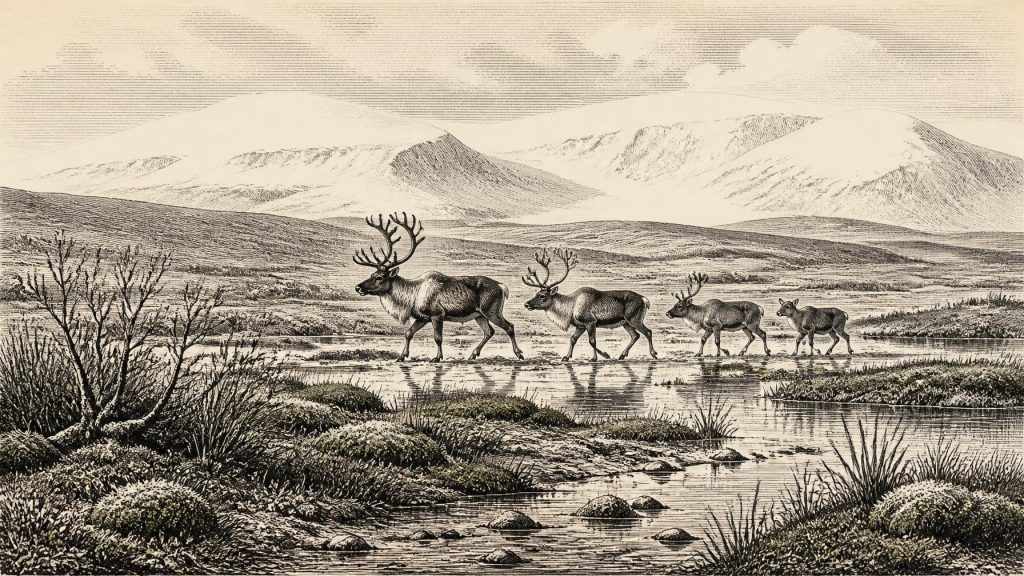
30,440 BCE is a modern label for an uncertain Late Pleistocene interval, not a datable Irish event. Derryvree sediments in County Fermanagh record cold freshwater vegetation between glacial deposits, demonstrating local ice-free or ice-marginal conditions, rather than island-wide deglaciation. Castlepook Cave, County Cork, preserves a long, mixed faunal record including mammoth, reindeer, giant deer, bear and hyena, indicating intermittent connections with Europe and open, varied terrain. No secure human settlement belongs to this period; a possibly modified reindeer bone remains inconclusive. Subsequent maximum glaciation erased much evidence, leaving fragmented archives of water, plants, animals, ice and changing routes to Europe.
Dateline
The label 30,440 BCE is a modern chronological convenience, not a date that can be matched to an Irish event, ruler, journey or settlement. It is roughly 32,390 years before the conventional radiocarbon baseline of AD 1950, but modern calendar-year precision is not available at this depth of time. The responsible setting is the Late Pleistocene, broadly Marine Isotope Stage 3, during the last Ice Age but before the fullest later expansion of the British–Irish Ice Sheet. Evidence comes in long, uncertain ranges: sediment layers, fossils, pollen, plant macrofossils, cave bones and radiocarbon measurements. These illuminate changing environments and possibilities, not a single year in the life of Ireland.
A Date Within Broad Ranges
The closest major Irish environmental archive is Derryvree, near Maguiresbridge in County Fermanagh. Roadworks exposed freshwater silts, sands and organic deposits between two thick layers of till, the stony sediment laid down by glacier ice. The sequence records a local order of events: ice deposited the lower till; an interval followed in which water and vegetation accumulated sediment; and later ice sealed the deposits beneath another till. Organic material from the freshwater horizon produced the radiocarbon determination BIRM-166, conventionally reported as 30,500 ± about 1,100 radiocarbon years BP.
That measurement cannot be read as 30,440 BCE. Radiocarbon years differ from calendar years because atmospheric carbon-14 has varied, and calibration at such antiquity produces wide ranges. Later treatments place the Derryvree freshwater phase broadly in the mid-to-late 30,000s calibrated years BP, with the exact span dependent on method and assumptions. The nominal year considered here lies near the younger edge of some published calibrations and outside others. Derryvree is therefore relevant as evidence for the wider climatic world, not as proof that a particular Fermanagh pool existed in this precise calendar year.
Fresh Water Beneath Future Ice
Derryvree offers something unusually valuable: direct evidence that at least one inland locality could be ice-free, or ice-marginal, during part of this unstable period. The plant and insect remains indicate cold freshwater conditions rather than a forested landscape. Sedges, mosses, dwarf willow, mountain-avens, bogbean, water-milfoil and other wet-ground or Arctic-alpine plants point to shallow water, saturated margins and open vegetation. There were short growing seasons, but not ecological emptiness. Plants rooted in mud; insects completed life cycles; and seasonal thaw sustained standing or slow-moving fresh water.
This was no uniform national landscape. Ireland’s uplands, western lowlands, eastern coasts and the floor of the Irish Sea basin responded differently to changes in temperature, snowfall and ice movement. Nor does the Derryvree record establish that the entire island was free of glacier ice at once. Its strength is local and stratigraphic. Yet that local evidence matters because later glaciers eroded, reworked and buried much of the earlier landscape. A small inter-till deposit beneath a drumlin can preserve a chapter otherwise lost from the surface of the island.
Open Country and Large Animals
The complementary archive lies far south-west at Castlepook Cave, also called Mammoth Cave or Doneraile Cave, in County Cork. Its excavated deposits and museum collections make it Ireland’s richest known source for vertebrate fauna of the period leading towards the Last Glacial Maximum. Individual bones have produced dates spanning a long interval, roughly 45,700 to 19,950 years before present. That is a useful chronological framework, but it also demands restraint: bones from different layers, rooms and episodes cannot be made into one simultaneous animal community.
Within that long record are woolly mammoth, reindeer, giant deer, brown bear and spotted hyena, alongside later evidence for Arctic fox, wolf and lemmings. The animals demonstrate that Ireland was repeatedly accessible to mammals from the wider north-west European world before the later maximum ice cover. They do not demonstrate that every species occupied Cork at 30,440 BCE, or that all were neighbours in one valley. Cave hyenas, for example, could carry or accumulate bones; water movement and old excavations also disturbed deposits. A cave bone assemblage is a filtered record of deaths, scavenging, transport and preservation, not a census.
Still, the fauna gives the period its scale. Reindeer and mammoth are consistent with extensive open terrain; giant deer required productive enough grazing and browse in parts of the landscape; large carnivores indicate prey and scavenging opportunities. The most defensible image is a varied, cold country of exposed grass-herb communities, wet hollows, sparse shrub cover and locally sheltered ground, bounded or interrupted by ice. There was no modern Irish woodland, no peatland system in its familiar Holocene form, and no settled agricultural countryside.
People: A Serious Question, Not a Settled Fact
The human story is especially uncertain. Ireland has no securely excavated settlement, hearth, tool assemblage, dwelling, grave or continuous population trace assignable to this horizon. Accordingly, no named group, language, political organisation or social institution can responsibly be placed on the island in 30,440 BCE. There were no states, borders, chiefs known from evidence, diplomatic ties or wars that history can recover. Terms such as government, trade policy and religion would falsely suggest records that do not exist.
Castlepook has nevertheless sharpened the question. A reindeer bone from the cave bears an incision interpreted as a possible cut or chop mark, and it has been associated in public reporting with a date around 33,000 years ago. If that interpretation is upheld by further study, it may indicate a human encounter with an animal in Ireland in the wider pre-Last Glacial Maximum period. It would not prove a permanent settlement, a hunting camp at the cave, or occupation in the nominal year. The specimen comes from an old, disturbed collection context, exactly the kind of context in which archaeological claims require repeated testing.
This distinction is important because the better-established Irish evidence for people is much younger. The butchered brown-bear bone from Alice and Gwendoline Cave in County Clare dates to about 12,810–12,590 calibrated years BP, while the National Museum of Ireland remains cautious about claiming clear Palaeolithic occupation overall. At 30,440 BCE, people may have reached, crossed or briefly used parts of the island during favourable phases; existing evidence cannot turn that possibility into a settled history.
Everyday Life Without a Settlement Record
If humans did visit Ireland during this broad interval, they would have belonged to highly mobile Upper Palaeolithic hunter-gatherer worlds known elsewhere in north-west Europe. Such a comparison can suggest practical challenges—cold exposure, seasonal movement, stone-tool maintenance, hunting and the use of animal materials—but it is not direct Irish evidence. No Irish campfire, worked stone concentration, shelter floor, food refuse deposit or personal ornament securely belongs to this date. The honest conclusion is that everyday human life in Ireland remains unknown, rather than merely undocumented in detail.
The evidence does allow a fuller account of non-human daily life. Plants at Derryvree exploited short summers and shallow water. Herd animals and browsers moved through open country as vegetation shifted seasonally. Bears and hyenas used caves or their surrounding landscapes in ways that left bones but rarely intact behavioural scenes. Predation, scavenging and winter mortality were parts of the ecosystem, though their exact locations and frequency cannot be reconstructed. The cave record preserves the aftermath of these processes rather than their moment-by-moment drama.
Connections Across a Changing Seascape
Lower global sea level, caused by water stored in northern ice sheets, altered coastlines and reduced some sea crossings. Ireland’s animal record shows that connections with Britain and continental Europe existed at intervals, although their precise routes changed with sea level, ice margins and local topography. It is safer to speak of changing corridors and barriers than to imagine one permanent land bridge. Recent sedimentary ancient-DNA work from Castlepook supports the broader conclusion that Irish Late Pleistocene fauna formed part of a European biogeographical continuum.
For humans, that connectivity means access was possible in principle, not demonstrated in practice for this date. For animals, it helps explain why a small island possessed mammoth, reindeer and hyena during parts of the Ice Age. It does not establish regular exchange, migration schedules or shared cultural territories. ‘Trade’ has no evidential basis here: no imported artefacts, managed resources or exchange network has been identified. Movement was ecological before it can be called economic.
The Approach of Maximum Glaciation
Several millennia after this nominal date, the British–Irish Ice Sheet reached its major Last Glacial Maximum extent. Modern reconstructions place the strongest, most extensive phase later, broadly around 27,000 to 23,000 calibrated years BP, with regional variation in advance and retreat. The ice that later reshaped Ireland erased much of the older terrain and explains why the surviving evidence is fragmented. Derryvree’s upper till is a physical reminder that a wetland interval could end beneath advancing ice.
Thus Ireland around 30,440 BCE is best understood not as a blank page before history, but as a difficult archive. Freshwater sediments in Fermanagh reveal a cold, living local landscape; Castlepook’s bones show that large mammals repeatedly reached the island; and the absence of secure settlements sets the boundary between evidence and imagination. There is no year-specific Irish event to narrate. There is, instead, a landscape in motion: water, tundra vegetation, animals and ice, preserved in fragments that remain capable of changing the story as new dating and excavation proceed.
Primary Sources
- A Middle Midlandian Freshwater Series at Derryvree, Maguiresbridge, County Fermanagh, Northern Ireland
- The Irish Quaternary Fauna Project
- Castlepook Cave: Cork County Geological Site Report
- Exploring the Controls on the Last British-Irish Ice Sheet Retreat in the NW Sector
- The Timing and Magnitude of the British–Irish Ice Sheet Between Marine Isotope Stages 5d and 2
- Growth and Retreat of the Last British–Irish Ice Sheet, 31,000 to 15,000 Years Ago: The BRITICE-CHRONO Reconstruction
- Radiocarbon Constraints on the Age of the Maximum Advance of the British–Irish Ice Sheet in the Celtic Sea
- Late Pleistocene Chronostratigraphy and Ice Sheet Limits, Southern Ireland
- New Data for the Last Glacial Maximum in Great Britain and Ireland
- Pattern and Timing of Retreat of the Last British-Irish Ice Sheet
- Deglaciation Chronology of the Donegal Ice Centre, North-West Ireland
- Trimlines, Blockfields and the Vertical Extent of the Last Ice Sheet in Southern Ireland
- Prehistoric Details
- Castlepook Cave, Castlepook South, Cork: 2022 Excavation Report
- First Evidence of a Late Upper Palaeolithic Human Presence in Ireland
- New Insights on the Fauna of Ireland’s Younger Dryas and Early Holocene from Alice & Gwendoline Cave
- Sedimentary Ancient DNA Reveals Late Pleistocene Faunal Connectivity Between Ireland and Eurasia
- The Quaternary of Ireland: Figure 6, Subdivision of the Quaternary Period in Ireland
- Field Guides
- Outreach and Education Resources
- Castlepook Caves
- Mammoth Cave