Castlepook Before Coalescence30361 BCE
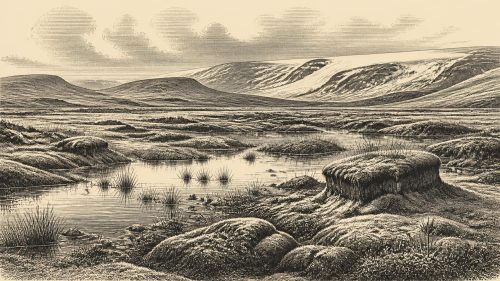
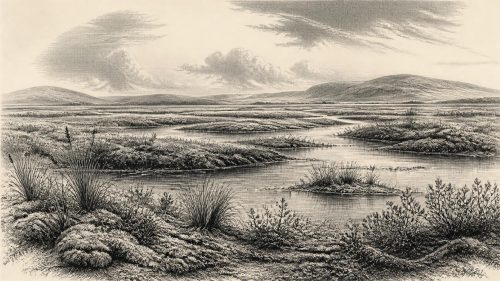
Around 30,361 BCE, Ireland was entering a major glacial crisis, although conditions varied regionally and no exact annual history is recoverable. Derryvree, County Fermanagh, preserves an ice-free freshwater interval between glacial tills, indicating cold, treeless tundra wetland with sedges, mosses, insects and seasonal thaw. Castlepook Cave, County Cork, contains diverse Ice Age fauna, including mammoth, reindeer and predators, demonstrating episodic cold-stage ecosystems rather than a single contemporary community. A marked reindeer bone may indicate Upper Palaeolithic butchery, but remains uncertain and cannot prove settlement. Advancing ice, shifting coastlines and sparse habitats shaped a fragmented landscape, burying much evidence of visits.

Dateline
30,361 BCE is a modern label, not a recoverable Irish calendar year. There is no written record, named community, political event or securely dated human occupation that can be assigned to that single year. In conventional archaeological terms it lies roughly 32,300 calendar years before AD 1950, within the Late Pleistocene and Marine Isotope Stage 3. Dates from this age carry substantial statistical ranges, and Irish evidence is generally dated in radiocarbon years before present, calibrated ranges, or broad climatic phases rather than exact BCE years. The responsible question is therefore not “what happened in Ireland in 30,361 BCE?” but what the best geological, palaeoecological and archaeological evidence can show about Ireland around this broad interval.
An Island Entering a Glacial Crisis
Ireland was approaching the major expansion of the British–Irish Ice Sheet. It had not yet reached the island-wide glacial maximum more familiar from accounts of the Last Glacial Maximum, but ice was becoming an increasingly decisive force in the north Atlantic world. Recent reconstructions stress that this advance was not a single, neat event: ice grew at different times and rates in different sectors. Scottish ice was advancing through the North Minch around 32,000–31,000 years ago, while ice masses over Ireland and Britain enlarged rapidly thereafter. The evidence is strongest for broad trends, not for a precisely mapped Irish ice margin in this particular year.
This was consequently neither a uniformly white island nor a reliably hospitable open country. Some districts were already affected by ice, snow accumulation, frozen ground and intense seasonal cold; elsewhere, exposed terrain and freshwater basins persisted for a time. Low global sea levels altered the outlines of the continental shelf, but Ireland’s relationship to Britain and western Europe cannot be reduced to a simple land bridge. Coastlines, sea ice, waterways and ice margins changed repeatedly. Any movement by animals or people depended on local conditions that could alter over generations or even more quickly.
Political affairs, diplomacy and organised warfare are beyond the evidence. There were no states, borders, rulers, written languages or institutions identifiable in Ireland. Nor can archaeologists responsibly assign an ethnicity, language or cultural name to any possible visitors. The primary history of this period is environmental: advancing ice, changing sea level, exposed or buried ground, shallow water, sparse plant cover and the movement of animals through a severe landscape.
Derryvree’s Buried Wetland
The most informative Irish environmental archive relevant to this broad horizon lies at Derryvree, near Maguiresbridge in County Fermanagh. Roadworks in 1969 cut through a drumlin and revealed organic-rich freshwater silts and fine sands sandwiched between two tills. The sequence matters as much as the fossils. A lower till records an earlier episode of glaciation; sediment and organic matter accumulated during an interval when this locality was ice-free and wet; an upper till records a later advance that buried and protected the deposit. It is an unusually direct record of environmental change, not a settlement layer.
Material from the organic horizon produced a radiocarbon determination of 30,500 +1,170/−1,030 BP. That is a radiocarbon age, not a calendar date, and calibration places the Derryvree interval broadly in the earlier part of the wider cold-stage world discussed here. A recent Bayesian treatment used the result as evidence for ice-free conditions in Ireland before the later build-up of the last ice sheet, while also making clear that the uncertainty is large. Derryvree can therefore illuminate conditions around 30,361 BCE, but cannot function as a diary entry for that year.
The fossils indicate a cold, open and largely treeless environment. Herbaceous pollen, freshwater mosses, sedges and an insect fauna of northern aspect point to tundra or muskeg-like ground with pools, wet margins and sparsely vegetated mineral soils. A seed of bogbean (Menyanthes trifoliata) and pollen of alternate water-milfoil (Myriophyllum alterniflorum) demonstrate that fresh water persisted locally; they do not imply a mild climate or a modern-style bog. Summer thaw could create biologically active shallow water and mossy ground, while winter brought deep cold, frost and exposure.
This evidence corrects two misleading pictures. Ireland was not necessarily lifeless beneath uninterrupted ice, but neither was it a wooded or fertile country awaiting settlement. The Derryvree basin supported plants and insects because local water, sediment and a brief growing season made that possible. Beyond such sheltered places, vegetation was thin and the climate severe. Treeless wetland, open grass- and sedge-rich patches, hardy herbs, wind and frozen ground are better guides than either a modern green landscape or an empty polar desert.
Animals in a Fragmentary Record
Irish caves preserve another kind of evidence. Castlepook Cave, near Doneraile in north County Cork, produced a major collection of Ice Age animal remains during early twentieth-century excavations. The historic report documented a rich cave fauna, and later reassessment has made the cave central to debates about Pleistocene Ireland. Mammoth, reindeer, giant deer, bear, wolf, foxes, hare, lemmings and spotted hyaena have all been associated with the wider Castlepook record. Such animals demonstrate that Ireland was reached, at different times, by a far more varied cold-stage fauna than survived into later millennia.
Yet this is not a population census for 30,361 BCE. A cave bone-bed can form through carnivore activity, animals dying in or near a cave, water transport, sediment movement, roof collapse and disturbance during early excavation. Individual bones may differ greatly in age. Mammoth and hyaena remains cannot simply be placed beside a particular reindeer or projected onto Fermanagh’s wetland. The safe conclusion is narrower but important: parts of Ireland, during intervals of the Middle Midlandian cold stage, contained or received grazing mammals and predators adapted to open, cold environments.
Those animals reveal an ecological system rather than a human economy. Reindeer and other herbivores could exploit sparse vegetation; predators and scavengers followed opportunities created by large carcasses; caves offered denning, shelter and preservation conditions. There is no evidence for farming, herding, field systems, craft production, markets, exchange networks or permanent villages. “Trade” is especially inappropriate: no imported object, route or recurrent exchange relationship can be demonstrated for Ireland at this date.
The Castlepook Human Question
A reindeer femur from Castlepook has nevertheless made this period exceptionally significant. The bone has been publicly presented as roughly 33,000 years old and as bearing a deep mark interpreted by palaeozoologist Ruth Carden as damage from a sharp stone tool used during carcass processing. If that reading is upheld, it would be evidence that a person handled a reindeer in Ireland during the Upper Palaeolithic, vastly earlier than the better-attested terminal-Pleistocene and Mesolithic record. County Cork heritage material identifies the specimen as part of the National Museum of Ireland’s natural-history collection.
The claim must be scaled carefully. The specimen comes from an old cave collection rather than a modern excavation of a sealed occupation floor. The date concerns the animal bone, not necessarily the exact moment when the mark was made. There is no securely associated hearth, stone-tool assemblage, shelter, burial, human bone, food-waste concentration or repeated camp of comparable age. A single possible cut mark cannot establish a settled population, continuous occupation, a hunting territory or the identity of the person who may have made it.
That uncertainty is not a reason to dismiss the bone. It is a reason to describe it accurately: Castlepook offers a potentially crucial trace of human activity, while the environmental evidence remains much firmer than the social narrative. Renewed fieldwork at the cave in 2022 was explicitly designed to test whether surviving Pleistocene deposits could clarify the site’s potential. Its investigators noted both the wealth of Ice Age fauna recovered by earlier excavators and the former lack of evidence for human occupation.
Society Without a Social Record
If people did enter Ireland during this broad period, the most defensible interpretation is that they were few, mobile and present briefly. A successful reindeer hunt or carcass-processing episode is possible; a resident community is not demonstrated. They may have travelled in small groups familiar with severe north-west European conditions, but Ireland provides no direct evidence for their dwellings, clothing, boats, social organisation, kinship, rituals or artistic traditions. It is tempting to supply such details from continental Upper Palaeolithic sites, yet analogy must not be mistaken for Irish evidence.
Religion and learning are similarly invisible. There are no shrines, graves, images, engraved objects, ceremonial deposits or monuments attributable to this interval in Ireland. The oldest securely dated evidence for human activity accepted in published archaeological scholarship remains enormously later: a cut-marked brown-bear patella from Alice and Gwendoline Cave, County Clare, dated to about 12,810–12,590 calibrated BP. That discovery shows why caves and old museum collections deserve renewed study, but it cannot fill the much earlier gap represented by Castlepook.
A History of Survival and Preservation
For Ireland around 30,361 BCE, settlement is best understood as a question rather than a fact. Derryvree preserves a cold freshwater world briefly free of ice before later glaciation sealed it away. Castlepook preserves animals that prove the wider reach of Ice Age ecosystems, alongside one provocative possible sign of human butchery. The growing ice sheet then destroyed, buried or reworked much of the contemporary land surface, helping to explain why the archaeological record is so sparse.
The important development was not a king’s accession, a battle or a treaty. It was the rapid transformation of Ireland into a more glaciated, fragmented and difficult landscape. Life persisted in local refuges of water, moss, sedge and open ground; large mammals ranged through parts of the island in different periods; and perhaps a small human party entered this demanding world. Beyond that, the evidence properly falls silent.
Primary Sources
- Growth and Retreat of the Last British–Irish Ice Sheet, 31 000 to 15 000 Years Ago: the BRITICE-CHRONO Reconstruction
- Exploring Controls of the Early and Stepped Deglaciation on the Western Margin of the British Irish Ice Sheet
- The Colonization of Ireland: A Human Ecology Perspective
- Reconstructing the Last Irish Ice Sheet 2: A Geomorphologically-Driven Model of Ice Sheet Growth, Retreat and Dynamics
- Early Midlandian–Middle Midlandian, Pleistocene, Northern Ireland
- Palaeoecology
- Figure 6.— The Subdivision of the Quaternary Period in Ireland
- The Quaternary of the Irish Midlands
- BSBI: Menyanthes trifoliata
- BSBI: Myriophyllum alterniflorum
- The Exploration of Castlepook Cave, County Cork
- 2022:564 – Castlepook Cave, Castlepook South, Cork
- Heritage Artefacts of County Cork
- First Evidence of a Late Upper Palaeolithic Human Presence in Ireland
- New Insights on the Fauna of Ireland's Younger Dryas and Early Holocene from Alice & Gwendoline Cave
- The Mesolithic in Ireland: When Was It?
- Ireland: Submerged Prehistoric Sites and Landscapes
- Early Deglaciation of Western Ireland and Implications for the Extent of the British-Irish Ice Sheet
- Late Pleistocene Chronostratigraphy and Ice Sheet Limits, Southern Ireland
- Marine Geophysical Evidence for Late Pleistocene Ice Sheet Extent and Recession off Northwest Ireland
- Irish Quaternary Association Publications
- Irish Quaternary Association Field Guides