BIRM-166’s Threeleaf Season30360 BCE
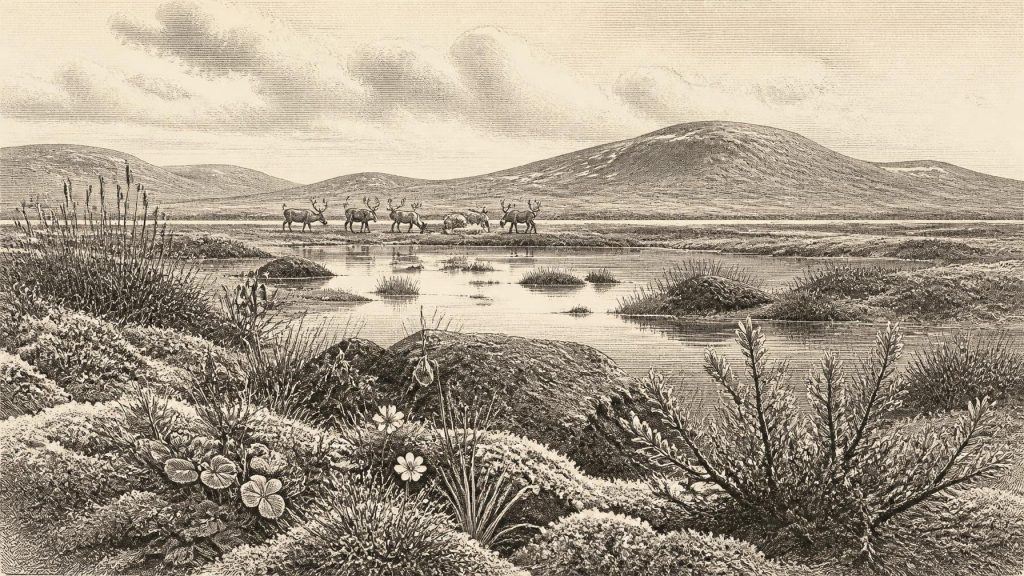
30,360 BCE is a modern chronological estimate within the Late Pleistocene, not a recoverable Irish year. Derryvree, County Fermanagh, preserves freshwater organic deposits between glacial tills, dated broadly to about 34,950–29,750 BCE. Its flora, including bogbean and mountain avens, indicates open, wet tundra shaped by frost, thaw and nearby shifting ice. Ireland’s ice cover was regionally variable, with no national reconstruction for this date. Castlepook Cave fauna demonstrates cold-adapted animal communities, though accumulated remains are not contemporaneous. A cut-marked reindeer bone may indicate transient human activity, but permanent settlement remains unproven. It depicts Ice Age conditions rather than recorded events.
Dateline
The label 30,360 BCE is a modern chronological peg, not a year that can be recovered from Irish evidence. Nobody in Ireland recorded a calendar, a ruler, a battle or a journey at this date. The most responsible account therefore works with broad scientific ranges. In calibrated terms, 30,360 BCE is about 32,310 years before AD 1950, within the later part of the Late Pleistocene and Marine Isotope Stage 3. It falls inside the wide calibrated range associated with a remarkable freshwater deposit at Derryvree, near Maguiresbridge in County Fermanagh: roughly 36,900–31,700 calibrated years before present, or about 34,950–29,750 BCE. That range is far too broad to identify a particular season or event, but it can illuminate a changing Ice Age landscape.
A Wetland Under the Drumlin
Derryvree is the best starting point because its evidence is local, stratified and unusually revealing. Road works in 1969 cut through a drumlin, exposing two separate sheets of glacial till with fine sands, silts and organic freshwater deposits between them. Till is the unsorted rubble left by glacier ice; the layers at Derryvree show that ice had occupied the locality, that an interval of open ground and freshwater followed, and that later glacial activity buried the record again. The site does not demonstrate that the whole island was ice-free at one moment, still less that conditions remained constant for thousands of years. It does show that this part of Fermanagh supported water, sedimentation and life during an interval bracketed by glacial episodes.
The radiocarbon determination from the organic deposit, BIRM-166, was reported as 30,500 radiocarbon years before present, with a substantial uncertainty of plus 1,170 and minus 1,030 years. Radiocarbon years are not identical to calendar years, because the amount of radiocarbon in the atmosphere has varied. Calibration converts a laboratory measurement into a probability range, rather than supplying a precise anniversary. Consequently, 30,360 BCE should be understood as lying within Derryvree’s broad chronological window, not as the date on which its plants grew or its waters stood at a particular level. This distinction is essential: the evidence is strong for a cold freshwater environment; year-by-year reconstruction is impossible.
Open Tundra, Not Ancient Woodland
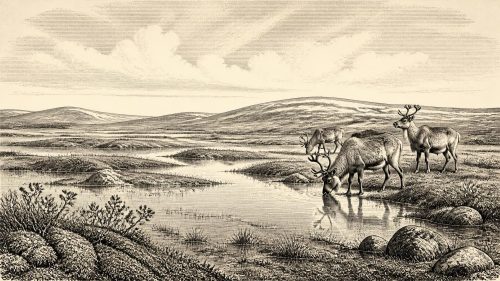
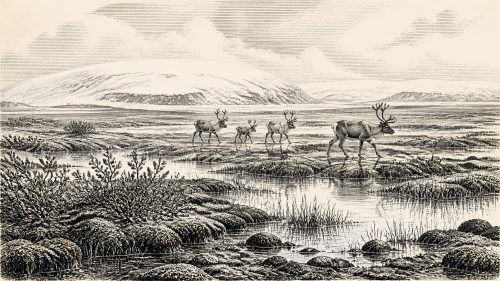
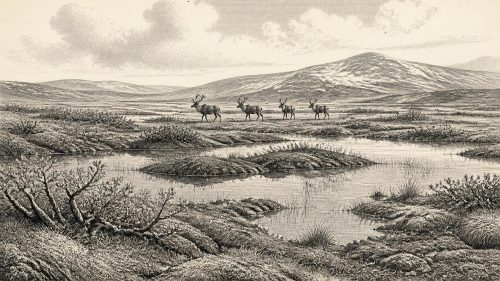
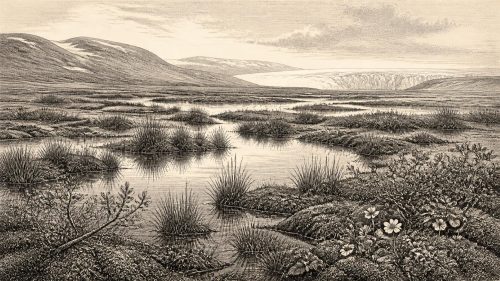
The Derryvree plant and animal remains point to open tundra and a periglacial regime. Periglacial does not mean permanently glaciated. It describes a cold landscape strongly shaped by frost, seasonal thaw, sparse vegetation and ground processes associated with nearby or recurring ice. Rather than later Irish oak woods, fields, hedges and peat bogs, the Fermanagh evidence evokes low, wet ground among sedges, mosses and cold-adapted herbs. Fossil finds reported from the deposit include bogbean or threeleaf (Menyanthes trifoliata) and mountain avens (Dryas octopetala), species that indicate wet margins and open, cold conditions. Dwarf willow, juniper and other hardy plants may have formed scattered cover in sheltered places, but this was not a densely wooded country.
Water mattered greatly in such a terrain. Freshwater silts and fine sands record slow-moving or shallow water, changing margins and sediment washed from the surrounding ground. Summer could have brought a short productive season: plants flowered, insects bred, animals grazed and thawed surfaces became soft or unstable. Winter brought a far harder world of frost, snow, reduced forage and frozen ground. Yet a tundra wetland should not be imagined as lifeless. It was a small ecological refuge, offering vegetation and water to herbivores and, indirectly, opportunities to carnivores and perhaps people. Derryvree makes visible the kind of habitat usually erased when later ice grinds, transports or buries earlier landscapes.
Ice in Motion
The wider setting was the growth and reorganisation of the British–Irish Ice Sheet, not the settled climax of the Last Glacial Maximum. Modern reconstructions show that the ice sheet’s advance and retreat were asynchronous between regions. Its maximum volume and broadest extent came later, while evidence for earlier phases of glaciation and fluctuating margins remains difficult to reconcile site by site. Around the early thirties of millennia before present, the north-west European world was climatically unstable. Ice could expand rapidly in one sector while an exposed basin elsewhere preserved freshwater deposits. Ireland was therefore neither simply “covered in ice” nor simply ice-free: it was a patchwork whose local conditions changed across considerable distances and over many generations.
This uncertainty affects every map of Ireland at 30,360 BCE. Derryvree proves an ice-free freshwater interval at one Fermanagh locality, while its enclosing tills prove glacial occupation before and after. Geological evidence from southern Ireland and the seas around the island indicates that ice-sheet growth had already begun during the wider last cold stage, and that the system remained dynamic before the later Last Glacial Maximum. It would be misleading to draw a crisp national ice margin for this one notional year. The safer conclusion is that Ireland’s physical geography was being repeatedly remade by ice, meltwater, frost and changing sea level.
Animals at the Atlantic Edge
Cave deposits offer a complementary, though more complicated, view. Castlepook Cave, near Doneraile in north County Cork, has produced one of Ireland’s richest collections of Pleistocene animal remains. Its fauna includes reindeer, woolly mammoth, giant deer, brown bear, wolf, Arctic fox, mountain hare, lemmings and spotted hyaena. Together these animals show that, during parts of the Late Pleistocene, Ireland lay within a wider north-west European network of open-country and cold-adapted habitats. Reindeer are especially apt for the Derryvree world: herd animals able to exploit tundra forage and an important potential resource for mobile hunters.
But Castlepook is not a photograph of a single day. Cave assemblages can accumulate through animal denning, carnivore scavenging, water movement, collapse, excavation disturbance and the repeated use of nearby landscapes over long periods. Mammoth, hyaena and reindeer bones found in one cave collection need not mean that all stood in the same Cork valley at the same time. The evidence supports a changing Ice Age fauna, not a fixed parade of creatures across every part of Ireland in 30,360 BCE. It also cautions against treating a cave as a human home merely because it contains bones.
The Castlepook Human Question
The most important possible human evidence relevant to this era is a reindeer femur from Castlepook. The bone has been publicly associated with an age of about 31,000 BCE and bears a deep mark interpreted by palaeozoologist Ruth Carden as damage made by a sharp stone tool during carcass processing. If that interpretation is confirmed, it would indicate that people reached Ireland during the broader Late Pleistocene interval represented by this article, far earlier than the substantial Mesolithic archaeological record. It would show a brief, practical act: cutting into fresh animal bone while processing a carcass.
Its limits are as important as its promise. The marked femur is not a settlement, hearth, dwelling floor, stone-tool assemblage, burial or artwork. Nor does it identify a language, ethnicity, named group or continuous population. No securely associated occupation surface has yet supplied the wider context needed to describe a permanent Irish Palaeolithic community. Renewed excavation at Castlepook has sought undisturbed deposits, faunal material and clearer archaeological evidence precisely because the old cave collections are so valuable yet difficult to interpret. The cautious historical conclusion is that short-lived visits by highly mobile people are possible, and perhaps represented by the bone, but enduring habitation at this date remains unproven.
Society Beyond the Evidence
There were no demonstrable political affairs, diplomatic relations, kingdoms or wars in Ireland that can be assigned to 30,360 BCE. Nor is there evidence for agriculture, villages, long-distance trade in goods, formal religious monuments, literacy or institutions of learning. A possible hunting party need not have been politically organised beyond immediate kinship and cooperation, and even that is inference rather than direct observation. If people were present, their economy would most plausibly have centred on mobility, animal resources, knowledge of seasonal terrain and the efficient use of portable tools. Such a party may have travelled through Ireland’s changing coastal and upland approaches rather than lived there year-round, but the route cannot yet be reconstructed.
Sea level was lower than today and the outlines of the surrounding seas differed markedly, but lower water does not automatically establish an easy, continuous land route from Britain into Ireland. Geological modelling has long treated the supposed Irish land-bridge with caution, while newer work shows that ice, changing relative sea level and exposed shelves made connectivity variable and geographically complex. For animals and any human visitors, movement to Ireland was possible only through landscapes and seaways whose precise form changed with climate and ice. “Island” in the modern sense is therefore an imperfect guide to the opportunities and barriers of this Ice Age world.
What This Date Can Mean
For Ireland, 30,360 BCE is best represented not by a named event but by Derryvree’s buried wetland: sedges and cold-water plants growing between episodes of glaciation, with open tundra beyond. Castlepook adds the possibility that people occasionally entered this wider animal-rich landscape and processed game. These are slender fragments, but they are historically profound. They place Ireland within the environmental and biological world of Ice Age north-west Europe, while reminding us that the island’s earliest human story is still being discovered rather than securely narrated.
Primary Sources
- Middle Midlandian Freshwater Series at Derryvree, Maguiresbridge, County Fermanagh, Northern Ireland
- Middle Midlandian Freshwater Series at Derryvree, Maguiresbridge, County Fermanagh, Northern Ireland
- The Timing and Magnitude of the British–Irish Ice Sheet Between Marine Isotope Stages 5d and 2
- Growth and Retreat of the Last British–Irish Ice Sheet, 31,000 to 15,000 Years Ago: The BRITICE-CHRONO Reconstruction
- Pattern and Timing of Retreat of the Last British-Irish Ice Sheet
- Timing and Pace of Ice-Sheet Withdrawal Across the Marine–Terrestrial Transition West of Ireland During the Last Glaciation
- Trimlines, Blockfields and the Vertical Extent of the Last Ice Sheet in Southern Ireland
- Radiocarbon Constraints on the Age of the Maximum Advance of the British–Irish Ice Sheet in the Celtic Sea
- Exploring the Controls on the Early and Stepped Deglaciation of the Western Margin of the Last British-Irish Ice Sheet
- Figure 6: The Subdivision of the Quaternary Period in Ireland
- Palaeoecology
- The Island of Ireland: Drowning the Myth of an Irish Land-Bridge?
- The Problem of a Late Quaternary Landbridge Between Britain and Ireland
- Heritage Artefacts of County Cork
- 2022:564 – Castlepook Cave, Castlepook South, Cork
- Archaeology Research Excavation Grant 2022: Final Reports
- Ireland’s Palaeolithic Archaeology: Fleeting Footprints in a Frozen Land
- Sedimentary Ancient DNA Reveals Late Pleistocene Faunal Connectivity Between Ireland and Eurasia
- New Insights on the Fauna of Ireland's Younger Dryas and Early Holocene From Alice and Gwendoline Cave
- The Irish Quaternary Fauna Project
- Timing and Pace of Ice Sheet Retreat: An Introduction to the BRITICE-CHRONO Transect Reconstructions of the British–Irish Ice Sheet