A Reindeer Femur in Cork30362 BCE
30,362 BCE is a modern label rather than a recoverable Irish historical year. During Marine Isotope Stage 3, Ireland experienced unstable cold conditions before the Last Glacial Maximum, with regional variations in ice cover, vegetation and access. At Derryvree, Fermanagh, freshwater sediments between tills indicate an ice-free interval supporting treeless wetland plants, insects and shallow pools. Castlepook Cave, Cork, preserves Late Pleistocene fauna including reindeer and mammals, though deposits are imperfectly dated and mixed. A cut-marked reindeer femur may indicate brief human carcass processing, but cannot establish settlement or society. Evidence chiefly records changing environments, animals and possible human activity.
Dateline
A Date Without an Event
30,362 BCE is a modern chronological label, not a recoverable year in Irish history. No written calendar, named community, settlement sequence or dated action allows historians to identify what happened in Ireland in that particular year. In simple calendar arithmetic it lies roughly 32,311 years before AD 1950, the conventional “present” used in radiocarbon reporting. That does not convert it into a radiocarbon age: radiocarbon years and calendar years diverge, and calibration at this depth carries substantial ranges. The responsible setting is therefore the later part of the Late Pleistocene, within Marine Isotope Stage 3, rather than a supposed annual annal of Ice Age Ireland.
Evidence relevant to this point is rare, local and often inherited from excavations undertaken long before modern standards of stratigraphic recording and laboratory dating. It consists chiefly of sediments trapped beneath later glacial deposits, fossil plants and insects, cave fauna, and one disputed-looking but potentially momentous modification to a reindeer bone. These sources can illuminate changing environments and animal life; they cannot yield an Irish kingdom, tribe, religion, trading system or settled population.
Cold, Unstable North Atlantic Conditions
This was an Ice Age world, but not simply an island hidden continuously beneath an unchanging ice cap. Marine Isotope Stage 3, conventionally dated to about 57,000–29,000 years ago, was marked by abrupt climatic swings recorded especially clearly in Greenland ice cores and North Atlantic sediments. Conditions in Ireland were shaped by that volatile Atlantic setting: cold phases, brief ameliorations and changes in the extent of ice, vegetation and available habitat occurred on timescales far longer than a single calendar year but sometimes surprisingly quickly in geological terms.
The fullest expansion of the last British–Irish Ice Sheet lay later, during the Last Glacial Maximum, conventionally placed around 26,500–19,000 years ago. It would eventually cover much of Ireland and radically reshape the land. Around the modern date used here, however, the island’s ice cover and its regional limits remain difficult to reconstruct. The safest conclusion is not that all Ireland was either open or glaciated, but that conditions varied by region and through time. Later ice repeatedly eroded, buried and rearranged older deposits, leaving an incomplete record of the landscapes that preceded it.
Freshwater Beneath Later Ice
The most informative Irish environmental evidence comes from a road-cut through a drumlin at Derryvree, near Maguiresbridge in County Fermanagh. There, researchers found organic freshwater silts and fine sands sandwiched between two thick deposits of till. Till is the unsorted debris left directly by glacier ice. The sequence therefore demonstrates an important order of events: ice occupied the locality, an ice-free interval followed in which freshwater sediment and organic material accumulated, and ice later returned.
A conventional radiocarbon determination from the organic deposit, BIRM-166, was reported as 30,500 ± 1,100 radiocarbon years before present. Published attempts to express this as calendar age place it broadly in approximately the 36,900–31,700 calibrated-years-before-present range, depending on the calibration treatment used. This is a broad interval, not an annual timestamp, but it overlaps the general chronological setting of 30,362 BCE. The deposit is therefore valuable evidence for a phase of ice-free ground in north-central Ireland, not proof that its freshwater basin existed in that exact numbered year or that the whole island looked the same.
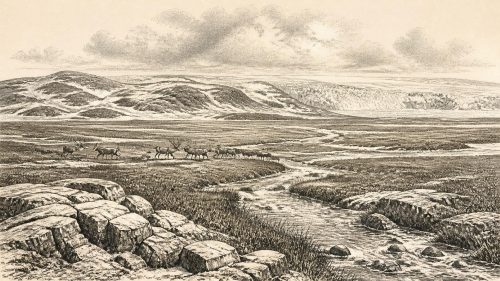
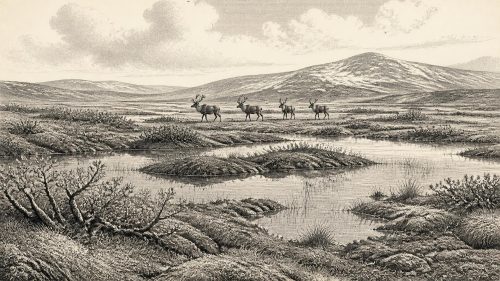
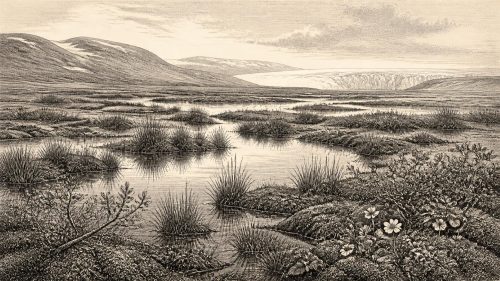
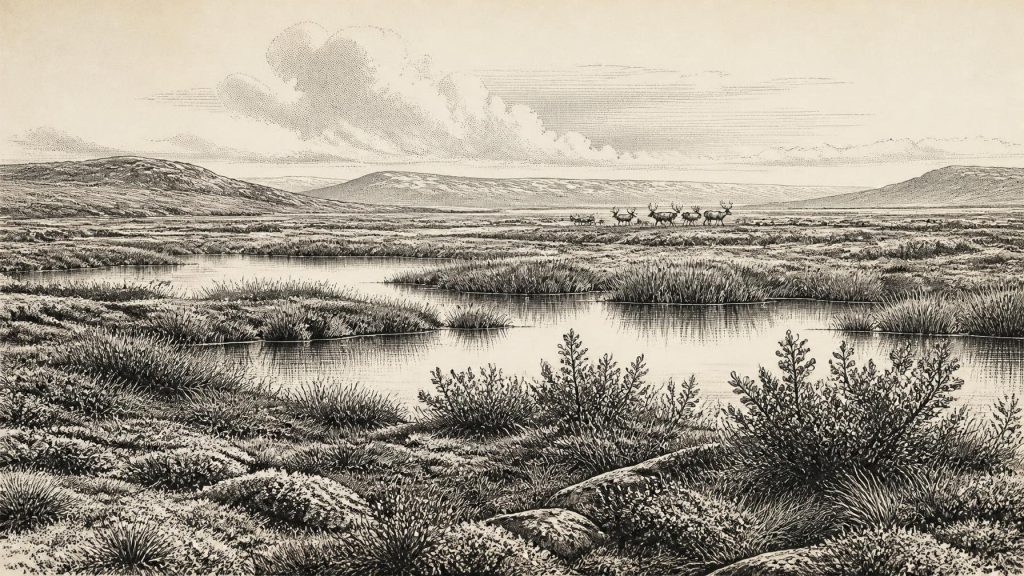
Plant macrofossils, mosses, pollen and insects from the deposit point to an open, treeless and severe environment. Grasses, sedges, herbs, dwarf willow, juniper and cold-tolerant plants occurred around wet ground. Fossil buckbean and water-milfoil indicate freshwater in or near pools, while the mosses and insect remains support a plant-rich wetland or muskeg rather than a dry, bare polar desert. This was a short-growing-season world of waterlogged hollows, exposed ground and low vegetation. It was not woodland, farmland or the green pasture familiar from later Irish landscapes.
What the Landscape Could Support
The Derryvree evidence permits a careful reconstruction of habitat rather than a scenic certainty. A low basin with sedgy margins and shallow water may have been surrounded by open tundra-like vegetation, with patches differing according to drainage, snow cover, soil and exposure. Winter cold was plainly important, yet summer thaw allowed plants, insects and freshwater communities to function. Such local refuges mattered because they supplied forage and water in a broader cold landscape. The record also cautions against imagining Ireland as environmentally uniform: a fossil assemblage from one buried basin is not a complete national map.
Across the island, the terrain inherited from earlier glaciations was being altered by frost, meltwater, sediment movement and later advances of ice. Valleys and low ground could collect water and organic sediment; higher or exposed places may have supported only sparse cover. Lower sea levels altered coastlines and shelf landscapes, but the precise geography of potential movement routes changed through time and cannot be confidently reduced to a simple land bridge connecting every part of Ireland with Britain or continental Europe. For people and animals alike, access depended on a changing combination of sea, ice, terrain and climate.
Animals in a Changing Island
Cave deposits, above all at Castlepook Cave near Doneraile in north Cork, preserve the clearest indication that a striking large-mammal fauna reached Ireland during parts of the Late Pleistocene. Assemblages attributed broadly to this era have included reindeer, woolly mammoth, giant deer, wolf, fox, Arctic fox, bear and spotted hyaena. Such lists should not be read as an exact inventory for 30,362 BCE. The bones accumulated over long periods, some were collected in early twentieth-century excavations, and the old cave deposits do not always preserve secure associations between individual specimens and layers.
Nevertheless, they show that Ireland was not biologically empty throughout the pre-maximum cold stages. Reindeer suited open, cold country; mammoth and giant deer evoke a landscape capable, at least intermittently, of sustaining substantial herbivores; and hyaenas and wolves indicate predators and scavengers within the food web. Cave bone assemblages are also records of accumulation, not merely of living animals. Carnivores could bring prey remains into shelters, water could move material, and bones may have been mixed by excavation. Castlepook is thus an exceptional window, but not a ready-made picture of a single herd grazing outside one cave at one moment.
The Mark on the Reindeer Bone
Castlepook matters especially because a reindeer femur from the cave’s historic collection has been described as bearing a deep mark interpreted by palaeozoologist Ruth Carden as damage made by a sharp stone implement during carcass processing. County Cork’s heritage publication has associated the specimen with about 31,000 BCE. If the mark was made by a person on fresh bone, it would be compelling evidence of human handling of a reindeer in Ireland tens of millennia before the island’s much better-attested terminal Pleistocene and Mesolithic occupations.
That possibility must be stated with its limits. The bone’s date concerns the death of the animal, not necessarily the exact moment any incision was made. Nor is the specimen part of a newly excavated, sealed camp floor accompanied by a stone-tool assemblage, hearth, shelter, human remains, repeated butchered animals or a cemetery. Recent work has also stressed that improved pretreatment and redating have changed the chronology of some Irish cave faunas. The femur is therefore evidence for a specific proposed act of butchery, not secure proof of permanent settlement, a named Upper Palaeolithic culture or continuous occupation.
People Without a Recoverable Society
If people did reach Ireland in this period, the available evidence is compatible with a brief visit by mobile hunter-gatherers rather than an identifiable resident community. Reindeer could have provided meat, fat, hide, sinew and bone, making a carcass worth processing even during a short stop. Yet that is an interpretation based on the ecology of hunter-gathering and the apparent cut mark, not a direct description of an Irish household. Archaeology cannot presently establish how many people came, where they travelled from, whether they crossed water, how long they stayed, or whether they returned.
Accordingly, political affairs, diplomacy and organised conflict are beyond the evidence. There are no known leaders, territorial boundaries, weapons caches, fortified places or inter-group exchanges attributable to this date in Ireland. There is likewise no direct evidence for trade, ritual, art, language, formal learning or burial practice. Absence of evidence is not evidence that Ice Age people lacked culture; it means that Ireland has not yet yielded material allowing those aspects of life to be described responsibly for this phase.
An Archive of Fragments
The central historical development around 30,362 BCE is therefore environmental and evidential. Ireland lay in a cold, rapidly changing North Atlantic zone before the later maximum growth of the last ice sheet. In Fermanagh, a buried freshwater wetland records an interval when plants, insects and shallow-water communities lived between separate episodes of glaciation. In Cork, cave bones demonstrate that large mammals entered Ireland during the Late Pleistocene, while one reindeer femur raises the serious but still limited possibility of very early human activity.
This is not yet a history of towns, monuments or dynasties. It is a history reconstructed from silt, moss, insect fragments, animal bone and ice-laid debris. Its uncertainties are part of its value: they distinguish what Irish evidence demonstrates from what later imagination might wish to supply. Around this modernly numbered year, Ireland was a changing cold landscape whose surviving traces preserve the conditions for life—and perhaps a fleeting human encounter with it—rather than a year-specific event.
Primary Sources
- A reconsideration of the radiocarbon dating of the Marine Isotope Stage 3 fauna from southern Ireland
- The Irish Quaternary Fauna Project
- Trimlines, blockfields and the vertical extent of the last ice sheet in southern Ireland
- Exploring the glacial history of the Celtic Sea sector of the British-Irish Ice Sheet
- Pattern and timing of retreat of the last British-Irish Ice Sheet
- Radiocarbon constraints on the age of the maximum advance of the British–Irish Ice Sheet in the Celtic Sea
- Character of advance and retreat of the southwest sector of the British-Irish Ice Sheet during the last glaciation
- New insights on the fauna of Ireland’s Younger Dryas and Early Holocene from Alice & Gwendoline Cave
- Heritage Artefacts of County Cork
- Castlepook Cave, Co. Cork, 2022 excavation report
- Our Ancient Landscapes: Hunter-Gatherers in Ireland
- Menyanthes trifoliata: Bogbean in Fermanagh
- NOAA/WDS Paleoclimatology: North GRIP MIS 3 methane, nitrogen isotope and temperature data
- Rapid global ocean-atmosphere response to Southern Ocean freshening during the last glacial
- Independent tephrochronological evidence for rapid and synchronous oceanic and atmospheric temperature rises over Greenland stadial-interstadial transitions between c. 32 and 40 ka b2k
- Pleistocene Vertebrates in the British Isles
- Proceedings of the Postglacial Colonization Conference
- Irish Quaternary Association
- BRITICE-CHRONO: Introduction
- Landscapes and environments of the last glacial-interglacial transition: a time of amazingly rapid change in Ireland
- The glacial stratigraphy of the Sperrin Mountains and its relation to the glacial stratigraphy of north-west Ireland
- Pleistocene vertebrate occurrence at Castlepook Cave