Castlepook Fresh Bone Incision30378 BCE
Around 30,378 BCE, Ireland lay within the volatile Late Pleistocene MIS 3, although no precise calendar dating or historical record is possible. At Derryvree, County Fermanagh, organic sediments between glacial tills document a locally ice-free, treeless wetland of pools, sedges, mosses, dwarf willow and tundra plants. Castlepook Cave, County Cork, preserved remains of reindeer and other cold-adapted mammals, but its fauna accumulated over long periods and cannot represent one moment. A cut-marked reindeer femur, perhaps around 31,000 BCE, may indicate human butchery, not settlement. Subsequent ice advances reshaped Ireland and obscured earlier evidence, leaving only fragmentary ecological and archaeological traces.
Dateline
Modern calendar-year precision is not available for Ireland at this depth of time. “30,378 BCE” is a useful modern label—equivalent to about 32,327 years before AD 1950—but it does not identify a witnessed Irish year, season, ruler or event. No written record, settlement sequence or securely dated human occupation can be fixed to it. The responsible setting is the Late Pleistocene, within Marine Isotope Stage 3 (MIS 3), an unstable phase of the last Ice Age before the fullest growth of the British–Irish Ice Sheet. The evidence is sparse, local and often preserved only because later ice buried it.
A Date Within Broad Ranges
The closest chronological anchor is Derryvree near Maguiresbridge, County Fermanagh. Roadworks exposed a remarkable sequence inside a drumlin: an older glacial till, freshwater sands and organic silts, then a later till. The organic deposit produced the conventional radiocarbon determination BIRM-166, 30,500 ± 1,100 radiocarbon years before present. Radiocarbon years are not calendar years; calibration produces a wide range. Published discussions place the deposit broadly between about 36,900 and 31,700 calibrated years before present, or approximately 34,950–29,750 BCE.
The numbered year considered here lies within that broad calibrated interval, but that does not mean the Derryvree sediments formed in 30,378 BCE exactly. The sample represents organic material accumulated in a changing wetland, and the uncertainty is measured in millennia. Its real importance is stratigraphic. It demonstrates that, after one episode of ice occupation and before another, this part of Fermanagh held open water, sediment and life. It is evidence for an ice-free or at least locally ice-free landscape at some point in the wider interval, not a map of conditions across every part of Ireland at one instant.
Water and Tundra at Derryvree
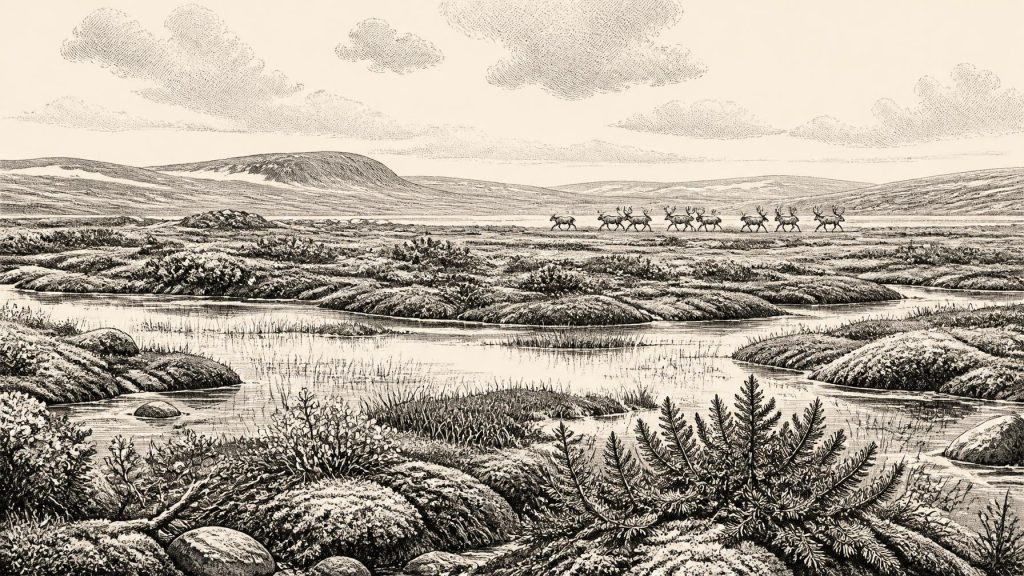
Derryvree offers the most vivid environmental picture available for this broad period. Plant macrofossils, pollen and moss remains indicate a treeless, cold-climate setting sometimes described as tundra or muskeg: wet, peaty ground with pools, sedges, mosses and low-growing herbaceous vegetation. Fossil evidence includes bogbean (Menyanthes trifoliata), water-milfoil, dwarf willow, juniper and mountain avens. These were not signs of a woodland recovering after winter, but of a landscape whose short growing season and severe climate prevented forest from taking hold.
This does not make Fermanagh a simple frozen desert. Freshwater vegetation requires open water during at least part of the year, while mosses and sedges point to saturated ground around pools and shallow channels. The landscape may have combined exposed mineral soils, patches of grass and herb tundra, low scrub and wet hollows. Snow, seasonal frost, strong winds and repeated thawing would have shaped the terrain. Such local diversity mattered: wet margins could support plants and invertebrates even where the wider countryside was cold, treeless and difficult to cross.
Yet Derryvree should not be made to speak for the whole island. It is a small fossil window, later sealed beneath glacial debris. Other Irish sites record different phases and different degrees of cold. The succession at Derryvree nevertheless captures a central fact of Irish prehistory at this time: the island’s environment was repeatedly transformed by shifts in ice, water and climate, leaving only discontinuous fragments from which to reconstruct the past.
The Cork Cave Fauna
County Cork provides a second, very different archive. Castlepook Cave near Doneraile—historically called Mammoth Cave—yielded a rich but complicated collection of Late Pleistocene animal remains. Reindeer are especially prominent, alongside woolly mammoth, giant deer, brown bear, wolf, Arctic fox, mountain hare, lemmings and spotted hyaena. The assemblage confirms that Ireland, or parts of it, could support a strikingly continental and cold-adapted animal community during MIS 3.
Cave bones do not form a straightforward census of a living landscape. Carnivores carried prey into caves; animals died at different times; water and excavation disturbed deposits; and older collections were not recovered to present archaeological standards. Modern redating has shown that several Castlepook bones are substantially older than earlier determinations suggested. Research indicates that giant deer and spotted hyaena may have disappeared locally around 40,000 calibrated years ago, well before the later Last Glacial Maximum. Therefore, the full list of animals from the cave cannot responsibly be placed together in 30,378 BCE.
Reindeer remain particularly relevant. Their presence fits the open, cold habitats indicated by Derryvree, where grazing and browsing animals could have moved through a mosaic of tundra, wetland and sparse shrub vegetation. Wolves and hyaenas were predators and scavengers within that wider food web; caves may have been their dens or feeding places rather than human homes. Mammoth and giant deer are powerful images of Ice Age Ireland, but their fossils illuminate long spans of time, not an annual scene.
The Reindeer Femur
A reindeer femur from Castlepook has made this period important for the human history of Ireland. Re-examination identified a deep incision interpreted as a cut made on fresh bone with a sharp stone tool during butchery. The bone has been presented as dating to around 31,000 BCE. If that interpretation is sustained, it is potentially Ireland’s earliest known evidence that people handled an animal, pushing the island’s human story far beyond the previously accepted terminal-Pleistocene evidence.
The limits of the find are as significant as its promise. One marked bone is not a settlement. No securely associated hearth, stone-tool assemblage, dwelling floor, burial, repeated butchery area or food store has yet demonstrated a resident community at Castlepook. Nor can the age of the bone establish the precise moment at which the cut was made. The safest conclusion is modest: people may have reached Ireland, perhaps briefly, during this broad pre-maximum Ice Age world. Whether they arrived on a hunting foray, crossed seasonally, or were part of any enduring population cannot presently be shown.
No Politics, But Possible Passage
There is no evidence from which to reconstruct political affairs, diplomacy, named groups, language, kinship systems or religious beliefs in Ireland at this date. It would be misleading to invent chiefs, tribal territories, alliances or rituals. If people did visit, their lives would have depended on skills common among Upper Palaeolithic hunter-gatherers elsewhere in north-west Europe: knowledge of animal movement, stone-working, clothing, fire and shelter. But those are informed comparisons, not excavated facts about an Irish camp.
Likewise, there is no demonstrable Irish economy or trade network. The surviving evidence gives no basis for claiming exchange, seafaring, mining, farming or permanent settlement. Ireland’s changing relationship with Britain and the European mainland is nevertheless relevant. Lower global sea levels exposed broad areas of the present seabed during glacial times, but changing ice, sea level, rivers and marine channels made routes highly variable. A lower sea is not, by itself, proof of a simple walkable land bridge or of routine movement. For any humans or animals, passage depended on the particular geography and climate of the moment.
Approaching the Great Ice Advance
At 30,378 BCE, the fullest Last Glacial Maximum still lay ahead. Later research places the major maximum of the British–Irish Ice Sheet broadly around 26,000–20,000 years ago, with regional variation and continuing debate over the extent and thickness of Irish ice. The later ice advance dramatically reshaped the island, eroding surfaces, depositing till, forming drumlins and masking much of the earlier archaeological record. That destructive power helps explain why the evidence for this earlier world is so slight.
The most accurate portrait is therefore one of thresholds rather than certainties. In Fermanagh, freshwater sediments preserve a cold, open wetland interval between advances of ice. In Cork, cave deposits show that reindeer and other large mammals occupied Ireland over the wider MIS 3 period, while a single marked bone raises the possibility of human butchery. These are exceptional survivals from a changing Ice Age landscape. They do not reveal an Irish society in the historical sense, but they show that the island’s deeper past was ecologically alive, climatically volatile and perhaps already touched by human travellers.
Primary Sources
- Exploring controls of the early and stepped deglaciation on the western margin of the British-Irish Ice Sheet
- A reconsideration of the radiocarbon dating of the Marine Isotope Stage 3 fauna from southern Ireland
- The Irish Quaternary Fauna Project
- Pleistocene glaciations in Ireland
- Growth and retreat of the last British–Irish Ice Sheet, 31,000 to 15,000 years ago: the BRITICE-CHRONO reconstruction
- Pattern and timing of retreat of the last British-Irish Ice Sheet
- Last Glacial Maximum cirque glaciation in Ireland and implications for reconstructions of the Irish Ice Sheet
- Late Pleistocene chronostratigraphy and ice sheet limits, southern Ireland
- Stratigraphic and palaeo-geomorphological evidence for the glacial-deglacial history of the last British-Irish Ice Sheet in the north-western Irish Sea
- Deglaciation chronology of the Donegal Ice Centre, north-west Ireland
- Episodic speleothem deposition tracks the terrestrial impact of millennial-scale climatic variability in the last glacial period
- Figure 6.— The subdivision of the Quaternary Period in Ireland
- The exploration of Castlepook Cave, County Cork
- Occurrence of mammalia relicts at site Castlepook Cave
- Archaeological Heritage of County Cork
- Heritage Artefacts of County Cork
- Castlepook Cave, Co. Cork, 2022
- Guide to the National Museum of Ireland
- The Island of Ireland: Drowning the Myth of an Irish Land-Bridge?
- A review of the timing of Mid-Devensian ice-sheet build-up in the British Isles