The Irish Sea Ice Margin30381 BCE
Around 30,381 BCE, Ireland lay within the unstable cold conditions of Marine Isotope Stage 3, not a securely dated historical year. Derryvree, County Fermanagh, preserves freshwater sediments between glacial tills, indicating temporary ice-free wetlands with tundra vegetation before renewed ice advance. Castlepook Cave, County Cork, yielded remains of reindeer, mammoth, giant deer, predators and other cold-adapted animals, demonstrating changing open habitats. A possibly cut-marked reindeer bone may indicate brief Upper Palaeolithic human activity, but its interpretation and context remain uncertain. No settlement, society or continuous occupation is established. Glaciation later erased or buried much evidence, leaving an environmentally dynamic frontier.

Dateline
“30,381 BCE” is a modern chronological label, not a date that can be recovered from an Irish settlement, grave, document or annual record. In archaeological terms it corresponds very approximately to 32,330 calendar years before present, conventionally measured from 1950. At this depth of time, that apparent precision is misleading. No evidence permits historians to identify events, individuals or even a securely occupied Irish place in this particular calendar year. The responsible approach is to place it within the Middle Midlandian, or Marine Isotope Stage 3 (MIS 3), part of the last glacial cycle, and to use broad calibrated ranges rather than pretend that a single year can be observed.
A Date Within a Long Cold Stage
Ireland around this point lay in a climate system marked by abrupt shifts, expanding and contracting ice, and highly mobile habitats. It was not yet at the Last Glacial Maximum, the later phase when the British–Irish Ice Sheet reached its greatest known extent. Nor should it be imagined as a uniformly frozen island. The record instead suggests a changeable cold-stage landscape in which ice-free ground could exist in some places and at some times, while glaciers and ice sheets advanced elsewhere or later erased much of what had survived.
The calendar conversion itself needs care. Radiocarbon years are not calendar years: atmospheric carbon-14 varied through time, and dates must be calibrated against internationally maintained curves. A conventional radiocarbon determination from a deposit may therefore translate into a much older, broad and sometimes discontinuous calendar-age range. Around 30,381 BCE, margins of error are normally measured in centuries or millennia, not seasons or years. The best evidence is consequently environmental and stratigraphic: layers of sediment, fossil plants, animal bones, cave deposits and the physical traces of ice.
Water Between the Tills
The most informative Irish environmental archive broadly relevant to this era was exposed at Derryvree near Maguiresbridge, County Fermanagh. Road works in 1969 cut through a drumlin and revealed freshwater silts and fine sands lying between two thick tills: unsorted debris laid down directly by glacier ice. The sequence has unusual explanatory power. It shows that ice had occupied the locality, that an ice-free freshwater basin and wet margins subsequently developed, and that a later glacial advance buried and protected the deposits beneath another sheet of till.
Organic material from this middle layer produced the radiocarbon determination BIRM-166, reported as 30,500 radiocarbon years before present, with an uncertainty of roughly a millennium. Using modern calibration, it belongs broadly within a range spanning parts of the mid- to high-30,000s calendar years before present; published reconstructions commonly place its possible range at approximately 36,900–31,700 cal BP. The range encompasses the modern label 30,381 BCE, but this does not mean the Derryvree wetland can be dated to that exact year. It is evidence for an interval, not a diary entry.
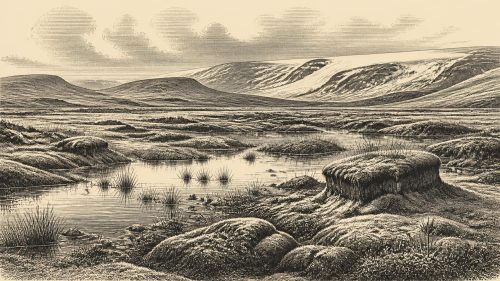
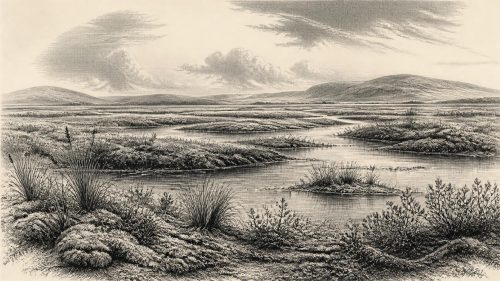
Within that interval, plant macrofossils and pollen indicate a cold, open freshwater environment. Mosses, sedges, grasses and clubmosses were accompanied by plants suited to northern or alpine conditions, including dwarf willow, mountain-avens, bogbean and water-milfoil. The combination matters. Water-milfoil and bogbean point to shallow or slow-moving fresh water and wet margins, while dwarf willow and mountain-avens signal exposed, treeless ground under severe climatic conditions. Derryvree was not a forested prehistoric Ireland awaiting farmers; it was part of a tundra-like mosaic of pools, marshy edges, mineral soils and sparse vegetation.
Animals on a Changing Peninsula
Southern Irish cave deposits add another, separate line of evidence. Castlepook Cave near Doneraile, County Cork, has produced remains attributed to a striking Ice Age fauna: reindeer, woolly mammoth, giant deer, brown bear, wolf, fox, Arctic fox, mountain hare, stoat, collared lemming, Norway lemming and spotted hyaena. Re-dating has shown that some Castlepook material belongs to MIS 3, though the cave’s deposits were excavated long ago, are complex, and cannot simply be treated as one undisturbed moment in time.
This fauna supports an image of Ireland as a place with open-country grazing and browsing opportunities, but also severe seasonality and formidable predators and scavengers. Reindeer and lemmings fit cold, open settings particularly well; hyaena remains show that large-carnivore ecology extended to Ireland during part of the period. Mammoth and giant deer remain especially evocative, yet they should not be made into fixtures of every valley or every decade. Their fossil presence demonstrates that populations reached Ireland during broad intervals, not that a mammoth herd stood at a known spot in 30,381 BCE.
How animals reached the land is an important but unresolved geographical question. Sea level was lower than today during the glacial cycle, and the outlines of the Irish Sea basin differed greatly from modern coasts. Yet the existence, timing and usefulness of any dry connection between Ireland and Britain are debated. Ice, water, exposed shelf and temporary coastal corridors all changed. It is safer to say that dispersal routes opened and closed with climate and sea level than to picture a permanent land bridge across which animals or people could reliably travel.
The Castlepook Human Question
The possibility of people in Ireland during this broad period rests principally on a reindeer femur from Castlepook. The bone has been presented as bearing a deep incision interpreted as a possible stone-tool cut mark, and it has been associated with an age of roughly 33,000 radiocarbon years. If microscopic and contextual work ultimately sustains that interpretation, it would indicate a brief episode of carcass processing by Upper Palaeolithic people far earlier than Ireland’s formerly accepted human record.
But the wording matters. The date is the age of the animal bone, not a directly dated cut mark; the cave collection has a difficult excavation history; and one modified fragment cannot establish a settlement, population size, route of arrival or continuous occupation. It cannot tell us a group’s language, kinship system, beliefs, names or political affiliations. Nor have securely associated hearths, stone-tool scatters, dwellings, burials, art or food-processing areas been identified in Ireland for this time. The Castlepook femur is important precisely because the evidence is so rare, not because it furnishes a complete Palaeolithic society.
By comparison, the better-established evidence for human action in Ireland comes much later: a cut-marked brown-bear kneecap from Alice and Gwendoline Cave, County Clare, dated to the terminal Pleistocene. That later discovery proves that mobile hunter-gatherers did visit Ireland near the end of the Ice Age. It does not retrospectively confirm a resident community around 30,381 BCE. The prudent conclusion is that human presence at the earlier date remains possible and potentially significant, but unproven beyond the narrow implication of the disputed Castlepook mark.
What Cannot Be Written
There are therefore no political affairs to narrate for Ireland at this date: no chiefs, territories, alliances, diplomacy or wars are documented. Equally, there is no basis for describing Irish religious rites, shrines, art styles, formal learning, trade partnerships or a settled economy. Such themes belong to human societies, and the Irish record has not demonstrated a society here from which they can responsibly be inferred. It would be tempting to import the rich art, ornament and hunting practices of Upper Palaeolithic France, Iberia or central Europe. That may offer comparison, but it is not evidence for Ireland.
If people did make a short visit, their immediate concerns were likely practical: movement through a cold landscape, shelter, fuel, water, clothing and the use of animal resources. That is an inference from wider Upper Palaeolithic lifeways, however, rather than a securely Irish observation. The same restraint applies to economy. Reindeer meat, hide, sinew, bone and antler were valuable resources in many contemporary European hunter-gatherer settings, but Castlepook’s single possible butchery trace cannot demonstrate a regular Irish hunting economy or exchange network.
An Unsettled Environmental Frontier
The decisive regional development was environmental instability. Derryvree preserves an episode when fresh water, wetland vegetation and open ground existed between ice advances. Subsequent ice covered much of Ireland more extensively, scouring surfaces, redepositing sediment and destroying or concealing many archaeological traces. This helps explain why Ireland’s deep Palaeolithic evidence is exceptionally thin. Absence of camps is not absolute proof that nobody ever came, but it does mean that continuous occupation cannot be claimed.
For this reason, 30,381 BCE belongs less to a narrative of Irish peoples than to the preconditions from which later Irish history eventually emerged: moving ice margins, intermittent habitable terrain, freshwater basins, cold-adapted plants and large mammals ranging through north-west Europe. At Derryvree, a short-lived wetland was sealed under glacier-laid debris; at Castlepook, cave deposits retained fragments of a vanished animal world. Together they offer a restrained but vivid picture of Ireland near this remote date: cold, open, ecologically active and profoundly changeable, with human activity a compelling question rather than an established chapter.
Primary Sources
- A Middle Midlandian Freshwater Series at Derryvree, Maguiresbridge, County Fermanagh, Northern Ireland
- Exploring Controls of the Early and Stepped Deglaciation on the Western Margin of the British Irish Ice Sheet
- A Reconsideration of the Radiocarbon Dating of the Marine Isotope Stage 3 Fauna from Southern Ireland
- The Irish Quaternary Fauna Project
- New Insights on the Fauna of Ireland's Younger Dryas and Early Holocene from Alice & Gwendoline Cave
- The Exploration of Castlepook Cave, Co. Cork. With 3 Plates.
- Pleistocene Vertebrates in the British Isles
- Occurrence of Mammalia Relicts at Site Castlepook Cave
- 32564: Castlepook Cave, Castlepook, Cork
- Mammoth Cave
- Late Pleistocene Chronostratigraphy and Ice Sheet Limits, Southern Ireland
- Pleistocene Glaciations in Ireland
- BRITICE Glacial Map, Version 2: A Map and GIS Database of Glacial Landforms of the Last British–Irish Ice Sheet
- Radiocarbon Constraints on the Age of the Maximum Advance of the British–Irish Ice Sheet in the Celtic Sea
- Early Deglaciation of the British-Irish Ice Sheet on the Atlantic Margin of Northwestern Ireland
- The IntCal20 Northern Hemisphere Radiocarbon Age Calibration Curve (0–55 cal kBP)
- IntCal Publications
- IntCal Data
- The Problem of a Late Quaternary Landbridge Between Britain and Ireland
- The Island of Ireland: Drowning the Myth of an Irish Land-Bridge?
- Irish Association for Quaternary Studies Guide 16: References and Recommended Reading
- Irish Association for Quaternary Studies Guide 13
- Our Ancient Landscapes: Hunter-Gatherers in Ireland
- Heritage Artefacts of County Cork