Derryvree’s Organic Interval30330 BCE
30,330 BCE is a modern label within a broad, uncertain Late Pleistocene range, not a recoverable Irish year. Derryvree, County Fermanagh, preserves freshwater organic deposits between glacial tills, indicating an ice-free interval with cold, treeless wetland, sedges, mosses, aquatic plants and insects before renewed ice cover. Elsewhere, evidence shows episodic, spatially variable glaciation as the British–Irish Ice Sheet expanded. Southern cave remains demonstrate a richer cold-stage fauna, including reindeer, mammoth, bear and hyaena, but cannot securely place species together. A possibly cut-marked reindeer bone from Castlepook suggests human activity, yet remains contested. No securely documented settlement or events are known.
Dateline
30,330 BCE is a modern calendar label, not a year that can be recovered from Ireland’s Late Pleistocene past. No written calendar, named community, individual life or event survives from this depth of time. The evidence is instead geological and biological: layers of sediment, fossils, pollen and plant remains, dated bones, cave deposits and the marks left by moving ice. These records can sometimes be related to broad calibrated ranges, but they cannot responsibly describe a particular Irish spring, hunt or political occurrence in a single numbered year.
The most useful framework is the Middle Midlandian, part of the last glacial cycle in Ireland and broadly within Marine Isotope Stage 3. Around the nominal date, the island lay in a climatically unstable northern Atlantic world. Cold phases, short-lived warmer intervals, changing sea levels and the growth of ice repeatedly altered its geography and ecology. Ireland was neither a timeless white wilderness nor a familiar green island: conditions varied greatly by place and over centuries and millennia.
A Date Within a Range
The closest substantial Irish environmental evidence comes from Derryvree townland near Maguiresbridge, County Fermanagh. Roadworks in 1969 cut through a drumlin and revealed a remarkable sequence. A lower glacial till, material deposited directly by ice, was separated from a later upper till by silts, fine sands and organic-rich freshwater deposits. The order of layers provides secure relative history: ice had occupied the site; an interval followed in which fresh water, sediment and vegetation accumulated; then ice returned and buried the deposit.
An organic sample from the Derryvree sequence, BIRM-166, produced a conventional radiocarbon age of about 30,500 radiocarbon years before present, with a large uncertainty. Radiocarbon years are not calendar years. When calibrated, the relevant range is commonly expressed as roughly 36,900–31,700 calibrated years before present, approximately 34,950–29,750 BCE. The nominal date of 30,330 BCE lies within that broad range. It cannot, however, be tied to one particular layer, plant, animal or episode at the site; the range is a statement of probability, not an annual chronology.
Nearby records reinforce the importance of Fermanagh without turning it into a complete picture of Ireland. Organic deposits at Greenagho, near Belcoo, and at other northern sites show that cold, ice-free or locally non-glacial environments existed at differing times between glacial advances. Such evidence establishes that ice cover was episodic and spatially varied. It does not prove that all regions were open, nor that a route through every part of Ireland was available at once.
Water Beneath the Drumlin
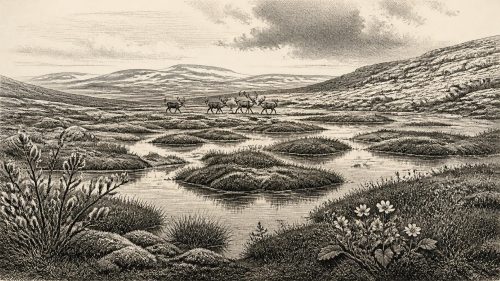
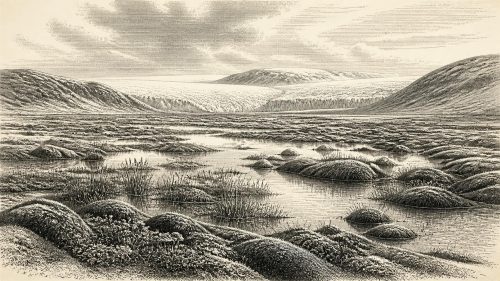
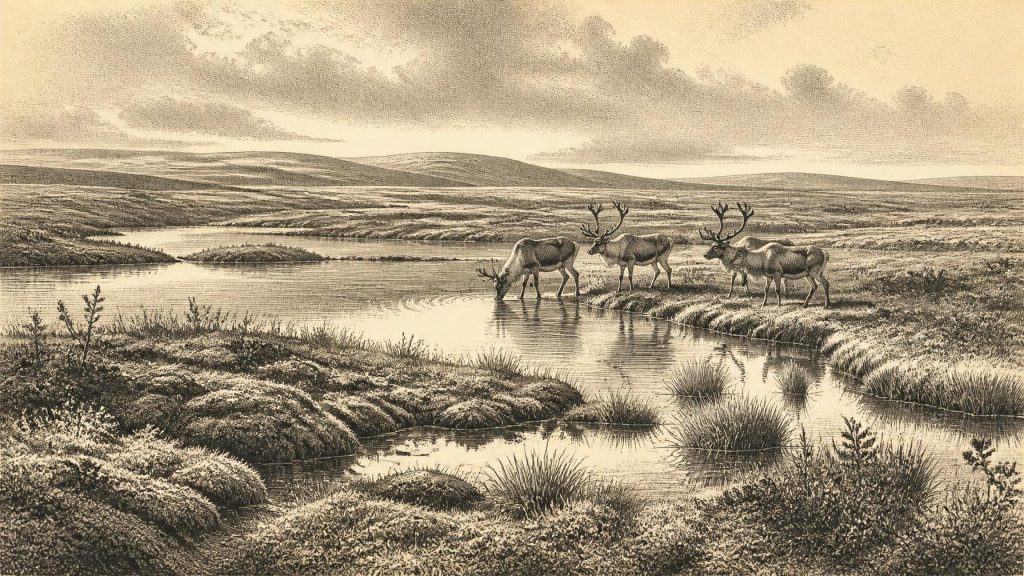
Derryvree’s freshwater bed offers a rare local view of a living cold-stage environment. Its plant and insect evidence points to open ground and wetland rather than closed forest. Mosses, sedges and aquatic plants grew in or beside standing or slow-moving water; the wider setting supported low vegetation adapted to exposure, severe winters and brief growing seasons. The landscape may be compared cautiously with tundra or muskeg, terms that convey cold, waterlogged ground and patchy plant cover, rather than a precise modern ecological equivalent.
That small wetland mattered. Pools and saturated margins concentrate life in landscapes where shelter, liquid water and summer growth are limited. They could support insects, plants, grazing animals and their predators. Yet the deposit is not a census of an entire island. Preservation favours organisms that lived near water and remains that entered the basin; absence from the sample is not proof that a species was absent from Ireland. The responsible reconstruction is therefore a mosaic: local freshwater and sedge-rich margins within a largely treeless, cold landscape whose extent changed with climate and ice.
At the scale of the island, the principal environmental development was the gathering strength of the last British–Irish Ice Sheet. Recent syntheses place major expansion of Irish and British ice after about 34,000 calibrated years before present, with the ice sheet’s greatest volume later, around 23,000 years before present. Around 30,330 BCE, the later full-glacial maximum still lay ahead. But it would be misleading to treat this as an uncomplicated prelude. Ice margins did not advance as a single wall, and local evidence records phases of ice-free ground, glacier growth and reorganisation.
Animals and Moving Landscapes
Caves in southern Ireland, particularly Castlepook Cave near Doneraile in County Cork, preserve another crucial but differently dated record. Reassessment of its animal remains has shown that some older radiocarbon determinations required revision, while confirming that the cave contains fauna from before as well as after the Last Glacial Maximum. The wider pre-maximum assemblage includes reindeer and other cold-stage mammals; Castlepook is also associated with such animals as spotted hyaena, brown bear and woolly mammoth in deposits or collections representing long spans of time.
These remains demonstrate that Ireland was reached by more mammal species during the Pleistocene than live there today. They do not establish that every recorded species shared the landscape in 30,330 BCE, or even that each cave bone was deposited in the same climatic phase. Cave collections often came from early excavations, disturbed deposits or material gathered without the standards now expected for stratigraphic recording. Direct dating and renewed excavation are improving the chronology, but the value of the evidence lies partly in showing its limitations.
Reindeer are especially evocative because they suggest open, cold terrain and mobile herds, but they should not be made to carry a detailed story of migration or seasonality in Ireland. The island’s lowered sea level and changing coasts altered access from Britain and continental Europe, while ice, water and sea ice may variously have obstructed or enabled movement. Precisely how individual herds arrived is unresolved. Animal dispersal need not have followed a single permanent land bridge, and conditions suitable for one species may not have suited another.
The Human Question
The most debated indication of people in Ireland at this remote time is a reindeer femur from Castlepook. Zooarchaeologist Ruth Carden has interpreted a deep linear mark upon it as damage made by a sharp stone implement while a fresh carcass was being processed. Public heritage material has associated the specimen with an age of roughly 31,000 BCE, making it relevant to the broad period considered here. If that interpretation and association are ultimately sustained, the bone would indicate human activity in Ireland far earlier than the island’s securely documented post-glacial settlement record.
It would still not prove an established population. There is no securely excavated dwelling, hearth, stone-tool assemblage, burial, art panel or human skeleton from Ireland that can be assigned to 30,330 BCE. Nor does the femur reveal whether people killed the animal, found it already dead, worked it at the cave, visited only briefly or returned. Natural damage and the disturbed history of old cave collections make rigorous microscopic, taphonomic and chronological testing essential. Ongoing work at Castlepook has sought intact Pleistocene deposits precisely because only a securely recorded context can answer these larger questions.
Accordingly, it is premature to describe an Irish band, language, identity or cultural tradition for this date. Upper Palaeolithic communities elsewhere in Europe made sophisticated stone tools, ornaments and images, but their existence cannot be transferred automatically across the Irish Sea. If people did visit Ireland during this interval, they were likely highly mobile foragers familiar with severe seasonal conditions. That is a contextual inference from north-west European archaeology, not direct evidence for a local settlement.
No Kingdoms, Farms or Shrines
There were no recoverable political affairs, diplomacy, rulers or territorial institutions in Ireland at this time. Nor is there evidence for farming, livestock, fields, houses, roads, trade networks, formal religion or monuments. The economy visible in the record is ecological rather than social: vegetation grew where moisture and summer warmth allowed; animals grazed, scavenged and hunted; freeze–thaw action broke rock; water carried mineral sediment and organic debris into hollows. A possible act of carcass processing, if confirmed, would be evidence of subsistence, not a trading system or settled economy.
Culture and learning are equally beyond direct recovery here. There is no reason to deny that visiting people, if present, possessed knowledge of animals, routes, weather and stone-working. But no Irish artefact assemblage permits those capacities to be described in detail. The deepest history of Ireland must allow silence where evidence does not survive. Calling Derryvree’s deposits an archive is not a metaphor for a lost written record; it means that the mud itself retained microscopic traces from a vanished environment.
The most defensible account of Ireland around 30,330 BCE is therefore one of precarious ecological possibility during climatic transformation. In Fermanagh, a freshwater system had formed between glacial episodes and sustained wetland life before later ice sealed it beneath a drumlin. Across the island, animal evidence records a richer Ice Age fauna than the modern one, while Castlepook preserves a tantalising but still contested possible trace of people. This is not a year of known events. It is a broad interval in which sediment, bone and ice show an Ireland repeatedly becoming habitable in places, and repeatedly transformed again.
Primary Sources
- A Middle Midlandian Freshwater Series at Derryvree, Maguiresbridge, County Fermanagh, Northern Ireland
- Middle Midlandian Interstadial Deposits at Greenagho, Near Belcoo, County Fermanagh, Northern Ireland
- Early Midlandian–Middle Midlandian, Pleistocene, Northern Ireland
- Trimlines, Blockfields and the Vertical Extent of the Last Ice Sheet in Southern Ireland
- Growth and Retreat of the Last British–Irish Ice Sheet, 31,000 to 15,000 Years Ago: the BRITICE-CHRONO Reconstruction
- The Timing and Magnitude of the British–Irish Ice Sheet Between Marine Isotope Stages 5d and 2: Implications for Glacio-Isostatic Adjustment, High Relative Sea Levels and ‘Giant Erratic’ Emplacement
- Late Pleistocene Chronostratigraphy and Ice Sheet Limits, Southern Ireland
- A Reconsideration of the Radiocarbon Dating of the Marine Isotope Stage 3 Fauna from Southern Ireland
- The Irish Quaternary Fauna Project
- Phylogeographic, Ancient DNA, Fossil and Morphometric Analyses Reveal Ancient and Modern Introductions of a Large Mammal: the Complex Case of Red Deer (Cervus elaphus) in Ireland
- Archaeology Research Excavation Grant 2022: Castlepook Cave Final Report
- 2022:564 – Castlepook Cave, Castlepook South, Cork
- Heritage Artefacts of County Cork
- Ireland’s Palaeolithic Archaeology – Fleeting Footprints in a Frozen Land
- Prehistoric Details: Mell Flint Flake
- The IntCal20 Northern Hemisphere Radiocarbon Age Calibration Curve (0–55 cal kBP)
- A Stratigraphic Framework for Abrupt Climatic Changes During the Last Glacial Period Based on Three Synchronized Greenland Ice-Core Records
- Extent and Timing of the Last Glacial Maximum (LGM) in Britain and Ireland: a Review
- Pattern and Timing of Retreat of the Last British-Irish Ice Sheet
- Early Deglaciation of the British-Irish Ice Sheet on the Atlantic Shelf Northwest of Ireland Driven by Glacioisostatic Depression and High Relative Sea Level