Castlepook Cave Sediment DNA30331 BCE
30,331 BCE is a modern label within a fluctuating Late Pleistocene interval, not a date for a recorded Irish event. Sediments at Derryvree, Fermanagh, preserved between glacial tills, indicate a local ice-free tundra wetland with freshwater, sedges and cold-adapted plants during a broadly calibrated period encompassing this date. Castlepook Cave, Cork, contains diverse fauna, including mammoth, reindeer, hyaena and Arctic fox, while sediment DNA confirms connections with European populations. A possibly cut-marked reindeer femur may indicate early human carcass processing, but remains provisional. No evidence supports permanent settlement, institutions, agriculture or a defined human community at this time or polity.
Dateline
30,331 BCE is not a recoverable year in Irish history. No calendar, inscription, settlement sequence or named individual allows events in Ireland to be placed in that single modern year. It is a retrospective label, roughly 32,280 calendar years before AD 1950, used here to locate a point within the Late Pleistocene, or last Ice Age. The responsible chronology is therefore a range, not an anniversary: a period within Marine Isotope Stage 3, when climates across the North Atlantic shifted sharply and Ireland’s landscapes, ice cover and animal populations changed repeatedly.
The nearest informative Irish evidence comes from two very different places: freshwater sediments sealed beneath a drumlin at Derryvree near Maguiresbridge, County Fermanagh, and animal remains in Castlepook Cave near Doneraile, County Cork. Neither preserves a community, a ruler or an event from 30,331 BCE. Together, however, they show that parts of Ireland supported cold-adapted life during this broad interval, and that the island was connected ecologically to wider north-western Europe. They also frame an intriguing but still limited claim for early human activity.
A Date Within a Long Cold Phase
At Derryvree, roadworks in 1969 cut through a drumlin and exposed organic silts and fine sands between two thick sheets of till, the unsorted debris deposited by glacier ice. This sequence matters because it records order rather than a single moment. Ice had covered the locality before the freshwater sediments formed; open water and wet ground then persisted long enough for sediment, plants and small animals to accumulate; later ice overrode and sealed the deposit. The site is therefore evidence for a local ice-free interval between glacial advances, not proof that all Ireland shared the same conditions at once.
The principal Derryvree radiocarbon determination, Birm-166, was 30,500 radiocarbon years before present, with a sizeable laboratory uncertainty. Radiocarbon years are not calendar years: changing atmospheric carbon-14 levels require calibration. Scholarship has placed the determination broadly at about 36,900–31,700 calibrated years before present, approximately 34,950–29,750 BCE. The modern label 30,331 BCE falls inside that broad range, but cannot be attached to a particular layer, season or organism. Calibration is especially important at this depth in time, where a single radiocarbon measurement can correspond to a long span of calendar years.
The wider ice-sheet history likewise discourages certainty. The British–Irish Ice Sheet did not advance and retreat as one uniform wall. Its margins, streams and upland centres changed at different rates, while sea level, snowfall, summer melting and surrounding glaciers altered the routes available to animals. Reconstructions indicate important ice growth across northern and central Ireland around 30,000 years before present, but local environmental records show that the history included reversals and ice-free pockets. It would be misleading to draw a precise coastline or to declare the whole island either habitable or ice-covered in 30,331 BCE.
Derryvree’s Treeless Wetland
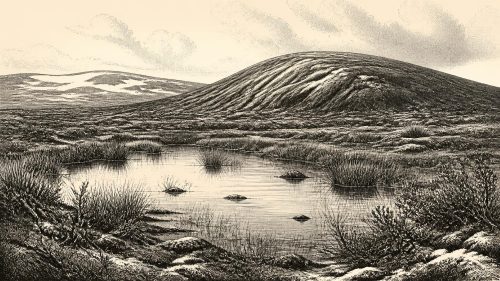
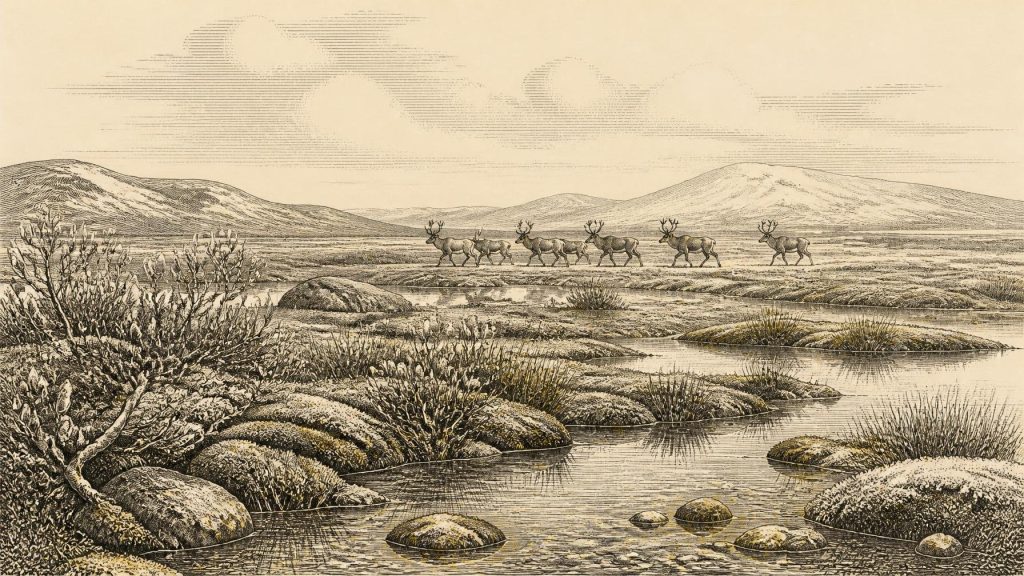
What Derryvree does provide is a vivid local picture of cold-country ecology. Its plant and animal remains indicate open, treeless tundra or muskeg: wet, mossy ground with sedges and herb-rich vegetation, interrupted by shallow freshwater. The assemblage includes plants suited to cold and exposed conditions, while records of bogbean, dwarf willow, mountain avens, rosy saxifrage and water-milfoil show that this was not lifeless frozen ground. There were wet margins and clear pools as well as drier, wind-exposed surfaces. Fossil water-milfoil is particularly useful evidence for freshwater habitat rather than a merely imagined Ice Age wilderness.
This was not the green, wooded Ireland familiar from later millennia. Trees were absent locally, and growing seasons were short. Frost action, seasonal thaw, sparse ground cover and shifting watercourses probably made travel difficult. Yet a tundra wetland could be productive in summer, supporting invertebrates, water birds and grazing mammals. The evidence demonstrates an ecosystem, not a fixed view from one day: pollen, seeds, mosses and insects accumulated over time, and the climate could have altered substantially during the deposit’s formation.
Environmental change is the principal ‘regional affair’ visible at this date. Later glacier movement reshaped much of Ireland and destroyed or buried older land surfaces. That helps explain why the record is so thin. The Fermanagh sediments survived because they were trapped between tills; their rarity is a warning against treating them as a complete inventory of the island’s vegetation or inhabitants.
Castlepook and the Mammal World
Some 300 kilometres to the south-west, Castlepook Cave preserves another fragment of this wider world. The limestone cave, long known as Mammoth Cave, has yielded one of Ireland’s richest Pleistocene vertebrate assemblages. Its material includes reindeer, woolly mammoth, giant deer, brown bear, wolf, Arctic fox, mountain hare, lemmings and spotted hyaena. These species were not necessarily all alive together, nor did they all occupy the cave in the same way. Cave deposits can mix material carried in by predators, water, scavengers and earlier excavators over very long periods.
Even with that caution, the assemblage establishes that a diverse cold-stage fauna reached Ireland during the wider interval from at least about 45,000 to 20,000 years ago. Castlepook was likely part of a broader European ecological zone rather than an isolated menagerie. Hyaenas could drag carcass parts into sheltered spaces; bears and other animals may have used caves differently; bones could subsequently be disturbed. The cave is therefore far better evidence for animal presence and ecological connection than for a simple food chain or a single hunting ground.
Recent genetic work from Castlepook sediments has strengthened the picture of connectivity. Ancient DNA has identified a range of taxa and linked Irish hyaenas and mammoths to wider Late Pleistocene European populations. This is important evidence that animals moved into and out of Ireland as physical geography and climate permitted. It does not, however, tell us exactly which route was usable in 30,331 BCE, or whether people followed the same paths. Sea level was lower than today, but ice, water, terrain and changing coasts made access variable rather than straightforward.
The Reindeer Femur Question
Castlepook’s most consequential object is a reindeer femur held in the National Museum of Ireland’s Natural History collections. A deep linear mark on it has been interpreted by palaeozoologist Ruth Carden as a cut made with a sharp stone tool while the bone was fresh. County Cork heritage material presents the find as approximately 31,000 BCE. If that interpretation and broad age are sustained, it is potentially Ireland’s earliest evidence of people processing an animal, far earlier than the better-established terminal-Pleistocene and early-Holocene traces of human presence.
The correct conclusion is deliberately narrow. A cut-marked limb bone could indicate carcass processing by one person or a small group; it does not establish that hunters killed the reindeer, camped at the cave, lived permanently in Ireland or formed an unbroken population. No securely associated hearth, stone-tool assemblage, dwelling floor, human remains, burial or extensive butchered refuse of this age has been recovered at Castlepook. Earlier cave excavations also lacked the stratigraphic control expected today, and recent research has demonstrated that some older Irish Pleistocene radiocarbon dates require reassessment using improved preparation methods.
People Without Polities
There is no evidence for political affairs, diplomacy, territorial rule, warfare or organised institutions in Ireland at this point. Nor can archaeology identify a language, ethnicity, personal name, religion or body of learning. No Irish shrine, grave, image, musical instrument, ornament or ceremonial deposit can responsibly be assigned to this interval. The absence is not a judgement on the capacities of any possible visitors; it is a limit of the surviving Irish record.
Society and everyday life are equally elusive. If the reindeer mark records human action, the most that can be said is that people possessed a sharp stone edge and used it on an animal carcass. They may have been highly mobile foragers travelling through a landscape shared with formidable predators, but this is an inference from the tool-mark interpretation and comparable Upper Palaeolithic lifeways elsewhere, not direct proof of an Irish camp. There is no evidence for permanent settlement, agriculture, livestock, fields, houses, exchange networks or regular maritime trade.
For that reason, ‘economy’ in 30,331 BCE means ecology before it means commerce. Reindeer and other grazing animals converted tundra vegetation into meat, fat, hides, bone and antler that visiting people could potentially have used. Predators and scavengers competed for carcasses. Wetland plants and freshwater shaped where animals could feed and move. But an economy of repeated local hunting, storage and trade cannot be reconstructed from one possibly worked bone.
What This Year Can Mean
Ireland around 30,331 BCE should not be pictured as a nation in waiting, nor as a blank sheet beneath permanent ice. It was a fluctuating northern landscape whose deepest history is preserved in exceptional fragments: a Fermanagh wetland caught between glacier advances, and a Cork cave containing the remains of Ice Age animals. Derryvree proves that cold freshwater habitats and tundra vegetation existed locally during a broad calibrated interval. Castlepook proves that large mammals, predators and small cold-adapted animals reached the island. Its reindeer femur raises the possibility that people did too.
That possibility is historically important precisely because it remains provisional. The evidence asks for curiosity, not embellishment. There are no kings, battles or monuments to record for this notional year; there is instead a buried wetland, a changing ice sheet, a cave fauna and one marked bone. Those are enough to show that Ireland’s human and environmental past reaches far beyond the later worlds of farms, tombs and written history.
Primary Sources
- Middle Midlandian Freshwater Series at Derryvree, Maguiresbridge, County Fermanagh, Northern Ireland
- The IntCal20 Northern Hemisphere Radiocarbon Age Calibration Curve (0–55 cal kBP)
- Growth and Retreat of the Last British–Irish Ice Sheet, 31,000 to 15,000 Years Ago: the BRITICE-CHRONO Reconstruction
- The Timing and Magnitude of the British–Irish Ice Sheet Between Marine Isotope Stages 5d and 2
- Figure 6.— The Subdivision of the Quaternary Period in Ireland
- Soils of County Waterford
- Myriophyllum alterniflorum DC.
- The Irish Quaternary Fauna Project
- Castlepook Cave, County Cork: Geological Heritage Audit Site Report
- Heritage Artefacts of County Cork
- 32564 – Castlepook, County Cork
- A Reconsideration of the Radiocarbon Dating of the Marine Isotope Stage 3 Fauna from Southern Ireland
- New Insights on the Fauna of Ireland’s Younger Dryas and Early Holocene from Alice & Gwendoline Cave
- Sedimentary Ancient DNA Reveals Late Pleistocene Faunal Connectivity Between Ireland and Eurasia
- The Island of Ireland: Drowning the Myth of an Irish Land-Bridge?
- The Problem of a Late Quaternary Landbridge Between Britain and Ireland
- Radiocarbon Constraints on the Age of the Maximum Advance of the British–Irish Ice Sheet in the Celtic Sea
- Pattern and Timing of Retreat of the Last British-Irish Ice Sheet
- Introduction to the Glacial Sand and Gravel Landscapes of Northern Ireland
- Mammoth Cave
- Ireland’s Palaeolithic Archaeology – Fleeting Footprints in a Frozen Land
- Irish Quaternary Fauna Project