Castlepook Reindeer Taphonomy30296 BCE
At around 30,296 BCE, Ireland lay within an unstable glacial environment before the British–Irish Ice Sheet’s maximum extent. Evidence is fragmentary: Derryvree in Fermanagh preserves sediments from an ice-free interval, indicating treeless cold wetlands with sedges, mosses and sparse vegetation. Castlepook Cave in Cork yielded remains of reindeer, mammoth, predators and other cold-adapted animals, accumulated over long periods. A reindeer femur bears a possible fresh-bone stone-tool cut mark, suggesting but not proving human carcass processing. No secure settlement, tools, burials or population evidence exists. These archives demonstrate ecological complexity and possible human contact, while requiring caution about dates or narratives.
Dateline
30,296 BCE is not a year that can be recovered from Irish evidence in the manner of a later historical date. It corresponds approximately to 32,246 years before 1950, the conventional ‘present’ used in radiocarbon and palaeoclimate work. At such depth in time, calibration produces ranges rather than anniversaries, while deposits themselves accumulated over seasons, centuries or longer. No written sources, named communities, settlements, tools or securely dated human remains allow an event to be assigned to this particular calendar year. Ireland at this point belongs to the later part of the Pleistocene, within the Upper Palaeolithic era of Europe but before the island has a securely documented archaeological occupation.
The responsible history of this date is therefore environmental and evidential. It concerns a cold, rapidly changing north-west European world; the developing British–Irish Ice Sheet; a small number of Irish sediment sequences; and an exceptional cave archive near Doneraile, County Cork. These records do not yield a narrative of rulers, wars or institutions. They do, however, show that parts of Ireland could sustain cold-adapted plants and large mammals during the wider period, and they preserve a provocative but still limited possible indication that people handled a reindeer carcass.
Dating a Deep Past
The numerical date needs translation before it can be interpreted. A date of 30,296 BCE is approximately 32.25 thousand calendar years BP (‘before present’, where present is AD 1950). It should not be confused with an uncalibrated radiocarbon age. Atmospheric carbon-14 varied considerably during the last glacial period, so radiocarbon determinations must be calibrated against independently dated records; their results remain probabilistic ranges, not exact points. In addition, a dated animal bone tells us when the animal lived, whereas a surface mark on that bone may have a separate history and requires taphonomic assessment.
This broad point falls close to the beginning of Greenland Interstadial 5.1 in some high-resolution North Atlantic chronologies: a short-lived climatic amelioration beginning around 32,250 years BP. That correspondence should be used cautiously. Greenland ice cores provide a valuable regional climate framework, not a weather report for Ireland. Ireland’s own record is fragmentary, locally variable and repeatedly disturbed or erased by later glaciers. The appropriate conclusion is not that Ireland experienced a particular warm year, but that the island lay within a volatile glacial climate system in which ice, sea level, vegetation and animal ranges could change substantially over millennia.
Before the Maximum Ice
This was before the fullest Late Pleistocene expansion of the British–Irish Ice Sheet. Modern reconstructions show that the ice sheet grew and reached its greatest volume later, with maximum volume around 23,000 years BP and different sectors advancing and retreating asynchronously. That later expansion profoundly reshaped Ireland, scouring older landscapes and burying or removing much evidence that might otherwise survive. It is consequently wrong to picture the whole island at 30,296 BCE either as uniformly ice-covered or as a stable, accessible plain.
Instead, the evidence supports a mosaic whose details remain uncertain. Ice-free or locally ice-free ground existed during portions of the wider Middle Midlandian interval, while glaciers and ice margins affected other districts. Lower global sea levels exposed areas now beneath the surrounding seas, altering coastlines and possible routes between Ireland, Britain and continental Europe. Yet a lower sea level does not automatically demonstrate a continuous, usable land bridge into Ireland at this specific time. Ice configuration, relative sea level, rivers, marine channels and seasonal conditions all mattered. There is no Irish evidence from 30,296 BCE for a regular migration corridor, boats, travel parties or exchange networks.
Derryvree’s Cold Wetland
The most illuminating environmental evidence comes from Derryvree near Maguiresbridge in County Fermanagh. Roadworks in 1969 exposed organic freshwater silts and sands sealed between two tills within a drumlin. The site is crucial because the sediments record a landscape that existed between episodes of glaciation rather than beneath permanent ice. Conventional radiocarbon dating of the organic material produced an age of about 30,500 radiocarbon years BP. Subsequent calibration and Bayesian modelling have placed the relevant ice-free phase broadly around 33.5 ± 1.2 thousand calibrated years BP. The notional date of 30,296 BCE therefore falls towards the younger edge of that broad modelled interval, not on a securely identifiable layer or moment.
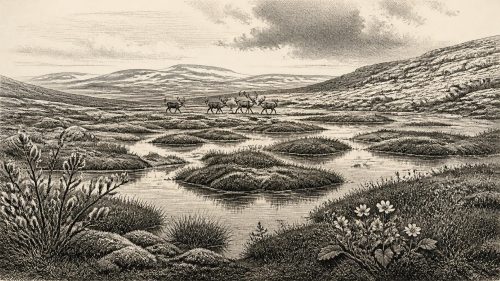
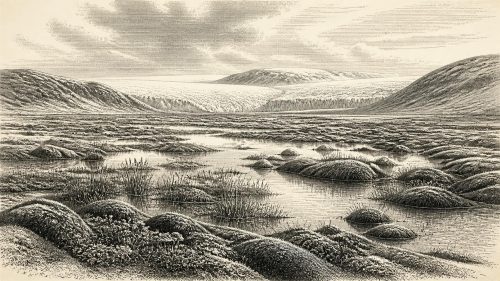
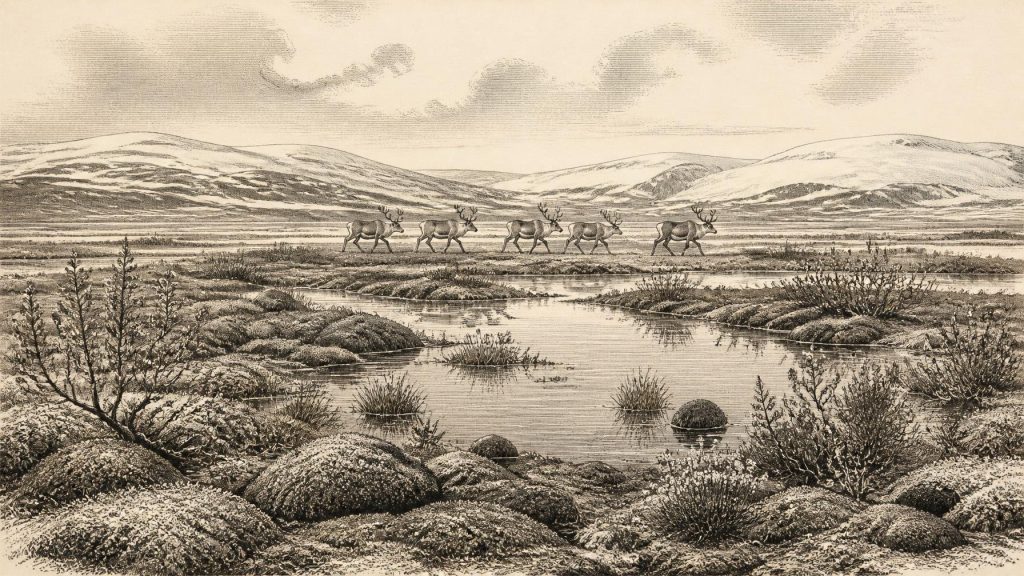
Derryvree’s plant and animal traces nevertheless give the best Irish indication of the kind of environment that could occur in this phase. Poorly preserved herb pollen, mosses, sedges and macrofossils point to open, treeless, cold ground. Records of dwarf willow, mountain avens, clubmosses, bogbean and aquatic water-milfoil indicate a varied periglacial wetland: shallow or slow water, mossy margins, sedge-rich ground and sparse low vegetation rather than forest. Such a place was not lifeless. It offered fresh water, plant cover and seasonally productive habitat, but it was subject to severe frost, thaw and climatic stress.
The Derryvree record is local, not a map of the whole island. It cannot establish that every Irish valley held a wetland, nor that its precise flora survived unchanged until the numerical year used here. Its real importance is methodological. It disproves a simple picture of Ireland as continuously and uniformly entombed beneath ice throughout the last glacial period, while also showing why the surviving evidence is so difficult to date finely. A freshwater basin could flourish, be overridden by ice, and leave its story compressed between tills.
Castlepook’s Faunal Archive
In southern Ireland, Castlepook Cave near Doneraile offers a different archive. Excavations made from the late nineteenth century into the early twentieth century recovered an extraordinary cold-stage fauna, now substantially held in the National Museum of Ireland collections. Direct dating undertaken by the Irish Quaternary Fauna Project demonstrated that the cave contains material accumulated over a very long period, rather than a single contemporaneous animal community. Its dated remains include reindeer, giant deer, brown bear, wolf, Arctic fox, lemmings, mountain hare, woolly mammoth and spotted hyaena.
Those species show that, during the broad pre-Last Glacial Maximum interval, Ireland could be reached by – and in suitable areas sustain – a far richer large-mammal fauna than the modern island. Reindeer in particular suit an open, cold landscape, while hyaenas and wolves remind us that carcasses and caves were part of predator as well as human ecologies. Caves were not automatically homes or camps. Carnivores accumulated bones, water moved sediment, natural deaths occurred, and early excavators worked before modern recovery and recording standards. Individual specimens may therefore be older or younger than nearby finds, and a cave assemblage must not be turned into a single imagined scene.
A Marked Bone, Not a Settlement
The most arresting item is a reindeer femur from Castlepook bearing a deep linear modification identified by zooarchaeologist Ruth Carden as a possible cut or chop made by a sharp stone implement while the bone was fresh. Public heritage accounts place the specimen broadly around 33,000 years ago, close enough to the date under discussion to make it historically important. If the mark is confirmed as human-made and belongs to the bone’s original depositional history, it would be evidence that one or more Upper Palaeolithic people processed a reindeer in Ireland far earlier than the formerly accepted terminal-Pleistocene evidence from Alice and Gwendoline Cave in County Clare.
But that conditional language is essential. The femur is not a hearth, a stone-tool assemblage, a dwelling floor, a burial or proof of a permanent population. It does not tell us whether people killed the animal, scavenged it, butchered it in the cave, or processed it elsewhere before the limb was moved. Nor can it identify their language, kinship, beliefs or origin. Recent work at Castlepook has located previously undisturbed Pleistocene-bearing deposits, making the cave a major research priority; until stratified occupation evidence is recovered, the marked femur remains a tantalising individual trace rather than a full settlement history.
Life Beyond the Evidence
If people did enter Ireland during this wider interval, their likely subsistence would have been mobile foraging, with animal resources central to survival. That is an inference from the reindeer evidence and wider European Upper Palaeolithic comparisons, not a demonstrated Irish economy. There is no basis for claiming farming, permanent villages, fields, metalworking, long-distance trade, formal political authority or diplomacy. Equally, no Irish evidence from this date can establish warfare, territorial borders, ritual practice, art, clothing or systems of learning. The survival of a single possible butchery mark is enough to open a question about human presence, not enough to answer all the questions that presence raises.
For the same reason, culture at 30,296 BCE cannot responsibly be supplied by importing cave art, named archaeological cultures or elaborate social practices from France, Iberia or central Europe. Those regions offer useful comparisons for what Upper Palaeolithic hunter-gatherers elsewhere were capable of doing; they are not substitutes for Irish finds. Ireland’s own evidence supports a more restrained but still remarkable account: cold wetlands in Fermanagh, a changing and dangerous mammal world in Cork, and possible human contact with that world before glaciers later transformed the island.
Thus the central development around 30,296 BCE was environmental rather than political. Ireland stood within a climatically unstable glacial north-west Europe, before the ice sheet’s later maximum. Its surviving archives preserve wetland plants and cold-adapted fauna, and perhaps the aftermath of a reindeer butchery. The gaps are as historically meaningful as the finds: no securely dated settlement, no artefact assemblage and no calendar-year event. What can be said with confidence is that the island’s deep past was neither empty of ecological complexity nor sufficiently known to bear invented certainty.
Primary Sources
- A Middle Midlandian Freshwater Series at Derryvree, Maguiresbridge, County Fermanagh, Northern Ireland
- Palaeoecology: Introduction to the Late Quaternary and Holocene of Northern Ireland
- The Irish Quaternary Fauna Project
- Trimlines, Blockfields and the Vertical Extent of the Last Ice Sheet in Southern Ireland
- Growth and Retreat of the Last British–Irish Ice Sheet, 31,000 to 15,000 Years Ago: the BRITICE-CHRONO Reconstruction
- Pattern and Timing of Retreat of the Last British-Irish Ice Sheet
- The Timing and Magnitude of the British–Irish Ice Sheet Between Marine Isotope Stages 5d and 2
- New Age Constraints for the Maximum Extent of the Last British-Irish Ice Sheet (NW Sector)
- New Data for the Last Glacial Maximum in Great Britain and Ireland
- The Problem of a Late Quaternary Landbridge Between Britain and Ireland
- Deglaciation, Earth Crustal Behaviour and Sea-Level Changes in the Determination of Insularity: A Perspective from Ireland
- Ireland: Submerged Prehistoric Sites and Landscapes
- The IntCal20 Northern Hemisphere Radiocarbon Age Calibration Curve (0–55 cal kBP)
- IntCal Publications
- Rapid Global Ocean-Atmosphere Response to Southern Ocean Freshening During the Last Glacial
- New Insights on the Fauna of Ireland’s Younger Dryas and Early Holocene from Alice & Gwendoline Cave
- Heritage Artefacts of County Cork
- Archaeological Heritage of County Cork
- 2022:564 – Castlepook Cave, Castlepook South, Cork
- Archaeology Research Excavation Grant 2022: Castlepook Cave Final Report
- Landscapes and Environments of the Last Glacial-Interglacial Transition: a Time of Amazingly Rapid Change in Ireland
- Exploring Controls on the Growth and Retreat of the Last British–Irish Ice Sheet