
BIRM-166’s Short Thaw30295 BCE
Around 30,295 BCE, Ireland has no datable historical events; evidence instead records Late Pleistocene environments over broad periods. At Derryvree, County Fermanagh, the BIRM-166 freshwater deposits, bracketed by glacial tills, indicate an ice-free or ice-distant interval within MIS 3. Fossils reveal open tundra wetland, with aquatic plants, sedges, mosses and cold-adapted species. Castlepook Cave, County Cork, preserves mixed, repeatedly deposited remains of mammoth, reindeer, giant deer, predators and other fauna, demonstrating wider European connectivity. A possibly cut-marked reindeer bone may indicate human activity, but no secure settlement evidence exists. Ireland remained an environmentally dynamic, glaciated northern fringe through unstable climates.
Dateline
“30,295 BCE” is a modern chronological label, not a year for which Ireland has an annal, a ruler, a settlement plan or a dated human event. No calendar used on the island can be projected this far back, and archaeological dating cannot isolate a particular season or generation. In relation to the conventional radiocarbon reference year of AD 1950, the label falls roughly 32,244 calendar years ago, within the Late Pleistocene and broadly within Marine Isotope Stage 3 (MIS 3). The responsible history of this point in time must therefore be written in ranges: from sediments, fossils and glacial landforms that record changing environments over centuries or millennia.
The strongest Irish evidence close to this nominal date comes not from an artefact or burial, but from a buried wetland at Derryvree near Maguiresbridge in County Fermanagh. In 1969, roadworks cut through a drumlin and exposed a remarkable sequence. Thick glacial till lay below and above beds of fine sand, silt and organic material deposited in freshwater. The order of events is secure: glacier ice had occupied the locality; an interval then allowed standing or slow-moving water, plants and small animals to leave a record; later ice sealed that record beneath another till. The middle deposit, known by its radiocarbon determination as BIRM-166, is a rare surviving fragment of an Irish landscape later overridden or buried by ice.
A Date Range, Not a Date
BIRM-166 returned a conventional radiocarbon age of 30,500 years BP, with an uncertainty of +1,170 and −1,030 years. A radiocarbon age is not the same thing as a calendar age, because atmospheric carbon-14 has varied through time. When calibrated with modern methods, the result is generally expressed as a broad range of about 36,900–31,700 calibrated years BP, or roughly 34,950–29,750 BCE. The modern label 30,295 BCE lies within that wide interval. It does not mean that the entire Derryvree bed, still less all Ireland, can be assigned precisely to that year.
That distinction is fundamental. The Derryvree deposit establishes an ice-free or ice-distant episode at one Fermanagh locality between phases of glaciation. It cannot provide a national weather report. Ireland’s terrain was varied, its ice margins mobile, and the evidence for the earlier stages of the last glacial cycle remains incomplete. Later glaciers scoured bedrock, remobilised sediment and concealed older land surfaces. An apparent absence of sites in one district may therefore mean destruction or burial of evidence rather than an absence of life.
Wet Ground in a Cold Country
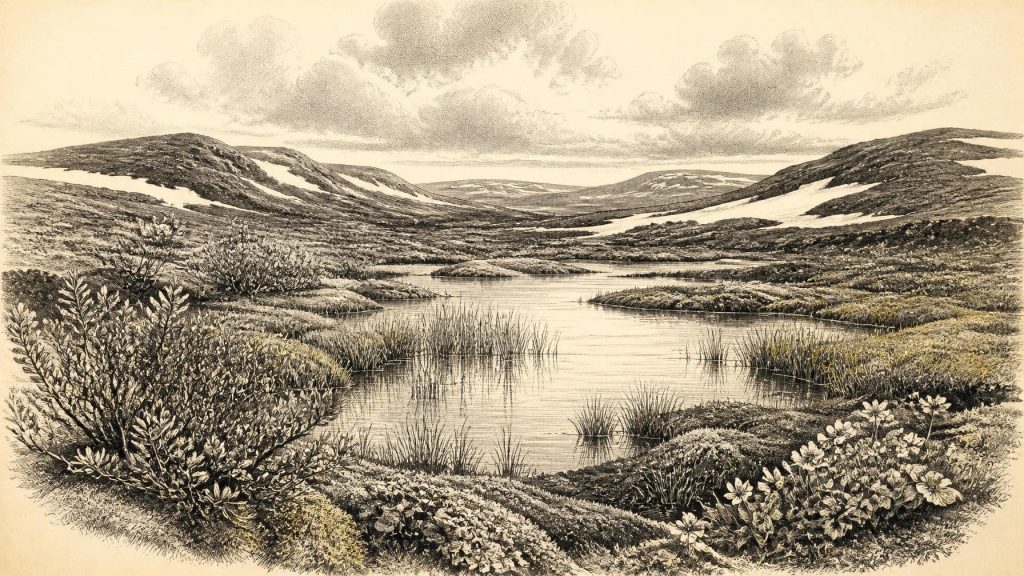
The Derryvree flora and fauna give the clearest picture available. They indicate open tundra vegetation and a periglacial regime: a cold landscape in which frost, seasonal thaw and waterlogged hollows shaped the ground. This was not modern, wooded Fermanagh. Plant remains include species associated with cold or exposed ground and wet margins, among them mountain avens, dwarf willow and bogbean. Sedges, mosses and aquatic plants point to sheltered freshwater habitats amid a generally treeless setting. In a short growing season, a pool edge or mossy hollow could sustain more plant life than an exposed slope, while winter freezing and frost action disrupted drier soils.
“Tundra” should not be mistaken for a featureless plain. Derryvree’s sedimentary record implies a mosaic: shallow water, wet mossland, sedge-lined margins, patches of herb-rich ground and bare or frost-disturbed surfaces. Nor does a few grains of tree pollen prove a local forest. Pollen can travel far on wind or water, and can be redeposited. The more persuasive evidence lies in the combined macrofossils, mosses, pollen, invertebrate remains and geological setting. Taken together, they support an open, cold wetland landscape rather than woodland.
The wider climatic setting was unstable. MIS 3 contained abrupt shifts between relatively milder interstadial conditions and much colder stadial phases, well documented in Greenland ice cores and imperfectly represented in Ireland. The Derryvree horizon belongs to this long, uneven story rather than to a simple advance from warmth to maximum ice. The global Last Glacial Maximum came later, broadly between 26,500 and 19,000 years ago. Around the period represented by Derryvree, parts of Ireland could support freshwater and tundra communities, even as ice was an increasingly important force in the wider British–Irish landscape.
Cork’s Cave Archive
At the opposite end of the island, Castlepook Cave near Doneraile in north County Cork—also called Mammoth Cave—provides Ireland’s most important archive of pre-Last Glacial Maximum vertebrates. Its collections include remains attributed to woolly mammoth, reindeer, giant deer, brown bear, wolf, Arctic fox, hare, lemmings and spotted hyaena. Such animals show that, at different times during the Late Pleistocene, Ireland supported or received a far richer cold-stage fauna than the historic island. Carnivore damage on bones is also a reminder that caves were often animal dens, feeding places and traps in the landscape, not necessarily human shelters.
It would be wrong, however, to arrange every species from Castlepook into one tableau for 30,295 BCE. Much of the material was excavated in the nineteenth and early twentieth centuries, and the cave contains deposits from more than one period. Later re-dating has shown that some older measurements underestimated the age of bones substantially. Recent work places key elements of the assemblage in MIS 3 and suggests that giant deer and spotted hyaena may have disappeared locally before the Last Glacial Maximum, perhaps around 40,000 calibrated years BP. Castlepook is evidence for repeated animal use and changing faunas across a long period, not a census taken in one year.
New sedimentary ancient-DNA work from the cave adds an important but still provisional dimension. A 2026 preprint detected ancient animal DNA in cave sediments and recovered mitochondrial evidence for mammoth, hyena and bear lineages with links to wider Eurasian populations. This supports the interpretation that Irish megafauna belonged to a broader north-west European ecological world before the Last Glacial Maximum. As a preprint, it is not yet a final peer-reviewed conclusion. Even if its findings stand, genetic affinity cannot specify one migration route, a single date of arrival or a permanent land bridge between Ireland and Britain.
People: A Possibility, Not a Population
The human question requires still greater restraint. A reindeer femur from Castlepook has been interpreted by zooarchaeologist Ruth Carden as bearing an incision made by a sharp stone tool, and public heritage accounts have associated the bone with roughly 31,000 BCE. If that interpretation is correct, and if the modification is broadly contemporary with the animal’s death, it could indicate that people processed a reindeer in Ireland during the wider period. It would be an exceptionally significant trace of Upper Palaeolithic activity.
It is not proof of a settled Irish population. The bone derives from an old collection rather than a newly excavated occupation floor containing a hearth, a stone-tool assemblage, a group of freshly butchered animals and securely associated sediments. The bone’s age does not by itself date the cut precisely, and one marked specimen cannot demonstrate the size, permanence or identity of a human group. No securely dated dwelling, fireplace, lithic workshop, burial, artwork or occupation layer has yet established a resident human community in Ireland at this time. Later glaciation may have destroyed evidence, but possibility is not evidence.
For the same reason, political affairs, diplomacy, organised conflict, trade, religion and learning cannot responsibly be narrated for Ireland in 30,295 BCE. Elsewhere in north-west Europe, Upper Palaeolithic people possessed sophisticated stone technologies, clothing, fire use, social networks and cultural practices; that comparison helps explain how a hypothetical visitor might have survived. It does not transfer those practices automatically to Ireland. There are no named peoples, territories, beliefs, languages or exchange routes here that archaeology can identify.
An Island in Formation
Economy, if people were present at all, would have meant immediate survival rather than a demonstrable Irish system of production or commerce: finding fuel and shelter, following accessible food and negotiating a cold, exposed terrain. Reindeer and other herbivores could have offered meat, fat, hides, sinew and bone to mobile hunters, but no Irish tool kit or camp confirms such use. The safer conclusion is ecological. Mammals moved through changing opportunities created by low sea levels, exposed shelf landscapes, shifting ice and altered waterways. Their presence shows connectivity with Britain and continental Europe at some stages, not commerce or deliberate human travel on a known route.
The most meaningful development around this date was environmental rather than political: Ireland was a dynamic northern fringe of Europe, not an empty white void and not yet the familiar island of woodland, farms and towns. At Derryvree, freshwater pooled between glacial episodes amid open tundra vegetation. At Castlepook, cave deposits preserve the fragmentary record of a formidable animal world and an unresolved clue to possible human action. These witnesses are sparse, local and often difficult to date. Yet they establish a history of wetlands, seasonal severity, mobile fauna and advancing ice—an ancient foundation beneath every later chapter of Irish history.
Primary Sources
- Middle Midlandian Freshwater Series at Derryvree, Maguiresbridge, County Fermanagh, Northern Ireland
- Middle Midlandian Freshwater Series at Derryvree, Maguiresbridge, County Fermanagh, Northern Ireland
- A Reconsideration of the Radiocarbon Dating of the Marine Isotope Stage 3 Fauna from Southern Ireland
- The Irish Quaternary Fauna Project
- Pleistocene Vertebrates in the British Isles
- Sedimentary Ancient DNA Reveals Late Pleistocene Faunal Connectivity Between Ireland and Eurasia
- Late Pleistocene Chronostratigraphy and Ice Sheet Limits, Southern Ireland
- The Timing and Magnitude of the British–Irish Ice Sheet Between Marine Isotope Stages 5d and 2: Implications for Glacio-Isostatic Adjustment, High Relative Sea Levels and ‘Giant Erratic’ Emplacement
- Deglaciation Chronology of the Donegal Ice Centre, North-West Ireland
- Reconstructing the Last Irish Ice Sheet 2: A Geomorphologically-Driven Model of Ice Sheet Growth, Retreat and Dynamics
- BRITICE Glacial Map, Version 2: A Map and GIS Database of Glacial Landforms of the Last British–Irish Ice Sheet
- Maximum Extent and Dynamic Behaviour of the Last British–Irish Ice Sheet West of Ireland
- Trimlines, Blockfields and the Vertical Extent of the Last Ice Sheet in Southern Ireland
- Timing, Pace and Controls on Ice Sheet Retreat: An Introduction to the BRITICE-CHRONO Transect Reconstructions of the British-Irish Ice Sheet
- Figure 6.— The Subdivision of the Quaternary Period in Ireland
- Castlepook Cave, Castlepook South, Cork: 2022 Excavation Report
- Archaeology Research Excavation Grant 2022: Castlepook Cave, Co Cork
- Castlepook Cave
- Heritage Artefacts of County Cork
- Mammoth Cave
- BSBI: Dryas octopetala
- BSBI: Menyanthes trifoliata
- BSBI: Salix herbacea
- New Insights on the Fauna of Ireland’s Younger Dryas and Early Holocene from Alice & Gwendoline Cave