Derryvree’s Intervening Silts30278 BCE
About 30,278 BCE, Ireland’s history can only be reconstructed from environmental evidence, not annual records. At Derryvree, County Fermanagh, organic silts between glacial tills reveal an ice-free interval of cold, treeless, waterlogged tundra, demonstrating fluctuating glaciation. Castlepook Cave, County Cork, preserves a long accumulation of Ice Age fauna, including mammoth, reindeer, giant deer, bear, hyaena and wolf, though not a single contemporaneous community. A marked reindeer bone may indicate human butchery, but cannot prove settlement or sustained occupation. Expanding ice sheets and lower sea levels reshaped coasts and routes. The evidence portrays a climatically unstable, resource-rich but uncertain Pleistocene Ireland.
Dateline
The label 30,278 BCE suggests a point on a calendar, but no evidence can identify a particular Irish year so remote in time. In modern chronological terms it is roughly 32,227 years before AD 1950, the conventional reference point for “cal BP”. Ireland then lay within the Late Pleistocene, in the long cold interval traditionally called the Midlandian in Irish geology. The responsible history of this moment is consequently not a sequence of rulers, battles or treaties. It is a reconstruction from sediments, fossil bones, landforms and laboratory dates, each of which records periods rather than individual years. The resulting picture is important precisely because it is sparse: an island-scale environment undergoing severe climatic change, with possible but unproven human contact.
Dating an Uncalendarable Landscape
There is no written record, annual chronology or securely dated settlement from Ireland for this period. The date in the heading should therefore be read as a modern indexing device, not as a claim that an event happened in a recognisable year. Radiocarbon laboratories measure ages in radiocarbon years before present, rather than in BCE years; those measurements need calibration against independently dated records because atmospheric radiocarbon has varied through time. At this depth of time, both the measurement uncertainty and the calibration range can span many centuries or millennia. Calendar-year precision is unavailable.
The best Irish environmental evidence relevant to this broad part of the Ice Age comes from Derryvree townland, near Maguiresbridge in County Fermanagh. Roadworks in 1969 cut through a drumlin and exposed organic silts and fine sands trapped between two separate sheets of glacial till. One radiocarbon determination, BIRM-166, was reported as 30,500 radiocarbon years BP, with a substantial uncertainty of +1,170 and −1,030 years. That is evidence for an interval of deposition, not a date for a single year, and its calibrated calendar age cannot responsibly be equated with 30,278 BCE. Nevertheless, it illuminates the environmental world of Ireland during the middle part of the last cold stage, close enough to make it indispensable context.
Derryvree’s Open Wetland
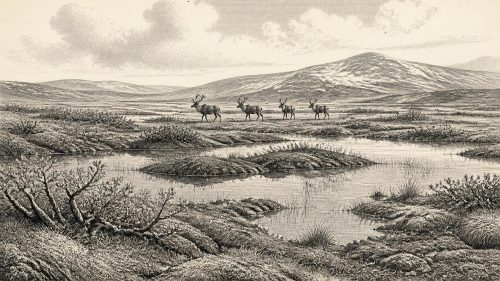
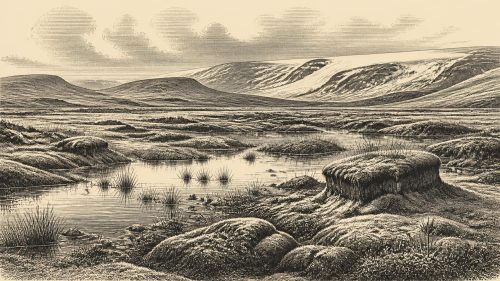
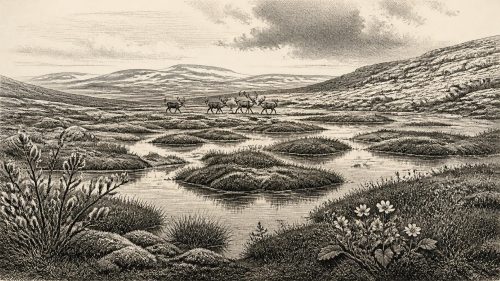
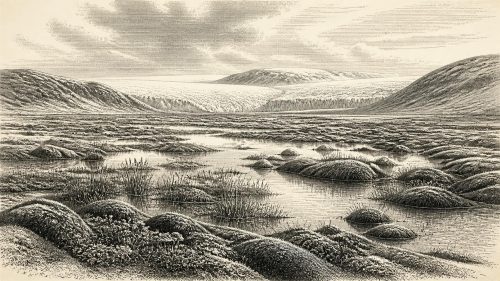
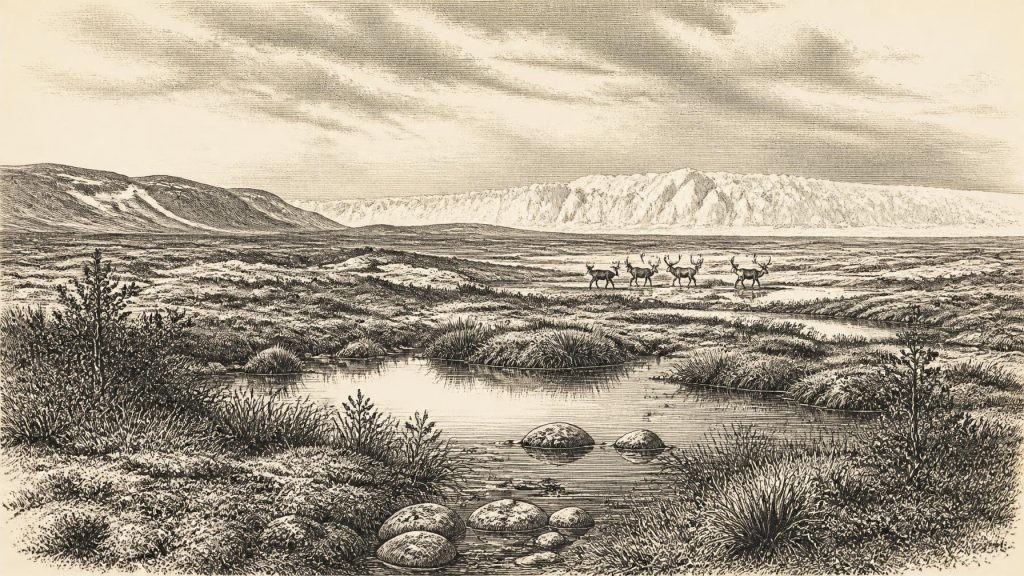
The Derryvree sequence demonstrates a crucial fact: at least at this Fermanagh location, there was a period without overriding glacier ice between two episodes of glacial deposition. The organic bed preserves a freshwater setting under periglacial conditions. Its plant and animal remains indicate open, treeless tundra or muskeg rather than the wooded Ireland familiar today. Grasses and sedges, dwarf shrubs and herbs, mosses, and plants associated with wet ground or pools provide the evidence. The landscape was not necessarily uniformly identical across the island; it is a local archive. But it gives unusually direct testimony to shallow water, saturated ground and low vegetation in a cold climate.
That evidence supports a world of short growing seasons and severe winters. Pools and slow watercourses could sustain aquatic plants, while mossy margins and sedge-rich ground occupied wetter hollows. The word “muskeg” is useful only if understood as a reconstruction of this waterlogged, organic-rich tundra environment, not as a claim that every square mile of Ireland was a modern analogue of any one northern landscape. The deposit records what entered and survived in one basin. It cannot yield temperatures for a particular day, nor prove the exact distribution of plants across all provinces.
Even so, Derryvree corrects a common image of an Ireland simply buried beneath permanent ice. Ice sheets advanced and retreated unevenly, and the island’s environmental history was regionally varied. At a time broadly relevant to this article, northern lowlands could contain exposed wetland, while glacier ice, snowfields and frozen ground shaped conditions elsewhere. The lower till at Derryvree represents an earlier glacial phase; the organic silts record the intervening ice-free interval; the upper till shows renewed glaciation. This layered sequence is physical evidence of environmental change on a scale far larger than human memory.
Animals in a Changing Island
County Cork’s Castlepook Cave, near Doneraile, supplies the principal faunal counterpart to Derryvree. Also known as Mammoth Cave, it has produced more than 2,000 bones and is Ireland’s richest known pre-Last Glacial Maximum vertebrate archive. The assemblage includes woolly mammoth, reindeer, giant deer (Megaloceros giganteus), brown bear and spotted hyaena, as well as wolf, Arctic fox and lemmings among later cold-stage material. These remains establish that animals now absent from Ireland formed part of its Pleistocene fauna.
They do not, however, establish a single living community at 30,278 BCE. Direct dates from Castlepook extend across a very long span, approximately 45,700 to 19,950 radiocarbon years BP. Cave chambers accumulated bones through carnivore activity, natural death, water movement and excavation practices that predated modern stratigraphic standards. A mammoth, hyaena and reindeer bone from the same cave need not represent animals that encountered one another in the same season, much less on one day. The sound inference is broader: during Ice Age intervals, Ireland could support a diverse cold-adapted fauna, including large grazers and their predators or scavengers.
The ecological implications are substantial. Reindeer indicate open terrain with accessible forage; mammoth and giant deer point to a landscape capable, at least episodically, of supporting very large herbivores. Spotted hyaenas could drag or accumulate bones in caves, complicating any attempt to identify human action. Carnivores, herbivores, wetland plants and shifting ice margins belong to the same wider story of a land whose resources and habitable ground were repeatedly transformed by climate. It is possible to speak of food webs and animal movement; it is not possible to reconstruct a human economy from them.
The Reindeer Bone Question
Castlepook is also central to the most provocative question about Ireland at this depth of time. A reindeer femur in the historic collection bears a deep linear mark that palaeozoologist Ruth Carden has interpreted as having been made on fresh bone by a sharp stone tool during carcass processing. County Cork heritage material presents the bone as dating broadly to about 31,000 BCE. If the interpretation and chronological association are upheld, it would push evidence for human handling of an animal in Ireland far earlier than the formerly accepted terminal-Pleistocene record.
Its importance demands caution. The find is one modified bone from a cave with complex depositional history, rather than a modernly excavated occupation floor. There is no securely associated hearth, stone-tool assemblage, dwelling, burial, art, storage pit or concentration of butchered remains of comparable age. A date on bone establishes when the animal died within a statistical range; it does not, by itself, date the incision to a precise calendar year. Nor can one possible butchery mark identify the visitors’ language, ancestry, number, route, sex, season of arrival or length of stay. It is evidence for a possible act, not proof of a settled population.
Accordingly, political affairs, diplomacy, organised conflict, named communities, religion and formal learning are beyond the evidence for Ireland around this date. No chiefdom, territorial boundary or ritual site can be responsibly supplied. If people did reach the island, they may have been highly mobile foragers, comparable in broad lifeway to Upper Palaeolithic groups elsewhere in Europe; that remains an inference from continental archaeology, not a demonstrated Irish society. The most defensible human narrative is deliberately modest: a reindeer carcass may have been processed, while the wider duration and character of human presence remain unknown.
Ice, Coast and Connectivity
The wider British–Irish Ice Sheet was building during the millennia around this nominal date. Modern reconstructions show that growth, maximum extent and retreat were not simultaneous across Ireland, Britain and their continental shelves. By the later part of the last glacial cycle, ice extended across much of Ireland and out over adjoining seas; its greatest overall extent came later, around 26,000–22,000 years ago in many reconstructions. At 30,278 BCE, therefore, Ireland should be seen as entering a phase of major ice-sheet expansion rather than as frozen in one unchanging “Ice Age”.
Sea level was lower than today, exposing parts of the continental shelf and altering coastlines radically. Yet lower sea level does not license the simple claim that Ireland was joined to Britain or continental Europe by a universally passable land bridge at this exact time. The configuration of ice, sea, rivers, exposed shelf and travel routes changed through time and differs between reconstructions. Any human crossing, if the Castlepook mark proves anthropogenic, remains archaeologically undocumented.
What This Year Can Mean
For Ireland, 30,278 BCE is not a year of recorded events but a window on evidence and uncertainty. Derryvree preserves an open, wet, treeless periglacial landscape between phases of ice advance. Castlepook preserves the bones of a remarkably different fauna and a tantalising possible trace of human butchery. Together they show an Ireland of cold-water basins, tundra vegetation, large mammals and advancing ice, not an empty stage awaiting later history. They also set firm limits: there is no basis for inventing a tribe, a conflict, a religion or a settlement. The real historical achievement is to let the sediments and bones speak at the scale they can sustain.
Primary Sources
- Middle Midlandian Freshwater Series at Derryvree, Maguiresbridge, County Fermanagh, Northern Ireland
- Middle Midlandian Freshwater Series at Derryvree, Maguiresbridge, County Fermanagh, Northern Ireland
- Irish Pleistocene Biostratigraphy
- Castlepook Cave, County Geological Site Report
- Heritage Artefacts of County Cork
- Europe and the County of Cork: A Heritage Perspective
- Occurrence of Mammalia Relicts at Site Castlepook Cave
- 32564: Castlepook Cave, Doneraile, Cork
- The Mammoth Caves of Castlepook, Near Doneraile
- Growth and Retreat of the Last British–Irish Ice Sheet, 31,000 to 15,000 Years Ago: the BRITICE-CHRONO Reconstruction
- BRITICE Glacial Map, Version 2: a Map and GIS Database of Glacial Landforms of the Last British–Irish Ice Sheet
- New Age Constraints for the Limit of the British-Irish Ice Sheet on the Isles of Scilly
- Maximum Extent and Dynamic Behaviour of the Last British–Irish Ice Sheet West of Ireland
- Stratigraphic and Palaeo-Geomorphological Evidence for the Glacial-Deglacial History of the Last British-Irish Ice Sheet in the North-Western Irish Sea
- The IntCal20 Northern Hemisphere Radiocarbon Age Calibration Curve (0–55 cal kBP)
- OxCal
- IntCal20 Issue
- The Greenland Ice Core Chronology 2005, 15–42 ka. Part 4: Comparison to the GRIP Ice Core Stratigraphy
- New Insights on the Fauna of Ireland’s Younger Dryas and Early Holocene from Alice & Gwendoline Cave
- Mammals: National Museum of Ireland Natural History Collections