Derryvree’s Dwarf Willow Silt30277 BCE
Thirty thousand years BCE cannot identify a known Irish event, but falls within the broad calibrated age of Derryvree’s freshwater silts in County Fermanagh. Deposited between glacial tills, these sediments record a temporary ice-free, treeless periglacial wetland containing dwarf willow, mountain avens and aquatic plants. They demonstrate regional climatic change rather than island-wide conditions. Castlepook Cave, County Cork, preserves late-Pleistocene fauna, including reindeer, mammoth, bear, fox, hare, lemming and hyaena, though its deposits are chronologically complex. A cut-marked reindeer bone may indicate Upper Palaeolithic butchery, but cannot prove settlement. Disturbance, incomplete records and uncertain dates leave Ireland’s human presence unresolved.
Dateline
The label “30,277 BCE” offers a useful point on a modern timeline, but it cannot describe a known year in Ireland’s remote past. No written record, settlement sequence or archaeological layer can be assigned to that calendar year. At this depth of time, evidence is dated in broad calibrated ranges, and the relevant Irish record belongs to the Late Pleistocene, within Marine Isotope Stage 3 and the Middle Midlandian cold stage. The most responsible account is therefore of an interval, not an event: a changing, cold Irish landscape in which ice, freshwater, tundra vegetation and large mammals left fragmentary traces.
Two places matter especially. At Derryvree near Maguiresbridge in County Fermanagh, an exposure made during roadworks revealed organic freshwater silts and fine sands trapped between two thick sheets of glacial till. In north County Cork, Castlepook Cave, also called Mammoth Cave, produced a remarkable but difficult collection of Ice Age animal bones. Together they show that Ireland was neither simply frozen nor continuously habitable: during parts of this long cold age, particular districts supported water, vegetation and animals, while later ice repeatedly altered or destroyed the evidence.
Dating an Uncertain Interval
The nearest direct chronological guide is Derryvree’s radiocarbon determination, Birm-166. Organic matter from the freshwater deposit returned an age of 30,500 radiocarbon years before present, with a substantial uncertainty of +1,170 and −1,030 years. In radiocarbon terminology, “present” is AD 1950. A radiocarbon age is not a calendar age, because atmospheric carbon-14 levels have varied greatly through time. Calibration with the Northern Hemisphere IntCal curve turns the result into a wide rather than a point-like calendar range, approximately 36,900–31,700 calibrated years before present, or about 34,950–29,750 BCE.
The nominal year 30,277 BCE lies within that broad calibrated span, but that does not mean a particular Derryvree seed, insect or sediment grain dates to that year. It means that the deposit is a legitimate window on the environmental world of the wider period. Its internal sequence is firmer than its absolute precision: glacier ice had occupied the site; a freshwater environment then developed and accumulated sediment; later ice advanced over it and sealed the record under another till. Such stratigraphy is powerful evidence for a local ice-free interval, but it is not a diary of annual weather or human activity.
A Freshwater Break Between Glaciers
Derryvree lay in what is now County Fermanagh, about two kilometres north-east of Maguiresbridge. When the drumlin was cut open in 1969, investigators found a lower till, then fine sands and organic silts, then an upper till. Till is the unsorted mixture of clay, stones and other debris laid down by glacier ice. The freshwater bed between the tills records a pause in local glaciation long enough for standing or slow-moving water, vegetation and organic matter to accumulate. Its later burial shows that the respite did not last.
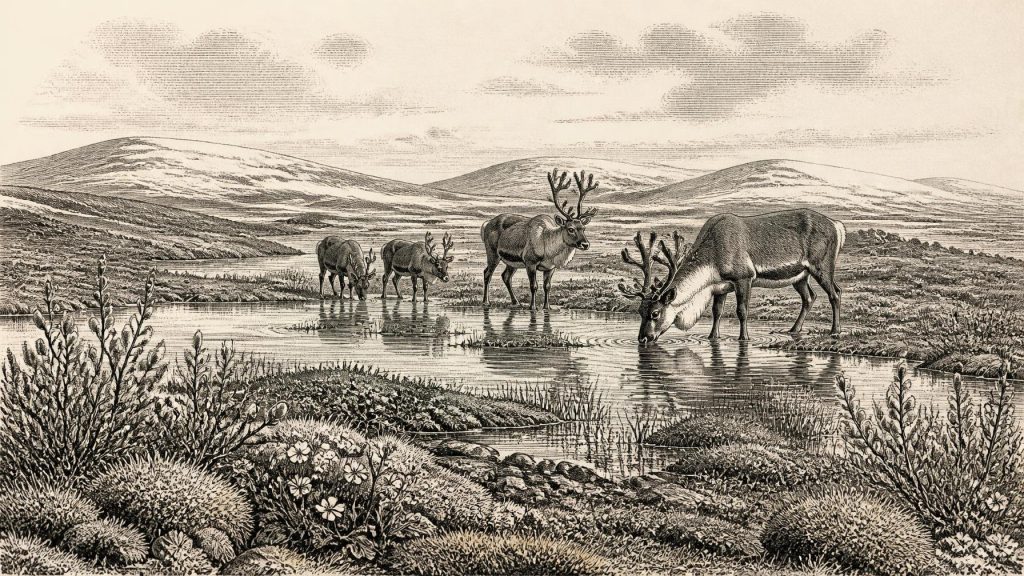
The plants and animals preserved there point to an open, treeless and periglacial environment. Earlier researchers used the word “muskeg” for the waterlogged ground: a mosaic of mossy, sedgy, organic-rich wetland, shallow pools and muddy margins rather than a modern Irish bog. Plant remains included dwarf willow, mountain avens, bogbean and aquatic water-milfoil. These are not a complete inventory of a whole island, nor proof that every Irish valley looked the same. They do, however, demonstrate a viable cold-climate freshwater community in this part of Fermanagh.
The implication is important for Ireland’s environmental history. Around this broad interval, Ireland was not yet at the full extent of the Last Glacial Maximum, when the British–Irish Ice Sheet expanded dramatically between roughly 30,000 and 22,000 years ago, with different sectors reaching maxima at different times. The island’s glacial history was dynamic and regional. A wetland could exist at Derryvree while ice margins lay elsewhere, and that wetland could subsequently be overridden. The surviving evidence is local, so it cannot settle the exact extent of ice across every region in any single century.
Cold-Season Ecology
Derryvree’s botanical remains give the clearest direct picture of everyday non-human life. There was no closed forest comparable to later Holocene Ireland. Instead, low-growing shrubs, herbs, mosses and wetland plants endured a climate marked by cold conditions and strong seasonality. Snow cover, frozen ground and spring thaw would have shaped water movement and the short growing season. Open vegetation would have made wind a prominent force and provided little shelter. Yet it was not a lifeless polar desert: the plant assemblage records freshwater, soil moisture and enough summer productivity to support a food web.
Irish cave deposits add the larger animals to that picture, although they are much less securely tied to one moment. Castlepook’s Pleistocene fauna includes reindeer, woolly mammoth, brown bear, fox, hare, lemming and spotted hyaena. Reindeer and mammoth are particularly evocative of the open, cold environments in which grazing and browsing animals moved through north-west Europe. Hyaenas and other predators or scavengers also matter: caves are not necessarily places where every bone represents an animal that died naturally. Carnivores could bring remains into dens, water and sediment could redeposit them, and antiquarian excavations sometimes mixed contexts now impossible to reconstruct fully.
Accordingly, the Castlepook collection demonstrates that these animals occurred in Ireland during the wider late-Pleistocene interval; it does not provide a census of a contemporaneous herd roaming north Cork in 30,277 BCE. Modern redating has shown why such care is necessary. Improved bone pretreatment produced dates for Castlepook specimens thousands of radiocarbon years older than some earlier determinations, placing elements of the fauna firmly within MIS 3 and suggesting that some species disappeared locally before the Last Glacial Maximum.
The Reindeer Bone and People
The most arresting possible human trace is a fragment of reindeer femur from Castlepook. Zooarchaeologist Ruth Carden has interpreted a deep linear mark on the bone as damage caused by a sharp stone tool while fresh tissue was being cut. County Cork’s heritage publication presents the bone as evidence of Palaeolithic butchery, and the object is held by the National Museum of Ireland – Natural History. If that interpretation is sustained, it indicates that a person, or a small group, handled a reindeer carcass in Ireland during a very early phase of the Upper Palaeolithic.
That is a major possibility, but it should not be enlarged into a settled Ice Age population. The bone came from a cave collection assembled in the early twentieth century, rather than from a newly excavated, intact living floor. No securely associated stone-tool assemblage, hearth, dwelling, burial, artwork or human remains has been established for the same episode. Recent work at Castlepook has located surviving deposits and recovered further fauna, but the 2022 excavation reported no cultural artefacts. The proper conclusion is narrower and more interesting: human modification of this bone is a serious claim under investigation, not evidence for a village, tribe, named culture or continuous occupation.
If people did enter Ireland in this broad period, the most economical interpretation is of mobile foragers operating within the wider Upper Palaeolithic world of north-west Europe. Processing a carcass could mean removing meat, sinew or hide, but a single cut-marked bone cannot identify the tool type, hunting method, group size, language or social organisation. It cannot tell us whether the animal was hunted, found already dead, or scavenged from another predator. Nor can it establish a route of arrival. Lower sea levels and altered ice conditions made the surrounding geography very different from today, but a locally ice-free Fermanagh wetland and a north-Cork faunal cave do not demonstrate a particular land bridge or crossing.
What Cannot Be Recovered
There is no evidence for political institutions, chiefs, diplomacy, territorial states, organised warfare, formal religion, writing, schooling, farming, trade networks or permanent towns in Ireland at this time. Those are not missing chapters waiting to be filled from later Irish history; they are questions for which the evidence is presently silent. Reindeer, mammoth and hyaena remains show ecological movement, not commerce. A possible butchery mark shows an act of carcass processing, not a developed economy. There is likewise no responsible basis for assigning ethnic, linguistic or modern national identities to any possible visitors.
Culture and learning must be approached through material survival. If a stone tool caused the Castlepook incision, it would show practical knowledge: the controlled use of a sharp edge on fresh bone. That small inference is secure only to the degree that the mark is anthropogenic. Nothing comparable yet demonstrates ornaments, cave art, music, ritual or a settled seasonal round in Ireland for this interval. The archaeological silence is partly historical: glaciers eroded landscapes, later sediments buried them, rising seas reshaped coasts, and many early cave investigations lacked modern recording methods.
An Island of Fragments
Ireland around the broad time represented by 30,277 BCE was a place of climatic instability rather than a stage for a datable national event. Derryvree preserves the most tangible scene: cold freshwater pools and waterlogged tundra vegetation, formed after one glacial advance and before another. Castlepook preserves the complementary evidence of large animals and the tantalising possibility that people briefly exploited one of them. These archives do not yield a year-by-year narrative. They do show that even in the deep Ice Age, parts of Ireland could hold complex, living landscapes—and that the question of the island’s earliest human visitors remains open, testable and profoundly dependent on careful dating.
Primary Sources
- Middle Midlandian Freshwater Series at Derryvree, Maguiresbridge, County Fermanagh, Northern Ireland
- Middle Midlandian Freshwater Series at Derryvree, Maguiresbridge, County Fermanagh, Northern Ireland
- Introduction to the Late Quaternary and Holocene of Northern Ireland
- Figure 6.— The Subdivision of the Quaternary Period in Ireland
- A Reconsideration of the Radiocarbon Dating of the Marine Isotope Stage 3 Fauna from Southern Ireland
- The Irish Quaternary Fauna Project
- Growth and Retreat of the Last British–Irish Ice Sheet, 31,000 to 15,000 Years Ago: the BRITICE-CHRONO Reconstruction
- Late Pleistocene Chronostratigraphy and Ice Sheet Limits, Southern Ireland
- Last Glacial Maximum Cirque Glaciation in Ireland and Implications for Reconstructions of the Irish Ice Sheet
- The Timing and Magnitude of the British–Irish Ice Sheet Between Marine Isotope Stages 5d and 2
- Deglacial Rates and Controls for BIIS Western Margin
- Pleistocene Glaciations in Ireland
- The Problem of a Late Quaternary Landbridge Between Britain and Ireland
- The IntCal20 Northern Hemisphere Radiocarbon Age Calibration Curve (0–55 cal kBP)
- IntCal Publications
- OxCal
- The Geology of Ireland: Cenozoic, Tertiary and Quaternary
- Heritage Artefacts of County Cork
- Archaeology Research Excavation Grant 2022: Final Report
- 2022:564 — Castlepook Cave, Castlepook South, Cork
- Occurrence of Mammalia Relicts at Site Castlepook Cave
- New Insights on the Fauna of Ireland’s Younger Dryas and Early Holocene from Alice & Gwendoline Cave
- Irish Pleistocene Biostratigraphy
- The Exploration of Castlepook Cave, County Cork