Derryvree’s Drumlin Interlude30181 BCE
Thirty thousand years BCE is a modern approximation, not a date capable of identifying a specific Irish event. At Derryvree, County Fermanagh, sediments between two glacial tills record an ice-free interlude around 33,500 calibrated years BP, when shallow freshwater, tundra plants and periglacial conditions existed before renewed ice advance. Irish cave fauna, notably Castlepook’s, shows cold-adapted mammals, including reindeer, mammoth and giant deer, occupied landscapes during Marine Isotope Stage 3. A possibly tool-marked reindeer bone may indicate human activity, but proves neither settlement nor occupation. No evidence supports communities, farming or institutions; Ireland’s fragmentary deep past is geological and palaeoecological.
Dateline
Modern calendar-year precision is not available for Ireland at 30,181 BCE. This is a useful modern label for a point roughly 32,131 years before AD 1950, not a recoverable year in which an Irish event can be assigned to a season, a ruler or even a human generation. The responsible setting is the Late Pleistocene, within Marine Isotope Stage 3 and close to the growth of the last British–Irish Ice Sheet. Evidence comes in broad radiocarbon and calibrated ranges, from layers of sediment, fossil plants, insects, bones and glacial landforms. It illuminates an unstable cold-world landscape, rather than a conventional national history.
A Date Measured in Ranges
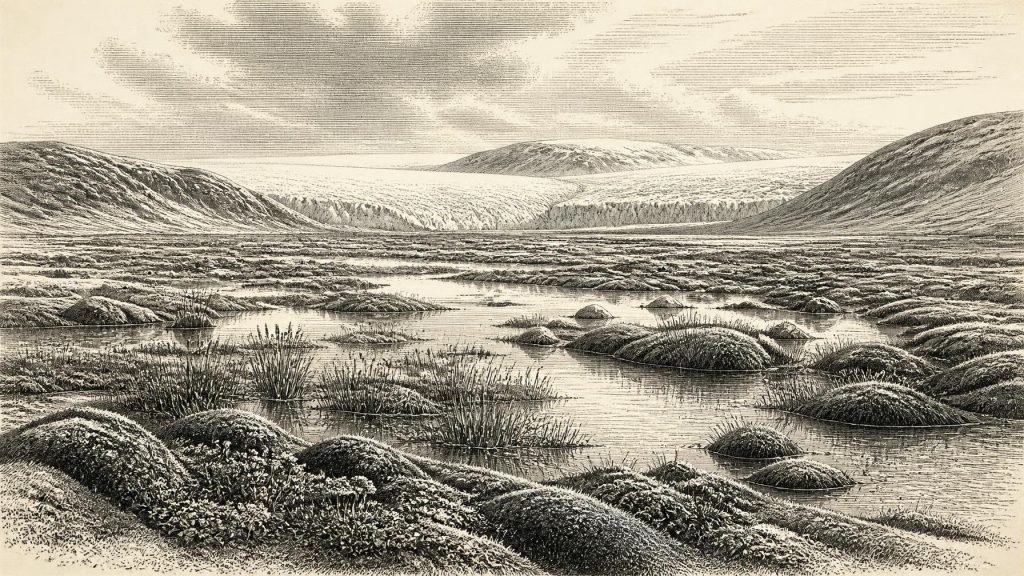
The most important Irish archive for this broad interval lies at Derryvree, near Maguiresbridge in County Fermanagh. Roadworks in 1969 cut through a drumlin and revealed an extraordinary sequence: a lower sheet of glacial till, then freshwater silts, fine sands and organic mud, then another thick till above. In simple terms, ice had occupied the site; a basin subsequently supported water, sediment and life; and ice later returned to cover the deposit. The middle layer therefore preserves a brief environmental interval between glacial advances.
Organic material from the Derryvree freshwater beds, sample BIRM-166, produced a conventional radiocarbon age of 30,500 years BP, with a large uncertainty of plus 1,170 or minus 1,030 years. Radiocarbon years are not calendar years. Calibration against changing atmospheric carbon levels moves such a result further back and leaves a broad probability range. Recent modelling has treated Derryvree as evidence for ice-free conditions around 33.5 ± 1.2 thousand calibrated years BP. That range overlaps the wider world relevant to 30,181 BCE, but it cannot demonstrate that the particular pond, plants or animals observed at Derryvree belonged to that numbered year. Its real historical value is stratigraphic: it records a cold, living landscape before a later expansion of ice.
Wet Ground Between Glaciers
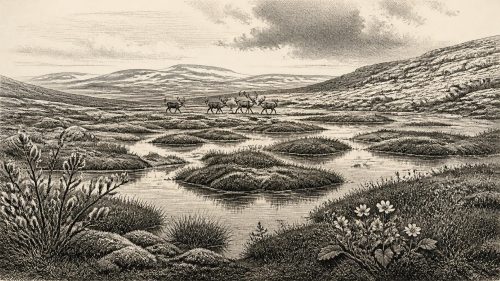
Derryvree was not a forested Ireland in miniature. The plant and animal remains indicate open tundra vegetation and a periglacial climate: ground shaped by frost, short growing seasons and severe winters, though not necessarily ice-covered at every moment. Moss-rich mud, sedges and freshwater plants show that shallow water and saturated ground existed locally. Such evidence supports a patchwork of pools, marshy margins, mineral soil and open herb-rich ground. It does not support a continuous peat bog, modern woodland or a settled farming landscape.
The location mattered. Fermanagh’s basin-and-drumlin terrain could retain water and sediments, while the same glacial processes that built and reshaped the landscape also repeatedly destroyed older surfaces. A freshwater ecosystem needed summer thaw, available water and enough seasonal productivity for plants and invertebrates to complete their life cycles. Yet the upper till is an equally important part of the story. It warns against treating the interval as a long climatic improvement. The landscape was vulnerable to renewed ice advance, and the ground beneath later glaciers was subject to erosion, transport and burial.
Across Ireland, conditions were unlikely to have been uniform. Ice-sheet reconstructions show that the timing of expansion, maximum extent and retreat differed markedly between sectors. At around this broad stage, ice masses in the north and west were developing within a changing British–Irish system; later, during the global Last Glacial Maximum, ice extended far across the Atlantic shelf west of Donegal and Galway. The precise position of individual ice margins around 30,181 BCE remains uncertain. What can safely be said is that Ireland contained shifting combinations of glacier ice, periglacial ground and ice-free refuges rather than one stable national climate.
Animals on an Open Landscape
Animal remains from Irish caves give the larger landscape a population of sorts. Castlepook Cave, near Doneraile in north County Cork, has yielded an exceptionally important, though complicated, Late Pleistocene fauna. Reindeer, woolly mammoth, giant deer, brown bear, wolf, Arctic fox, mountain hare and lemmings are among the animals identified from its historic collections. Not all occupied the cave at once, and no single cave assemblage should be read as a snapshot of one season. Revised radiocarbon programmes have also shown that some older determinations from Irish cave bone require caution. Nevertheless, the overall record establishes that sizeable cold-adapted mammals reached Ireland during Marine Isotope Stage 3, broadly between about 45,000 and 20,000 years ago.
Reindeer are especially evocative because they fit an open, productive tundra or tundra-steppe environment. Their movements could have followed seasonal grazing, while carnivores and scavengers made use of carcasses and caves. Castlepook itself was not necessarily a place where every animal died naturally or where people lived: caves can be dens, traps, shelters, bone accumulators and sites disturbed by later excavation. The faunal record is therefore evidence for the presence of animals and ecological possibilities, not a census of a stable Cork community.
The Human Question
There is no securely published settlement surface, house, hearth, stone-tool assemblage, burial or artwork from Ireland that can be assigned to 30,181 BCE. Political affairs, diplomacy, organised warfare and named communities are consequently beyond the evidence. There were no states, kingdoms or institutions that archaeology can identify here; indeed, archaeology cannot yet establish a resident human population on the island at this time.
One discovery makes the question more interesting without resolving it. A reindeer femur from Castlepook has been publicly interpreted as bearing a deep incision made during carcass processing with a sharp stone tool, and local heritage material places it at about 31,000 BCE. If that interpretation is sustained, it would suggest that people encountered and processed a reindeer in Ireland during this broad cold-stage interval. It would not prove permanent settlement, a hunting camp at the cave, the identity of the tool-user, or repeated occupation. The radiocarbon age dates the animal bone, while the interpretation of a surface mark concerns a separate taphonomic question. Careful language is therefore essential: the bone is a potentially important indication of human activity, not a foundation for an invented Palaeolithic society.
Even a short visit by mobile hunters would have required knowledge, cooperation and material skill. Upper Palaeolithic groups elsewhere in Europe made tailored clothing, composite hunting equipment and complex social connections in demanding climates. But those wider European facts cannot be transferred automatically to Ireland. No Irish artefact of this date demonstrates the kind of tools used, how people travelled, whether they crossed water or exposed lowlands, or whether an encounter with reindeer involved hunting, scavenging or transport by carnivores. Possibility must remain separate from proof.
Everyday Life Beyond Recovery
For the same reason, economy and trade can be described only negatively. There is no evidence for farming, herding, metalworking, pottery, exchange networks or permanent built settlement in Ireland at this date. Nor is there evidence for an Irish market, territory or political boundary. The movement of reindeer, mammoth or carnivores across cold landscapes was ecological movement, not trade. Low sea levels altered the geography of the continental shelf and may have changed access routes around the Irish Sea basin, but reconstructed shorelines and ice margins remain too uncertain to specify a route taken in this particular year.
Religion, language, stories, music and learning leave no identifiable Irish trace from this interval. It would be wrong to infer their absence from silence: people, if present, would have possessed social lives and ways of making meaning. Yet evidence does not permit a responsible description of beliefs, ceremonies, kin groups or languages. The proper historical emphasis lies instead on the physical record: cold-water sediments, plant remains, mammal bones and the capacity of later ice to erase or redeposit what came before.
An Island’s Fragmentary Deep Past
Derryvree’s organic seam and Castlepook’s cave fauna show why Ireland’s deep past is not simply an empty prelude to later prehistory. They reveal episodes when water stood in a Fermanagh basin, tundra vegetation grew, and large mammals ranged through Irish landscapes during a fluctuating cold stage. They also explain why the record is so incomplete. Advancing ice scoured land surfaces; rising and falling seas altered coastal zones; early excavations removed or mixed cave deposits; and organic remains survive only in unusual settings.
Thus 30,181 BCE should not be populated with invented chieftains, battles or villages. It belongs to a time before Ireland’s documented human history, when the island’s story is read chiefly through geology and palaeoecology. The strongest conclusion is both modest and remarkable: somewhere in the broad chronological neighbourhood of this modern date, parts of Ireland supported open, cold, intermittently ice-free habitats, while the ice sheet that would later transform the island was gathering strength. The drumlin at Derryvree preserves that fleeting interval precisely because later ice buried it.
Primary Sources
- Middle Midlandian Freshwater Series at Derryvree, Maguiresbridge, County Fermanagh, Northern Ireland
- The IntCal20 Northern Hemisphere Radiocarbon Age Calibration Curve (0–55 cal kBP)
- A Reconsideration of the Radiocarbon Dating of the Marine Isotope Stage 3 Fauna from Southern Ireland
- The Irish Quaternary Fauna Project
- Growth and Retreat of the Last British–Irish Ice Sheet, 31,000 to 15,000 Years Ago: The BRITICE-CHRONO Reconstruction
- Deglaciation Chronology of the Donegal Ice Centre, North-West Ireland
- Reconstructing the Last Irish Ice Sheet 1: Changing Flow Geometries and Ice Flow Dynamics Deciphered from the Glacial Landform Record
- Reconstructing the Last Irish Ice Sheet 2: A Geomorphologically-Driven Model of Ice Sheet Growth, Retreat and Dynamics
- Pattern and Timing of Retreat of the Last British-Irish Ice Sheet
- Response of the Irish Ice Sheet to Abrupt Climate Change During the Last Deglaciation
- Dimensions and Chronology of the Last Ice Sheet in Western Ireland
- The Last Glacial Maximum
- First Evidence of a Late Upper Palaeolithic Human Presence in Ireland
- New Insights on the Fauna of Ireland’s Younger Dryas and Early Holocene from Alice & Gwendoline Cave
- Aghnadarragh ASSI
- Figure 6—The Subdivision of the Quaternary Period in Ireland
- Heritage Artefacts of County Cork
- 2022:564 — Castlepook Cave, Castlepook South, Cork
- Oscillating Retreat of the Last British-Irish Ice Sheet on the Continental Shelf Offshore Galway Bay, Western Ireland
- The Deglaciation of the Western Sector of the Irish Ice Sheet from the Inner Continental Shelf to Its Terrestrial Margin