Castlepook’s Solitary Reindeer31205 BCE
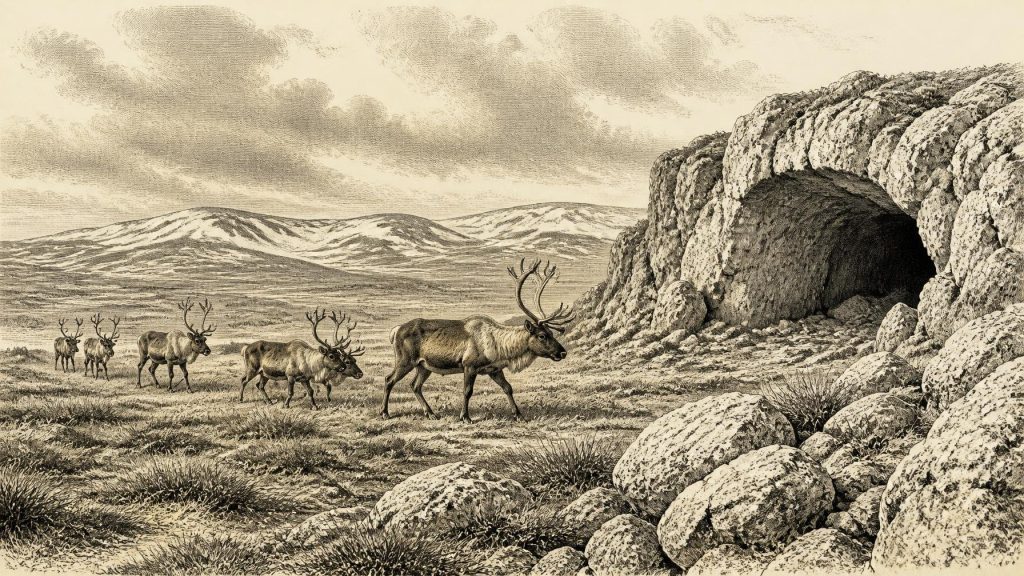
Around 31,205 BCE, an approximate modern label for a fluctuating MIS 3 interval, Ireland was a cold, changing landscape before the Last Glacial Maximum. Castlepook Cave, County Cork, preserves bones of mammoth, reindeer, giant deer, hyaena and animals, showing intermittent habitats for mammals but not a single contemporaneous community. A reindeer femur reportedly bears a possible stone-tool butchery mark and may represent Ireland’s earliest human activity, although dating, context and interpretation remain uncertain. No evidence establishes settlement or culture. Cave deposits, sediments and faunal remains instead reveal open tundra-like environments, mobile wildlife, shifting access, and records obscured by advancing ice.
Dateline
“31,205 BCE” is a modern chronological label, not a date that anyone living in Ice Age Ireland could have recorded. At this depth of time, calendar-year precision is unavailable. The label corresponds only approximately to 33,150 years before 1950, within Marine Isotope Stage 3 (MIS 3), a long and climatically unstable part of the Late Pleistocene. Radiocarbon results from this era must be calibrated and normally produce ranges rather than a single year. The responsible subject, then, is not an event on a particular day or in a particular year, but the fragmentary evidence for Ireland in the millennia around it.
A Landscape Before the Maximum Ice
This was before the Last Glacial Maximum, when the British–Irish Ice Sheet later reached its greatest known extent, broadly between about 27,000 and 23,000 calibrated years ago. Ireland was not yet necessarily the uniformly ice-covered country often imagined from its later Ice Age history. It formed part of a northern Atlantic world in which glaciers, sea ice, ocean circulation and vegetation could change sharply over centuries or millennia. MIS 3 itself is defined by repeated abrupt oscillations between colder stadials and relatively milder interstadials. A single nominal BCE year cannot tell us which short-lived climatic phase was being experienced at a particular locality.
That uncertainty matters. The evidence suggests that parts of Ireland had supported terrestrial mammals during earlier Late Pleistocene intervals, but it does not permit a national weather report for 31,205 BCE. The Irish landscape was probably a patchwork shaped by cold, wind, frozen ground, sparse cover and changing ice margins. Open grass-herb communities, dwarf shrubs and tundra-like vegetation are more defensible comparisons than forests or settled pasture. Conditions varied markedly with altitude, exposure, drainage and proximity to ice. Rivers and shallow basins could create locally richer strips of vegetation and water, while exposed uplands and ground close to glaciers offered little shelter.
Substantial sea-level lowering altered coastlines, but it did not make access to Ireland a simple matter. The geography of the Irish Sea changed as water was locked in continental ice, yet the exact configuration and habitability of possible crossings varied over time. Animal arrivals show that dispersal was possible during some Pleistocene windows; they do not prove a permanent land bridge, a single migration route or easy travel for people. Ireland’s position at Europe’s north-western edge remained a powerful ecological filter.
Caves, Bones and a Narrow Window
The most relevant Irish evidence comes from cave deposits, above all Castlepook Cave near Doneraile in north County Cork. Its faunal archive has produced remains attributed to animals including mammoth, reindeer, giant deer, spotted hyaena, wolf, fox and bear. Taken together, such finds demonstrate that parts of Ireland could at times sustain a cold-climate large-mammal community. They do not mean that all these animals occupied the same valley, or even the island, simultaneously. Caves accumulate material over long periods through deaths, predation, scavenging, water movement, roof fissures and later disturbance.
This distinction is central at Castlepook. Much of its bone assemblage was excavated in the late nineteenth and early twentieth centuries, when recording standards were unlike those expected today. Later research has shown that some cave material was disturbed or reworked. Radiocarbon determinations on individual bones therefore date those bones, not a neatly bounded occupation layer. The 1997 Irish Quaternary Fauna Project nevertheless identified a pre-Last Glacial Maximum sequence in which several mammals had reached Ireland between at least roughly 45,000 and 20,000 radiocarbon years ago. Its results remain valuable, while also warning against treating the cave as a snapshot.
Older dates from Castlepook include a mammoth bone reported at 33,500 ± 1,200 radiocarbon years BP and a spotted-hyaena bone at 34,300 ± 1,800 BP. Such determinations overlap broadly with the time represented by this entry after calibration, but their uncertainties are large and radiocarbon ages are not calendar ages. Giant deer and reindeer were also among the fauna recovered. The secure conclusion is modest but important: south-western Ireland was intermittently available to sizeable grazing and browsing animals, together with predators and scavengers, long before the great ice advance.
The Reindeer Bone Question
A reindeer femur from Castlepook has given this period exceptional public interest. County Cork heritage material reports that it dates to about 31,000 BC and bears a deep mark interpreted by zooarchaeologist Ruth Carden as a cut or chop made during butchery with a sharp stone tool. If that interpretation and attribution withstand further scrutiny, it would be the earliest known indication of human activity in Ireland: evidence that a person or very small party handled a reindeer during MIS 3.
But this is not evidence for an Irish population in the usual sense of the word. There is no securely associated hearth, stone-tool assemblage, dwelling, burial, food store, art panel or repeated concentration of butchered bones from Castlepook at this age. Nor can the dated bone establish the precise moment that the mark was made. Its discovery is a compelling research lead, not a licence to populate the cave mouth with an imagined camp. The appropriate formulation is that human butchery has been proposed for a reindeer bone of broadly this antiquity; permanent settlement, group size, language, identity and duration of any visit remain unknown.
The caution is strengthened, rather than weakened, by later Irish cave research. At Alice and Gwendoline Cave in County Clare, a brown-bear patella with cut marks has been robustly dated to the terminal Pleistocene, around 12,800–12,600 calibrated years BP. That much later find supplies clearer evidence that humans reached Ireland in difficult glacial conditions. It demonstrates what rigorous dating and close study of fresh-bone marks can achieve, but it cannot be projected backwards to describe Castlepook’s visitors tens of millennia earlier.
No Politics, Only Possibilities
There is no evidence from Ireland around this time for political institutions, chiefs, territories, warfare, diplomacy or named communities. There is equally no Irish evidence for ritual sites, burial practice, artistic traditions or formal learning. Absence of evidence is not proof that people lacked social relationships, beliefs or knowledge; it means that none can responsibly be reconstructed for this island and period. Upper Palaeolithic societies elsewhere in Europe made sophisticated stone tools, maintained wide social networks and sometimes created ornaments and art. These comparisons establish human capacity in the wider world, not an Irish cultural inventory.
If people did reach Castlepook, the practical act indicated by the marked bone would have been economically significant: obtaining meat, marrow, hide, sinew or bone from a reindeer. Reindeer were highly mobile animals adapted to cold environments, and a single carcass could be valuable to a small travelling group. Yet even this inference must stay close to the object. It does not establish that people hunted the animal rather than encountered a carcass; nor does it demonstrate seasonal rounds, trade, clothing styles or a reindeer-focused economy. No exchange goods or imported lithics of this age have been securely identified in Ireland.
Animals as Environmental Witnesses
The animal record provides the strongest evidence for everyday ecological realities. Mammoth, reindeer and giant deer imply open country with substantial plant resources, while hyaena and wolf imply carnivore pressures and complex carcass histories. Arctic fox, lemmings and other cold-adapted animals in Irish Pleistocene assemblages point towards rigorous conditions in at least some phases. These species did not form a timeless “Ice Age fauna”; their presence shifted as climate, vegetation, coastlines and ice cover changed. Ireland was a changing frontier, repeatedly entered, abandoned or made inaccessible by different species.
The environmental record from beneath and between glacial deposits adds a complementary perspective. Organic silts at Derryvree near Maguiresbridge, County Fermanagh, have preserved plant remains, pollen and insects from an earlier Midlandian cold-stage interval. They reveal treeless, waterlogged tundra or muskeg conditions, with pools, sedges, mosses and cold-adapted plants. Those deposits cannot be assigned confidently to the nominal year 31,205 BCE, and their radiocarbon results carry wide uncertainty. Their importance is methodological: they show that beneath later tills, Irish sediments can preserve brief ice-free environmental episodes that would otherwise be erased from view.
What This Date Can Mean
Around the notional date of 31,205 BCE, Ireland belongs to deep environmental history rather than conventional national history. The island had no documented rulers or boundaries; it left no contemporary written account and no demonstrable political narrative. Its most tangible witnesses are cave bones, glacial sediments, plant traces and the physical landscapes later ice reshaped. Castlepook’s reindeer bone is important precisely because it is so slight: a possible human action among overwhelmingly non-human evidence.
The larger development was vulnerability to climatic change. Before the Last Glacial Maximum transformed Ireland again, limited habitats could support animals and perhaps occasional people. Afterwards, expanding ice removed or buried much of that record. The scarcity of evidence should therefore not be mistaken for an empty past. It is the expected result of an exposed island at the edge of the North Atlantic, repeatedly altered by ice, water and time. For this year, the most honest history is one of open cold landscapes, mobile animals, uncertain human contact and a surviving cave bone that still asks more questions than it answers.
Primary Sources
- New insights on the fauna of Ireland’s Younger Dryas and Early Holocene from Alice & Gwendoline Cave
- The Irish Quaternary Fauna Project
- Reindeer on the move: the colonisation of Ireland
- Our Ancient Landscapes: Hunter-Gatherers in Ireland
- Heritage Artefacts of County Cork
- Archaeological Heritage of County Cork
- First evidence of a Late Upper Palaeolithic human presence in Ireland
- Maximum extent and dynamic behaviour of the last British–Irish Ice Sheet west of Ireland
- Radiocarbon constraints on the age of the maximum advance of the British–Irish Ice Sheet in the Celtic Sea
- Character of advance and retreat of the southwest sector of the British-Irish Ice Sheet during the last glaciation
- Dimensions and chronology of the last ice sheet in Western Ireland
- Ice sheet extension to the Celtic Sea shelf edge at the Last Glacial Maximum
- Response of the Irish Ice Sheet to abrupt climate change during the last deglaciation
- Britain and Ireland: glacial landforms from the Last Glacial Maximum
- Oscillating retreat of the last British-Irish Ice Sheet on the continental shelf offshore Galway Bay, western Ireland
- Dansgaard–Oeschger events in climate models: review and baseline Marine Isotope Stage 3 (MIS3) protocol
- Equilibrium simulations of Marine Isotope Stage 3 climate
- Global distribution of centennial-scale records for Marine Isotope Stage (MIS) 3: a database
- Oxygen isotope stage 3 fluvial and eolian successions in Europe compared with climate model results
- Did the Eurasian ice sheets melt completely in early Marine Isotope Stage 3? New evidence from Norway and a synthesis for Eurasia
- Irish Association for Quaternary Studies Guide 13
- Figure 6.— The subdivision of the Quaternary Period in Ireland