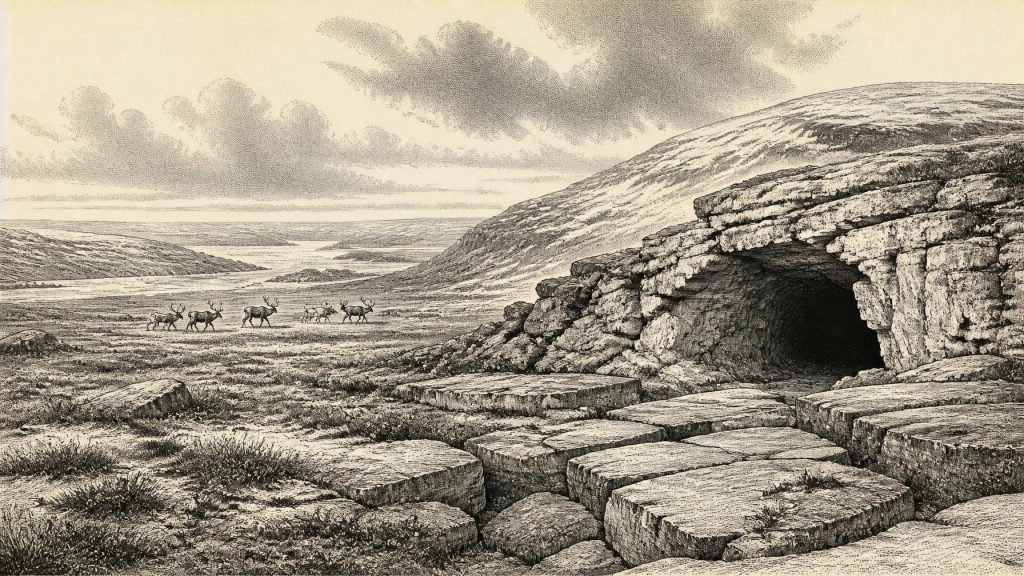
Mammoth and Reindeer at Castlepook30220 BCE
Around 30,220 BCE, Ireland lay in the later Marine Isotope Stage 3, approaching but preceding the Last Glacial Maximum. Conditions varied between expanding ice, frozen lowlands, snowfields and altered coastlines, while erosion has left a fragmentary record. Castlepook Cave, County Cork, produced over 2,000 bones, including mammoth, reindeer, giant deer, bears, hyaenas, wolves, Arctic foxes and lemmings. Its deposits accumulated over long periods through natural and carnivore processes, not one event. A possibly stone-marked reindeer bone may indicate human presence around 33,000 years ago, but cannot demonstrate settlement. Castlepook instead records Ireland’s intermittent ecological connection to cold north-western European ecosystems.
Dateline
“30,220 BCE” is a modern calendar label, not a date that can be recovered from an Irish Ice Age deposit with year-by-year precision. In a simple conversion it falls roughly 32,170 years before AD 1950, the reference point used for “BP” dating, but that does not make it a securely dated moment in the archaeological record. Radiocarbon ages must be calibrated, samples carry uncertainties, and the evidence from Ireland is usually separated by centuries or millennia. The responsible setting is therefore the later part of Marine Isotope Stage 3 (MIS 3), before the Last Glacial Maximum, rather than an imagined event on a particular day or in a particular year.
A Landscape Approaching Maximum Cold
Ireland at this broad point was in the Midlandian cold stage, the Irish expression of the last glacial cycle. It was not yet the climatic low point conventionally called the Last Glacial Maximum: scholarship commonly places that severe interval at about 28,200–20,400 calibrated years BP, while the greatest extent of particular British–Irish Ice Sheet sectors was asynchronous. The ice sheet did not simply switch on across every district at once. Ice caps and ice streams grew, merged, advanced and later retreated at different rates in response to snowfall, temperature, sea level, seabed topography and the changing weight of the ice itself.
That matters particularly for a date around 30,220 BCE. It is unsafe to picture either a uniformly ice-covered Ireland or a wholly open, habitable island. Modern reconstructions indicate rapidly expanding ice over northern Ireland and mountain areas, with ice also developing in the south and west. Offshore evidence shows that major Irish sectors later reached the continental shelf edge, but the timing differed from one margin to another. A map with a single neat ice line would hide the real uncertainty. Local ground conditions may have varied enormously between ice-covered uplands, frozen ground, windswept lowlands, temporary snowfields, meltwater channels and exposed coastal shelves.
The familiar Irish landscape was also absent. There were no peat bogs, enclosed fields, towns or wooded valleys. Sea level was far lower than today because vast quantities of water were locked in northern ice sheets. Coastlines lay well beyond their modern positions, and the geography of the Irish Sea region differed profoundly, although the precise routes available to animals and people at any one phase remain difficult to reconstruct. Later glacial erosion removed or disturbed many earlier deposits, helping to explain why evidence for this period is sparse and uneven.
Castlepook’s Time-Depth
The strongest directly Irish evidence for this general world comes from caves, above all Castlepook Cave near Doneraile in north County Cork, also historically called Mammoth Cave. Its narrow limestone galleries yielded more than 2,000 animal bones during excavations in the early twentieth century. Individual radiocarbon determinations from the cave span a long middle-to-late Ice Age interval, rather than one occupation episode. Recent re-dating has shown that some older measurements from Castlepook and other southern Irish caves understated the antiquity of their material by thousands of radiocarbon years. This is a major lesson in method: a date is not a self-explanatory historical fact, but the result of sampling, preservation, pretreatment and calibration.
Castlepook is consequently indispensable, but it must not be treated as a frozen snapshot of 30,220 BCE. Bones entered caves in several ways: an animal could die there; carnivores could drag in prey; water could move remains; sediment could be redeposited; and nineteenth- and twentieth-century excavation could mix material from different layers. The cave’s impressive faunal list therefore demonstrates repeated ecological connections and the presence of species over long spans of time. It does not prove that every recorded animal lived together, nor that every bone belongs to the same season or century.
Nevertheless, the assemblage transforms the scale on which prehistoric Ireland should be imagined. It includes woolly mammoth, reindeer, giant deer, brown bear and spotted hyaena, alongside wolf, Arctic fox and lemmings in material attributed to cold phases. These animals indicate that Ireland was, at intervals, linked ecologically to the wider north-west European world. Reindeer point to open cold-country habitats; lemmings and Arctic fox reinforce the evidence for harsh conditions; mammoth and giant deer evoke a landscape capable of sustaining very large herbivores. Hyaenas were not passive curiosities: their denning and scavenging activity may account for part of the cave accumulation and warns against casually identifying every broken or marked bone as human work.
The Human Question
The political history of Ireland cannot yet begin here. There are no named communities, leaders, territories, alliances, wars or diplomatic contacts. Nor is there evidence for a settled population, dwellings, hearths, tool-making floors, burials, ornaments, art or a spoken language in Ireland at this time. Religion and learning likewise leave no identifiable Irish trace. To supply any of these would be invention, not reconstruction.
There is, however, an important but still limited question. A reindeer femur from Castlepook has been reported as bearing deep marks interpreted as stone-tool damage, and has been publicly associated with an age of about 33,000 years ago. If that interpretation and contextual association are ultimately sustained, it would indicate that people processed a reindeer in Ireland during this broad pre-maximum phase of the Ice Age. It would be an exceptional early sign of human activity. It would not establish permanent occupation, a camp at the cave, or an event in 30,220 BCE itself. No published excavated assemblage of securely associated tools and features currently permits such a detailed narrative.
The distinction between evidence and interpretation is especially important because caves attract predators as well as people. Cut marks, percussion damage, trampling, carnivore tooth marks, sediment abrasion and excavation damage can sometimes resemble one another. A single modified bone can be historically momentous, but it needs microscopic study, independent dating and secure stratigraphic context. The more securely documented evidence for Late Upper Palaeolithic people in Ireland is much later: a butchered brown-bear bone from Alice and Gwendoline Cave in County Clare has calibrated dates around 12,810–12,590 BP. That later evidence confirms that people reached Ireland before the Holocene, but it cannot fill the long chronological gap back to Castlepook.
Economy Without an Economy
If people did visit Ireland in the period represented by the Castlepook reindeer bone, their economy was not an Irish economy of farms, markets or trade routes. It would have depended on mobile hunting and gathering within a larger north-west European landscape, probably following seasonal opportunities rather than exploiting a permanently occupied territory. Reindeer would have provided meat, fat, hide, sinew, antler and bone; yet these are reasonable possibilities derived from Upper Palaeolithic lifeways elsewhere, not things demonstrated by an excavated Irish camp. There is no evidence that mammoth was hunted in Ireland, rather than scavenged by carnivores or represented by animals dying naturally.
Nor can contact be described as trade or diplomacy. Movement of animals and perhaps people across the exposed, ice-affected lands and altered seaways around Ireland implies changing connectivity, but no exchange goods or social networks can be identified on the island. The safest conclusion is more modest and more revealing: Ireland was not necessarily biologically empty before the climatic maximum. It formed an intermittently accessible edge of a changing cold-world ecosystem, where large mammals, predators and perhaps small numbers of human visitors could appear and disappear as conditions altered.
What This Date Can Mean
For Ireland around 30,220 BCE, environmental history carries the weight that later historical documents, monuments and settlements carry for other eras. Ice-sheet landforms, cave sediments, animal collagen, fossil identifications and improved radiocarbon methods are the archive. They show a dynamic island-region moving towards the Last Glacial Maximum, not a blank stage awaiting later settlers. Castlepook’s mammoth and reindeer remains give this otherwise remote period a tangible Irish character, while their complicated contexts set firm limits on what can be claimed. The story is one of deep climate change, mobile fauna and a tantalising, still unresolved possibility of very early human passage.
Primary Sources
- A reconsideration of the radiocarbon dating of the Marine Isotope Stage 3 fauna from southern Ireland
- The Irish quaternary fauna project
- Pleistocene glaciations in Ireland
- Growth and retreat of the last British–Irish Ice Sheet, 31,000 to 15,000 years ago: the BRITICE-CHRONO reconstruction
- Timing and pace of ice-sheet withdrawal across the marine–terrestrial transition west of Ireland during the last glaciation
- The deglaciation of the western sector of the Irish Ice Sheet from the inner continental shelf to its terrestrial margin
- Stratigraphic and palaeo-geomorphological evidence for the glacial-deglacial history of the last British-Irish Ice Sheet in the north-western Irish Sea
- Marine geophysical evidence for Late Pleistocene ice sheet extent and recession off northwest Ireland
- First evidence of a Late Upper Palaeolithic human presence in Ireland
- The colonization of Ireland: A human ecology perspective
- Phylogeographic, ancient DNA, fossil and morphometric analyses reveal ancient and modern introductions of a large mammal: The complex case of red deer (Cervus elaphus) in Ireland
- Cork County Geological Site Report: Castlepook Cave
- 2022:564 – Castlepook cave, Castlepook South, Cork
- New insights on the fauna of Ireland's Younger Dryas and Early Holocene from Alice & Gwendoline Cave
- Late Pleistocene chronostratigraphy and ice sheet limits, southern Ireland
- The timing and magnitude of the British–Irish Ice Sheet between Marine Isotope Stages 5d and 2: implications for glacio-isostatic adjustment, high relative sea levels and ‘giant erratic’ emplacement
- A critical review and re-investigation of the Pleistocene deposits between Cranfield Point and Kilkeel, Northern Ireland: implications for regional sea-level models and glacial reconstructions of the northern Irish Sea basin
- Palaeoecology
- Regional Pleistocene Geology
- Field Guides – Irish Quaternary Association
- Anthropogenic changes to the Holocene nitrogen cycle in Ireland
- Pleistocene vertebrates in the British Isles
- Reindeer bone found in Cork cave shows human activity in Ireland 33,000 years ago