Membership is completely free, giving members unlimited access to all available resources, services, features, and benefits without any restrictions or fees.
Welcome back. Sign in to continue enjoying unlimited access to all available resources, services, features, and member benefits at no cost.
For Ireland, 1937 was defined above all by the making, approval and commencement of a new constitution. The process was neither a single dramatic day nor an uncomplicated national consensus. It unfolded through public argument, parliamentary scrutiny, an election and a plebiscite, while the State remained economically entangled with Britain, politically divided by partition and socially marked by poverty, emigration and religious authority. Yet the outcome gave the twenty-six-county State its enduring constitutional name, institutions and vocabulary. On 29 December, the Constitution of Ireland came into operation: the Irish Free State’s constitutional order was replaced by one describing the State as Éire in Irish and Ireland in English.
Éamon de Valera’s Fianna Fáil government remained in office, pursuing the long campaign to reduce the constitutional traces of British authority without provoking a rupture that might damage Irish interests abroad. This was delicate work. Britain remained the indispensable economic neighbour, the principal destination for much Irish produce, and the country to which many Irish people emigrated. Partition remained intact, while Northern Ireland continued under its own parliament at Stormont and within the United Kingdom. Constitutional assertion in Dublin could not by itself settle either question.
The year began with the Coal–Cattle Pact, announced on 3 January. It was not a final settlement of the Economic War, which had begun after the Free State withheld land-annuity payments claimed by Britain under the Treaty settlement. Rather, it was a practical bargain. Britain enlarged the quota for Irish cattle entering its market, while the Free State undertook to buy a corresponding value of British coal. John Dulanty, the Irish High Commissioner in London, played a central part in securing the arrangement.
In 1933 the Irish Free State moved decisively from the unsettled compromises of its foundation towards a more assertive interpretation of self-government. The defining act of the year was the removal of the oath required of members of the Oireachtas: a change whose legal wording was narrow enough to pass as legislation, but whose political meaning reached back to the Anglo-Irish Treaty, the Civil War and the bitter question of whether Irish representatives could fully serve the nation while making a declaration involving the Crown. The year also brought a general election, continuing conflict with Britain over land annuities and trade, a sharp confrontation over organised political uniforms, and new efforts to reshape agriculture, industry and social provision.
The year’s most consequential development came on 11 December, when the British Parliament enacted the Statute of Westminster. It applied to the Irish Free State alongside the other self-governing dominions. In constitutional terms, it ended the general power of Westminster to legislate for a dominion without that dominion’s request and consent, removed the old rule that colonial legislation could be invalid because it conflicted with British law, and recognised dominion power to legislate beyond its territory. For the Free State, this confirmed in law a degree of legislative autonomy that Irish representatives had increasingly asserted in practice through diplomacy and participation in the League of Nations.
The clearest assertion of external independence came in September. On 17 September 1930 the Irish Free State began a three-year term on the Council of the League of Nations. This was more than ceremonial advancement. The League’s Council was a small body at the centre of interwar diplomacy, and the Free State’s presence there offered an international stage to a country that had entered the League only seven years earlier.
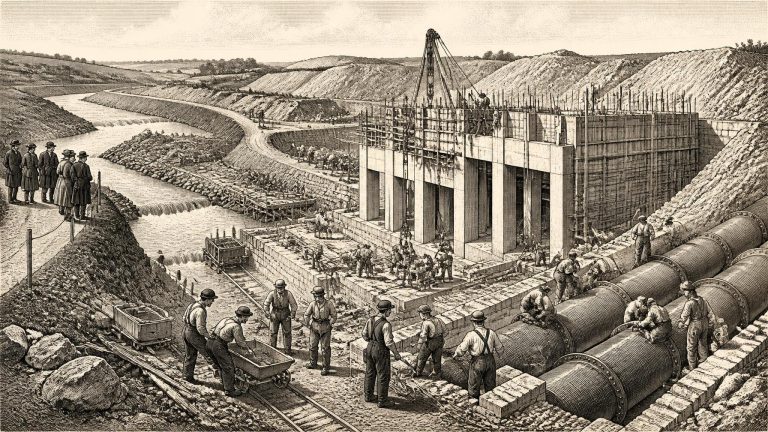
The defining event came on 22 July, when W. T. Cosgrave, President of the Executive Council, formally opened the Shannon Scheme at Parteen, near Limerick. Water was admitted from the intake works into the headrace canal leading to the generating station at Ardnacrusha. The scheme had been built for the Free State by the German firm Siemens-Schuckertwerke and involved a dam, diversion works, canal, turbines, transmission lines and a new organisation of national electricity supply. It was an immense undertaking for a state still only six years old, and it advertised a determination to use public infrastructure to overcome the disadvantages of a small, overwhelmingly agricultural economy.
The Oireachtas made substantial constitutional changes during the year. On 12 July, the Constitution (Amendment No. 10) Act repealed Articles 47 and 48 of the 1922 constitution. Those articles had provided, respectively, a route by which legislation could be referred to the people after a petition and a route for legislative initiatives from voters. Their removal narrowed the constitution’s provisions for direct democracy. The arguments in the Dáil were fierce. Éamon de Valera, then leading Fianna Fáil in opposition, portrayed the measure as taking a safeguard from the electorate, while the Government maintained that the provisions could be exploited to generate destabilising agitation. The episode illustrates a central tension of the period: the Government sought a settled parliamentary order, whereas its opponents feared that stability might be bought at the expense of popular control.
The first general election was held on 9 June. It was the first national election fought by Fianna Fáil, founded by de Valera in 1926 after his break with abstentionist Sinn Féin. The party sought a republican route into electoral politics while refusing the Oath of Allegiance required before members could take their seats. Its campaign therefore combined a promise to remove the oath with an attempt to win votes from those dissatisfied with the cautious, fiscally restrained administration of W. T. Cosgrave’s Cumann na nGaedheal.
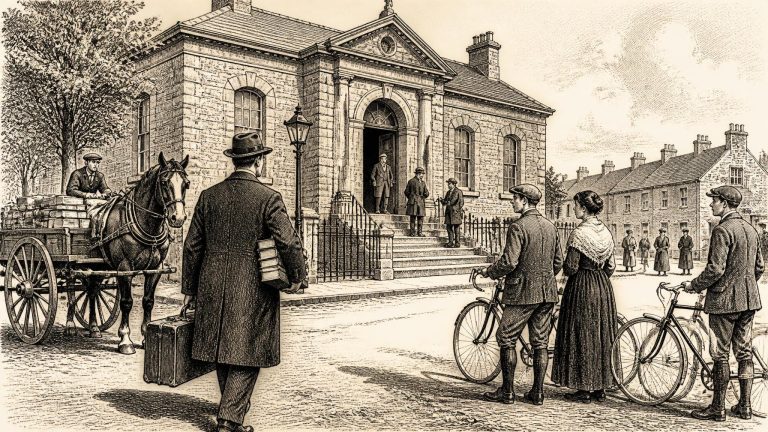
The most comprehensive event of the year was the Census of Population, taken on the night of Sunday 18 April. It was the first census conducted by the government of the Irish Free State. The machinery of the new state reached into private houses, farms, lodging houses, religious institutions, barracks, hospitals, prisons and vessels in Irish waters. Household heads were asked to record each person present at midnight; returns could be made in Irish or English. The census order also required information on dwellings and buildings, as well as the population’s age, sex, marital condition, birthplace, occupation, religion and Irish-language knowledge. Members of the Garda Síochána collected the forms, a significant everyday demonstration of the authority of a police force created in the aftermath of revolution.
The Boundary Commission was the year’s central political drama. Article 12 of the 1921 Treaty had promised that a three-person commission would determine the boundary between Northern Ireland and the Free State, taking account of inhabitants’ wishes where compatible with economic and geographic conditions. Many nationalists expected substantial areas with Catholic and nationalist majorities, particularly in Fermanagh, Tyrone and south Armagh, to move into the Free State. Such expectations were politically important: they helped make partition appear temporary, or at least corrigible.
The year’s most dangerous domestic confrontation came not from the defeated anti-Treaty IRA but from within the National Army that had fought for the Free State. The wartime force was expensive, oversized for peacetime and internally divided. Demobilisation threatened the positions and expectations of officers who had entered the army from different revolutionary organisations and personal networks. For a government attempting fiscal restraint, a smaller, disciplined military answerable to civilian ministers was essential. For officers who believed the army’s revolutionary standing gave it a special political role, retrenchment seemed both a practical injustice and a betrayal.
The Civil War did not end through a negotiated settlement, formal surrender or single peace treaty. Its closing phase was instead a sequence of military reverses, political decisions and orders issued by the anti-Treaty leadership. Liam Lynch, chief of staff of the anti-Treaty IRA and a determined opponent of ending the campaign, was fatally wounded by Free State troops on 10 April while fleeing on the Knockmealdown Mountains in County Tipperary. He died that evening in Clonmel. His death removed the leading military advocate of continued resistance at precisely the moment when the republican movement was exhausted, increasingly fragmented and under severe pressure.
The immediate issue was the Anglo-Irish Treaty signed in London in December 1921. It offered dominion status within the British Commonwealth, required an oath connected with the Crown, accepted the possibility that Northern Ireland would remain separate, and retained important British strategic safeguards. Supporters, including Michael Collins and Arthur Griffith, argued that it supplied the institutions and freedom from which fuller national independence could be developed. Opponents believed that accepting it abandoned the republic proclaimed in 1916 and defended during the War of Independence.