
Ferguson’s Hillsborough Flight1909 CE
In 1909, Ireland remained within the United Kingdom, yet social, political and cultural change accelerated. Old-age pensions, introduced in January, gave qualifying elderly people a statutory income. The Irish Land Act advanced tenant purchase and addressed western congestion, while the People’s Budget and the United Irish League’s baton convention exposed nationalist divisions, prompting William O’Brien’s All-for-Ireland League. James Larkin’s general union established an Irish labour base. University reform replaced the Royal University with national and Belfast institutions. Synge’s death, Irish-language opera and the Clare Island Survey reflected innovation. On 31 December, Harry Ferguson’s monoplane achieved Ireland’s first self-designed, self-built flight.
Dateline
For Ireland, 1909 was not a year of a single constitutional breakthrough or dramatic rebellion. Home Rule remained an aspiration pursued at Westminster, while the island was still governed within the United Kingdom. Yet the year brought a series of firmly dated changes and incidents which exposed the forces remaking Irish life: a state pension reached elderly people for the first time; land purchase legislation attempted to complete a rural revolution; nationalist unity fractured in public; a new university order took legal effect; and, on the final day of the year, a County Down mechanic rose briefly into the air in a machine of his own making. Taken together, these developments show an Ireland in which social need, political strategy, cultural confidence and technological curiosity were all becoming more visible.
Money for Old Age
The most immediate change came on 1 January, when the Old Age Pensions Act of 1908 began to operate in Ireland. For qualifying men and women aged seventy or over, it provided a non-contributory weekly payment from public funds. A person with yearly means of no more than £21 could receive the full five shillings a week; smaller payments were available up to an income of £31 10s. The sum was modest, and the threshold of seventy was high even by contemporary standards. Nonetheless, this was money paid as a legal entitlement rather than charity offered by a landlord, family, parish or Poor Law authority.
The scheme did not abolish insecurity. Applicants had to prove age, residence and means, and could be disqualified by receipt of poor relief, imprisonment and other provisions of the Act. Establishing age could be especially difficult in a society where civil registration had begun only in 1864 and many claimants had been born decades earlier. Family memory, parish records and recollections of notable events could therefore acquire official importance. The pension was administered through the Post Office, a deliberate contrast with the stigma attached to the workhouse and Poor Law relief.
Ireland’s large number of potential claimants made the measure especially consequential. In rural districts, where small farms, seasonal labour, emigration and dependence on relatives shaped household economies, even a few shillings could alter the balance of a home. It could help an older parent remain with family rather than enter an institution, or provide a small but dependable contribution towards food, fuel and rent. The pension was not a remedy for poverty, but its arrival made the state a new presence in the daily calculations of old age.
Land Purchase and Political Fracture
Land remained central to politics because the ownership of the countryside was still being transferred, estate by estate, from landlords to occupying tenants. The Irish Land Act received royal assent on 3 December 1909. It amended the financial machinery of earlier land-purchase legislation, made provision for compulsory acquisition in specified circumstances, and extended the work of the Congested Districts Board. Its technical clauses mattered because they affected the pace and terms on which farms could be sold, purchased, enlarged or redistributed.
For many tenant farmers, ownership promised a degree of security unimaginable in the worst decades of the nineteenth century. But the process was neither simple nor universally satisfactory. Purchase annuities had to be paid; the quality and size of holdings varied greatly; and the landless rural labourer did not automatically benefit when a tenant became an owner. The Act also continued the effort to address congestion in poorer western districts, where holdings could be too small to sustain families adequately. Thus the countryside of 1909 was being transformed, but not made equal.
At Westminster, the Liberal government’s People’s Budget sharpened Irish political tensions. Introduced in April by Chancellor David Lloyd George, it proposed new taxes, including duties affecting land and alcohol. John Redmond’s Irish Parliamentary Party judged elements of the Budget damaging to Irish interests, particularly in a country where the politics of land and drink excise had powerful local consequences. Yet the wider constitutional struggle mattered at least as much. The House of Lords’ power to block finance legislation was an obstacle to any future Home Rule measure, so the Budget crisis potentially opened a route towards curbing that veto.
That strategy did not produce uniform nationalist agreement. In February, a United Irish League convention at the Mansion House in Dublin descended into the notorious “baton convention”, a confrontation which helped confirm the breach between the party leadership and William O’Brien’s followers. In March, O’Brien launched the All-for-Ireland League. Its principal base was in Cork, and it argued for conciliation across political and religious divisions, particularly with southern unionists and moderate landlords. Its appearance did not displace Redmond’s party as the main nationalist force, but it showed that constitutional nationalism was neither as disciplined nor as socially settled as its Westminster representation could suggest.
Labour Finds an Irish Organisation
The labour movement also entered a consequential new phase. James Larkin had formally founded the Irish Transport and General Workers’ Union on 28 December 1908, after breaking with the British-based National Union of Dock Labourers. Its significance belongs squarely to 1909 because the new organisation began the year as an Irish general union and Larkin soon made Dublin its principal base. His aim was unusually ambitious: to organise skilled and unskilled workers, women and men, across trades rather than confining them to narrowly defined crafts.
Its prospects were shaped by the harsh conditions of urban employment. Dublin contained great wealth and commerce, but also overcrowded tenement housing, insecure casual work and low-paid occupations. Dockers, carters, labourers and other workers who could be hired by the day had limited bargaining power as individuals. Larkin’s insistence on solidarity, including the possibility of sympathetic action, offered a radically different response. The union was still small in 1909 and the famous Dublin Lockout lay four years ahead; it would be misleading to treat the later conflict as already inevitable. But the institutional foundation from which that confrontation grew was now in place.
Universities Reordered
Higher education underwent a definite administrative turning point on 31 October, when the Royal University of Ireland was dissolved. The Irish Universities Act of 1908 had created the National University of Ireland and Queen’s University of Belfast, but 1909 was the year in which the transition was completed and the National University had fully replaced the Royal University with a senate in being. The National University brought together University College Dublin, University College Cork and University College Galway as constituent colleges.
The reorganisation reflected one of the most persistent Irish controversies of the previous generation: whether Catholic students could receive university education in institutions acceptable to their community without surrendering academic standing. It did not end all argument about religion, public money or intellectual freedom. It did, however, create durable institutions whose names and successor bodies would remain central to Irish education. In Belfast, the new Queen’s University, established by charter in 1908, was developing its own distinct role in an industrial, predominantly unionist city. The university settlement therefore marked both an all-Ireland educational reform and the growing differentiation of regional public life.
Culture, Science and Public Argument
Irish cultural life recorded loss as well as innovation. The playwright J. M. Synge died in Dublin on 24 March, aged thirty-seven. His plays had helped make the Abbey Theatre a site of argument about language, rural society, sexuality, religion and national representation. The controversy surrounding The Playboy of the Western World was recent enough for his death to register not merely as the passing of a writer, but as a blow to a theatre movement still defining itself. In the same year Lennox Robinson’s The Cross Roads reached the Abbey stage, indicating that the theatre was continuing to cultivate new Irish dramatists.
The Gaelic Revival was equally active in music. Robert O’Dwyer’s Eithne, nó Éan an Cheoil Bhinn, with a libretto by Tomás Ó Ceallaigh, was performed at the Oireachtas festival in Dublin in August. The National Library of Ireland identifies it as the first grand opera with a text entirely in Irish. Its production mattered not because opera had suddenly become a mass entertainment, but because it demonstrated the range of ambition within the language revival. Irish could be presented not only in classes, speeches and traditional song, but in an extended modern theatrical form.
Scientific work also began to map Ireland with new systematic purpose. Fieldwork for the Clare Island Survey commenced in 1909 under Robert Lloyd Praeger’s direction. The project, conducted over several seasons under the auspices of the Royal Irish Academy, brought researchers to County Mayo to study plants, animals, geology, archaeology, weather, farming, place-names and local life. Such an undertaking treated an island and its neighbouring district as an interconnected environment rather than a collection of curiosities. It preserved knowledge of a western landscape at a moment when migration, economic change and modern communications were altering the communities within it.
A Flight at Year’s End
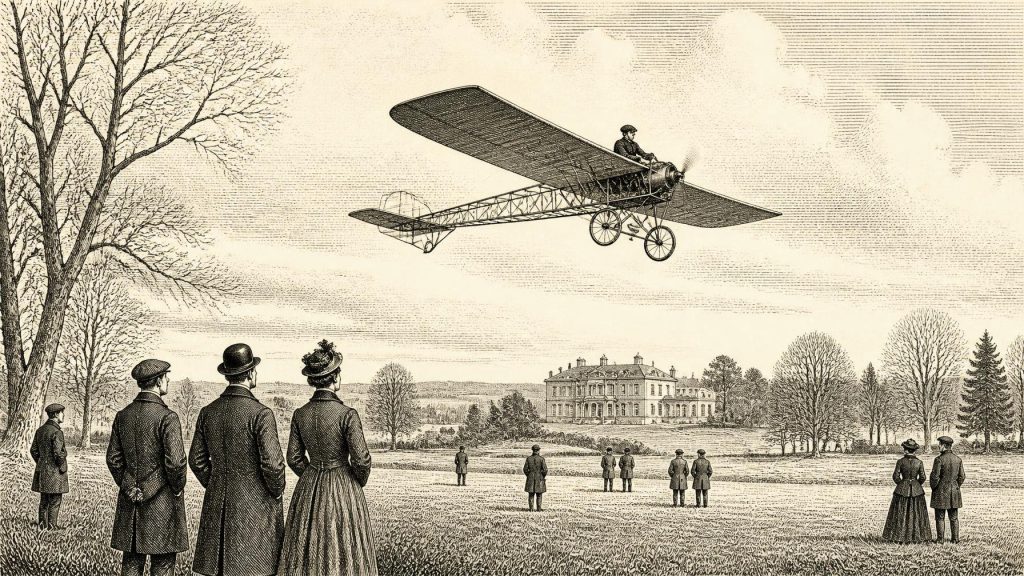
On 31 December, Harry Ferguson made a successful powered flight at Hillsborough, County Down, in a monoplane he had designed and built with engineering help from the Ferguson family business. The flight covered about 130 yards at a height of roughly fifteen feet. It was brief, risky and far from a practical transport service, but it was a genuine technical milestone: Ferguson became the first person in Ireland to design, build and fly his own aeroplane.
The image of the machine lifting over the Downshire estate provides an apt closing scene for 1909. Ireland was still largely rural, still politically subordinate to Westminster, and still divided by class, religion and constitutional allegiance. Yet its people were receiving pensions, buying land, organising workers, remaking universities, staging Irish-language opera, surveying remote environments and attempting flight. The year did not settle Ireland’s future. It made clearer how many different futures were already being built.
Primary Sources
- Old Age Pensions Act 1908
- Revenue and Old Age Pensions in the 1920s and 1930s
- Poverty and Health
- Old Age Pensions (Ireland), 12 July 1909
- Irish Land Act, 1909
- O'Brien, William
- Devlin, Joseph
- The ‘baton’ convention, February 1909
- Commons Chamber, 4 November 1909
- Larkin, James
- Our History
- Manuscript Extract from The Irish Nation of 2 January 1909 Concerning the Formation of the Irish Transport and General Workers' Union
- Irish Universities Act, 1908
- History
- History and Heritage
- Synge, (Edmund) John Millington
- The Cross Roads
- Original Music Manuscript Written by Robert O'Dwyer for the Opera Eithne, nó Éan an Cheoil Bhinn
- Eithne, ceoldráma
- Hyde and MacNeill
- Twelve Portraits: Robert Lloyd Praeger
- The Survey of Clare Island: Report of Progress During 1910
- Harry Ferguson & Aviation
- Harry Ferguson Guide
- Context: Copy Letter from Francis Sheehy-Skeffington to John Redmond, 1909 December
- Suffrage in Wicklow