Muckross and the Poet-Master1448 CE
Records for 1448 depict Ireland as a patchwork of lordships, religious houses and learned networks rather than a single national story. A severe plague in Meath caused deaths among laymen, a ruling family and friars. Killings in Leinster and Connacht, alongside changes in regional lordships, reveal persistent rivalry within and between political communities. Bishops, abbots and aristocrats died, while a couple drowned on an Ulster waterway, underlining travel’s hazards. Donal Mac Cárthaigh Mór supported the Observant Franciscan foundation at Muckross. The deaths of poets Tadhg Óg Ó hUiginn and Diarmait Ó Dálaigh highlighted institutions of education, hospitality, patronage and commemoration.

Dateline
In 1448, Ireland’s written record does not offer one commanding national event. Instead, the surviving notices bring several worlds into view at once: disease in Meath, violent local rivalries in Leinster and Connacht, deaths among bishops and abbots, a fatal accident on an Ulster waterway, the passing of two distinguished poets, and the foundation of a Franciscan house at Muckross in Kerry. Taken together, they show a country of many political jurisdictions and overlapping communities, bound together by travel, religion, learning and patronage as much as divided by lordship and war.
The year must be handled carefully. Much of what is known comes from annals: selective records compiled within particular learned and ecclesiastical traditions, rather than a complete chronicle of daily life. The Annals of the Four Masters, compiled much later from earlier material, supply the fullest Irish sequence for 1448. The Annals of Ulster independently preserve several important notices, including the death of Tadhg Óg Ó hUiginn and a precisely dated drowning. They permit firm statements about recorded deaths and incidents, but not a claim that every important development of the year was written down.
Plague in Meath
The most alarming entry is concise: a “great plague” raged in Meath. Among those said to have died were Conchobhar, son of Aodh Ó Fearghail; Diarmait Mac Conmaighe; and three friars of Longphort Uí Fhearghail, the settlement associated with the Ó Fearghail lordship in what is now County Longford. The annalist did not identify the disease in modern medical terms. It is therefore safer to call it plague or epidemic disease, as the source does, rather than diagnose it as bubonic plague.
The notice nevertheless conveys the social reach of mortality. A local lordly family, another named man and members of a religious community all appear in the same sentence. Religious houses were not isolated retreats: friars depended upon surrounding communities for food, labour, alms and protection, while offering preaching, burial, prayer and hospitality. Deaths within a friary could thus be felt beyond its walls. The epidemic of 1448 also followed a plague reported in 1447 across parts of Meath, Munster and Leinster. That sequence may indicate continuing or recurrent sickness, though the record does not allow its precise spread, duration or scale to be reconstructed.
For ordinary people, disease joined the familiar vulnerabilities of a predominantly rural economy. A bad season, insecurity on roads, the loss of livestock, warfare, or the death of a household’s working adults could all threaten subsistence. Yet 1448 supplies no securely dated general harvest failure, famine or environmental catastrophe. The responsible conclusion is not that conditions were universally desperate, but that illness was sufficiently severe in Meath to command annalistic attention.
Lordship and Local Violence
Several deaths expose the hard edges of political life. Cathal, son of the lord of Uí Fhailghe, was slain by the English of Leinster. The wording matters. It does not describe a war between two modern nations, but a frontier conflict involving the Gaelic lordship of Uí Fhailghe and the English-descended political and landed communities of Leinster. Uí Fhailghe lay beside the English lordship’s central territories, where raids, counter-raids, tribute claims and shifting alliances were recurrent features of power. Cathal’s death is firmly assigned to 1448; the annals do not provide a battlefield, date, commander or fuller cause, and none should be invented.
Elsewhere, Niall Ó Maolmhuaidh was killed by the Uí Riagáin, identified in later usage with the O’Dunnes. In Connacht, Cathal, son of Feidhlimidh and grandson of Ruaidrí Ó Conchobhair, was killed by two members of his wider kin group, Toirdelbach and Diarmait, sons of Ruaidrí son of Cathal Ó Conchobhair. Such notices are reminders that succession and territorial authority were negotiated within extended ruling families as well as contested against neighbours. Annalists often named killings without explaining their immediate political background; the fact of death is secure, but an elaborate narrative of motives would be speculation.
The year also brought the death of Conchobhar Mac Branáin, lord of Corca Achlann in Magh Aí, after thirty-seven years as ruler. He had resigned his lordship in the preceding year and was buried at Roscommon. This is a rare glimpse of an orderly transfer or withdrawal from office, rather than a violent displacement. The annal places political authority within family, territory and ritual: resignation from lordship was followed by burial at an important religious centre. The death of Ó Lochlainn, lord of the Burren, similarly marks a change in a regional lordship, though the surviving notice gives no detail of succession.
Churches, Communities and Memory
Ecclesiastical deaths were prominent. Conchobhar Mac Faolchadha, bishop of Ros Ailithir—Ross Carbery in west Cork—died in 1448. So did the abbot of Holy Trinity on Lough Key. Trinity Abbey stood on an island in the lake and had long been a significant religious house in the Connacht–Roscommon region. The annal’s brief wording does not tell us how either office was filled afterwards, but it shows that episcopal and monastic institutions remained central reference points in the country’s historical memory.
In Fermanagh, Cú Chonnacht, son of Pilib Mag Uidhir, died one month after May Day and was buried in the church at Achadh Urchair, now Aghalurcher, beside Lough Erne. The Annals of Ulster frame his death in the conventional language of penitence; the Four Masters likewise record his burial. Such formulas were not casual embellishments. A “good death” joined aristocratic standing to repentance, burial in a sacred place and the expectation of intercessory prayer. They also show how local churches served as dynastic places of memory.
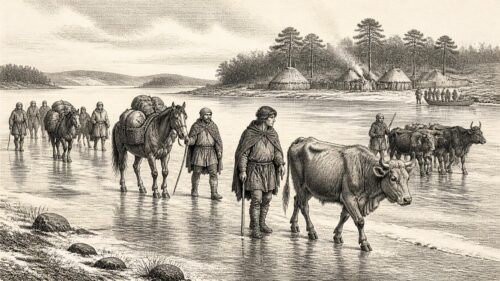
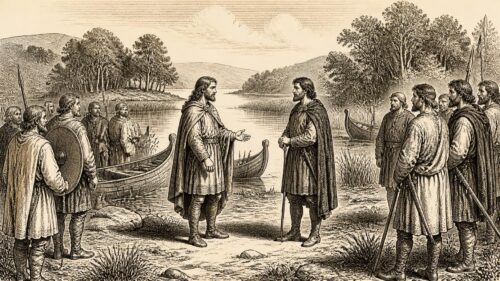
A more startling notice records that Brian Mac Gilla-Coisgle and his wife, Caitilín Ó Ceallaigh, drowned in the port of Ard Uí Luinín on 6 February. This exact date is one of the few in the year’s Irish record. It points to the practical importance—and risk—of travel by water. Lakes, rivers and sea inlets connected communities more efficiently than many land routes, carrying people, food, livestock, messages and ecclesiastical visitors. The annal does not say whether the couple were travelling by boat or how the disaster occurred. What it preserves is the loss of a married pair, and thus the human cost behind a brief formula.
Muckross and Reforming Franciscanism
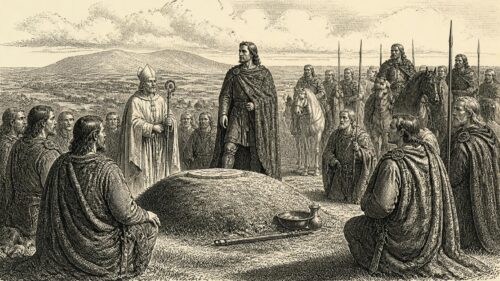
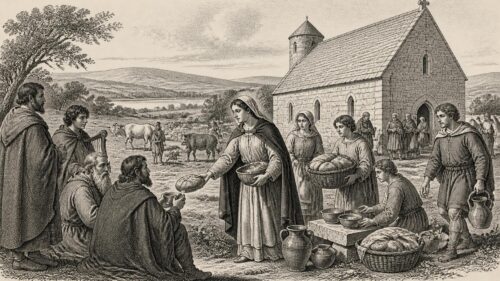
In south-west Munster, 1448 is traditionally and officially given as the foundation date of the Observant Franciscan friary at Muckross, near Killarney. Donal Mac Cárthaigh Mór, a Gaelic lord of Desmond, provided the political support and patronage. The precise stages of planning and construction cannot be dated day by day, and the surviving ruins should not be imagined as completed in a single year. But the establishment of the community belongs securely to 1448.
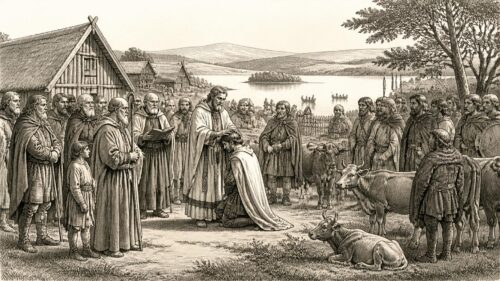
The choice of Observant Franciscans connected Muckross to a wider movement for stricter religious observance within the order. Such foundations were spiritual institutions, but also public statements of lordly standing. A patron could seek prayers for kin, provide a burial place, attract learned and religious visitors, and display wealth through endowment and building. The friars, in turn, embedded a local lordship within a Christian geography that stretched beyond Kerry through Irish, British and continental Franciscan networks. Muckross therefore belongs both to the religious life of the region and to the politics of patronage.
The Death of a Poet-Master
The cultural loss most fully marked in 1448 was that of Tadhg Óg Ó hUiginn. The Annals of Ulster call him preceptor of the schools of Ireland and Scotland in poetry and learning, keeper of a general guesthouse for learned retinues and Irish pilgrims. He died at Cill Chonnla, in County Galway, and was buried at Athleathan. The annal immediately adds that Tuathal Ó hUiginn succeeded him as director. This is unusually valuable evidence for continuity: a school and its responsibilities outlived its master.
Ó hUiginn’s status illustrates the organised character of late medieval Gaelic learning. Professional poets did far more than compose praise. They preserved genealogies, shaped public reputations, framed political claims in inherited literary forms, and participated in a learned culture shared by patrons across Ireland and Gaelic Scotland. The annal’s reference to hospitality is equally revealing. Scholars, poets and pilgrims travelled; a household capable of receiving them possessed prestige as well as resources. Tadhg Óg’s death was thus not merely the loss of an individual author, but a transition within an institution of teaching, patronage and movement.
Diarmait Ó Dálaigh, described as ollamh or chief learned poet of all Meath, also died in 1448 and was buried at Durrow, the Columban monastery. His notice reinforces the point. Poetry was an educated profession with regional offices, recognised rank and connections to great ecclesiastical sites. At a moment when plague and political killing feature in the record, the annals also insisted on recording scholarly succession and burial. That balance is one of the clearest impressions left by 1448: a violent and vulnerable society, certainly, but one sustained by durable institutions of devotion, hospitality and learning.
Primary Sources
- Annals of the Four Masters, M1448
- Annals of the Four Masters: CELT Project Description
- The Annals of Ulster, U1448
- The Annals of Ulster: CELT Project Description
- Ó hUiginn, Tadhg Óg
- Muckross Franciscan Friary
- Muckross (Co. Kerry)
- Trinity Abbey
- O'Connor Faly (Ó Conchobhair Failghe), Conn
- Annála Connacht
- Annála Connacht: CELT Project Description
- Translated Texts at CELT
- Irish Texts at CELT
- Annales Dominicani de Roscoman
- Annales Hiberniae
- Annals of Loch Cé: A Chronicle of Irish Affairs from A.D. 1014 to A.D. 1590
- Muckross
- The Abbey of Muckross
- Ross Carbery
- Boyle Cistercian Abbey