
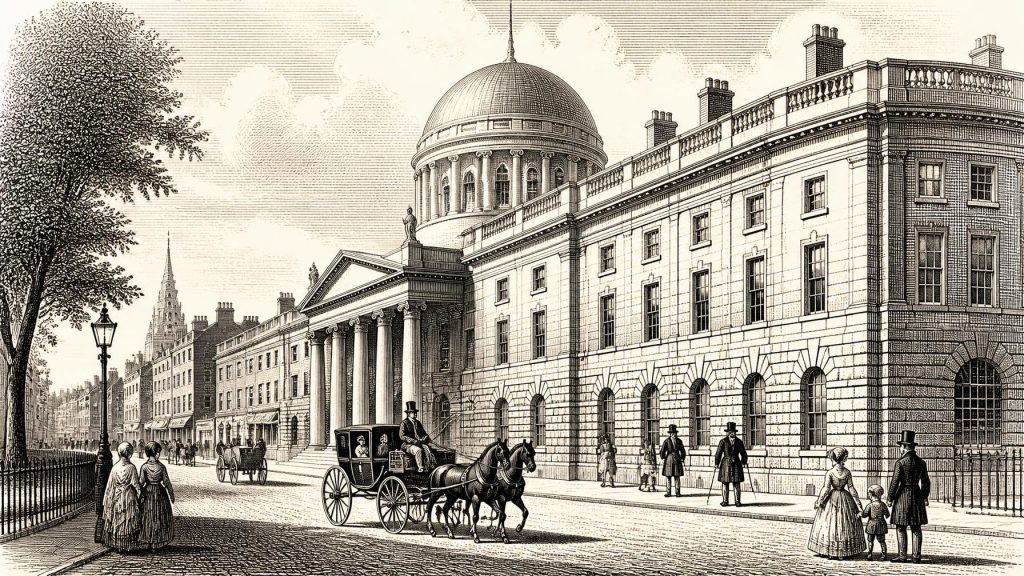
Parliament House Becomes a Bank1808 CE
In 1808, seven years after the Union, Ireland experienced political subordination, wartime economic activity and Catholic institution-building. The Bank of Ireland opened in Dublin’s former Parliament House, symbolising the loss of domestic legislature and the growing importance of finance and commerce. Catholic petitions, presented by Henry Grattan, sought equality but were overwhelmingly rejected at Westminster; controversy over a proposed royal veto on bishops deepened divisions. Meanwhile, the Patrician and Presentation Brothers were founded, and Cork’s North Cathedral was dedicated. Cork Harbour dispatched Wellesley’s expedition to Iberia, while Nelson’s Pillar foundation and Mary Leadbeater’s poetry reflected imperial commemoration and cultural life.
Dateline
In 1808 Ireland was seven years into the United Kingdom created by the Act of Union, but the Union was still visible less as an abstract constitution than as a daily redistribution of authority. The old Irish parliament no longer met in Dublin; decisive debates took place at Westminster; war with Napoleonic France connected Irish ports, food supplies and troops to a contest extending from the Atlantic to the Iberian Peninsula. Yet the year was not simply one of political diminution. It brought conspicuous acts of Catholic institution-building, an energetic renewed campaign for civil equality, and changes to the built fabric of Dublin and Cork that expressed competing ideas of Ireland’s place in the Union.
A Parliament House Recast
The most eloquent architectural symbol came at College Green. In June, the Bank of Ireland opened its banking hall in the former Irish Houses of Parliament. The bank had acquired the building in 1803; its public opening as a bank in 1808 transformed the working home of the pre-Union legislature into a financial institution. The change did not erase the building’s political associations. Its great chambers, designed for Lords and Commons, continued to proclaim the scale and confidence of the eighteenth-century parliament that had disappeared in 1801. But their new purpose demonstrated a hard fact of the Union: Dublin’s former national legislature had no legislative successor within Ireland.
This was not merely a melancholy relic. Banking, credit and commercial calculation mattered greatly in a wartime economy. Ireland’s exports and agricultural production were tied closely to British and imperial demand during the Napoleonic conflict. Grain, provisions, cattle products and other supplies moved through market towns and ports, while merchants and larger farmers could benefit from high wartime demand. The gains were uneven. Most people still lived by the land, often as tenants, cottiers or labourers with little security, and the prosperity of export agriculture did not mean comfort for every household. Contemporary county surveys promoted drainage, improved cultivation, roads and other ‘improvements’, but such programmes were generally conceived through the priorities of landowners, officials and investors rather than the poor who worked the soil.
Hely Dutton’s Statistical Survey of the County of Clare, published in 1808 for the Dublin Society, belongs to this world of measurement and improvement. It offered a detailed contemporary account of a county’s terrain, farming, population and resources. Such surveys should not be treated as neutral snapshots: they were arguments for making Ireland more productive and governable. Nonetheless, their appearance indicates the practical attention being paid to rural resources at a moment when the war made Irish food and supplies economically and strategically valuable.
Catholic Claims at Westminster
The year’s central political struggle concerned the remaining disabilities imposed on Roman Catholics. Catholic relief had advanced substantially in the late eighteenth century, but Catholics still could not sit in parliament and remained excluded from important offices. In county meetings, Catholic gentry, clergy and professional men organised support for a new petition. At Ennis on 11 February, for example, a meeting of County Clare Catholics resolved that it was time to renew applications to parliament for equality of political rights and immunities. Its language joined a request for justice to professions of loyalty and attachment to the constitution.
Henry Grattan, the veteran parliamentary reformer and former leader of the Irish parliament, presented the Irish Catholic petition in the House of Commons on 23 May. The petition made a striking national argument. It maintained that legal exclusion affected the great majority of Ireland’s inhabitants and harmed industry, commerce, public tranquillity and the strength of the state. Catholics asked not for separation from the United Kingdom but for full admission to its political constitution. The petition’s careful emphasis on loyalty shows the narrow ground on which advocates worked after the rebellion of 1798, the Union and the continuing French war.
On 25 May Grattan sought a committee of the whole House to consider the petition. The motion failed decisively, by 281 votes to 128. Other Irish Catholic petitions from places including Wexford, Waterford, Kilkenny and Kerry were also presented. Their presence records genuine organisation beyond Dublin; the result demonstrated the limits of Irish representation at Westminster. Catholic relief was a major public question, but the government and a large Commons majority would not take it forward.
The Veto Dispute
The defeat was made more complicated by the issue that became known as the royal veto. In trying to reassure Protestant opponents of emancipation, Grattan indicated that Catholic leaders could contemplate Crown approval of future Catholic bishops. The proposal was meant to prove that an emancipated Catholic body would be politically safe. Instead, it raised a different and profound anxiety: whether a Protestant government could acquire a determining voice in the internal appointments of the Catholic Church.
The distinction mattered intensely. Catholic political equality and the independence of Catholic religious authority had become entangled. Some prominent Catholic laymen and bishops had been prepared to consider a safeguard of this kind, but the proposal was repudiated within Irish Catholic opinion. By September 1808, the Irish hierarchy had rejected government interference, direct or indirect, in episcopal appointments. The year therefore brought no emancipation and no settlement. It did, however, expose a widening gap between established advocates willing to bargain for relief and those who believed that no civil concession could justify Crown influence over bishops. Later campaigns would carry the memory of this controversy.
Schools, Brothers and a Cathedral
While the political campaign faltered, Catholic religious life acquired durable institutional foundations. On 2 February, Bishop Daniel Delany of Kildare and Leighlin founded the Brothers of St Patrick at Tullow, County Carlow. The Patrician Brothers were created to educate boys and provide religious instruction, part of Delany’s broader response to poverty, limited educational opportunity and what he saw as religious neglect. Four men initially consecrated themselves as brothers. Their small beginning should not be exaggerated into a nationwide school system in a single year, but it marked the establishment of a teaching congregation whose work would eventually reach far beyond Carlow.
Waterford witnessed another foundational moment on 15 August. Edmund Rice and six companions made annual religious promises before Bishop John Power of Waterford and Lismore, adopting the Presentation rule. Rice had already devoted resources to schooling poor boys in the city. The community begun in 1808 became the origin of the Presentation Brothers, while the expanding institute associated with Rice later developed into the Christian Brothers. In the immediate setting, the significance lay in a practical Catholic response to urban need: disciplined religious men undertaking education for boys who were unlikely to have access to elite schooling.
Cork offered an even more public assertion of Catholic presence. On 22 August the Cathedral of St Mary and St Anne, commonly called the North Chapel, was dedicated after nine years of construction under Bishop Francis Moylan. The ceremony was reported as one of exceptional solemnity. The new building, an early Irish example of neo-Gothic architecture, stood near Shandon in a busy port city whose commercial life was closely bound to the war. It was not evidence that Catholics had won political equality; they had not. Rather, it showed the confidence, resources and organisational capacity of a church able to build a substantial urban cathedral despite continuing disabilities.
War Through Cork Harbour
War was not distant from Ireland. Cork and Cove were important embarkation and supply points for British forces. On 12 July Lieutenant-General Sir Arthur Wellesley sailed from Cork with an expedition intended to assist resistance to Napoleon in the Iberian Peninsula. The force went first towards Coruña before operations turned to Portugal. Wellesley’s correspondence from Cork in the preceding days reveals the practical business behind imperial strategy: transports, artillery horses, arriving regiments, hospital accommodation, contrary winds and the timing of departure.
The expedition did not make Ireland a battlefield in 1808, nor should the sailing be mistaken for an Irish national military undertaking. It did, however, make Cork Harbour a working hinge between Irish society and the wider war. Soldiers, sailors, suppliers, dock labourers, merchants and local authorities encountered the demands of mobilisation. Later fame would make Wellesley’s departure appear prophetic, but in July 1808 it was first of all a large and urgent logistical operation from an Irish port.
Monuments and Print
Dublin also registered the war’s commemorative culture. On 15 February the Duke of Richmond, the lord lieutenant, laid the foundation stone of Nelson’s Pillar in Sackville Street. Subscribed for by leading merchants, bankers and citizens after Trafalgar, the monument honoured Admiral Horatio Nelson and naval command of the sea. Its location on one of Dublin’s grandest streets gave imperial victory a permanent intended presence in the city. The pillar was not completed until 1809, so 1808 should be remembered as the year of its foundation rather than its opening.
Irish cultural life was not confined to monuments or political argument. Mary Leadbeater of Ballitore, County Kildare, published Poems by Mary Leadbeater in 1808, including her translation of the thirteenth book of the Aeneid attributed to Maffeo Vegio. A Quaker writer whose work drew on rural and domestic experience, Leadbeater represents a quieter but important Ireland: literate, provincial, connected to print, and capable of bringing women’s authorship into public view.
Thus 1808 joined symbols of loss, war and adaptation. A bank took possession of parliament’s former home; a pillar began to rise for a British naval hero; troops departed Cork for continental war. At the same time, Catholic petitioners pressed a claim to citizenship, bishops rejected state intrusion, and new teaching communities and a cathedral strengthened Catholic society on the ground. The year did not resolve Ireland’s constitutional or religious divisions. It made their institutional consequences more visible.
Primary Sources
- Roman Catholic Petition, House of Commons, 23 May 1808
- Roman Catholic Petition, House of Commons, 25 May 1808
- Roman Catholic Petition, House of Lords, 27 May 1808
- The Beginning of the Veto Controversy in Ireland
- 1808 Meeting of Ennis Catholics
- The Office of the Chief Secretary of Ireland: Select Chronology
- The Brothers of St Patrick
- The Patrician Brothers: History
- North Cathedral Bicentenary Exhibition
- Bank of Ireland Granted Planning Permission for €36m College Green Investment
- Wellington's Dispatches: July 1808
- Arthur Wellesley, 1st Duke of Wellington, Dictionary of National Biography
- 2001:397 – Dublin: The Monument of Light, Nelson's Pillar, O'Connell Street
- Dictionary of Irish Architects: Nelson Monument, Dublin
- Leadbeater, Mary, Dictionary of Irish Biography
- Holdings: Letters to and Accounts of Mary Leadbeater and Elizabeth Leadbeater of Ballitore, Co. Kildare, 1807–29
- Dutton: Statistical Survey of the County of Clare
- ‘Wholesome Regulation and Unlimited Freedom’: Governing Market Space in Southern Ireland Before the Famine
- The Granary of Great Britain: The Case of Ireland
- Galway: Statistical Surveys of Ireland
- The Nineteenth Century
- The Royal Veto
- Edmund Rice Context