
Taylor’s Mountain Road1809 CE
In 1809, post-Union Ireland remained governed through Dublin Castle, Westminster and local institutions amid war and unresolved Catholic disabilities. Administrative changes followed Arthur Wellesley’s departure for Portugal. Captain Alexander Taylor’s Military Road across Wicklow, completed in October, extended state access to former insurgent terrain. Legislation supported road improvements, Dublin waterworks, Church of Ireland buildings and investigation of bog reclamation. Nelson’s Pillar opened in Dublin, celebrating imperial naval power. Belfast manufacturing collapse prompted charitable relief, while Cork’s Magdalene asylum reflected religious social discipline. Edward Bunting’s music collection preserved and reshaped Irish harp traditions through print, illustrating infrastructure, commemoration and cultural interpretation.
Dateline
In 1809 Ireland was eight years into the United Kingdom created by the Union, yet government was still experienced at close quarters through Dublin Castle, county grand juries, parish institutions and a dense network of military posts. The year did not bring a single national crisis comparable to the rebellion of 1798 or Robert Emmet’s rising of 1803. Its importance lies instead in a series of firmly dated or securely attributable developments: a change in the Irish executive; the completion of a strategic road across the Wicklow mountains; new Westminster schemes for roads, churches, water and bogs; and conspicuous acts of commemoration and cultural preservation.
An Administration in Transition
The Irish administration began the year with Sir Arthur Wellesley as chief secretary, serving the lord lieutenant, Charles Lennox, fourth duke of Richmond. Wellesley’s office was at the centre of a system designed to keep order after the recent republican rebellions and during the continuing war with Napoleonic France. His attention to defence and communications in Ireland had been substantial, but his position also revealed how Irish administration was governed by imperial priorities. In February 1809 he had to defend in the House of Commons his retention of the secretaryship and its salary while absent on military service.
That question was soon overtaken by events abroad. After Sir John Moore’s death at Corunna in January, Wellesley was selected to command British forces in the Peninsula. He resigned both his Irish office and parliamentary seat in April and sailed for Portugal. His successor as chief secretary was Robert Dundas, appointed in April; in October, William Wellesley-Pole succeeded Dundas. These changes were administrative rather than a change in the constitutional settlement: Ireland remained represented at Westminster but had no domestic parliament, its former legislature having been extinguished when the Union took effect in 1801.
The Catholic question remained unresolved. The failure of the 1808 parliamentary effort towards Catholic relief was recent, and the controversy over whether the Crown should possess a veto over appointments of Catholic bishops was dividing Catholic political and clerical opinion. It would be misleading to treat 1809 as the beginning of Daniel O’Connell’s mass movement; his Catholic Association belonged to a later phase. But the year belongs squarely to the long post-Union struggle in which Catholic committees, professional men, bishops and lay elites contested the disabilities that still excluded Catholics from parliament and important offices.
The Road Through Wicklow
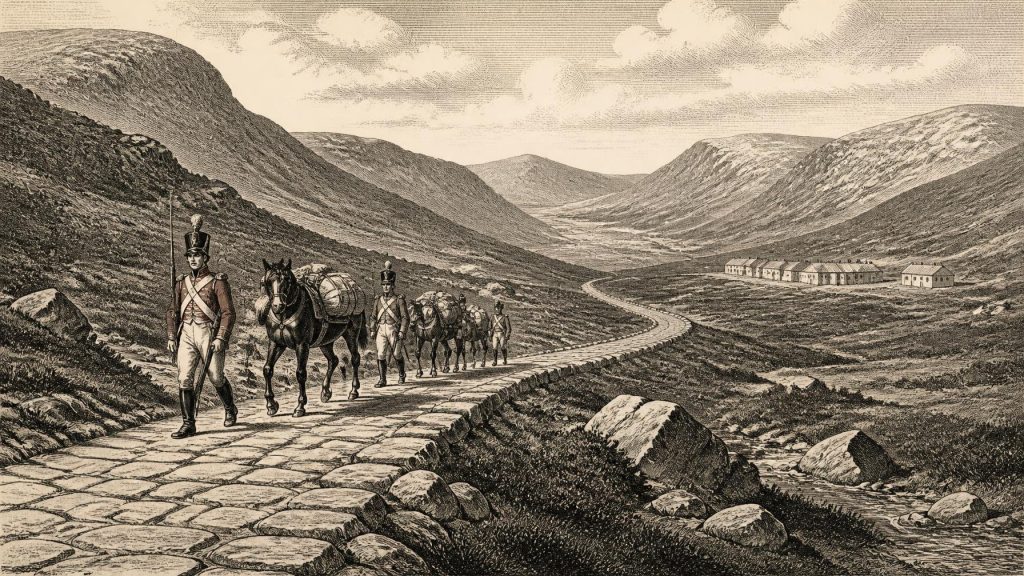
The most tangible achievement of the year was completed in October: the Military Road through the Wicklow Mountains. Captain Alexander Taylor of the Royal Irish Engineers had directed the project from 1800. Its principal route ran from Rathfarnham southwards through Glencree, Laragh and Glenmalure to Aughavannagh, with a branch towards Enniskerry. It was an imposing intervention in a difficult landscape of high ground, blanket bog, steep valleys and severe weather. Soldiers worked in rotating teams using hand tools and wheelbarrows; barracks at key points were intended to accommodate and protect troops.
The road’s origins explain its character. The Wicklow uplands had offered cover to insurgents and fugitives after 1798, most famously Michael Dwyer and his followers. They also worried officials who feared a French landing and renewed internal revolt. Yet Dwyer had surrendered in 1803, six years before the road was finished. Thus its completion marked the institutional afterlife of emergency as much as an immediate campaign. A route devised to penetrate and police a supposed refuge of rebellion was finished when the original insurgent threat had diminished.
It was nevertheless more than a military artefact. The road joined previously difficult districts to Dublin’s hinterland and to one another, enabling official travel, supply, trade and later tourism. That does not mean that every local inhabitant welcomed it or benefited equally. Roads could improve access to markets while also making the movement of troops, constables, rents and authority easier. In 1809, though, the finished line and its barracks embodied the state’s determination that mountain terrain should no longer set the limits of government reach.
Improvement, Water and Peat
Westminster legislation in 1809 gives an unusually clear view of the practical ambitions of Union-era government. The Irish Road Acts were amended to permit grand juries to raise money for widening, fencing, levelling and repairing important mail-coach routes. The statute acknowledged that charging the cost of post roads locally could be unequal and oppressive, but it did not remove the central role of county presentments: local property holders remained pivotal in deciding how infrastructure was funded.
Dublin’s expanding urban services were also under review. The Dublin Water Act of 1809 authorised the Corporation to replace older timber mains with cast-iron pipes and to levy water rates towards the expense. Construction was already under way on the reservoir later known as Blessington Street Basin, supplied ultimately from Lough Owel through the Royal Canal system. Sources differ over whether the basin should be described as opened in 1809 or completed in 1810; it is safer to place it in the active building programme of 1809, rather than attach a confidently precise opening date. Either way, the works show a city seeking a more dependable northern water supply as its population and commercial activity grew.
Far beyond Dublin, Parliament established the Bogs Commission in 1809. Its remit was vast: commissioners were to investigate Irish bogs of more than 500 acres, assess their depth and underlying strata, decide whether they could be drained, estimate costs, consider roads and canals, and advise on cultivation and tree planting. The immediate setting was the Napoleonic war and British concern over supplies of flax and hemp, materials essential to linen production and naval sailcloth. Ireland’s wetlands were consequently treated by officials as potential farmland and strategic raw-material reserves.
This was a programme of inquiry, not a completed reclamation revolution. The commission’s later surveys would show the expense, technical difficulty, uncertain ownership and local dependence on turf fuel that made wholesale drainage far harder than proponents supposed. In 1809, however, the act itself is revealing: it translated environmental knowledge into an imperial project, measuring peatlands for productivity, transport and state-directed ‘improvement’.
Urban Display and Uneven Livelihoods
On 21 October, the fourth anniversary of Trafalgar, Nelson’s Pillar opened to the public in Sackville Street, Dublin. The Doric column, topped by a statue of Horatio Nelson carved by the Cork sculptor Thomas Kirk, had been funded by subscription. For an admission charge, visitors could climb its internal stair and look across the city, bay and surrounding country. The monument celebrated naval victory and British imperial power in Ireland’s principal street. Its public viewing platform also made commemoration a paid urban experience, available to those with the means and inclination to ascend it.
Such display sat beside sharp economic insecurity. War could raise demand for Irish provisions and raw materials, but its benefits were regional and uneven. In Belfast and its hinterland, a collapse in manufacturing during 1809 reportedly left 2,000 calico looms idle within five weeks. The town’s response included the establishment of a voluntary House of Industry at Smithfield, intended to curb mendicancy while giving relief to poor families and encouraging work. Its creation should not be romanticised as a public welfare system: it depended on subscription, discipline and contemporary distinctions between the ‘deserving’ and ‘undeserving’ poor. But it records an immediate urban recognition that industrial employment could disappear with alarming speed.
Churches, Confinement and Music
Religion entered public policy in several ways. An 1809 act provided further borrowing capacity for the Board of First Fruits to make loans for building or rebuilding Church of Ireland churches, chapels and glebe houses. These were practical measures for the established church, whose parochial buildings and resident clergy formed part of the governing fabric of rural Ireland. They did not answer the wider Catholic claim to equal civic standing.
In Cork, St Vincent’s Magdalene Asylum was founded in Peacock Lane in 1809 by Nicholas Therry. Contemporary charitable language described such institutions as protecting and reforming ‘penitent’ women through honest industry. That language itself signals the moral assumptions of the institution: women judged sexually fallen were separated, supervised and expected to support themselves by labour. The year therefore offers an early Irish example of a form of confinement and religiously framed social discipline that would acquire a far longer and darker history.
Another 1809 publication preserved a very different inheritance. Edward Bunting issued his second A General Collection of the Ancient Music of Ireland, arranged for pianoforte, in London. The volume drew upon his lifelong engagement with the repertory of Irish harpers, begun when he notated performers at the Belfast Harp Festival of 1792. It presented traditional airs to a literate, middle-class market through printed notation, piano arrangements and English-language adaptations. The book did not reproduce oral performance unchanged; arrangement and publication altered the music’s setting. Yet it also ensured that melodies associated with an endangered harp tradition circulated widely at a moment when antiquarian interest, print culture and ideas of Irish cultural distinctiveness were gathering force.
Thus 1809 can be read through its new lines: Taylor’s road scored across Wicklow; cast-iron water mains and a canal-fed basin reshaped Dublin; surveyors prepared to map bogland; a column fixed imperial memory in Sackville Street; Bunting’s engraved pages carried older airs into new homes. None settled Ireland’s great constitutional or social conflicts. Together they show a country being connected, measured, commemorated and culturally interpreted under the pressure of war and Union.
Primary Sources
- The Military Road
- The Military Road – A Brief Overview
- Wellesley (Wesley), Arthur
- Office of the Chief Secretary for Ireland
- Sir Arthur Wellesley
- The Office of the Chief Secretary of Ireland: Chief Secretaries
- Parliamentary Union
- Catholic Emancipation
- O’Connell, Daniel
- An Act for Amending the Irish Road Acts
- An Act to Appoint Commissioners to Enquire into the Nature and Extent of the Several Bogs in Ireland
- Irish Bogs Draining Bill
- Mapping the Past, Shaping the Future
- Napoleon’s Irish Legacy: The Bogs Commissioners, 1809–14
- Dublin Water Act 1809
- City of Dublin v Francis Blackburne, HM Attorney General
- Blessington Street Basin
- Nelson’s Pillar Destroyed
- An Act to Amend Provision for Building and Rebuilding Churches, Chapels and Glebe Houses in Ireland
- Cork Hospitals and Asylums
- A General Collection of the Ancient Music of Ireland
- Edward Bunting’s First Collection
- Bunting’s Printed Collections
- Introduction: Begging, Charity and Religion in Pre-Famine Ireland
- A List of Those Who Contributed to the Funds of the House of Industry, Belfast, 1834