Regency Crisis1789 CE
In 1789, George III’s incapacity prompted Ireland’s parliament to invite the Prince of Wales to govern as unrestricted regent, asserting constitutional judgement distinct from Westminster before the king’s recovery ended the crisis. The episode exposed parliament’s Protestant, elite and unrepresentative character, while the Irish Whig Club reflected growing reform organisation. Rural proclamations recorded conflicts over land, tithes and authority amid an unequal agricultural economy. Charlotte Brooke’s Reliques of Irish Poetry made Irish-language literature accessible through English paraphrases and Irish texts, demonstrating scholarly networks despite women’s exclusion from institutions. News from France widened debate, foreshadowing 1790s upheavals without determining Irish politics.
Dateline
In 1789, Ireland’s most dramatic political episode began not with an Irish rebellion or an election, but with the incapacity of the king. George III’s illness, which had become a public constitutional crisis late in 1788, forced politicians in Dublin to consider who could lawfully exercise royal authority in the kingdom. The answer they offered in February 1789 was bold: the Irish parliament proposed that George, prince of Wales, should govern as regent in Ireland without the restrictions being contemplated at Westminster. The scheme vanished as the king recovered, but it revealed both the reach and the limits of the constitutional order created in 1782.
The same year also produced a quieter but enduring landmark in Irish cultural history. Charlotte Brooke’s Reliques of Irish Poetry, printed in Dublin, brought a substantial selection of Irish-language verse to English-reading audiences while also printing the originals in Irish type. The contrast is revealing. At College Green, a narrow political nation argued over the Crown; in the book trade, a woman scholar working with Irish-speaking learned networks made an older and much wider cultural inheritance newly visible.
A Regency for Ireland
The Irish parliament assembled on 5 February 1789 under the lord lieutenant, George Nugent-Temple-Grenville, marquess of Buckingham. Its immediate business was overshadowed by the unresolved question of the king’s health. Since George III could not personally direct government, politicians in Britain and Ireland had to decide whether the prince of Wales possessed an automatic right to act, or whether parliament should define and confer the regency.
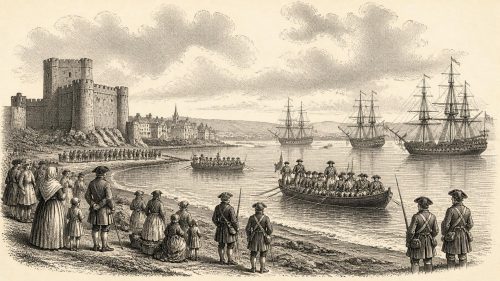
In Britain, William Pitt’s administration favoured a regency limited in significant respects. In Ireland, Henry Grattan and other opposition figures took a different line. They argued that the prince should be asked to assume the government of Ireland in the king’s name for the duration of the illness, without conditions imposed by the Irish legislature. In February the Irish Houses approved an address to the prince, and the Commons appointed four delegates to carry it. John O’Neill of Shane’s Castle, a leading Ulster patriot, was among them.
This was not a declaration of Irish independence, nor an attempt to establish a separate monarchy. The proposed regent was the king’s eldest son and would act in George III’s name. Yet the episode mattered because the Irish parliament acted before any British settlement had been completed and chose a formula different from that favoured by the British ministry. It asserted that the kingdom possessed a constitutional judgement of its own in a crisis touching the executive itself.
The move alarmed Buckingham and ministers in London. It also gave the Irish parliamentary opposition a powerful rallying point. Grattan had been central to the parliamentary achievements of 1782, which removed the British parliament’s claimed right to legislate for Ireland and altered the operation of Poynings’ Law. The Regency Crisis now tested how far that settlement could be pressed when the Crown was unable to function normally. In practical terms, the test ended quickly. Official news of the king’s convalescence reached Dublin on 17 February, and the prospect of a regency receded. By spring, George III’s recovery had removed the immediate issue.
Constitution Without Representation
The crisis showed the confidence of a parliament that called itself independent, but it also exposed the restricted character of the political nation. The Irish House of Commons represented counties and boroughs, yet electoral power was unevenly distributed and many seats lay under the influence of patrons. The legislature was overwhelmingly Protestant. Roman Catholics, although forming the great majority of the population, could not vote in parliamentary elections or sit in parliament. Presbyterians and other dissenters also faced disabilities within the established political and religious order.
Consequently, the dispute over the regency was a contest among elite politicians rather than a national consultation. The public could nevertheless follow it closely through newspapers, pamphlets, clubs and the sociable world of Dublin coffee houses and taverns. Political language reached beyond the chamber, even where political rights did not. The Irish Whig Club was founded in Dublin during 1789, providing Grattan’s supporters and other reform-minded men with a more organised association committed to maintaining the constitutional gains of 1782 and pursuing reform.
That development should not be projected too far forward. The United Irishmen were not founded until 1791, and the revolutionary movement of the 1790s had not yet taken shape. But 1789 helped establish habits of opposition organisation and sharpened disagreement over patronage, representation and the relationship between Irish government and British ministers.
Order, Land and Local Pressure
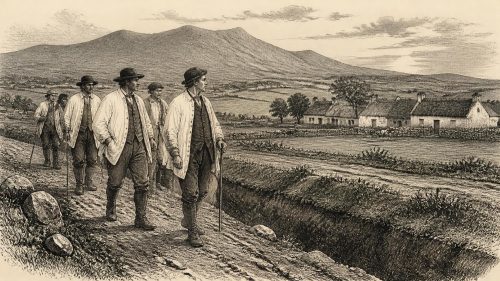
For many people outside Dublin, the pressing realities of 1789 lay in rent, land, employment, tithes and local authority rather than in the constitutional niceties of the regency. Government proclamations issued during the year provide carefully limited but valuable evidence of strain. In January, proclamations concerned forcible possession in Roscommon, Galway, Sligo and Galway town. Other notices offered reward and pardon for information about attacks, including fires at the properties of clergymen in Forkhill, County Armagh, and Clonoulty, County Tipperary.
Further proclamations in June and September named men sought for resistance to law enforcement or disputes involving possession in Clare, Galway and Tipperary. These notices do not prove a single co-ordinated island-wide rising. They do, however, show that the state encountered coercion and conflict in several regions, particularly where property, landholding and local power were contested. They belong to the same unsettled rural world in which recent Rightboy disturbances had protested against tithes, rents and other charges in parts of Munster.
Religion was entangled with these everyday pressures. The Church of Ireland was the established church, supported by tithes that could be levied on cultivators irrespective of their own denomination. Catholic worship had become less constrained than under the harshest phase of the penal laws, owing to relief measures passed in the late 1770s and early 1780s, but equality before the political system remained remote. A Catholic family’s parish life, obligations to landlord and priest, work on a holding, and access to local protection could matter far more immediately than speeches in Dublin.
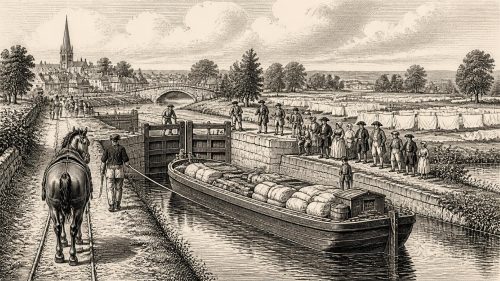
Economic life remained predominantly rural, though it was linked to towns, ports and overseas markets. Linen was especially important in Ulster, combining commercial manufacture with household spinning and weaving. Elsewhere, livestock, grain, butter, hides and other agricultural goods moved through fairs, market towns and harbours. The trade concessions won in the previous decade had encouraged confidence among merchants and manufacturers, but benefits were neither geographically even nor socially shared. A government order in June allowing brewers across the kingdom temporarily to make small beer as well as ale and strong beer is a small reminder that regulation, provisions and urban consumption were also matters of public concern.
Irish Poetry in Print
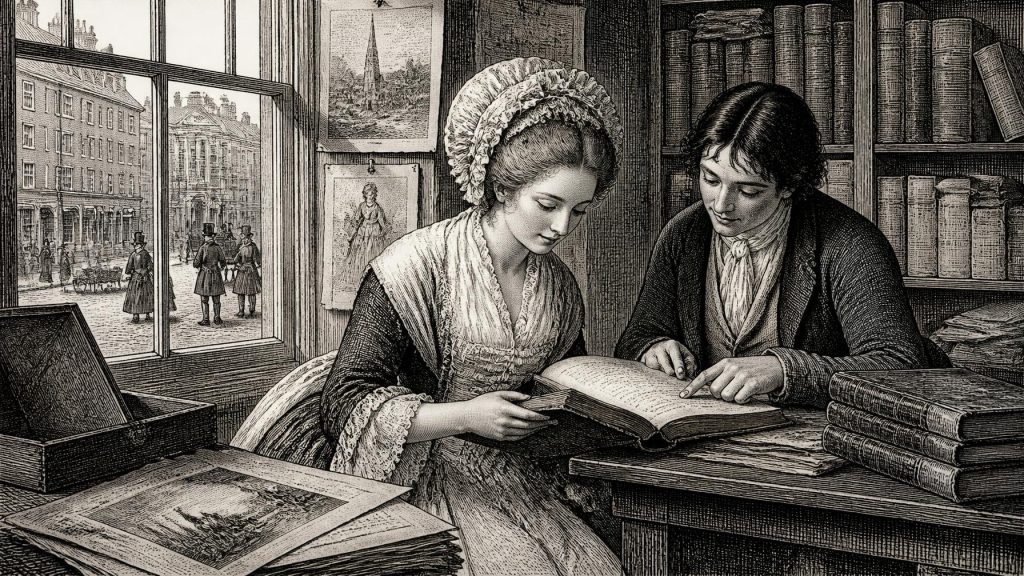
Charlotte Brooke’s Reliques of Irish Poetry was the year’s outstanding cultural event. Published by George Bonham of South Great George’s Street, Dublin, it presented heroic poems, odes, elegies and songs in English verse, with explanatory and historical notes and the Irish originals printed alongside. Brooke included material associated with the Fenian and Ulster cycles, songs attributed to Turlough Carolan, and later Irish verse. For readers without Irish, the English versions opened a literature often treated by the anglophone educated world as remote, obscure or merely antiquarian.
Brooke did not conceal the difficulty of her task. She described her English renderings as paraphrases rather than exact translations, recognising that sound, idiom and meaning could not simply be transferred from Irish into eighteenth-century English verse. Her work depended on sustained learning and collaboration: she had taught herself Irish, gathered manuscripts and oral material, and received assistance from scholars including Muiris Ó Gormáin. The book therefore records an active Irish-language intellectual world, not the survival of a culture already extinct.
Its publication also illuminates the inequalities of polite learning. The Royal Irish Academy, founded in 1785 to promote science, literature and antiquities, supported an expanding scholarly interest in Ireland’s past; Brooke had friends and helpers among its circle. Yet women could not become Academy members. Her achievement came through personal study, manuscript networks and the commercial risks of printing rather than institutional equality. In 1789, cultural recovery and exclusion could sit side by side.
France and an Unsettled Future
News from France gave 1789 a wider horizon. The fall of the Bastille in July and the rapidly changing French political situation were reported and discussed in Ireland, as elsewhere in the Atlantic world. At this early stage, however, it would be misleading to treat Irish opinion as already divided into later camps of loyalist and revolutionary, or to make the French Revolution the cause of organisations that did not yet exist. Some reformers could initially interpret French events through the familiar language of constitutional liberty and the Revolution of 1688; others watched a major Catholic European monarchy with uncertainty.
The immediate Irish year ended without a regent, without parliamentary reform, and without a decisive alteration in Catholic political rights. Its significance lay instead in what became visible. The Regency Crisis demonstrated that the post-1782 constitution could produce a serious divergence between Dublin and London. Rural proclamations registered coercion beneath elite politics. Brooke’s book placed Irish-language poetry before new readers. Together, these developments made 1789 a year in which constitutional ambition, social strain and cultural transmission were all plainly present, even before the upheavals of the 1790s transformed their meaning.
Primary Sources
- Official correspondence of George IV, as Prince of Wales
- Henry Grattan, the Regency Crisis and the emergence of a Whig party in Ireland, 1788–9
- Acts and statutes, made in a session of Parliament at Dublin, begun 5 February 1789
- Statute Law Revision Act 2015
- Irish Legislation Database: Browse
- The Constitutional Position
- Grattan, Henry
- O’Neill, John
- Resolutions and declarations of the Whig Club
- Brooke, Charlotte
- Reliques of Irish Poetry
- Ó Gormáin (Mac Gormáin, O’Gorman, Gorman), Muiris (Maurice)
- Rainsford Papers
- ‘Better without the ladies’: the Royal Irish Academy and the admission of women members
- A contemporary account of the Rightboy movement: the John Barter Bennett manuscript
- The Brethren of Britons: the emergence of Irish counter-revolutionary loyalism, 1789–96
- Irish Revolutionaries and the French Revolution
- Industry, c. 1780–1914: An Overview
- Irish Statute Book: Pre-Union British Statutes
- Proclamation: Extending the prorogation of parliament to 17 January 1788
- Historical notice of penal laws against Roman Catholics