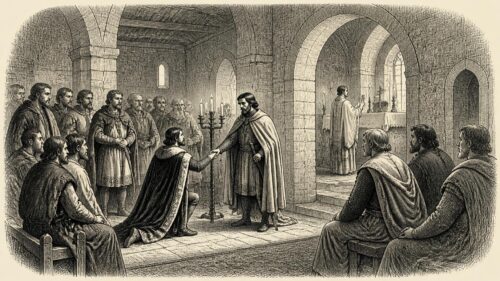
Henry Luttrell1717 CE
In 1717, Ireland remained a separate kingdom under Hanoverian rule, governed by a Protestant establishment that excluded most Catholics. Charles Paulet, Duke of Bolton, became lord lieutenant, while parliament renewed revenue and reinforced Protestant municipal control in Galway and Kilkenny. Colonel Henry Luttrell, a former Jacobite accused of betrayal, was murdered in Dublin; despite official rewards and proclamations, the crime remained unsolved. Authorities also pursued mutiny and armed disorder. Penal restrictions shaped Catholic and Presbyterian life. Hugh MacCurtin defended Irish antiquity in print. Rural society depended on vulnerable agricultural and export economies amid variable weather, reflecting an anxious political order.
Dateline
In 1717, Ireland was a separate kingdom under the Hanoverian crown, but its political life was narrow, its public security anxieties palpable and its religious divisions built into law. The most memorable incident occurred in Dublin on 22 October, when Colonel Henry Luttrell was shot while travelling home in a sedan chair. The killing quickly acquired a political meaning because Luttrell had served the Jacobite cause before changing sides during the Williamite war. Yet the murderer was never identified, and the episode remains a warning against turning later nationalist legend into certainty. Around that unresolved crime, the year also brought a new lord lieutenant, a sitting of parliament, municipal legislation designed to consolidate Protestant power, and a notable assertion of Irish historical learning in print.
A New Viceroy and an Old System
George I was king, and the practical government of Ireland rested on a Protestant political establishment operating through Dublin Castle, the Irish privy council, the Church of Ireland and a parliament elected by a restricted electorate. Charles Paulet, second duke of Bolton, was appointed lord lieutenant in April 1717 and was sworn in at Dublin on 7 August. His arrival mattered as a renewal of the crown’s representation in Ireland after government by lords justices. Bolton was an English Whig grandee with prior experience in Irish administration, not an Irish political leader rooted in the country. His appointment therefore illustrated a central feature of eighteenth-century governance: Irish institutions remained formally distinct, but the direction of high policy came from the crown and ministry across the Irish Sea.
William King, the forceful Church of Ireland archbishop of Dublin, was among the leading figures who had served as a lord justice before Bolton’s arrival. King’s standing shows how closely episcopal office and political authority could overlap within the established order. That order had emerged from the Williamite victories of the 1690s and was still shaped by the security fears revived by the Jacobite rising in Britain in 1715. Ireland did not rise in arms in 1717, but official language and policy continued to treat Catholic political allegiance, armed disorder and international danger as connected concerns. The majority of the population, Roman Catholic in religion, had little formal share in the state that claimed to govern it.
Parliament and Protestant Municipal Power
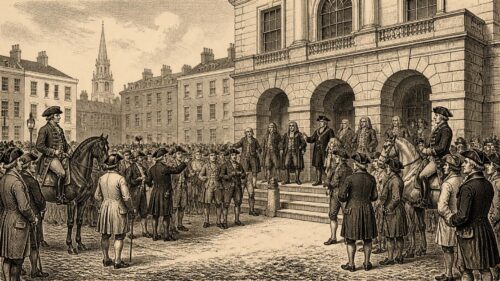
The second session of George I’s Irish parliament met from 27 August to 23 December. Its legislation was practical as well as political. Two supply measures renewed revenue for two years from November, helping to fund the machinery of government. Other acts addressed such matters as distress for rent, legal costs, fees charged by officials and the continuation of temporary statutes. These technical measures affected relations between landlords, tenants, litigants and officeholders, although surviving statutory titles cannot tell us how evenly the rules worked in daily life.
More openly confessional were acts concerning Galway and Kilkenny. Each was framed as a measure for regulating the town or corporation and for strengthening the “Protestant interest”. In Galway, an important Atlantic-facing port with a long Catholic mercantile history, and in Kilkenny, an old inland civic centre, corporate government was not merely local housekeeping. Control of charters, offices, records and municipal elections helped determine who could exercise urban power, manage property and speak for a town. The 1717 acts thus show the Protestant establishment working through law to secure institutions below the level of Dublin Castle. Private legislation, meanwhile, dealt with estate sales and the naturalisation of named individuals, a reminder that parliament also served landholding families and migrants seeking a secure legal place in Irish society.
In August Gustavus Hamilton, a veteran soldier of the Williamite wars and already Baron Hamilton of Stackallan, was raised to the Irish peerage as Viscount Boyne. The honour was one small but revealing expression of the regime’s reward structure. Hamilton’s family interests lay in Leinster and the north-west, while his military reputation had been made in conflicts that established the political settlement now being defended. Such creations joined land, service to the crown and legislative status together: an Irish title could confer local consequence without making its holder an independent national statesman.
A Murder in Stafford Street
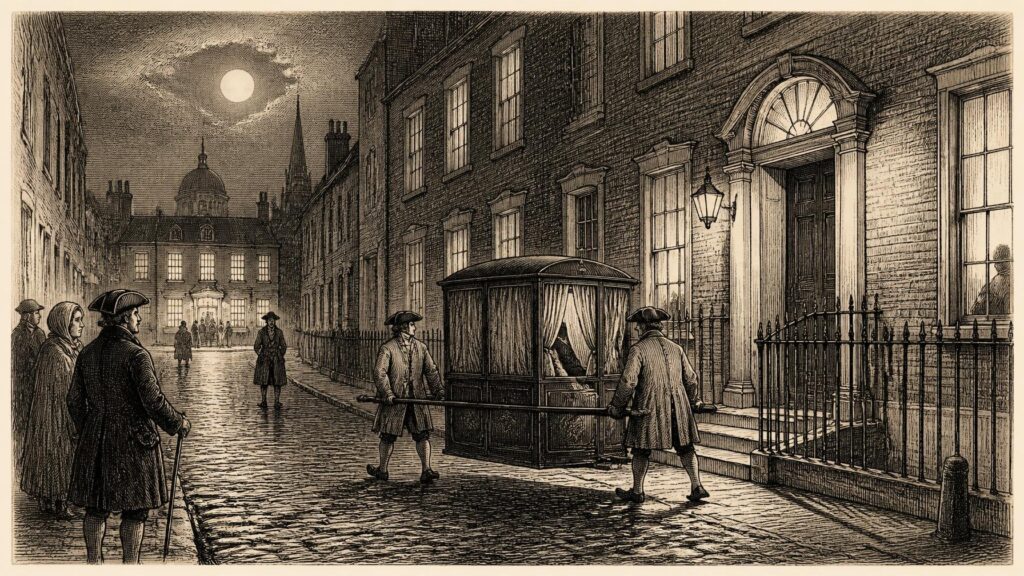
Henry Luttrell’s death gave 1717 its sharpest drama. On the night of 22 October he was shot in or beside his hired chair as he returned from a coffee house on Cork Hill towards his town house in Stafford Street. He was badly wounded and died soon afterwards. The attack occurred in the centre of a city where coffee houses, hackney chairs and private houses connected military men, lawyers, merchants, officeholders and political gossip. Luttrell’s will, dated that same day and later registered, names his wife, children, relations and prominent executors; it provides a stark documentary trace of a man whose public reputation was far more turbulent than the orderly language of property settlement suggests.
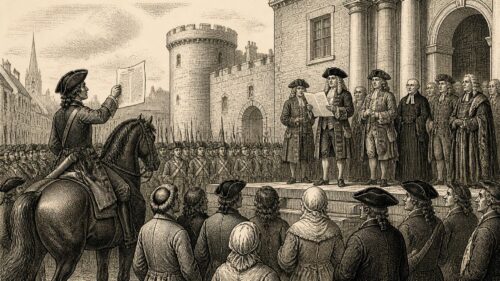
Luttrell had been a Jacobite officer, but during the war of 1689–91 he was accused of secret dealings with the Williamite enemy. His later service under William III, and his acquisition of family property, made him notorious. Popular hostility followed him in Dublin; ballads represented him as a traitor. The Irish House of Commons interpreted the murder as potentially political and pressed for a reward, while a proclamation issued on 24 October offered pardon and payment for information that could bring those responsible to justice. It also linked the case with an attempted attack on the commander-in-chief, Charles O’Hara. A further proclamation in November renewed the pursuit. None of this proves that Catholics or Jacobite sympathisers organised Luttrell’s killing. Modern scholarship has stressed alternative possibilities, including private enmity, debt or family grievance. The crime was never solved.
The government’s wider security worries were not imaginary abstractions. In June a proclamation sought information about a regimental mutiny at Athlone, a strategic Shannon crossing and garrison town. At the year’s close another ordered alleged tories, robbers and rapparees named by grand juries in Antrim, Monaghan, Louth, Clare and Cavan to surrender. The official labels tell us more about the state’s categories of disorder than about each accused person’s conduct. Together, however, they show an administration attentive to the reliability of soldiers, armed crime and the reach of local authority.
Religion, Language and Print
For Catholics, 1717 fell within the penal era. The harsh legal framework limiting Catholic property, education, clergy and public participation had been assembled over previous decades; enforcement varied by locality and circumstance. A late-1716 proclamation ordering enforcement against Catholic ecclesiastics and regular clergy formed the immediate background to 1717. Catholic worship and clerical organisation nevertheless endured, often through informal arrangements and local protection. Presbyterians, especially numerous in Ulster, also faced exclusions from office under the sacramental test. Ireland’s religious life was consequently much richer and more varied than the official institutions, dominated by the established church, admitted.
That tension gives particular force to Hugh MacCurtin’s A Brief Discourse in Vindication of the Antiquity of Ireland, printed in Dublin in 1717. MacCurtin came from a learned Clare family associated with Irish-language poetry and scholarship. Drawing substantially on Geoffrey Keating’s earlier history as well as other authorities, he presented Ireland’s antiquity, people and learned tradition to an English-reading public. The book did not create an eighteenth-century national movement, and its early-modern historical claims must be read critically. Its importance lies in the act of preservation and argument: Irish historical memory was being defended in print within a polity that excluded most Irish Catholics from political power. Later accounts place MacCurtin’s imprisonment in Dublin’s Newgate after publication; the date of the book is secure, while the precise grounds and timing of his detention are less clear.
Work, Weather and Uneven Recovery
Most people experienced the year not through parliamentary statutes or Dublin murders but through rents, labour, crops, markets and worship. Ireland remained overwhelmingly rural. Cattle, butter, hides, linen yarn and grain linked farms and market towns to ports, while restrictions on the overseas woollen trade continued to distort economic choices. Official attention to the regulation of butter and tallow casks in May points to the importance of standardised containers in a provisioning and export economy. It should not be mistaken for evidence of prosperity shared equally between producers, merchants and labourers.
Climate evidence permits caution rather than a dramatic verdict for 1717 itself. Reconstructions based partly on Dublin weather observations treat 1717–22 as a period of general improvement after earlier difficulties, but describe its crucial springs and autumns as variable and associate the wider years with poor harvests and social strain. There is no sound basis for assigning a single nationwide famine or bumper harvest to 1717. What can be said is that subsistence remained vulnerable: a variable growing season, rent demands and constrained employment could carry grave consequences for households with little reserve.
By December, therefore, Ireland had not undergone a single transformative rupture. Rather, the year exposed the working texture of the Protestant state: a new viceroy presided over parliament; laws tightened corporate authority; proclamations pursued mutiny, crime and assassination; and the established political order remained anxious about its Catholic majority. Against that background, Luttrell’s fatal journey through Dublin and MacCurtin’s defence of Ireland’s past reveal two contrasting inheritances of the seventeenth-century wars—one of unresolved betrayal and violence, the other of cultural survival and argument.

Primary Sources
- Paulet (Powlett), Charles
- King, William
- Luttrell, Henry
- Hamilton, Gustavus
- Acts and statutes made in a Parliament begun at Dublin, the twelfth day of November, Anno Dom. 1715
- Irish Legislation Database: Browse
- Irish Legislation Database: Sources for Irish legislation, 1692–1800
- Irish Legislation Database: Regnal years and statute numbers
- Statute Law Revision Act 2015
- Acts of the Pre-Union Parliament of Ireland
- Central Aspects of the Eighteenth-Century Constitutional Framework in Ireland: Government, Supply and the House of Commons
- Registry of Deeds, Dublin 59: Abstracts of Wills, 1708–45
- Aodh Buidhe Mac Cuirtín
- A Brief Discourse in Vindication of the Antiquity of Ireland
- Climate
- Processes Prior and during the Early 18th Century Irish Famines—Weather Extremes and Migration
- The Penal Laws: Origins, Purpose, Enforcement and Impact
- Securing the Protestant Interest: The Origins and Purpose of the Penal Laws of 1695
- Constitutional differences
- Journals of the House of Commons of the Kingdom of Ireland archives
- Irish Statute Book: Pre-Union British Statutes
- Historical and Genealogical Memoirs of the House of Hamilton