
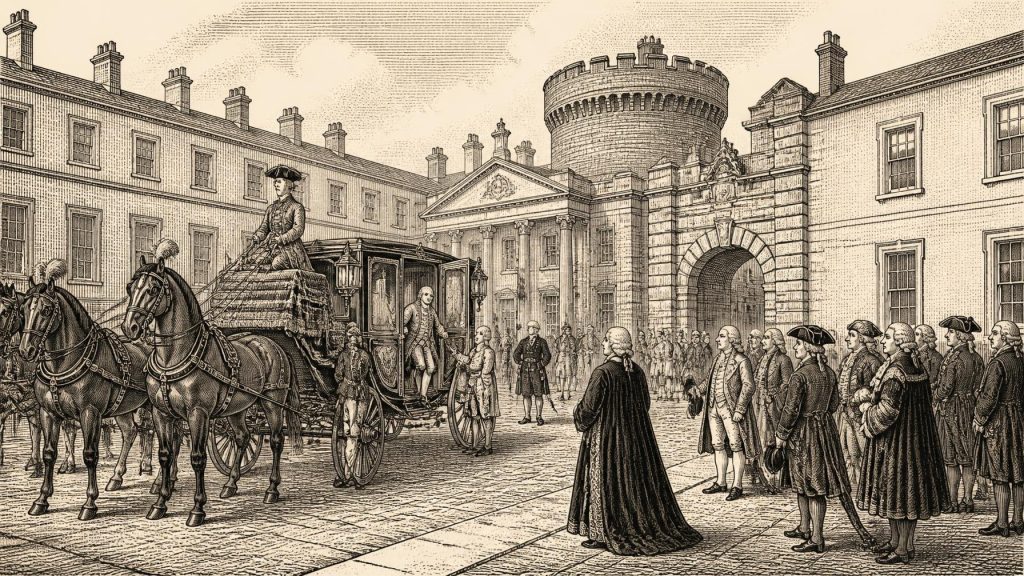
Townshend at Dublin Castle1767 CE
In 1767 George Townshend became resident lord lieutenant, strengthening Dublin Castle’s presence and preparing conflict with parliamentary undertakers led by John Ponsonby. Parliament debated increased Irish funding for imperial troops alongside proposals for regular parliaments and secure judicial tenure, though settlement came later. In Belfast, Lord Donegall’s extensive leases reshaped property, encouraged development and served estate income within the expanding linen economy. Dublin’s Magdalen Asylum, founded by Lady Arabella Denny, provided Protestant women relief, work and strict moral supervision. John O’Keeffe’s theatrical debut reflected cultural vitality. Together, these developments exposed Ireland’s commercial and institutional change amid narrow Protestant political control.
Dateline
In 1767, Ireland entered a year whose most important development was not a battle, rebellion or new law, but the arrival of a new kind of ruler. George Townshend, fourth Viscount Townshend, was appointed lord lieutenant in August and took the oath of office in Dublin on 14 October. His coming mattered because he intended to reside in Ireland rather than appear only for parliamentary sessions. That practical decision altered the balance between Dublin Castle, the Irish parliament and the great Protestant political families who had long managed government business in the lord lieutenant’s absence.
A Resident Lord Lieutenant
The Kingdom of Ireland had its own parliament in College Green, its own executive administration and a distinct revenue, but it was neither representative of the whole population nor constitutionally independent. Roman Catholics, who formed the great majority of the people, could not vote or sit in parliament. Presbyterians and other Protestant dissenters also faced civil disabilities. Political power was concentrated among Anglican landowners, office-holders and borough patrons. Moreover, under Poynings’ Law, proposed Irish legislation had to pass through the Irish and British privy councils before it could be presented to parliament, leaving the British government substantial scope to amend or block it.
In practice, much Irish administration had been conducted through powerful parliamentary managers known as “undertakers”. They undertook to deliver parliamentary support for the Crown’s business and were rewarded with offices, pensions and influence. John Ponsonby, speaker of the Irish House of Commons and a commissioner of revenue, was the foremost figure in this system. The arrangement gave leading Irish politicians considerable leverage, but ministers in London increasingly regarded it as costly, unstable and too independent of direct executive control.
Townshend’s appointment therefore carried an institutional purpose. The decision that future lords lieutenant should reside continuously in Ireland had been made in London in 1765, but previous appointees had not put it into effect. Townshend did. His residence gave Dublin Castle a permanent political presence and foreshadowed a more assertive executive. It would be misleading to treat the transformation as complete in 1767: the decisive clashes with Ponsonby and the other undertakers still lay ahead. Yet the new viceroy’s arrival made the contest unavoidable.
Parliament Reopens
The Irish parliament met on 20 October. Townshend’s immediate assignment was to secure Irish consent to an increase in the troops paid for from Irish revenue, from 12,000 to 15,325 men. The proposed augmentation was connected to an imperial scheme of regimental rotation. Britain had emerged from the Seven Years’ War with a far-flung empire to police, and George III’s ministers wanted a more flexible military establishment. In Ireland, however, the proposal raised an obvious question: why should a polity with limited control over its own legislation and commerce bear a larger military charge for imperial purposes?
The government possessed an inducement. Irish political reformers had long demanded that parliaments should end at regular intervals. The parliament elected in 1761 could, in theory, continue until the death of George III, since a general election was normally triggered by the monarch’s death rather than a fixed term. Charles Lucas, veteran Dublin patriot and MP, introduced heads of a bill on 20 October for septennial parliaments; a measure on judicial tenure was introduced at the same time. Regular elections and judges holding office during good behaviour promised limits on patronage and arbitrary power.
These initiatives were significant in 1767, but their outcome belongs carefully to the following year. The limiting-of-parliaments measure became the Octennial Act only in 1768, after being altered in Britain from seven years to eight. Likewise, the army question was not resolved in the autumn of 1767. The year should therefore be understood as one of bargaining, manoeuvre and expectation rather than constitutional settlement. Townshend arrived offering concessions while seeking a military commitment; Irish political interests weighed reform against the danger of a more intrusive Castle administration.
Belfast Leases and Urban Change
On 20 July, far from College Green, Arthur Chichester, fifth earl of Donegall, granted new leases affecting most holdings in Belfast. The surviving counterparts number at least 258. This was a major intervention in the property structure of a still modest but growing town. Belfast stood largely on the Donegall estate, and the terms on which its landlord granted or renewed leases could determine whether merchants and artisans had the security to repair premises, construct houses, establish yards or improve commercial streets.
The leases did not represent disinterested urban benevolence. Donegall was an absentee proprietor and the reallocation of leases brought entry fines and higher rents, raising money for his wider interests. Nevertheless, long leases and building stipulations helped shape the physical town. In later years, resentment at estate practices would contribute to rural and urban tensions in Antrim. In 1767, however, the lease programme captured a basic feature of eighteenth-century Irish development: towns were frequently built, constrained and profited from through private estates rather than municipal planning.
Belfast’s prospects were tied to the linen economy. Linen was principally a domestic rural manufacture: flax was grown and prepared locally, yarn spun within households, cloth woven by small producers, then sold through markets to bleachers and merchants. Belfast merchants increasingly connected Ulster production with Irish Sea trade, while the port handled imports essential to town life, including coal. The new leases therefore mattered beyond architecture. They concerned the commercial space in which a northern town linked farms, workshops, warehouses, quays and overseas markets.
Charity, Discipline and Women’s Work
Dublin saw another firmly dated institutional beginning. On 11 June, Lady Arabella Denny’s Magdalen Asylum opened in Leeson Street. The charity had been prepared over earlier years, and its surviving admission registers begin in 1767. It was intended for Protestant women described in the language of the period as “penitent” or “fallen”: women exposed to prostitution, poverty, abandonment and public disgrace. The asylum offered lodging, food, clothing, religious instruction and training in domestic or needlework, but it also imposed close supervision, regulated time and moral discipline.
It is important not to collapse this eighteenth-century institution into the later history of Ireland’s Magdalene laundries. The Leeson Street asylum was a Protestant, lay-founded charitable enterprise and must be assessed in its own setting. Still, its opening reveals how elite philanthropy could combine genuine material assistance with a determination to reform women according to Anglican, class-based ideals of respectability. Denny herself was already active in the Foundling Hospital and in industrial improvement. In 1767, the Dublin Society recorded her support for children at the hospital who excelled in lace-making, linking charity to the cultivation of marketable skills.
That same year Hugh Kelly published Memoirs of a Magdalen, a novel centred on a woman’s sexual reputation and social vulnerability. It was not a record of the new Dublin asylum, but the coincidence is revealing. Both the charity and the novel belonged to a wider eighteenth-century preoccupation with urban poverty, female dependency, sexual double standards and the possibility—or social usefulness—of repentance.
Stages, Print and an Unequal Public
Dublin’s cultural life also produced a small but notable theatrical debut. John O’Keeffe’s The She Gallant; or, Square-Toes Outwitted was performed at Smock Alley Theatre in 1767, with O’Keeffe himself appearing in it. The play belongs to the lively English-language theatre and print culture of the capital, a world of actors, booksellers, subscribers, coffee-house talk and fashionable audiences. Such institutions made Dublin a significant cultural city, even though access to their pleasures and influence was sharply unequal.
The contrast between the theatre, parliament and the Leeson Street asylum is instructive. Each was an urban institution sustained by particular networks of money, patronage and social authority. Yet most Irish people had no parliamentary voice, lived outside the capital, and depended on agriculture, seasonal employment, household production and local credit. Their political world was shaped indirectly by rent, tithes, estate rules, market prices and the decisions of a Protestant legislature in which they could not participate.
A Year of Repositioning
Thus 1767 was a threshold year. Townshend’s arrival announced a resident and more forceful Dublin Castle; parliament reopened amid debate over army finance and regular elections; Donegall’s Belfast leases reordered urban property; and Lady Arabella Denny opened an institution that joined relief to moral regulation. None by itself remade Ireland overnight. Taken together, they show an eighteenth-century kingdom in which imperial strategy, landlord power, commercial growth, philanthropy and cultural life were all being reorganised—while political authority remained confined to a narrow minority.
Primary Sources
- Townshend, George
- Ponsonby, John
- Flood, Henry
- Lucas, Charles
- Chichester, Arthur
- Denny (Fitzmaurice), Lady Arabella
- Irish Statute Book: Public Acts of the Parliament of Ireland, 1767
- Poynings’ Law
- Poynings’ Law and the Making of Law in Ireland, 1660–1800
- Monitoring the Constitution: The Operation of Poynings’ Law in the 1760s
- The Irish House of Commons in 1769
- George Townshend’s Ireland
- Belfast Leases, Lord Donegall, and the Incumbered Estates
- Sources for Irish Women’s History: Magdalen Asylum, Dublin
- Representative Church Body Library, MS 551: Magdalen Asylum
- The She Gallant; or, Square-Toes Outwitted
- Research Guide for Archival Sources of Smock Alley Theatre
- Memoirs of a Magdalen; or, the History of Louisa Mildmay
- History of the Commercial and Financial Relations Between England and Ireland from the Period of the Restoration
- Irish Sea and Coastal Trade
- A Chronology of Irish History
- Dublin: A Short History