
College Green’s First Session1731 CE
In 1731, Dublin witnessed institutional developments that illuminated eighteenth-century Ireland’s unequal political and social order. Thomas Prior, Samuel Madden and fellow Protestant elites founded the Dublin Society to promote agriculture, manufactures and useful knowledge, creating a forum for economic improvement. In October, the Irish parliament first met in Edward Lovett Pearce’s Parliament House on College Green, a grand but constitutionally constrained home for a legislature representing Protestants alone. Its session considered regulation and transport, including roads. Meanwhile, the Lords’ hostile inquiry into popery documented enduring Catholic worship, clergy, schools and religious communities, exposing the narrow social base of Protestant rule.
Dateline
Two Dublin events give 1731 an unusual clarity in the history of eighteenth-century Ireland. On 25 June a small group founded the Dublin Society, an association dedicated to improving husbandry, manufactures and the useful arts. On 5 October the Irish parliament assembled in the new Parliament House on College Green. One was a voluntary initiative; the other was the formal stage of an established Protestant political order. Together they reveal a country in which influential people increasingly spoke the language of economic “improvement”, even as political power, religious rights and much landed wealth remained unequally distributed.
A Society for Improvement
The Dublin Society was founded at Trinity College on 25 June. It was not yet the chartered Royal Dublin Society of later memory, nor did it possess the extensive public funds, schools, collections and exhibition programmes with which it would subsequently be associated. Its first name was descriptive of its ambition: the Dublin Society for improving husbandry, manufactures and other useful arts. At a subsequent early meeting, “and sciences” was added. Such language mattered. The founders proposed that practical knowledge—about cultivation, materials, craftsmanship and production—could make Ireland wealthier and provide work.
Thomas Prior was central to the initiative. His earlier writing on absentee landlords had attacked the departure of rental income from Ireland and argued, in effect, that resident proprietors owed duties to the country in which their estates lay. Samuel Madden, clergyman, writer and later celebrated as “Premium Madden”, was another formative figure. Both belonged to a Protestant educated world that linked public virtue with experiment, learning and productive labour. Their circle included landowners, clergymen, physicians and men connected with commerce and government. It was a sociable elite project, but its declared subjects—farming, manufacturing and employment—reached far beyond elite life.
The Society’s foundation should not be mistaken for the immediate launch of every later RDS activity. Its famous premiums, rewarding useful work and innovation, belong chiefly to the later 1730s and beyond; its royal charter came later still. In 1731 the significant development was institutional: people who wanted to foster Irish production created a continuing forum in which observations could be exchanged, projects considered and patronage organised. The surviving register and minute book for 1731–33 makes this modest beginning unusually tangible.
Its agenda reflected real conditions. Most people in Ireland lived through agriculture, whether as smallholders, tenants, labourers, cottiers, estate servants or members of households combining tillage with spinning and other by-employments. Linen was already Ireland’s outstanding protected manufacturing interest and a major export; flax growing, spinning, bleaching, weaving, marketing and carriage tied rural districts to merchants and ports. Yet prosperity was uneven. Roads could be poor, markets distant, credit precarious and subsistence vulnerable to weather, rent and harvest. Calls for “improvement” promised better techniques and output, but they also assumed that landlords and gentlemen should direct rural change.
That assumption limits any easy celebration of the Society’s language. Improvement could mean planting, drainage, new crops, skills and local employment. It could also mean a more intensive management of tenants and land, with the benefits not necessarily shared equally. The Dublin Society nevertheless supplied a durable institutional expression to a question that had become urgent among politically connected Irish Protestants: how could the island increase production within an empire whose commercial rules did not treat all its kingdoms alike?
Parliament Enters College Green
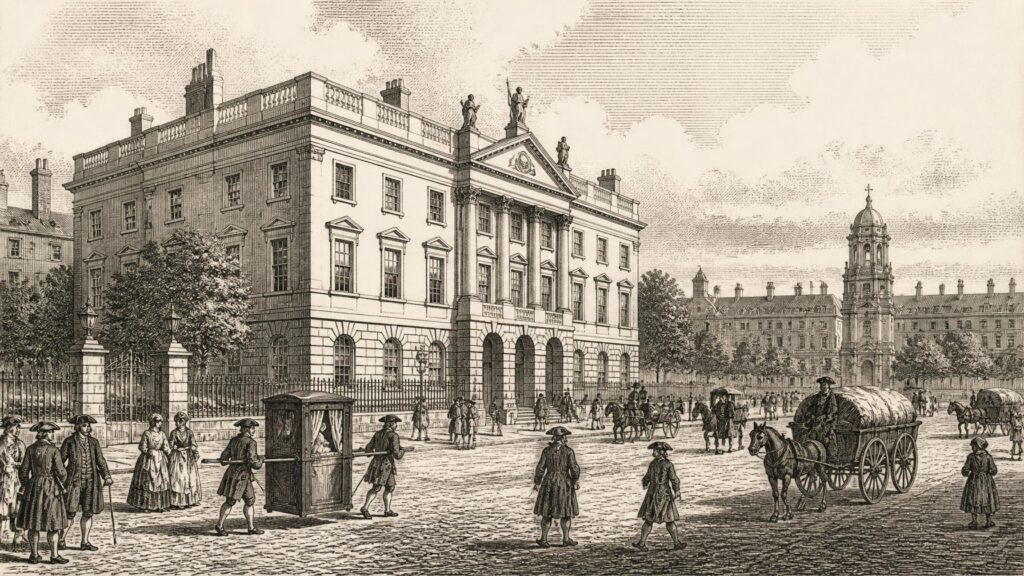
On 5 October, Lionel Sackville, Duke of Dorset, the lord lieutenant, opened a new parliamentary session in Dublin. It was the first session associated with Edward Lovett Pearce’s new Parliament House on College Green. Pearce was himself an MP as well as an architect, and his design gave the legislature a permanent and conspicuous home in the capital. The complex would be enlarged and altered in later decades, but its opening marked a decisive shift from improvised or borrowed accommodation to a purpose-built setting for Ireland’s two parliamentary houses.
The visual message was substantial. A legislature housed in a monumental classical building appeared settled, dignified and public-facing. College Green stood close to Trinity College, Dublin Castle, commercial streets and the city’s expanding professional life. MPs, peers, clerks, petitioners, lawyers, servants and tradespeople converged there when parliament sat. Political business brought custom to printers, coffee houses, lodgings, carters and suppliers, while formal debate depended on a much wider urban workforce.
Yet the grandeur of the new house must not be confused with democratic inclusion. The parliament represented the Protestant political nation, not Ireland’s population as a whole. Roman Catholics were excluded from parliamentary power, and the franchise and borough system gave a limited electorate and powerful patrons immense influence. Nor was the Dublin legislature wholly sovereign. Under the constitutional arrangements inherited from Poynings’ Law, proposed Irish legislation required prior approval through the British and Irish privy councils; the Declaratory Act of 1719 had also asserted Westminster’s power to legislate for Ireland and made the British House of Lords the final court of appeal. The Parliament House was therefore both a symbol of domestic political importance and a reminder of constrained authority.
The 1731–32 session nevertheless dealt with matters close to daily economic life. Measures emerging from it included provisions on pawnbroking and navigation, while a succession of road schemes showed concern with internal movement. The statutory measures are conventionally catalogued as the 1731 acts because of the parliamentary session, although several received enactment in March 1732; that distinction matters when describing the calendar year itself. What can safely be said of 1731 is that, from October, parliament was meeting in Dublin and considering the practical infrastructure and regulation of a trading, agricultural country.
Road improvement was more than a convenience for gentlemen travelling to the capital. Routes connecting Dublin with Kinnegad, Athboy, Kilcullen, Kilkenny, Clonmel, Cork, Limerick, Naas and Maryborough were placed before the legislature in this period. Better surfaces, bridges and turnpikes could reduce delays in moving livestock, grain, butter, cloth and people, although tolls also imposed costs on users. The later legislation was not a completed network in 1731. It is better understood as evidence that access between towns, ports and hinterlands had become a recognised public concern.
Religion Under Inspection
Another 1731 development exposes the limits of the Protestant establishment more starkly. The Irish House of Lords’ inquiry into the “state of popery”, associated with Archbishop Hugh Boulter of Armagh, gathered returns on Catholic clergy, places of worship, religious houses and schools. The language was hostile and the exercise was one of surveillance, not a neutral census. Its title alone repeated the official assumption that Catholic religious life was a political danger. But the returns are historically revealing precisely because they recorded the resilience of a faith practised by the great majority of the population.
On 4 November the Lords’ committee directed Dublin’s lord mayor, parish ministers and churchwardens to provide accounts of mass houses, priests, private chapels, reputed nunneries and friaries, and Catholic schools within the city, suburbs and liberties. Similar enquiries extended across the country. The resulting document is normally known as the Report on the State of Popery in Ireland, 1731, though the fuller printed report appeared in 1732. It should thus be used carefully: the investigation belongs firmly to 1731, whereas the publication and some parliamentary consequences belong to the following year.
The inquiry did not show a Catholic Church driven wholly underground. It identified public mass houses as well as private chapels in wealthier households, alongside schools and communities of religious women and friars. Conditions varied greatly. Worship might occur in a built mass house, a private room, a makeshift cabin or outdoors; clergy could be registered, tolerated, vulnerable to prosecution or operating beyond the law. Catholic families faced the wider disabilities of the penal code in property, education, office and political participation, while also contributing tithes to the established Church of Ireland. The official returns therefore reveal both constraint and persistence rather than either total suppression or unrestricted toleration.
Boulter’s concern was political as well as ecclesiastical. A Church of Ireland hierarchy, sustained by tithes and law, served a population overwhelmingly outside its communion. The inquiry’s emphasis on Catholic numbers, schools and clerical organisation reflected establishment anxiety that legal superiority had not brought religious conversion. It is an important corrective to a view from College Green alone: the state’s institutions were imposing, but their social base was narrow.
Connected Changes, Unequal Ireland
The Dublin Society, the new Parliament House and the religious inquiry did not form a single programme. They were, however, connected by the governing assumptions of 1731. Improvement was imagined from above: through legislation, learned conversation, elite example, regulated trade and the moral direction of the poor. The Catholic inquiry shows the coercive edge of that order; the Society’s foundation shows its constructive and inquisitive side. Both arose from an establishment seeking security, prosperity and authority in a country it did not represent socially or confessionally.
For most inhabitants, the year brought no single dramatic national event. Life continued through work in fields, cabins, workshops, markets, fishing communities, ports and towns; through family obligations, rents, seasonal rhythms and religious observance. But 1731 left unusually clear marks in institutions. In Trinity College rooms, the Dublin Society began a long career in agricultural, scientific, artistic and industrial encouragement. On College Green, Pearce’s building gave Irish parliamentary politics a new architectural centre. And in the Lords’ inquiry, the state produced an unwilling but valuable record of the Catholic life that endured beneath and alongside Protestant rule.
Primary Sources
- Register and Minute Book of the Dublin Society (1731–1733)
- RDS Manuscripts
- Our History
- Premiums and Progress—How the Dublin Society Shaped Eighteenth-Century Ireland
- Improvement as Philanthropy: The Royal Dublin Society
- Improvement and the Discourse of Society in Eighteenth-Century Ireland
- Pearce, Sir Edward Lovett
- Parliament House, College Green, Dublin
- Pearce, Edward Lovett (Sir)
- His Grace Lionel, Duke of Dorset, Lord Lieutenant General and General Governor of Ireland; His Speech to Both Houses of Parliament, at Dublin: On Tuesday the Fifth Day of October, 1731
- Constitutional Differences: Parliament and Ireland
- Irish Legislation Database: Browse
- Irish Legislation Database: Regnal Years and Statute Numbers
- Statute Law Revision Act 2007
- Irish Statute Book: 1731
- Kinnegad Bridge, Kinnegad, County Westmeath
- A Report Made by His Grace the Lord Primate [H. Boulter] from the Lords Committees Appointed to Enquire into the Present State of Popery
- Report on the State of Popery, 1731
- Appendix V: Report on Popery in Ireland, 1731
- 18th Century Reports on Dublin ‘Mass Houses’
- Boulter, Hugh
- The Penal Laws: Origins, Purpose, Enforcement and Impact
- History of the Commercial and Financial Relations Between England and Ireland from the Period of the Restoration