Sherlock Annesley1719 CE
In 1719, the Sherlock v Annesley inheritance dispute escalated into a constitutional conflict between the Irish and British Houses of Lords over appellate jurisdiction. Although Westminster’s Declaratory Act followed in 1720, the controversy exposed Irish Protestant elites’ defence of judicial dignity within constrained government. Dublin’s parliament managed revenue, regulation and militia security, while granting Protestant dissenters, especially Presbyterians, limited worship protections; Catholics and non-Trinitarians remained excluded. Rebuilt St Werburgh’s Church symbolised Anglican confidence, while a 1719 issue of Cornelius Nary’s New Testament evidenced Catholic learning. Expanding linen exports linked rural households to markets, yet prosperity remained uneven and livelihoods precarious.
Dateline
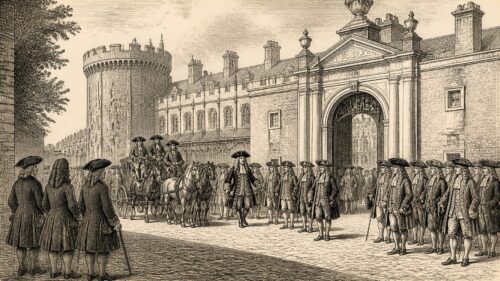
In 1719, Ireland’s most consequential drama was conducted not on a battlefield but through petitions, decrees and competing orders from two Houses of Lords. The immediate dispute was a private inheritance case, Sherlock v Annesley; its implications concerned the constitutional standing of the whole kingdom. At the same time, the Dublin parliament enacted a limited toleration for Protestant dissenters, maintained institutions of security and local order, and saw a rebuilt city church become usable for worship. These developments belonged to a country ruled by King George I, administered through Dublin Castle, and marked by sharp inequalities of confession, property and political power. The year therefore reveals both a measure of adjustment within the Protestant governing order and the mounting question of whether Ireland’s institutions possessed any final authority of their own.
A Private Case, A Public Constitution
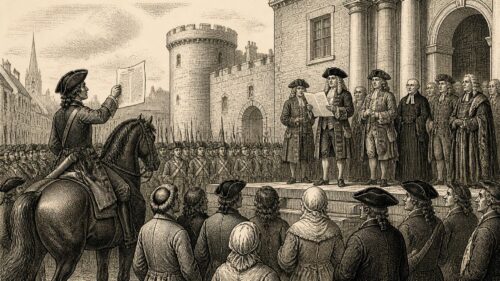
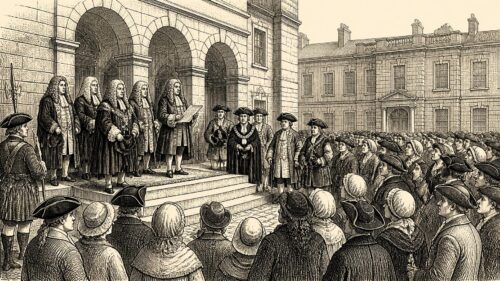
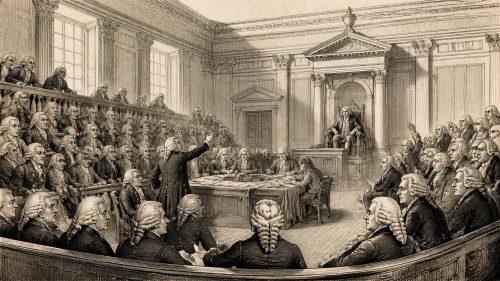
The roots of Sherlock v Annesley lay in a long-running Kildare property suit. Hester Sherlock had obtained a decision from the Irish House of Lords in 1716, while Maurice Annesley secured a contrary decision from the British House of Lords. In 1719 the conflict became acute because the Irish Exchequer was faced with incompatible commands. The Irish Lords defended their own decree and treated the British intervention as an infringement of the kingdom’s judicial rights; the British Lords insisted upon their appellate authority. What might otherwise have remained litigation among landholders became a test of where, within the composite monarchy, a final appeal could end.
The episode mattered especially to the Protestant landowning and legal elite who dominated the Irish parliament. They were not seeking democratic independence: Catholics, who formed the great majority of the population, were excluded from parliament and were constrained by the penal code. Yet many of those same Protestant politicians regarded an Irish House of Lords able to hear final appeals as an essential attribute of the kingdom’s constitutional life. The controversy exposed an important distinction. The Irish parliament could legislate only through procedures constrained by Poynings’ Law and royal government, but its members still defended the jurisdiction and dignity of Irish courts against direct interference from Westminster.
It is important not to put the later settlement of this quarrel into the wrong year. The statute commonly called the Declaratory Act or the Sixth of George I was passed at Westminster in March 1720, although its regnal citation is 6 George I and older dating conventions sometimes label it “1719”. It declared Westminster’s power to legislate for Ireland and confirmed the British House of Lords as the final appellate court. That statute was not an event of calendar year 1719; the year’s firmly connected development was the escalation of the Sherlock–Annesley dispute that supplied its immediate constitutional setting.
The Dublin Session
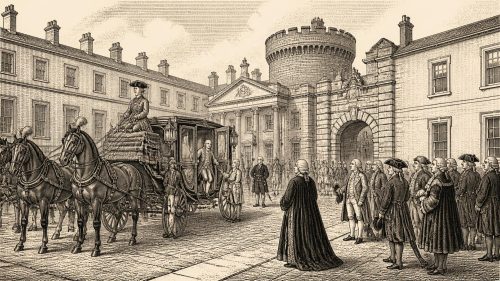
The Irish parliament’s third session of the parliament elected in 1715 sat during 1719 and concluded on 2 November. Charles Powlett, second Duke of Bolton, was lord lieutenant, though government was ordinarily conducted through the administrative machinery of Dublin Castle and the kingdom’s political managers rather than by continuous viceregal residence. The statutes printed in Dublin by Andrew Crooke show a legislature concerned with revenue, military administration, judicial procedure and urban regulation as well as religious policy. Its agenda was practical in form: collecting duties, renewing temporary provisions, reducing delays in writs of error and addressing paving, fires and the River Dodder. Such measures remind us that high constitutional conflict coexisted with the routine business of governing towns, courts, roads and waterways.
One continuing measure concerned the militia. The 1719 act continued and amended earlier legislation intended to make it more useful. The militia was part of the post-Williamite security order: a Protestant-controlled force embedded in a society whose rulers still feared Jacobitism and political instability. The associated law could impose a local financial burden upon Catholic inhabitants for militia exercises. This was not a sign of war in Ireland during 1719; rather, it illustrates the normalised coercive framework within which a relatively peaceful kingdom was administered. The state’s claims on ordinary people were felt through parish, county and magistrates’ institutions as much as through soldiers.
Toleration With Firm Boundaries
The most memorable Irish statute of the session received royal assent on 2 November: An Act for exempting the Protestant Dissenters of this Kingdom from certain Penalties to which they are now subject, now usually called the Toleration Act 1719. It gave a more secure legal basis to worship by qualifying Protestant nonconformists, above all Presbyterians in Ulster. Ministers who made the stipulated declarations against transubstantiation and Marian devotion and took the oath of allegiance gained relief from penalties that had threatened their religious practice. The accompanying provisions protected congregations permitted by the act from deliberate disturbance: an offender convicted of disrupting worship could face recognisances, imprisonment pending sessions and a monetary penalty.
This was a significant concession, but it was neither religious equality nor a general freedom of conscience. The law explicitly withheld its benefits from Catholics and from those denying the Trinity. Nor did it remove the sacramental test that obstructed dissenters’ access to public office. Its political purpose was partly Protestant consolidation: easing tensions among loyal Protestants was thought likely to unite them “in interest and affection”. In Ulster, where Presbyterian congregations were socially and economically important, the practical effect was considerable. Yet the unequal character of the settlement was unmistakable. A Presbyterian meeting-house had gained greater security; a Catholic chapel and clergy remained subject to a far harsher legal and social regime.
Worship, Books and the City
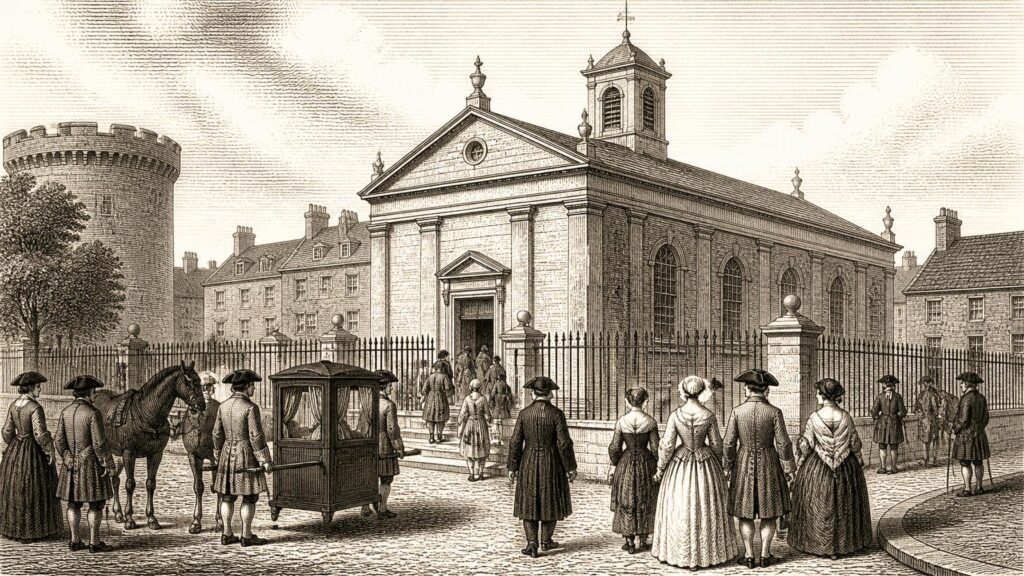
Religious life in 1719 also left material and printed traces. In Dublin, the rebuilding of St Werburgh’s Church, close to Dublin Castle, had progressed sufficiently for divine service to be held. Thomas Burgh, surveyor general and architect, had designed the replacement for the decayed medieval parish church; work had run from 1715 to 1719. The building’s completion for worship was an urban event as well as an ecclesiastical one. It represented investment in the established Church of Ireland at the administrative heart of the capital, where parish worship, vestry business and civic status were closely connected.
In Catholic intellectual life, the evidence needs more caution. Cornelius Nary’s English New Testament, translated from the Latin Vulgate with reference to Greek and other vernacular versions, survives in issues bearing the imprint year 1719; bibliographical records also identify a closely related 1718 Dublin issue. It is safest, therefore, to say that a 1719 issue of Nary’s work circulated or was printed, probably in Dublin, rather than to treat it as an unquestionably new publication on a known day. Its very existence is revealing. Catholic learning and print persisted despite legal disability, using English as well as Latin and Irish, and addressing readers who wanted annotated scripture within a Catholic interpretative tradition.
Linen, Land and Uneven Prosperity
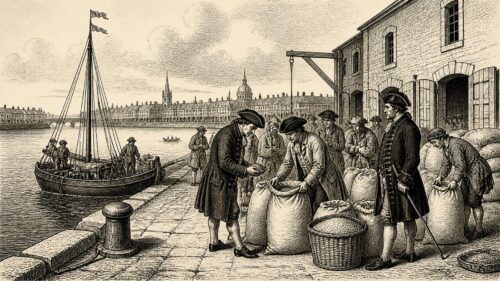
For most people, however, the year was determined less by parliamentary argument than by work, rent, crops, household production and local markets. Ireland remained overwhelmingly rural, but its regions were changing at different speeds. Farming and linen manufacture were central to Ulster’s economy, linking smallholders, spinners, weavers, bleachers, merchants and ports. Linen had become the principal textile encouraged after restrictions on the overseas export of Irish woollens. Surviving trade compilations record more than two million yards of linen cloth exported from Ireland to Great Britain in the accounting year labelled 1719, alongside a smaller Atlantic plantation trade. Those totals should not be mistaken for a complete measure of prosperity, but they indicate the scale of a commercial network that reached far beyond the loom and the farmyard.
Such growth did not dissolve dependence or poverty. Much spinning and weaving was undertaken in dispersed domestic settings, with returns shaped by merchants, credit, fluctuating prices and access to land. Elsewhere, cattle, butter, grain and other agricultural produce connected estates and market towns to Irish Sea and Atlantic commerce. The contrast between a prosperous export sector and insecure household livelihoods was already embedded in eighteenth-century Ireland. It would be misleading to attach a specific harvest crisis or famine to 1719 without firm evidence; nevertheless, historians emphasise that rural living standards were vulnerable to poor harvests, disease and trade downturns. The relative absence of a recorded national catastrophe in this year should not obscure that underlying fragility.
An Unequal Accommodation
Thus 1719 was not a year of spectacular Irish rebellion or invasion. Its importance lies in the interaction of law, religion and everyday governance. The Lords’ struggle in Sherlock v Annesley made judicial authority a constitutional issue; the parliamentary response to Protestant dissent extended a guarded toleration while reinforcing the exclusion of Catholics; and Dublin’s rebuilt St Werburgh’s showed the physical confidence of the established church and governing city. Linen exports and rural industry, meanwhile, tied households to expanding markets without assuring security. Ireland entered the 1720s with institutions active and commerce developing, but with political power narrowly held and the question of subordination to Westminster moving from dispute towards statutory assertion.

Primary Sources
- Prohibition of Disturbance of Worship Act, 1719, Section 14
- Irish Statute Book: Pre-Union Irish Statutes Affected, 1719
- Statute Law Revision Act 2007
- Acts and Statutes Made in a Parliament Begun at Dublin… Being the Third Session
- Constitutional Differences
- The Case of the Protestant Dissenters of Ireland, in Reference to a Bill of Indulgence, Represented and Argued
- Ireland
- Ireland
- Statutes in Chronological Order: The Reigns of King George I and II
- Background: Chronology of Key Events 1169 to 1799
- Life of Lord Chancellor Midleton — Concluded
- St Werburgh’s Church, Dublin, Werburgh Street
- St Werburgh’s Church: Architectural Heritage Impact Assessment
- Dublin City Urban Archaeology Survey: Parish Churches
- The New Testament of Our Lord and Saviour Jesus Christ
- Cornelius Nary
- New Testaments 393
- The Commercial Restraints of Ireland
- Famine and Economic Change in Eighteenth-Century Ireland
- The Early Modern Economy, 1600–1780
- The Kingdom of Ireland, 1641–1760
- The Cambridge History of Irish Literature