
Wool, Woods and Forfeitures1699 CE
In 1699, post-war Ireland remained shaped by land redistribution, Protestant security and contested trade. The Irish parliament concluded legislation imposing woollen export duties, supporting Church of Ireland clerical residences, protecting timber and regulating butter casks. Westminster’s Woollen Act then barred most Irish wool and woollen exports to foreign markets, restricting a vital, widespread industry and encouraging, but not immediately replacing it with, linen. A parliamentary commission investigated Williamite forfeitures, reporting thousands attainted and over one million plantation acres affected, deepening uncertainty over titles. Anti-Catholic laws and proclamations restricted solicitors, arms and clerical jurisdiction. Dublin’s print trade nevertheless demonstrated wider connections.
Dateline
In 1699 Ireland’s long post-war settlement was still being made, argued over and imposed. Eight years after the Treaty of Limerick ended the Williamite war in Ireland, the country was formally at peace under William III, yet its politics were governed by the distribution of land, the security of Protestant rule and the direction of trade. Three developments gave the year its particular importance: new restraints upon the woollen export trade, a Westminster investigation into Irish forfeited estates, and the continued tightening of legal and administrative pressure on Catholics.
These were not isolated matters. Wool supported farmers, spinners, weavers, merchants and port communities. Forfeited estates determined who possessed land and influence after the war. Religious restrictions shaped access to the courts, public office and learned professions. Meanwhile, measures concerning timber, clerical residences and butter casks reveal a government concerned not only with grand constitutional questions but with the material fabric of recovery: houses, barrels, trees, parish life and taxable commerce.
A Parliament Concludes
The Irish parliament sitting at the start of 1699 had first assembled in September 1698. Its final legislative business was completed in January 1699, and the parliament was formally dissolved on 14 June. It was not a representative national assembly in the modern sense. Catholics were excluded from parliamentary life by the oaths required for office, while the executive and the machinery of legislation remained closely tied to Dublin Castle, the crown and English approval under Poynings’ Law. Nonetheless, its statutes mattered deeply, especially to the Protestant landowning and mercantile interests who dominated it.
Among the acts associated with the session was one laying an additional duty on woollen manufactures exported from Ireland. Its provisions were scheduled to operate from 25 March 1699. Broadcloth faced an additional charge of four shillings for every twenty shillings in value, while most newer woollen draperies were charged two shillings in every twenty; friezes were excepted. The measure was presented as revenue for the defence and security of the kingdom, but its commercial significance was unmistakable. It made the foreign sale of important Irish woollen goods substantially more difficult at exactly the moment when English manufacturers and parliamentarians were pressing against Irish competition.
The session also enacted measures that speak to the practical concerns of a society still rebuilding after warfare. Legislation on glebes and clerical houses encouraged the provision of residences for clergy of the established Church of Ireland. Such policy was part of consolidating a Protestant ecclesiastical structure across parishes whose resources, buildings and population had been disrupted by decades of conflict. An act for planting and preserving timber trees and woods addressed another legacy. Its preamble linked the shortage of timber to the recent rebellion and to former ironworks, arguing that there was insufficient wood even for repairing ruined houses, much less for future building and improvement.
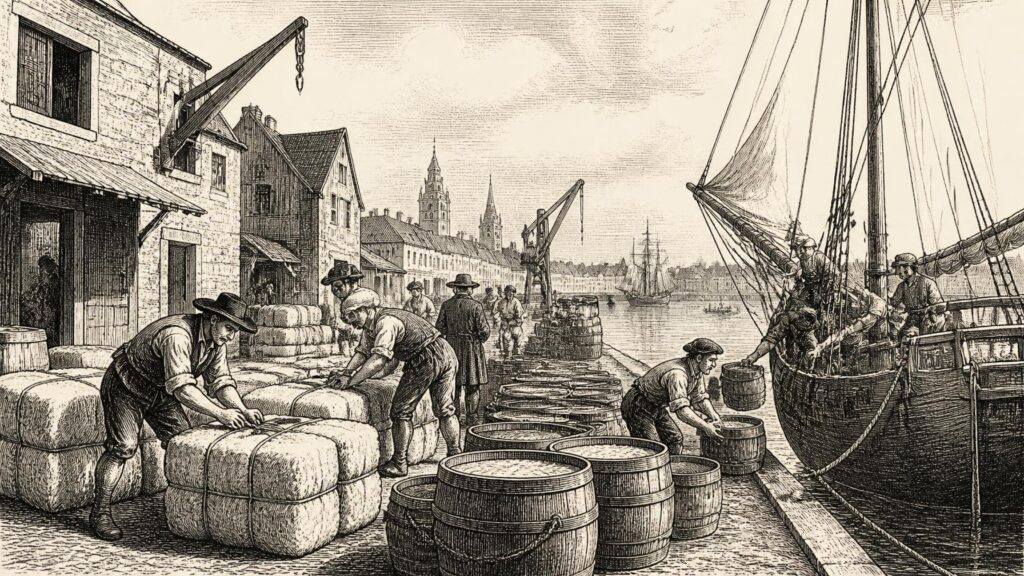
That language should not be mistaken for a modern environmental programme. Timber was valued above all as a strategic and economic resource: for building, fuel, estate improvement, transport, industry and maritime uses. Yet the legislation recognised a visible regional change in the Irish landscape. Landowners were urged towards planting and conservation because mature woods could not be replaced quickly. A further concern with commercial standards appeared in April, when a proclamation regulated the making of butter casks. Butter was a major Irish export, and casks were not trivial containers: their size, soundness and uniformity affected the quality, storage and marketability of a perishable commodity carried by sea.
The Woollen Blow
The most consequential external intervention came from Westminster. On 4 May 1699 the English parliament passed the statute usually called the Woollen Act. From 24 June it prohibited the export from Ireland to foreign destinations of wool, yarn and a wide range of goods made wholly or partly of wool. England and Wales were the formal exception, but Irish woollens already faced serious obstacles in the English market. The Act was explicit about its purpose: English legislators feared that Irish and colonial manufactures were supplying foreign markets previously served from England and might reduce the value of English land and trade.
For Ireland, this was not simply a regulation of one commodity. Wool was embedded in rural and urban livelihoods. Sheep farmers supplied fleeces; women and men spun yarn in homes and small workshops; weavers, fullers, dyers, carriers, merchants, sailors and exporters depended upon the circulation of cloth and related materials. The evidence does not permit a precise count of those whose work was affected in 1699, and the Act did not make Irish woollen production disappear overnight. It did, however, close the legal overseas markets on which expansion depended and redirected commercial calculation towards England’s needs.
The Irish export duty and the Westminster prohibition must be distinguished. The former was an act of the Irish parliament, passed in a session that opened in 1698 and whose concluding acts were printed in 1699; the latter was an English statute directly binding Ireland, passed on 4 May 1699. Together they demonstrate the imbalance of power within the Stuart composite monarchy. Irish legislators could tax their own export trade, but Westminster could determine whether that trade could reach foreign buyers at all.
Advocates of the policy presented linen and hemp as suitable alternatives for Ireland, industries thought complementary rather than competitive to English manufacture. This was an official expectation, not an immediate transformation. Linen required flax, skills, capital, equipment, trading connections and dependable markets; it could not instantly replace wool in every locality. In 1699, therefore, the future of the Irish economy was being narrowed and redirected rather than settled. The coastal trade, the movement of raw wool, and the temptation to evade restrictions would remain matters of official concern. The statute even provided for naval patrols intended to check illicit exports around the coasts of England and Ireland.
Land Under Inquiry
Land was the other great unsettled question. The Williamite victory had brought extensive attainders and confiscations from those judged to have supported James II. Some estates had been restored or protected through legal claims and the Articles of Limerick and Galway; others had been granted by William III to military supporters and political favourites. In England, resentment grew that such Irish lands had been disposed of by royal grant when public finance remained strained after continental war.
On 4 May 1699, Westminster authorised a commission of inquiry into the administration of the Irish forfeitures. The commission’s work extended across the year through examinations, records and valuations. It was not an abstract audit. Its findings threatened existing expectations of ownership, mortgages, family settlements, patronage and local authority. Francis Annesley, an Irish lawyer and politician, was among the commissioners. Their investigation drew Irish land questions into English party conflict, where criticism of royal favour and concern for public revenue could become inseparable from hostility to particular grantees.
On 15 December the commissioners delivered their report to the House of Commons. It recorded 3,921 people outlawed or attainted in connection with the Irish war and calculated the attached lands at more than one million plantation acres, while acknowledging that some lands could not be measured because of imperfect surveys. These were official administrative figures, not a complete social map of dispossession. They nevertheless convey the scale on which war, law and property had been fused. Behind the aggregate stood landlords, tenants, widows, creditors, purchasers and communities whose security depended on titles that could be reopened.
The report did not finish the matter in 1699. Rather, it prepared the controversy that would lead to the resumption and sale of forfeited property in the following years. For contemporaries, its immediate effect was uncertainty. A grant thought secure could be politically vulnerable in London; an old claimant might see reason to petition; and every valuation exposed the continuing consequences of the war in particular counties and estates.
Security, Religion and the Courts
Religious policy remained inseparable from the Williamite state’s idea of security. The 1698–99 parliamentary session passed an act preventing Catholics from practising as solicitors unless they took the prescribed oaths and subscribed the declaration against transubstantiation. Those who practised without qualifying faced a £100 penalty as well as further civil disabilities. The statute did not bar a person from conducting his own case, and it contained exceptions connected with the Articles of Limerick. But it sought to reduce Catholic professional influence at the point where property, inheritance, debt and litigation were decided.
This was the fourth major anti-Catholic measure of the decade, following laws on disarmament, overseas education and the banishment of bishops and regular clergy. Its importance lay in its target. In a society shaped by confiscation, disputed titles and estate management, lawyers and agents possessed practical power. Restricting Catholic solicitors was a means of reserving influence in the courts for those prepared to conform to the Protestant state.
Government enforcement continued after parliament’s dissolution. A proclamation of 19 July reiterated the law requiring Catholics to be disarmed. Another, on 13 September, enforced the prohibition on Catholics exercising ecclesiastical jurisdiction; on 29 November, licences previously granted to Catholics to bear arms were recalled. Such documents do not prove that every instruction was effectively carried out in every parish or county. They do show that Dublin Castle regarded Catholic arms, clerical authority and professional activity as continuing matters of surveillance in 1699, despite the absence of open war.
Print and a City in Motion
Dublin was also a place of commerce in words. John Dunton, a London bookseller, published The Dublin Scuffle in 1699, drawing on his visit to Ireland in the preceding year. Its lively, partisan and highly personal observations should not be treated as a statistical portrait of the country. Yet the book is valuable evidence of a connected print world in which Dublin booksellers, printers, readers and visiting London traders exchanged stock, gossip, religious argument and commercial information. Print remained tightly regulated by patents and privilege, but it was already an important medium through which the capital’s social and intellectual networks could be seen.
Thus 1699 was not defined by a battle or a change of monarch. It was a year in which the structures produced by war were worked into ordinary governance. The Irish parliament legislated over exports, parishes, trees and containers; Westminster curtailed woollen commerce and scrutinised conquered land; Dublin Castle renewed coercive religious policy; and Dublin’s print trade recorded a city tied to wider British and European circuits. The effects would unfold over decades, but the measures and reports of this calendar year made their direction clear.
Primary Sources
- Acts and statutes made in a Parliament begun at Dublin the twenty seventh day of August 1695
- Pre-Union Irish Statutes
- Statute Law Revision Act 2007, Schedule 2
- Statute Law Revision Act 2015
- An Act to prevent the Exportation of Wool out of the Kingdoms of Ireland and England into Forreigne parts
- Constitutional differences: Parliament and Ireland
- History of the Commercial and Financial Relations between England and Ireland from the Period of the Restoration
- The Irish Revenue System: Government and Administration, 1689–1702
- The Woods of Ireland
- Statutes by Subject: Offices and Employment
- Introduction: Irish Penal Laws
- The Penal Laws: Origins, Purpose, Enforcement and Impact
- Securing the Protestant Interest: The Origins and Purpose of the Penal Laws of 1695
- Public Act, 11 William III, c. 2
- The Report of the Commissioners Appointed by Parliament to Enquire into the Irish Forfeitures
- The Report of the Commissioners Appointed by Parliament to Enquire into the Irish Forfeitures: catalogue record
- Annesley, Francis
- Book of Survey and Distribution, 1636–1703, Volume I: County Roscommon
- National Library of Ireland Sources: Forfeited Estates manuscripts
- Parliamentary Papers Relating to Royal Grants
- The Dublin Scuffle
- First Impressions: Dublin and London to 1699
- The Irish Trade
- Catalogue of Early Dublin-Printed Books, 1601 to 1700
- William III
- The Constitutional Position