
The Sixth of George I1720 CE
In 1720, Westminster’s Sixth of George I asserted Britain’s power to legislate for Ireland and made the British Lords Ireland’s final appellate court, deepening dependency. Ireland’s Anglican ascendancy governed a population restricted by penal laws; James Cotter’s execution heightened sectarian tensions. Jonathan Swift’s Irish Manufacture pamphlet urged consumers to reject English goods, articulating economic patriotism amid mercantilist constraints. A proposed national bank reflected commercial ambition, but the South Sea Bubble’s collapse brought banking panic. Construction began on Dr Steevens’ Hospital, promoted by Grizelda Steevens, while Cork Harbour’s Water Club was founded. Together they exposed dependence, inequality, charity and elite sociability.
Dateline
A Westminster Statute, an Irish Year
The most consequential development connected firmly to 1720 was made not in Dublin but at Westminster. On 7 April, the Parliament of Great Britain gave royal assent to 6 George I, chapter 5, formally entitled An Act for the better securing the dependency of the Kingdom of Ireland upon the Crown of Great Britain. It is often called the Declaratory Act, or the Sixth of George I. Older references frequently label it an act of 1719 because the parliamentary session had begun in that regnal year; its assent nevertheless belongs unambiguously to April 1720.
The measure arose from the long-running Annesley v Sherlock property dispute, concerning land near Naas in County Kildare. What began as a quarrel between cousins became a constitutional collision when the Irish and British Houses of Lords issued incompatible judgments. Westminster’s answer went far beyond settling that case. The Act asserted that the British Parliament had authority to make laws binding Ireland and declared the British House of Lords the final court of appeal in Irish causes. It thereby denied the Irish House of Lords a role which it had claimed as the kingdom’s highest judicial tribunal.
This was not the abolition of Ireland’s parliament. Lords and Commons still met in Dublin, and Irish legislation still passed through the established constitutional machinery. But the Act expressed, with unusual bluntness, the hierarchy within the composite monarchy. Under Poynings’ Law, proposed Irish bills already required approval through the British and Irish privy councils before they could be introduced in Dublin. The statute of 1720 added a sharply memorable statement of Westminster’s superior authority. Later eighteenth-century Irish patriots would treat it as a defining constitutional grievance; for people living through 1720, it was an immediate reminder that the kingdom’s political institutions operated within limits set elsewhere.
Government by a Narrow Establishment
The statute mattered because political participation in Ireland was exceptionally restricted. The Church of Ireland was established and its members dominated parliament, office-holding and much of the landed order. Roman Catholics formed the substantial majority of the population, while Presbyterians were especially numerous in parts of Ulster; neither community enjoyed equal civic standing. The penal legislation enacted from the 1690s through 1719 constrained Catholic education, property arrangements, religious life and access to public power, while Dissenters also encountered disabilities. Enforcement and local experience varied, and Catholics continued to worship, trade, farm and use legal strategies to protect family interests. Yet the law plainly reinforced an Anglican political ascendancy.
That setting gives an added significance to the death of James Cotter the younger. Cotter, a Catholic gentleman of Anngrove, County Cork, had Jacobite connections and considerable standing among Catholics in Munster. Convicted at Cork of the rape of Elizabeth Squibb, a Quaker woman, he was hanged on 7 May 1720. The case cannot responsibly be reduced to a single explanation: it involved a serious criminal accusation and a formal trial. But Cotter’s social position, religion and political associations meant that many contemporaries read the prosecution through the language of sectarian power and post-Williamite suspicion. His execution was followed by attacks on Quakers in southern Ireland and the ransacking of a Quaker meeting-house in Dublin. Irish-language poems of lament also preserved the depth of feeling surrounding his death. The episode showed how a courtroom verdict could become a flashpoint in a society marked by unequal rights and unsettled communal memory.
Swift’s Domestic Challenge
Jonathan Swift supplied 1720 with its most enduring Irish political text. Dean of St Patrick’s Cathedral, Dublin, and already a formidable satirist, he wrote A Proposal for the Universal Use of Irish Manufacture, in Clothes, and Furniture of Houses. Its title announced a consumer campaign: Irish people should refuse English-made wearable goods and buy products made at home. Swift wrote in a deliberately provocative voice, turning the conventional language of imperial benefit against the policies and habits that, in his view, drained wealth from Ireland.
The pamphlet should not be read as a statistical report. Its descriptions of landlords discouraging tillage, land being converted to pasture, dear grain, depleted cash and dependence on imports were polemical, selected to sting Dublin’s governing class and English policy-makers. Nonetheless, its force came from recognisable pressures. Ireland’s place within a mercantilist empire brought a qualified advantage for linen, which had access to the English market, but restrictive rules bore heavily on woollens. Landlords’ preference for grazing, rent remittances to absentees, uneven employment and constrained manufacturing were all live subjects of debate. Swift made everyday purchases—cloth, furnishings and food—into a language of public responsibility.
The authorities did not regard the argument as harmless. Though Swift published anonymously, his authorship was widely suspected. The printer Edward Waters was prosecuted for seditious libel, and the case exposed the limits of press freedom under Dublin Castle. Swift’s immediate demand was modest in form: people could change what they wore and bought without waiting for constitutional reform. Its larger implication was less modest. If Ireland’s prosperity depended on choices made in London, Irish consumers might still exercise a collective economic will. The pamphlet thus connected the April assertion of dependency with a newly emphatic idiom of Irish economic patriotism.
Credit, Coffee-Houses and the Bubble
Financial news also tied Dublin closely to London in 1720. In early May, promoters issued a proposal for a national bank of Ireland, inviting subscriptions for a projected capital of £500,000. Names were to be received at Dublin’s Merchant’s Coffee House from 19 May. The plan reveals an urban commercial world in which merchants, landowners and office-holders discussed banks, circulating credit, joint-stock enterprise and overseas investment. It was a proposal, not a bank successfully created that year, and its fate should not be confused with the later Bank of Ireland, founded in 1783.
Its timing was unfortunate. The South Sea Company’s shares had risen spectacularly in London during spring and summer, attracting Irish money and attention as well as English investment. By late September the price had collapsed. In October, panic reached Dublin’s banks, producing runs that local financial and political figures worked to contain. The shock did not affect every household alike: it was most direct for investors, merchants and people dependent on credit. Yet it mattered beyond that circle because coin, bills, loans and confidence lubricated trade. It also sharpened anxieties that money was leaving Ireland for speculative opportunities centred in London. The national-bank scheme and the crash belong together as evidence that Ireland was neither isolated from modern finance nor able to control its hazards.
Building Care in Kilmainham
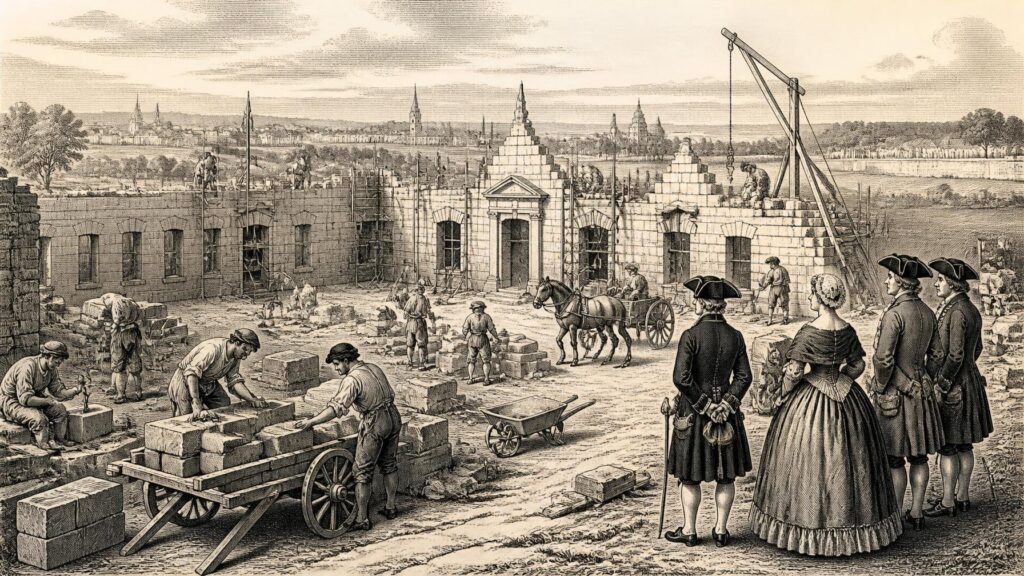
Another development of 1720 was slower, more tangible and ultimately more humane. Construction began at Dr Steevens’ Hospital near Kilmainham, Dublin, on the institution endowed in the will of the physician Richard Steevens. His twin sister, Grizelda Steevens, drove the project forward with the trustees, among whom were the physician and bibliophile Edward Worth and the architect Thomas Burgh. An inscription on the east gate later marked 1720 as the year building commenced. It did not mean that a completed hospital opened its wards that year: the building campaign was prolonged, and the hospital began receiving patients in 1733.
Even unfinished, the project signalled the growing ambition of charitable institutions in Dublin. Burgh’s design organised wards around a courtyard and incorporated circulating access, kitchens, laundries and other practical facilities. Its intended beneficiaries were ‘curable poor’ patients, a phrase that reflects both an expanding ideal of organised relief and the period’s hard distinctions between those considered treatable, deserving or manageable. Grizelda Steevens’s role is especially important. In an age when formal political authority was overwhelmingly male, her inheritance, persistence and fundraising made a major Dublin medical institution possible.
Harbour Sociability
At Cork Harbour, a very different institution traces its formal beginning to 1720. William O’Brien, Lord Inchiquin, and associates established the Water Club of the Harbour of Cork, based at Haulbowline. The modern Royal Cork Yacht Club regards it as its predecessor and as the world’s oldest yacht club. The surviving institutional tradition should not be made to imply a modern sports club suddenly appeared in finished form. Rather, it records an elite association built around private vessels, dining, sociability and the disciplined display of seamanship in one of Europe’s finest natural harbours.
Its foundation belongs beside, rather than above, the year’s graver matters. Cork Harbour was a working maritime space, connected with provisioning, naval concerns and Atlantic commerce. The Water Club demonstrates that a small wealthy stratum could turn command of boats, land and leisure into a durable social institution, while the vast majority experienced 1720 through tenancy, work, worship, markets and legal restrictions. Taken together, the Westminster statute, Cotter’s execution, Swift’s pamphlet, the financial crash, a hospital building site and a harbour club reveal an Ireland closely bound to British power and Atlantic exchange, yet increasingly articulate about the costs of that dependence.
Primary Sources
- Constitutional differences
- The Constitutional Position
- The South Sea Bubble and Ireland: Money, Banking and Investment, 1690–1721
- Financial Crisis and Historical Perspective
- A Proposal for the Universal Use of Irish Manufacture
- Trinity Writers: Jonathan Swift
- Cotter, James
- Journal of the Cork Historical and Archaeological Society
- Building | Dr Steevens’ Hospital
- Grizelda Steevens | Dr Steevens’ Hospital
- 1720 at the Edward Worth Library
- Club History | Royal Cork Yacht Club
- Marine Leisure | Port of Cork
- The Cambridge History of Irish Literature
- Constitutional Change, Law and Grattan’s Parliament
- Swift and the Sacramental Test: A New Attribution from 1719
- The Politics of A Modest Proposal: Swift and the Irish Crisis of the Late 1720s
- Slave Codes and Penal Laws in Eighteenth-Century Jamaica and Ireland: A Comparative and Historiographical Survey
- Catholic Inheritance under the Penal Laws in Ireland
- Penal Laws
- History of the Commercial and Financial Relations between England and Ireland from the Period of the Restoration
- A Collection of Several Statutes and Clauses of Acts Made and Passed in This Kingdom, and in Great-Britain, Relating to His Majesty’s Revenue of Ireland
- Oireachtas Library and Research Service Display Case