Butler’s Dublin Knighthoods1313 CE
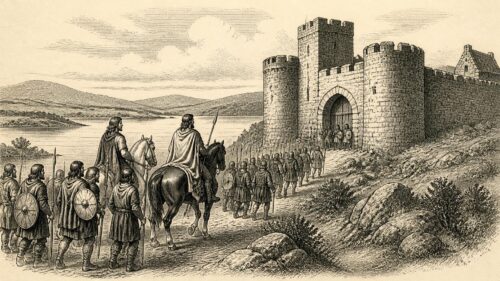
In 1313, Thomond faced a contested O’Brien succession after Diarmait Cléirech Ó Briain died and was buried in the Franciscan habit at Ennis. Donnchad Ó Briain asserted his claim through destructive campaigns in Uaithne and Ara, while Muirchertach Ó Briain entered from Connacht, defeated his rivals and ravaged the Limerick district. Their conflict ended in a territorial partition, though warfare resumed in 1314. Regional struggles involved O’Brien factions, Mac Conmaras and Anglo-Irish magnates, notably Richard de Clare and the de Burghs. In Dublin, acting justiciar Edmund Butler held a feast and knighted thirty men, asserting royal authority amid political instability.

Dateline
For Ireland, 1313 is best approached through a small number of securely dated notices rather than by attaching every striking annal entry filed under that year to the modern calendar. Medieval Irish chronicles did not always reckon years alike: their chronological headings can drift, and later compilations sometimes place the same death or campaign differently. The Annals of Inisfallen, whose 1313 section is particularly rich for north Munster, provides the firmest framework here. It records a death, a contested succession, destructive campaigning and a subsequent division of territory in Thomond. In Dublin, meanwhile, the acting justiciar Edmund Butler staged a conspicuous September ceremony in which he made thirty knights. These events illuminate two connected political worlds: Gaelic kingship in the west and south-west, and the crown’s Anglo-Irish administration in the eastern lordship.
A King Buried at Inis
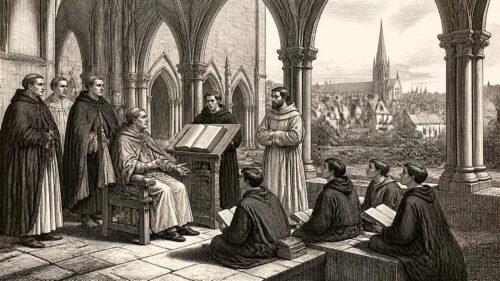
The year opened in Thomond with the death of Diarmait Cléirech Ó Briain, the ruler whom the Annals of Inisfallen call chief of Tuadmumu, or north Munster. The annalist adds an unusually revealing detail: Diarmait was buried “in the habit of the Friars Minor” at Inis, the Franciscan house at Ennis. This should not be inflated into evidence for a lengthy religious career. It does, however, show that the Franciscan friary was a recognised place of high-status burial and that association with its religious habit mattered at a ruler’s death.
The choice had political as well as devotional meaning. The O’Briens were patrons of the Franciscan community at Ennis, an island site by the River Fergus close to their power base at Clonroad. Friaries were not remote refuges from public life. They stood within networks of lordship, patronage, burial, prayer and hospitality. To be laid there linked Diarmait’s memory to a prestigious religious institution supported by his dynasty. The burial also came at a moment when succession was anything but settled. The day after the funeral, according to the same annal, Lochlainn Mac Conmara and Máel Echlainn were killed by the Trícha Cét Uí mBlait. The speed with which violence followed the funeral conveys the instability around the transfer of power, even if the terse record does not explain every motive.
Donnchad’s Immediate Claim
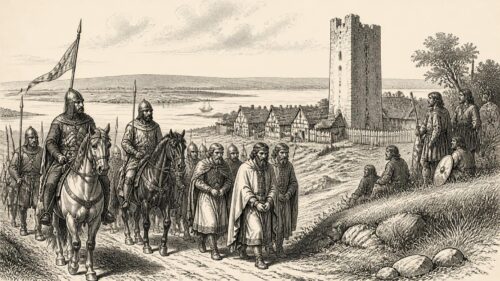
Diarmait’s successor was Donnchad, son of Domnall Ó Briain, of the rival Clann Bhriain Ruaidh line. The succession did not bring a pause for mourning. In the same year, Donnchad and his brother Brian, accompanied by “many nobles” of Thomond, invaded Uaithne, the district around the lower Shannon and Limerick hinterland, killing many inhabitants. Brian then entered Ara, the barony around the Arra hills, overcoming local opposition and taking prisoners, among them Áed Ó Conchobuir and Donnchad son of Congalach Ó Lochlainn.
Such notices expose the working methods of regional politics. A king’s title rested not merely on descent but on the ability to draw nobles into a hosting, punish resistance, take captives and demonstrate that his followers could move through contested country. The annal’s concern with named prisoners is significant. Captivity could secure obedience, compel agreements or generate ransom; it was a political resource as well as a human consequence of war. The unnamed people killed or despoiled in Uaithne and around Limerick remind us that campaigns bore most heavily on cultivators, tenants, herdsmen and households whose stock, food stores and security were vulnerable to passing armies.
Muirchertach from Connacht
Donnchad faced a determined challenger in Muirchertach, son of Toirdelbach Ó Briain, of Clann Toirdelbach. The roots of their rivalry lay in the years before 1313, when competing O’Brien claimants had become entangled with larger Anglo-Irish interests. Richard de Clare, lord of Thomond, supported the Clann Bhriain Ruaidh interest, while the de Burgh connection in Connacht aided Muirchertach’s side. This was not a simple opposition of Gaelic against settler. Irish dynastic contenders, Anglo-Irish magnates, local kindreds and hired or household fighting men formed shifting coalitions in pursuit of territory and influence.
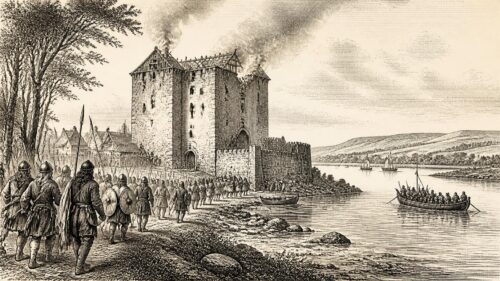
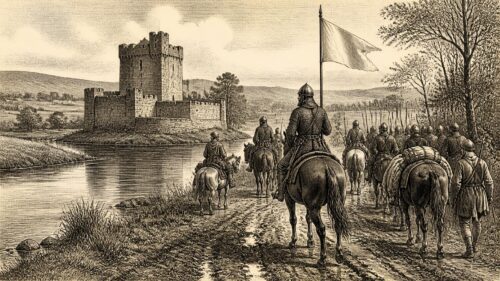
In 1313 Muirchertach assembled an army in Connacht and entered Thomond. The Annals of Inisfallen says that he fought Donnchad and Mathgamain; Muirchertach’s force won, killing Murchad son of Mathgamain and many others. Mathgamain and his son Brian were wounded, while the survivors fled. Muirchertach then advanced towards Limerick and despoiled much of its surrounding area. The wording does not establish a siege or capture of the city, and it would be wrong to claim either. What it securely shows is that an army campaigning for the Thomond kingship reached the Limerick district and could inflict substantial damage there.
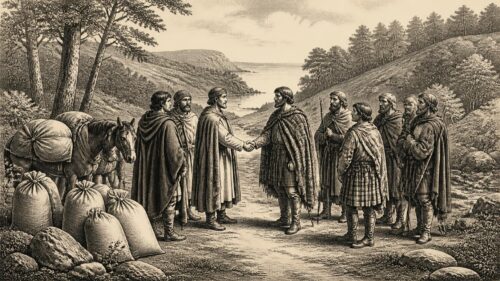
The campaign ended not in a final victory but in compromise. Later in the same year, the territory was divided between Muirchertach and Donnchad, and peace was made. No surviving account sets out the boundaries or full terms. Yet the settlement demonstrates that both contestants commanded enough support to require recognition. Partition was a practical response to a balance of force: it contained a conflict without resolving the rival principles of kingship beneath it. Its fragility is underlined by the renewed struggle recorded in 1314.
Magnates Behind the Contest
The division of Thomond cannot be understood apart from the great lordships bordering it. Richard de Clare held Bunratty and claimed authority in Thomond through the inheritance of his family. Richard de Burgh, earl of Ulster, was the foremost magnate in Connacht and Ulster; his cousin William Liath de Burgh was an especially active military figure in Connacht. Their competition had already drawn them into O’Brien politics. Their interests were territorial, fiscal and strategic: control of routes, castles, dependants and access to the Shannon mattered as much as the personal fortunes of any individual claimant.
For local dynasties such as the Mac Conmaras, the crisis created danger but also opportunity. Their lordship in eastern Clare made their allegiance valuable to an O’Brien king and to de Clare alike. The killings and woundings recorded in 1313 are therefore more than isolated feuds. They formed part of a regional struggle over who could command service, collect renders and make peace. Nevertheless, the evidence does not permit a neat map of fixed “sides”. Alliances could be personal, temporary and conditional, while the same family might contain men with different interests.
A September Display in Dublin
While Thomond was being fought over and then divided, the royal administration projected its own version of order at Dublin. Edmund Butler had been acting justiciar since August 1312, replacing John Wogan in active government. Butler’s responsibilities ranged across Leinster and Munster, combining justice, military leadership and the management of royal authority. In September 1313 he held a sumptuous feast in Dublin and created thirty knights.
The surviving notice does not name the new knights, identify the exact venue or preserve the ritual’s wording. Even so, the scale is meaningful. Knighthood publicly marked men as members of the mounted and landholding military elite on whom the lordship relied. A large ceremony bound personal honour to the crown’s administrative centre, brought magnates and retainers into view, and advertised the justiciar’s capacity for patronage. In a lordship where political authority was dispersed among great liberties, towns, church lands and private lordships, ceremony was not superficial. It was one way of making government visible.
Butler’s feast should not be read as proof that Dublin controlled the whole island. Its contrast with Thomond is the point. Dublin was a centre of written administration, courts, taxation and aristocratic display; Thomond’s settlement emerged from campaigning and negotiated division among rival rulers. Both systems, however, depended on armed followings, hospitality, personal alliances and the ability to reward service. The border between “Gaelic” and “Anglo-Irish” political life was consequential, but neither society was simple or static.
What 1313 Does—and Does Not—Show
Later catastrophe should not be imported into this year. Edward Bruce’s Scottish army did not land near Larne until 26 May 1315, and the island-wide famine associated with the Bruce wars belongs to the years that followed. Likewise, some annals place dramatic Connacht and Scottish episodes beneath headings that look like 1313 but whose internal chronology is demonstrably displaced. Those entries are valuable evidence for the later crisis, not grounds for moving it back into this calendar year.
What can responsibly be said is that 1313 already revealed serious vulnerabilities. Thomond was fractured by succession, magnate intervention and local warfare. Raiding harmed ordinary communities around Uaithne, Ara and Limerick. The Franciscan house at Ennis offered an O’Brien ruler burial and commemoration, while Dublin’s government answered uncertainty with a deliberate assertion of aristocratic service. The year was not yet the great island-wide emergency of 1315–18. It was, rather, a year in which the political relationships that would shape that emergency were being contested, displayed and temporarily patched together.
Primary Sources
- Annals of Inisfallen, AI1313–AI1314
- Annals of the Four Masters, M1311–M1315
- The Annals of Ulster, Year U1313
- Annála Connacht, Annal 1313
- Annála Connacht, Annal 1315
- Annála Connacht, Annal 1316
- Annals of Loch Cé, 1305–1324
- Butler (le Botiller), Edmund | Dictionary of Irish Biography
- O'Brien (Ó Briain), Muirchertach | Dictionary of Irish Biography
- Clare, Richard de | Dictionary of Irish Biography
- Burgh, Richard de | Dictionary of Irish Biography
- Wogan, John | Dictionary of Irish Biography
- Bruce, Edward | Dictionary of Irish Biography
- The Bruces in Ireland, 1315–18
- The Impact of the Bruce Invasion, 1315–27
- Bruce Invasion
- The Uí Bhriain
- The Normans in Thomond
- Ennis Friary | Heritage Ireland
- Ennis, Irish Historic Towns Atlas Text
- Franciscan Friary, Ennis Parish
- Parchment Conquest, 1171–1307
- Mapping and Measuring the Impact of the Bruce Invasion