Settlement Act1662 CE
In 1662, the Irish Act of Settlement established a Restoration framework for resolving land disputes arising from rebellion, conquest and Cromwellian redistribution. It protected Protestant interests while offering limited restitution to Catholics deemed innocent, subject to reprisal and political tests. The lord lieutenant, Duke of Ormond, oversaw preparations for claims procedures, amid paperwork, proclamations and titles. Government reinforced Anglican conformity, regulated Catholic and dissenting assemblies, reorganised parishes, customs and trade, and improved postal links with Scotland. Dublin’s Theatre Royal at Smock Alley opened as a symbol of Restoration authority. The year converted conquest into an unequal landed and confessional order.
Dateline
In 1662, Ireland’s Restoration settlement became less a promise than a procedure. Two years after Charles II had regained his kingdoms, the unanswered question of Irish land still dominated politics: who would keep the estates seized, redistributed and occupied during the wars of the 1640s and the Cromwellian conquest, and who—if anyone—would recover what had been lost? The year brought the Irish Act of Settlement into law, returned James Butler, duke of Ormond, to Dublin as lord lieutenant, and set the administration to work upon claims that reached into nearly every county. It also revealed a striking contrast. While property, religion and political authority were being regulated with renewed force, Dublin acquired a new Theatre Royal at Smock Alley, an emphatic public marker of Restoration culture.
A Settlement for Competing Interests
The Act of Settlement was the central Irish development of 1662. Its full title promised the “better execution” of the king’s earlier declaration for settling Ireland and satisfying adventurers, soldiers and other subjects. That language concealed a problem which no formula could neatly resolve. Adventurers who had financed the parliamentary war, officers and soldiers paid in confiscated land, Protestant landowners dispossessed during the 1641 rebellion, royalists, and Catholic proprietors who claimed both loyalty and innocence all advanced titles that overlapped. The land available could not meet every obligation.
The statute therefore did not restore a pre-war order. Instead, it confirmed the basic framework created by conquest and redistribution while allowing carefully defined exceptions. Lands affected by the rebellion and subsequent war were treated as vested in the Crown, to be disposed of under the settlement. Protestant proprietors who had not joined the rebellion were protected. So too, in principle, were “innocent papists”: Catholics able to meet demanding legal and political tests of conduct during the wars. But even those eligible for restoration faced the principle of reprisal. A soldier, adventurer or other occupant displaced to make room for a restored owner was to receive land of equal value elsewhere first. The promise of restitution was consequently dependent upon finding further forfeited land.
The statute’s own categories expose the settlement’s political character. Eligibility was not simply a matter of proving ownership before 1641. The qualifying rules excluded many Catholics who had participated in Confederate institutions, held land in rebel-controlled districts, assisted the papal nuncio’s party, or acted against the king’s authority as defined by the Restoration government. The official text described the 1641 rising in sweeping and hostile terms; it was legislation shaped by a victor’s account of recent war. Yet it also acknowledged, indirectly, that not every Catholic proprietor could be treated alike. That narrow distinction offered a route to recovery for some families, but not a general restoration of Catholic landholding.
Ormond Takes Charge
James Butler, newly created duke of Ormond, was appointed lord lieutenant in late 1661, but did not land in Ireland until 26 July 1662. He was sworn in the following day. By then the Irish parliament, which had assembled in 1661 and was overwhelmingly Protestant in composition, had passed the settlement bill through both houses during May. Ormond’s arrival and consent gave the measure its effective viceregal direction at the point when paper provisions had to become decisions about real houses, manors, rents and boundaries.
Ormond’s position was inherently awkward. A great Irish magnate and long-standing royal servant, he understood Catholic royalist grievances and had attempted to secure concessions. But he governed amid an entrenched Protestant interest: older Protestant proprietors, Cromwellian settlers, army officers and investors possessed land, influence in parliament, and links to the administration. The duke himself recognised the arithmetic of the crisis: if all competing promises were honoured, as he put it privately, a “new Ireland” would have to be found. No such Ireland existed. His task in 1662 was thus to impose a settlement sufficient to secure order, revenue and Protestant confidence without making the restored monarchy appear incapable of mercy.
Michael Boyle, bishop of Cork, was publicly thanked by the Irish House of Lords on 24 May for his work in England on the settlement bill. The episode is revealing. Bishops were not merely ecclesiastical figures in Restoration government; they were political agents, legislators and intermediaries between Dublin and the court. Boyle’s acknowledged service also signalled the strength of the established Protestant leadership in the making of the new order.
Claims, Paperwork and Possession
The Act envisaged commissioners and a Court of Claims to determine disputed rights. Its importance lay not merely in eventual judgements but in the new administrative world it created. Claimants needed to assemble deeds, pedigrees, leases, witness testimony and explanations of their conduct over two decades of rebellion, war, exile and transplantation. Possession of land remained immensely valuable, but it now had to coexist with a bureaucracy of petitions, deadlines and proclamations. For families with a disputed estate, the calendar of 1662 could mean journeys to Dublin, fees for legal assistance, searches for papers, and anxious efforts to prove a past that hostile witnesses might describe differently.
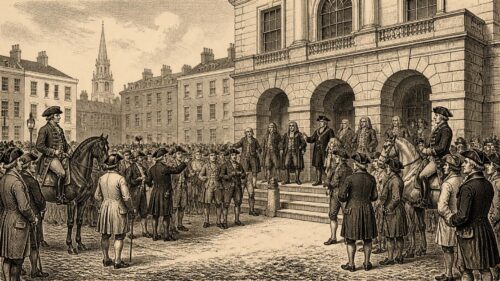
Government proclamations show that the process was being organised in detail during the autumn. On 2 October, the Dublin administration prescribed the manner and forms for submitting claims under the Act; on 17 October it extended the time for submissions. These firmly dated measures should not be mistaken for a completed settlement. They demonstrate the opposite: titles remained unsettled, and the machinery required adjustment before it could cope with the volume and complexity of applications. The court’s main hearings belong principally to 1663, but its work was prepared by the legal architecture and claim-making of 1662.
The consequences were felt beyond the circles of named claimants. Landownership determined who collected rent, appointed tenants, controlled mills, woods and grazing, and exercised local influence. A proclamation of 22 September forbidding the cutting of woods on adventurers’ and soldiers’ lands illustrates how closely the government connected property, improvement and order. Another, issued on 18 December, dealt with debts owed by soldiers. Such orders did not end the insecurity produced by the wars; they show an administration attempting to manage its material aftermath estate by estate.
Church, Conformity and Surveillance
Restoration authority in Ireland was also confessional. On 30 April, before Ormond’s arrival, the lords justices and council proclaimed that indulgence towards recusants, nonconformists and sectaries was to cease and that the uniformity laws were to be executed. The proclamation did not create a simple religious landscape: Catholic practice remained deeply rooted, and Protestant dissent included several traditions with different histories in Ireland. But it made clear that the state intended public conformity to the established church to be a test of political reliability as well as religious observance.
That pressure sharpened later in the year. On 12 November the government issued a proclamation against unlawful assemblies of Catholics and dissenters. It is important not to read this as proof that every gathering was suppressed or that all worship disappeared from public life. Rather, it records official suspicion and the broad discretionary power claimed by the Restoration administration. Catholics seeking land as “innocents” were required to negotiate a system whose legal language repeatedly identified Catholic political activity with past rebellion. Dissenters likewise encountered a government restoring episcopal and liturgical order. In 1662, settlement of property and settlement of religion were inseparable projects.
The parliament’s legislation also included an Act for the real union and division of parishes, concerning churches and free schools. Its title alone cautions against claiming an immediate nationwide transformation in schooling. Nonetheless, it shows the Restoration state addressing the local institutional map: parish boundaries, church provision and places of instruction mattered because they shaped taxation, clerical oversight, poor relief, worship and the education of the propertied classes.
Ports, Revenue and a Narrow Sea
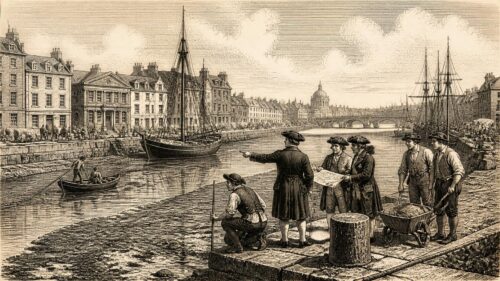
Economic government was visible in customs, ports and communications. The Irish Customs Act of 1662 settled tonnage, poundage and other duties on goods entering and leaving the kingdom; its detailed schedules covered shipping documentation and commodities including corn, hides and horses. On 15 September a proclamation exempted foreign and colonial produce from customs, while another on 19 September designated places for loading and landing imports and exports. These measures were not evidence of unrestricted Irish commerce. They were instruments through which the Crown sought regular revenue and supervision over maritime exchange.
The short crossing between Donaghadee in County Down and Portpatrick in south-west Scotland also acquired greater regularity in 1662, when a weekly postal route was established through Portpatrick. The passage was weather-dependent and far from modern reliability, but it joined Ulster more closely to Scottish correspondence and official communication. In a year when Dublin required documents, instructions and claims to circulate, such links mattered. They also remind us that Ireland’s political settlement was part of a three-kingdom world, not an isolated domestic affair.
A Theatre for Restoration Dublin
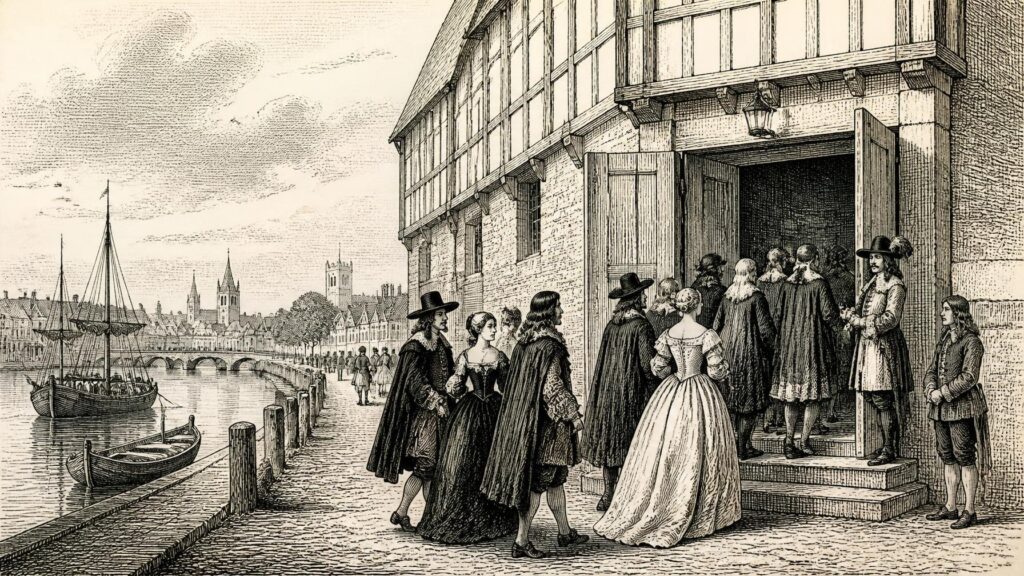
Amid these hard questions of title and conformity, Dublin gained a conspicuous cultural institution. On 18 October John Ogilby opened the Theatre Royal at Smock Alley with John Fletcher’s Wit without Money. Ogilby, master of the revels in Ireland by royal patent, had returned to Dublin after the Restoration and built the theatre with viceregal support. The opening is firmly dated, although the building was still incomplete and the stage bare. Even so, it was an ambitious purpose-built Restoration theatre, with a proscenium arrangement that separated actors from rear scenery.
Smock Alley was socially ordered as well as theatrical. Benches in the pit served the nobility, while common spectators occupied the upper galleries. Its English actors, repertory and royal patent connected Dublin to metropolitan cultural circuits, but it was also distinctly a Dublin institution, situated close to the Liffey quays in a city reshaped by administration, commerce and migration. Attendance at court-approved drama could be read as a gesture of loyalty to the restored monarchy. The theatre therefore complemented, rather than escaped, the politics of 1662.
Two smaller biographical facts underline the year’s longer reach. William Conolly, later speaker of the Irish House of Commons and a major figure in the Protestant landed elite, was born at Ballyshannon on 9 April. On 30 June Daniel O’Daly, the Kerry-born Dominican, diplomat and historian of the Geraldines, died in Lisbon. O’Daly’s death abroad points to the enduring continental networks of Irish Catholic learning and religious life; Conolly’s birth belongs to the generation that would prosper within the order being stabilised.
An Unequal Peace
By December, Ireland had not been reconciled. The most contentious claims were still ahead, religious mistrust endured, and the settlement would require further alteration in 1665. Yet 1662 decisively established the terms on which those disputes would proceed. Ormond’s government pursued a kingdom of registered titles, regulated worship, taxable trade and restored public ceremony. The bright new stage at Smock Alley offered a visible image of renewal. Behind it lay a more consequential drama: the conversion of conquest into law, and the creation of a landed and confessional order whose inequalities would shape Ireland for generations.

Primary Sources
- Act of Settlement [1662] and Act of Explanation [1665]
- Butler, James
- BUTLER, James (1610-88)
- Pre-Union Irish Statutes Affected: 1662
- Tenures Abolition Act 1662
- Customs Act 1662, Section 49
- Statute Law Revision Act 2015
- Statute Law Revision (Pre-Union Irish Statutes) Act, 1962
- Ogilby, John
- Historical Restoration of 17th Century Theatre Royale
- The New Smock Alley Theatre
- Portpatrick Harbour
- Port-Patrick, pp.560-562
- Conolly, William
- Daniel O'Daly
- The Court of Claims, Popery and Stuart Authority
- State Formation in Seventeenth-Century Ireland: the Restoration Financial Settlement, 1660–62
- 1641 Depositions, Volume 7
- The Catholic Interest in Irish Politics in the Reign of Charles II
- Part 2 of History of the Commercial and Financial Relations between England and Ireland from the Period of the Restoration
- The Diocesan Schools—1570–1870
- Access the Electronic Irish Statute Book