Ardglass Fleet1453 CE
In 1453, Irish annals record regional struggles rather than a national crisis. At Ardglass, a Dublin fleet pursuing Welsh raiders who had seized the archbishop defeated Henry Mac Néill Buidhe’s Clandeboye force, aided by the Savages; leading Ulster men died and Henry was captured. In Oriel, Hugh Roe MacMahon died and was succeeded by Felim MacMahon, while Donnchadh MacCarthy Reagh’s death brought Diarmaid an Dúna to power in Carbery. Killings, deaths and disputed lordships in Connacht, Bréifne and Tirerrill revealed political dependence on kin, followers, castles and church patronage. The record depicts maritime, localised and interconnected late-medieval society in Ireland.
Dateline
The clearest Irish story of 1453 unfolded where sea power, local lordship and the fragile authority of Dublin met: at Ardglass on the County Down coast. Yet the year’s surviving notices range much more widely, from Carbery in the south-west to Connacht, Bréifne and Oriel. They show no single national crisis and no central Irish government directing events. Instead, power was exercised through lordships, kin-groups, church connections, ports and armed followings. A raid at sea could quickly become a contest on land; the death of a lord could prompt an orderly succession, or expose a rivalry that neighbours might exploit.
Reading a Sparse Year
The evidence for 1453 is principally annalistic. Such entries are invaluable because they preserve names, places, successions and occasional precise dates, but they are not a complete record of life. They tend to notice the deaths of leading men, warfare, changes of lordship and conspicuous religious patronage. They say little about harvests, women outside elite families, labour, local markets or the experience of most households. Accordingly, the events below can be placed in the calendar year, while broader observations about society are offered only as context, not as claims that every development occurred in 1453 itself.
The Ardglass Encounter
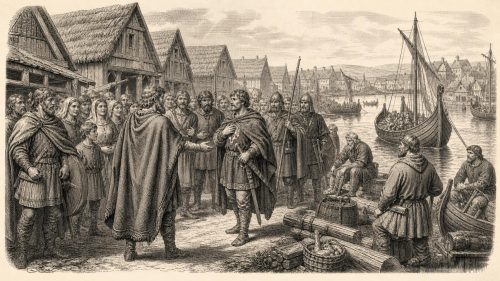
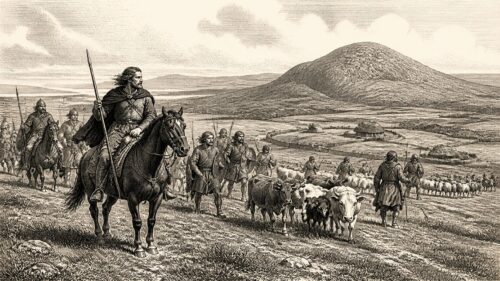
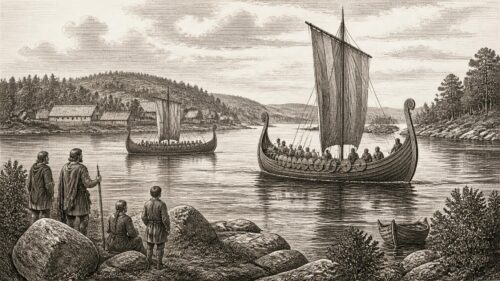
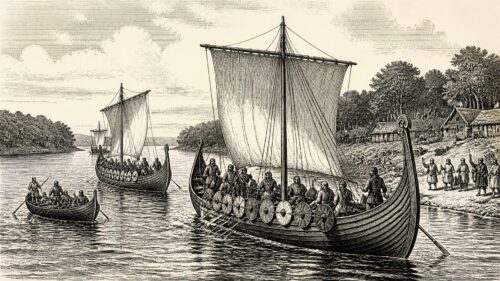
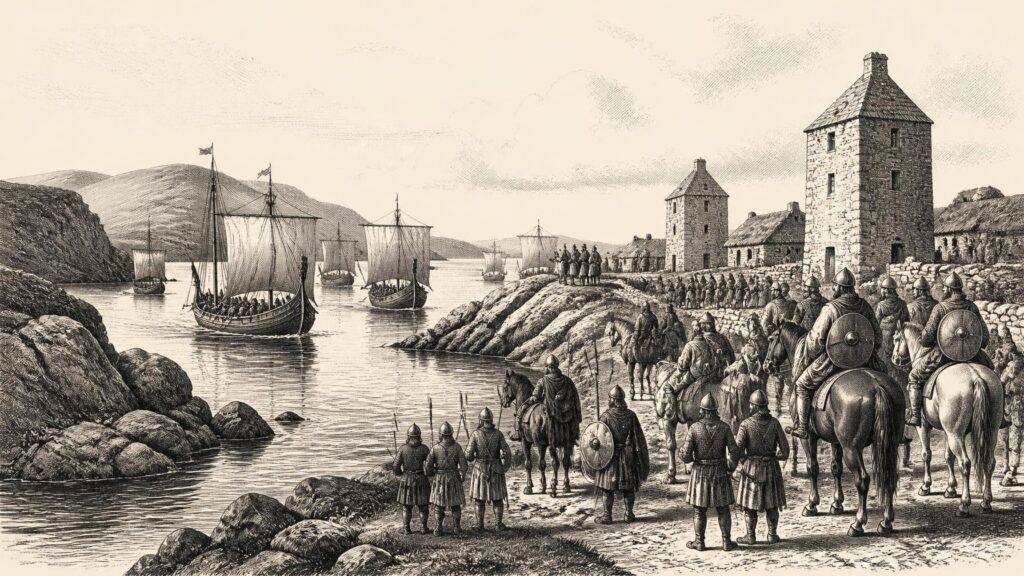
The year’s most dramatic recorded episode was the defeat of Clann Aodha Buidhe, or Clandeboye O’Neill, at Ardglass. The Annals of the Four Masters report that armed ships described as Welsh had plundered Dublin shipping and seized the archbishop. Dublin men pursued the raiders in a large fleet, as far as the “north sea” in the annalist’s language. On the return journey, at Ardglass, Henry Mac Néill Buidhe met them. The annal says that he was captured by the English and that the Savages, an Anglo-Irish family established around Lecale, aided the Dublin force.
Several prominent men were killed: Cú Uladh, son of Cathbharr Magennis and heir to Iveagh; Hugh Magennis; Mac Artan; and a body of captains from the Route in north Antrim. The same account puts losses on the Irish side at 520. That total must be treated cautiously. Medieval annals often preserve numbers, but they rarely explain how they were counted, and the figure cannot be independently verified. It nevertheless conveys the scale of the defeat as understood by the record’s compilers. Later accounts identify Archbishop Michael Tregury of Dublin as the captive prelate and state that he was freed near Ardglass; the annal itself is firmer on the capture, pursuit, battle and named casualties than on the precise sequence of his release.
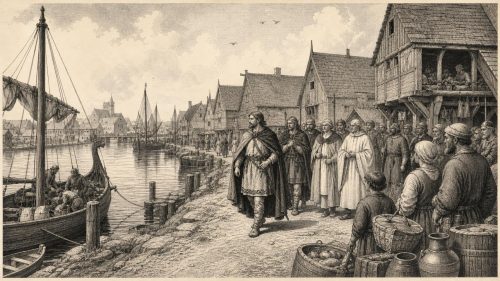
This was not simply a clash between neatly separate “Irish” and “English” worlds. The force said to have pursued the raiders was a Dublin maritime expedition; the Savages were locally rooted lords of the old colony; their opponents included O’Neill, Magennis, Mac Artan and men of the Route. The sea lane between Dublin and Ulster connected merchants, churchmen, raiders, fishermen and fighting men as well as royal officials. Ardglass, with its harbour and clustered late-medieval tower houses, was well placed within that Irish Sea traffic. The encounter also demonstrates how swiftly maritime insecurity could reshape local politics: a pursuit prompted by an attack on Dublin shipping ended in a major reverse for neighbouring Gaelic lordships.
It would be unsafe to claim that Henry Mac Néill Buidhe’s motives are known, or that the battle settled the balance of power in east Ulster. The annal does not explain why he confronted the returning fleet, and he was later able to escape captivity. What is firmly supported is narrower but important: in 1453, an episode of piracy and counter-action at sea intersected with an existing struggle for security and influence around the Down coast.
Succession at Clones
In Oriel, the death of Hugh Roe MacMahon, son of Rory, brought a change of lordship. The Annals of Ulster and the Annals of the Four Masters agree that he died at his residence in the Lurgan at Easter and was buried at Clones. Their wording differs slightly on whether this was Easter Eve or Easter night, so the safest conclusion is that the death and burial belonged to the Easter season of 1453 rather than to a precisely reconstructed hour. Felim, son of Brian MacMahon, succeeded as lord over the Oirghialla.
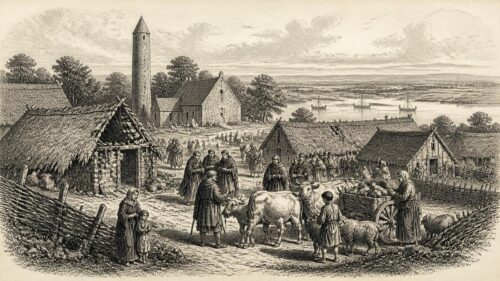
The annalists’ obituary language is revealing. Hugh Roe is praised as courteous, pious, learned in the arts, hospitable and brave. Such phrases were conventional, but conventions mattered: they expressed the expected qualities of a successful lord. Rule required more than fighting capacity. A leader was meant to sustain a household, reward learned dependants, protect clients, uphold religious standing and offer hospitality. Burial at Clones, an important ecclesiastical site, joined family succession to the prestige of the church. Felim’s accession, recorded without an accompanying battle, suggests that succession could at times be managed through acceptance among the leading kin and allies rather than determined immediately by open warfare.
Carbery’s New Lord
A comparable succession occurred in the south-west. Donnchadh Mac Carthaigh Riabhach, called “the Swarthy” in the Annals of Ulster, died in 1453. The annal calls him a general protector of the men of Ireland and Scotland, an honorific that should not be read as evidence of a formal all-island office. It does, however, point to the standing expected of a substantial Gaelic lord within a wider Gaelic world linked across the North Channel. His brother Diarmaid an Dúna, “of the fortress”, succeeded him as lord of Carbery.
Carbery was a coastal lordship in south-west Munster, where political power was inseparable from control of estates, landing places, maritime contacts and alliances. The MacCarthy Reagh succession therefore belongs beside the Ardglass episode, though the sources do not connect the two directly. Both remind us that fifteenth-century Ireland was not isolated from its neighbouring seas. Scottish and Irish connections could be invoked in the political language of a lord’s obituary, while ships operating from Wales, Dublin and the Irish coast could precipitate violence far from the royal administration’s immediate reach.
Connacht, Bréifne and Local Rivalries
Elsewhere, 1453 was marked by smaller-scale but consequential conflicts within and between lordly families. Rory, son of Hugh O’Conor, was killed by a son of John Burke in Conmaicne Dunmore. Another Rory O’Conor died in Roscommon castle, while Murtough O’Conor was killed by his own kinsmen, Donnell and Cathal. These brief notices do not permit a full reconstruction of Connacht politics, but they underline the dangers of contested lordship. Castles were residences and symbols of authority, while kinship could provide protection, obligation and the means of deadly competition.
The Annals of Connacht also record the death of Brian Mac Donnchada, described as full king of Uí Ailella and Corann and as a protector of the mendicant religious orders in Ireland. The wording again is panegyrical, not an administrative job title. Still, it preserves something significant about political culture: patronage of friars was an acknowledged source of honour. Mendicant houses depended on gifts and protection; lords gained spiritual standing, commemoration and public prestige through their support. Religion in this setting was embedded in the practical networks of lordship rather than separate from them.
In the north-west, Cormac Maguire died on 16 June, the one precisely dated death in the principal Ulster annal for the year. Owen O’Reilly also died, while Edmond, son of Turlough O’Reilly, was killed by unnamed “English” opponents. In Tirerrill, Brian Mac Donnchada assumed lordship after Teige Mac Donnchada was abandoned by his own followers. These notices are terse, but together they show the political importance of allegiance. A lordship was not an impersonal territory transferred automatically by inheritance: it depended upon followers, relatives, ecclesiastics, military retainers and neighbouring powers recognising, or withdrawing recognition from, a claimant.
What the Record Does Not Say
There is no securely dated notice of exceptional weather, famine, epidemic, major building work or a general commercial change in Ireland during 1453. Nor should the year be made to stand for the end of the Hundred Years’ War abroad, however large that event became in European history. For Ireland, the surviving record points instead to regional realities: a vulnerable but active Dublin maritime community; armed and politically connected lordships in Ulster; orderly and disputed successions; castles and church sites as centres of authority; and patronage as a measure of status.
The year therefore deserves to be remembered not as a blank interval between larger narratives, but as a sharply localised picture of late-medieval Ireland. At Ardglass, an archbishop’s capture and a sea chase culminated in a bloody encounter. At Clones, the burial of Hugh Roe MacMahon accompanied a transfer of power in Oriel. In Carbery and Connacht, obituaries and accessions recorded the continuing work of lordship: sustaining authority, securing followers and seeking honour in a world where the coast, the church and the kin-group all mattered.
Source References
Hover over a number to see the source. Select it to open the source.

- [1] Annals of the Four Masters
- [2] Part 9 of Annals of the Four Masters
- [3] Annals of the Four Masters (Irish text)
- [4] The Annals of Ulster
- [5] Annála Connacht
- [6] Part 216 of Annála Connacht
- [7] Mac Carthaigh's Book
- [8] Part 5 of Mac Carthaigh's Book
- [9] Annals of Inisfallen
- [10] List of Published Texts at CELT
- [11] Exploring the Irish Annals
- [12] Tregury, Michael
- [13] MacCarthy (Mac Carthaigh), Diarmaid an Dúna
- [14] MacCarthy Reagh (Mac Carthaigh Riabhach), Domhnall Glas
- [15] Register of Wills and Inventories of the Diocese of Dublin in the Time of Archbishops Tregury and Walton, 1457–1483
- [16] The Impact of War and Piracy
- [17] The Rise and Fall of the Clann Éinrí Aimhréidh Uí Néill: Dynastic Feuding and Geopolitics in the Late Medieval Irish Sea World
- [18] Exploring Peasant and Bourgeois Identity: Haggards, Masers, Sheep and Spoons in Later Fifteenth-Century County Dublin
- [19] ‘Herring of Sligo and Salmon of Bann’: Bristol's Maritime Trade with Ireland in the Fifteenth Century
- [20] Factions, Feuds and Noble Power in the Lordship of Ireland, c. 1356–1496
- [21] Tudor Policy and the Kildare Ascendancy in the Lordship of Ireland, 1496–1534
- [22] Irish Annals: Chronology and Synchronisms
Primary Sources
- Annals of the Four Masters
- Part 9 of Annals of the Four Masters
- Annals of the Four Masters (Irish text)
- The Annals of Ulster
- Annála Connacht
- Part 216 of Annála Connacht
- Mac Carthaigh's Book
- Part 5 of Mac Carthaigh's Book
- Annals of Inisfallen
- List of Published Texts at CELT
- Exploring the Irish Annals
- Tregury, Michael
- MacCarthy (Mac Carthaigh), Diarmaid an Dúna
- MacCarthy Reagh (Mac Carthaigh Riabhach), Domhnall Glas
- Register of Wills and Inventories of the Diocese of Dublin in the Time of Archbishops Tregury and Walton, 1457–1483
- The Impact of War and Piracy
- The Rise and Fall of the Clann Éinrí Aimhréidh Uí Néill: Dynastic Feuding and Geopolitics in the Late Medieval Irish Sea World
- Exploring Peasant and Bourgeois Identity: Haggards, Masers, Sheep and Spoons in Later Fifteenth-Century County Dublin
- ‘Herring of Sligo and Salmon of Bann’: Bristol's Maritime Trade with Ireland in the Fifteenth Century
- Factions, Feuds and Noble Power in the Lordship of Ireland, c. 1356–1496
- Tudor Policy and the Kildare Ascendancy in the Lordship of Ireland, 1496–1534
- Irish Annals: Chronology and Synchronisms