Saul Relics1293 CE
In 1293, Ireland experienced interconnected political, administrative and religious upheavals. In Connacht, Magnus Ó Conchobair’s death triggered rapid changes of kingship, as Áed mac Eógain, Cathal Ruad and Anglo-Irish interests contested authority. Violence destabilised Moylurg and claimed several regional rulers. William de Vesci’s rivalry with John fitz Thomas FitzGerald prompted Edward I to restrain military mobilisation, reform sheriffs’ accountability and investigate the justiciar. At Saul, Nicholas Mac Máel Ísu enshrined reported relics of Patrick, Columba and Brigid, reinforcing ecclesiastical prestige. Episcopal deaths and contested elections linked Irish churches to royal administration, monasteries and Rome, revealing overlapping, insecure jurisdictions across Ireland.
Dateline
In 1293, the most decisive developments in Ireland lay not in a single nationwide war but in a sequence of local crises whose effects reached far beyond their immediate settings. Connacht lost its king and saw its crown change hands repeatedly. Royal government in Dublin attempted to tighten its administrative grip while the justiciar, William de Vesci, became embroiled in a dangerous dispute with John fitz Thomas FitzGerald. In the north-east, Nicholas Mac Máel Ísu, coarb or hereditary successor of St Patrick, publicised the discovery of relics at Saul. The year therefore reveals a country of overlapping jurisdictions: Gaelic kingships, Anglo-Irish lordships, royal offices, churches and monastic communities all exercised authority, but none was secure from rivalry.
A Connacht Kingship Unravels
The clearest chain of firmly dated events comes from Connacht. The Annals of Connacht place the death of Magnus Ó Conchobair, king of Connacht for five and a half years, in 1293. He died at Loch Caircin after an illness of three months. The annalist’s praise of him as formidable in warfare, generous and valiant follows the conventions used for an important ruler, but it also indicates his standing among contemporaries. Magnus’s death removed a king who had held together an uneasy provincial balance between competing branches of the Ó Conchobair dynasty and powerful neighbouring interests.
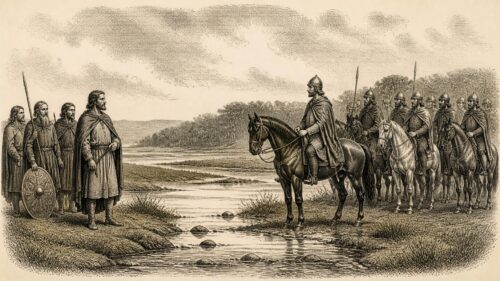
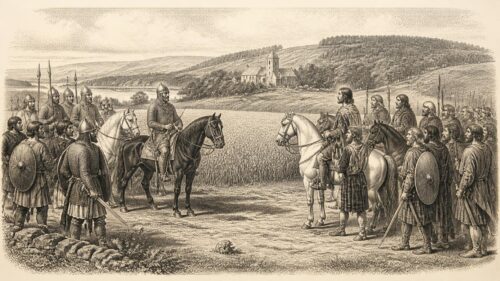
His successor was Áed mac Eógain Ó Conchobair. This was not simply an internal dynastic choice. The annals say that Áed was made king by the justiciar and “the King of England’s men”: in practice, William de Vesci and the administration of the lordship of Ireland. Such backing did not make Áed secure. On the tenth day after his inauguration he was seized by Mac Gerailt, the annals’ name for FitzGerald; fifty of Áed’s followers were killed and substantial cattle-prey was taken. The capture demonstrates the practical limits of governmental endorsement in Connacht. A provincial kingship still depended on kinship alliances, armed followings, hostages, access to pasture and the capacity to defend clients, rather than on a single act of installation.
Cathal Ruad Ó Conchobair then assumed the kingship. His rule lasted less than three months before he was killed by Ruaidrí, son of Donnchad Riabach Ó Conchobair. Áed was released and again assumed the kingship, with the justiciar’s support. This rapid succession—Magnus, Áed, Cathal Ruad and Áed again—was not a routine rotation of office. It exposed the rivalry of branches within the ruling family, while also showing that leading Anglo-Irish figures could influence, and seek advantage from, Gaelic succession disputes. It would be misleading to treat Connacht as either independent of the lordship or straightforwardly controlled by it. The record instead shows a contested political landscape in which intervention, alliance and coercion crossed cultural and legal boundaries.
Moylurg’s Violent Settlement
The disruption did not stop at the provincial crown. Cathal Mac Diarmata, king of the Muinter Máelruanaid and lord of Moylurg around Lough Key, was captured by Áed mac Eógain. The annals identify Conchobar son of Taichlech Mac Diarmata, Máel Sechlainn Ó Flannacáin and the Síl Muiredaig as instigators. During the seizure, Moylurg was plundered, explicitly including both church lands and secular territory. That detail is important. Warfare did not fall only upon warriors or rival elites: it endangered clerics, dependants, tenants, livestock, food stores and the resources on which religious houses and lordly households depended.
The Annals of Connacht make an unusually sweeping judgement, saying that the ruin of Connacht sprang from these offences. This should be read as an annalist’s interpretation rather than a literal claim that all later disorder had one cause. Yet it rightly points to the gravity of the attack. Cathal escaped his fetters by force and retaliated against the sons of Cathal Ó Flannacáin. In the same year Conchobar Mac Diarmata, an elder lord of Moylurg and Airtech, died and was buried at Boyle monastery. His death, alongside the imprisonment and escape of Cathal, made the internal politics of this strategically placed lordship still more unstable.
Other deaths recorded during the year convey the wider reach of political violence. Fergal Ó Ráigillig, chief of Muintir Máelmórda for twelve years, was killed in his own residence by the Tullagh Dunchada. Tuathal, son of Muirchertach Ó Conchobair, was killed by the Luigni. Murchad Ó Máel Sechlainn, king of Meath, died. These entries do not amount to a single coordinated conflict, but together they show that lordship remained personal and precarious. A residence, cattle raid, local alliance or family quarrel could decide the fate of a ruler and redistribute authority in a district.
FitzGerald, Vesci and Royal Authority
The Connacht succession was bound up with an escalating quarrel among the leading men of the English lordship. John fitz Thomas FitzGerald had acquired extensive Geraldine interests in Leinster and Connacht, including claims around Sligo. He favoured a different alignment in Connacht from that supported by William de Vesci, lord of Kildare and justiciar of Ireland. The seizure of Áed mac Eógain by FitzGerald’s side was thus part of a larger contest over influence, land and political patronage, not merely an opportunistic intervention in a Gaelic dispute.
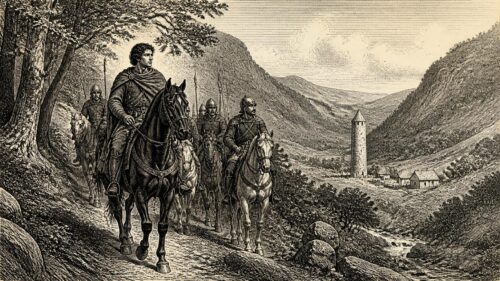
Royal records demonstrate how serious the confrontation had become. On 1 July 1293 Edward I ordered Vesci to revoke a summons calling those who owed military service in Ireland to assemble. Although the stated purpose was campaigning against the Irish of Offaly, the king feared that the force might instead be used against FitzGerald. The order is a rare, precisely dated glimpse of royal anxiety: the Crown needed the justiciar to maintain order, but could not allow him to turn the machinery of government into a private army.
On 12 July, Edward issued ordinances for Ireland that included the measure later called the Sheriffs Act 1293. Sheriffs were to be appointed and removed by the treasurer and barons of the Dublin Exchequer, be answerable to that body, and appoint bailiffs for whose conduct they could answer. The ordinance did not create a uniform administration across the whole island. Its immediate reach was the English lordship and its counties, not the many Gaelic territories beyond them. Nevertheless, it shows the Crown trying to make fiscal and judicial officers in Ireland more accountable to Dublin’s Exchequer, while preserving the justiciar’s authority to command them.
By December, complaints against Vesci’s conduct had generated a royal commission of inquiry involving senior Dublin officials. The political dispute was therefore not confined to private rivalry. It became a question of administration, justice and the credibility of royal rule. For inhabitants of towns, liberties and rural estates subject to the lordship, such conflicts could affect courts, taxation, military service and the enforcement of rights. In 1293, the institutions of government were active, but their officers and magnates competed fiercely over how those institutions should operate.
The Relics at Saul
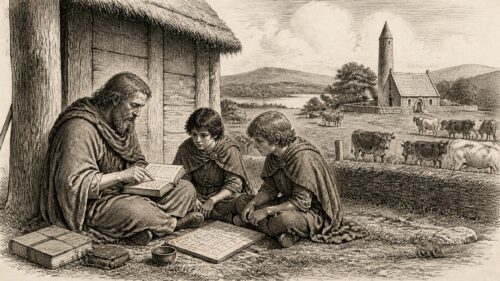
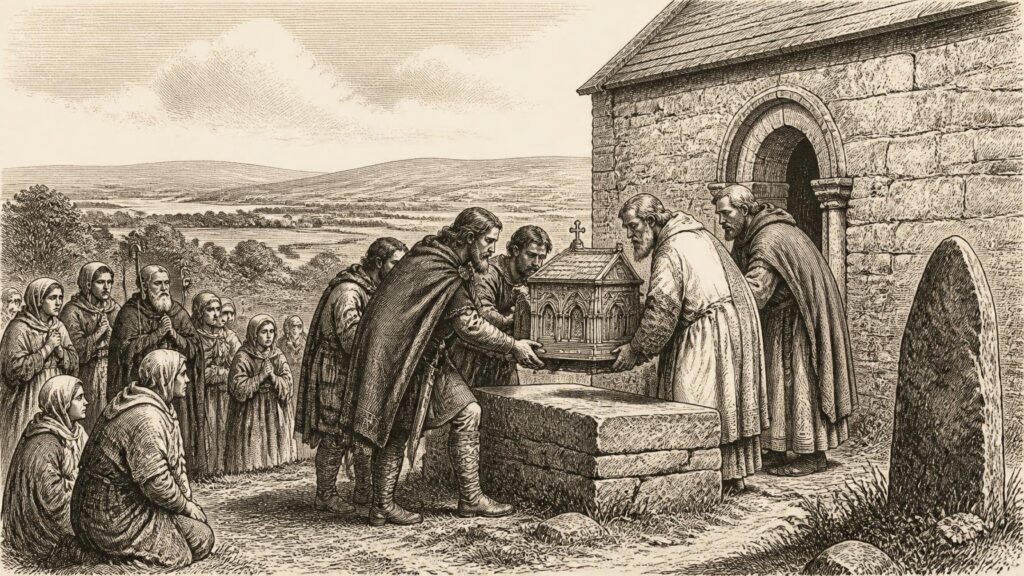
Against this background of armed politics, the year’s most resonant religious episode occurred at Saul, or Sabhall Pátraic, in County Down. The annals report that it was revealed to Nicholas Mac Máel Ísu, coarb of Patrick, that relics of Patrick, Columba and Brigid were at Saul. He had them exhumed and placed in an honourably decorated shrine; the annalists add that miracles and great wonders followed.
This is firmly an annalistic report for 1293, but its miraculous element must be treated as evidence of medieval belief rather than something modern history can verify. What can responsibly be said is that relics mattered profoundly. They concentrated sacred prestige, drew pilgrims, affirmed the claims of churches and custodians, and could connect a local site to Ireland’s three most celebrated saints. In an age when ecclesiastical institutions depended on landed resources, offerings, patronage and public confidence, a shrine could be both a devotional focus and a source of standing.
The report also carried a political charge. Patrick was particularly associated with Armagh and its primatial claims, while Saul and Down lay in a region where Gaelic, Anglo-Norman and ecclesiastical interests met. Traditions concerning the burial places and relics of Patrick, Brigid and Columba had already varied. The 1293 account should not be treated as a conclusive identification of their bodily remains. It is, however, compelling testimony to the continuing power of their cults and to a deliberate act of commemoration by Patrick’s coarb.
Bishops, Monasteries and Movement
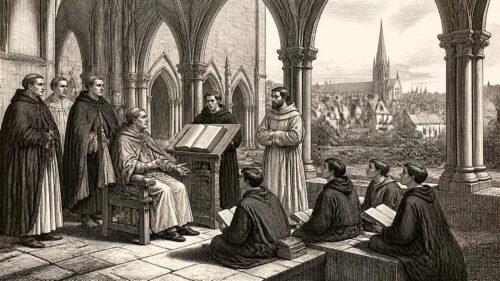
Church life in 1293 was also marked by deaths and disputed appointments. Florence Ó Cerbhalláin, bishop of Cenél nÉogain—described in other annals as bishop of Derry—died. Royal records show that Derry’s dean and chapter notified Edward I of their election of Michael, the cathedral treasurer, as successor in October. The episode illustrates the mixed character of episcopal government: a local chapter elected, but royal assent and the restoration of temporalities were significant within the lordship’s political order.
The Annals of Ulster record the death of Henry Mag Oirechtaigh, bishop of Connor and a Cistercian monk, who was buried at Mellifont. They also note that William Ó Dubthaigh, bishop of Clonmacnoise, died after falling from his horse. Such notices bring the year close to ordinary realities of travel, accident and the dependence of bishops upon horses and household movement. Another contested election concerned Elphin: Máel Sechlainn Mac Briain, abbot of Boyle, and Marian Ó Dondobuir, a Dominican friar, were rival candidates. Marian travelled to Rome to uphold his claim and died on the journey. Even a regional Irish bishopric could therefore be connected directly to papal adjudication and the roads, ships and dangers of wider Christendom.
By year’s end, Ireland in 1293 had seen no final settlement. Connacht’s kingship had been repeatedly overturned; Moylurg had been plundered and struck back; the justiciar’s authority was checked by the king; and sacred memory was renewed through a shrine at Saul. These were not separate worlds. Political legitimacy, church prestige, military force, official administration and local communities were entwined. The year’s surviving records preserve that complexity with unusual clarity.
Source References
Hover over a number to see the source. Select it to open the source.

- [1] Annála Connacht: Annal 1293
- [2] Annals of Loch Cé: Annal LC1293
- [3] Annals of Ulster: Year U1293
- [4] Annals of the Four Masters: Annal M1293
- [5] Annales Hiberniae
- [6] Sheriffs Act, 1293
- [7] Pre-Union Irish Statutes Affected: 1293 Legislation
- [8] Calendar of Documents Relating to Ireland, 1171–1307
- [9] William de Vesci, named 1221 to 1507
- [10] Burgh, Richard de
- [11] FitzGerald, John fitz Thomas
- [12] Vescy (Vesci), William de
- [13] O'Connor (Ó Conchobair), Cathal Ruad
- [14] O'Connor (Ó Conchobair), Fedlimid
- [15] Irish Historic Towns Atlas: Sligo
- [16] A Medieval Irish Roll with Hidden Grievances
- [17] CSI St Patrick: Just Where Is the Saint’s Body?
- [18] Medieval Irish Manuscripts and Early Printed Books
- [19] Chronological Synchronisation of the Irish Annals
- [20] National Library of Ireland Sources Database: Manuscript Records for the Early Fourteenth Century
Primary Sources
- Annála Connacht: Annal 1293
- Annals of Loch Cé: Annal LC1293
- Annals of Ulster: Year U1293
- Annals of the Four Masters: Annal M1293
- Annales Hiberniae
- Sheriffs Act, 1293
- Pre-Union Irish Statutes Affected: 1293 Legislation
- Calendar of Documents Relating to Ireland, 1171–1307
- William de Vesci, named 1221 to 1507
- Burgh, Richard de
- FitzGerald, John fitz Thomas
- Vescy (Vesci), William de
- O'Connor (Ó Conchobair), Cathal Ruad
- O'Connor (Ó Conchobair), Fedlimid
- Irish Historic Towns Atlas: Sligo
- A Medieval Irish Roll with Hidden Grievances
- CSI St Patrick: Just Where Is the Saint’s Body?
- Medieval Irish Manuscripts and Early Printed Books
- Chronological Synchronisation of the Irish Annals
- National Library of Ireland Sources Database: Manuscript Records for the Early Fourteenth Century