Property Registry1708 CE
In 1708, Ireland’s new Registry of Deeds entered its first memorial, strengthening recorded property claims while serving a Protestant order shaped by confiscation and penal laws. During the French-backed Jacobite invasion scare, Dublin Castle issued anti-Catholic proclamations and detained clergy and gentlemen, though no rebellion followed. Parliament was prorogued under Lord Lieutenant Pembroke, while Thomas Wharton’s appointment foreshadowed change. Belfast Castle burned, killing three Donegall daughters and servants. Samuel Molyneux’s northern tour recorded contrasting landscapes, rebuilding, Belfast’s growth and Ulster’s developing linen trade. Thomas Milles became bishop of Waterford and Lismore in 1708, illustrating the Church of Ireland’s institutional authority.
Dateline
In 1708 Ireland acquired an institution whose paper trail would outlast the kingdom that created it. On 29 March, the first memorial was entered in the new Registry of Deeds in Dublin: a concise official record of a transaction concerning land or property, rather than the original deed itself. It was an administrative beginning, but not a minor one. Land lay at the centre of power, wealth, inheritance and religious exclusion in early eighteenth-century Ireland. The new registry made claims to property more visible, more contestable and, for those who used it, more secure in law.
A Public Record for Private Property
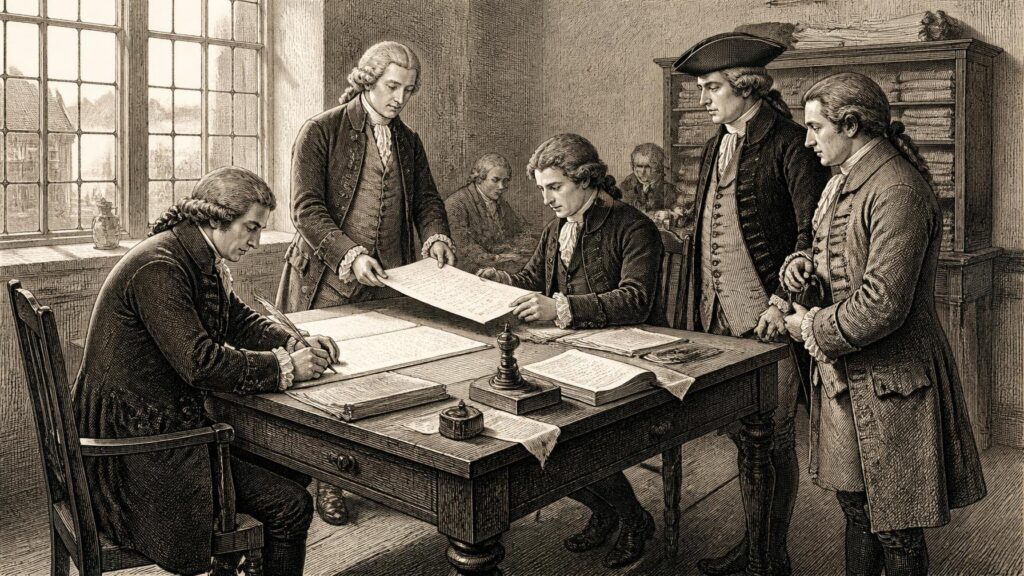
The Registry originated in the Registration of Deeds Act of 1707, which came into force on 25 March 1708. It established a public office in Dublin to register memorials of conveyances, wills and other instruments affecting land. Four days later Memorial No. 1 was registered. Benjamin Parry, an Irish MP, was the first registrar. The office did not initially compel every owner to register a deed; nevertheless, registration gave a deed precedence over an unregistered instrument or one entered later. That practical advantage encouraged use of the system.
The procedure was deliberately formal. Parties or their representatives brought the signed deed with witnesses; a memorial recorded the names involved, the place and nature of the property, and such terms as price or length of lease. The original document was returned, while the memorial was copied into transcript books. Thus a sale, mortgage, settlement or long lease could acquire an official timestamp in Dublin. In an age when estates were frequently burdened by family settlements, debts and competing claims, the registry helped lenders and purchasers judge whether a title might be safe.
It would be misleading to present the new office as a neutral modern land register. Its statute announced an aim of preventing fraud, but its language explicitly associated suspect conveyances with ‘papists’ and the protection of the Protestant interest. The Registry arose after the Williamite confiscations and amid legislation intended to narrow Catholic access to land, education, office and public influence. It helped Protestant purchasers and grantees secure title to estates whose ownership had been transformed by war and confiscation. At the same time, the institution had wider commercial consequences: land could serve more reliably as security for loans, and the registry would become a major archive of transactions across the island.
An Island on Alert
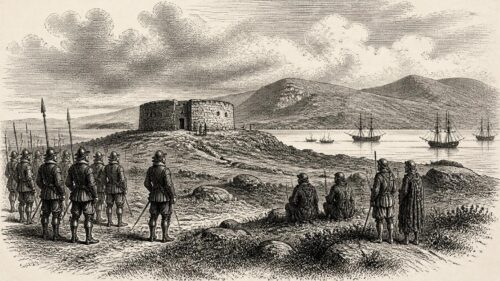
1708 also brought an acute, if short-lived, security crisis. Britain and France were at war in the War of the Spanish Succession, while James Francis Edward Stuart, the Catholic son of the deposed James II and VII, remained a potential rallying point for Jacobites in the three kingdoms. A French force sailed from Dunkirk in March intending to land James in Scotland. It failed to land troops and eventually withdrew, but the alarm reached Ireland quickly.
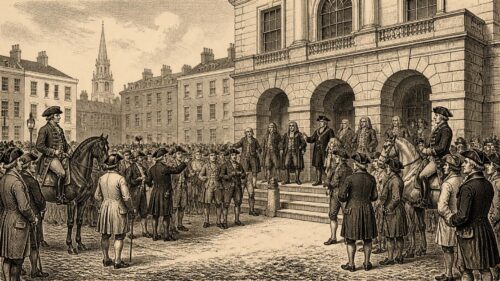
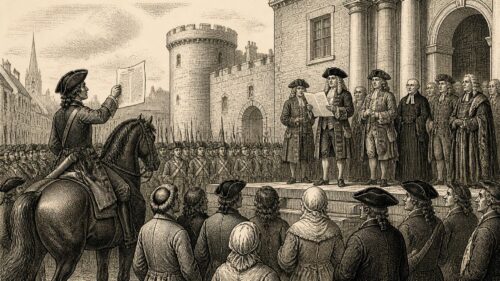
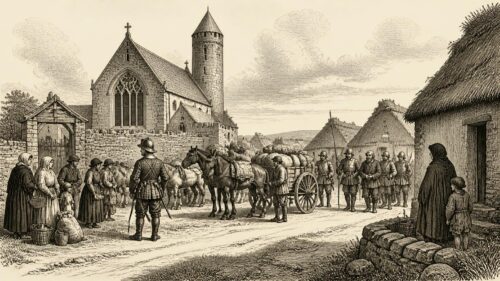
The Irish administration reacted as though invasion, intelligence-gathering and domestic rising might be connected. On 2 March it offered rewards for information about people supplying provisions or intelligence to the queen’s enemies. A proclamation of 16 March sought the Pretender and directed enforcement of the laws against Catholics; on 23 March came an order for the apprehension of Catholic priests not already secured. These acts were not evidence of an Irish rebellion in 1708. Rather, they reveal how the government interpreted international danger through the memory of the Jacobite war in Ireland less than two decades earlier. Catholic clergy and lay gentlemen could be treated as a security problem, irrespective of individual conduct or loyalty.
Some Catholic gentlemen detained during the scare were released on recognisances in early April, suggesting that the emergency measures were temporary rather than the opening of a general rising. Yet the episode exposed the coercive reach of the Protestant state. Catholic worship and community organisation continued, but under laws that registered secular priests, banned regular clergy, restricted education and circumscribed property. Protestant dissenters also had cause for grievance: the sacramental test attached to the 1704 anti-Catholic legislation excluded Presbyterians and other dissenters from many civic and crown offices. The governing order was therefore Anglican and Protestant, not simply Protestant in the broadest sense.
Government Between Sessions
Queen Anne was sovereign of Ireland, but Ireland remained a separate kingdom from the new Kingdom of Great Britain created by the Anglo-Scottish Union of 1707. Its parliament sat in Dublin; its administration operated through Dublin Castle and the lord lieutenant. In 1708 the lord lieutenant was Thomas Herbert, eighth earl of Pembroke. Parliament was prorogued in April until 28 February 1709, so the year was marked less by parliamentary legislation than by proclamations, legal administration and the management of war anxiety.
There was nevertheless a change in prospect. In December Thomas Wharton was named to succeed Pembroke as lord lieutenant. Wharton was a Whig sympathetic to Protestant dissenters, and Pembroke had unsuccessfully sought to remove the sacramental test. But Wharton did not arrive in Ireland until April 1709. For 1708, therefore, his appointment belongs to the year’s political horizon rather than to its active government. It is a useful reminder that major decisions affecting Ireland were frequently made elsewhere and implemented later.
Fire at Belfast Castle
On 25 April, a fire destroyed the old Belfast Castle, the Chichester and Donegall family residence at the heart of the town. The building, a plantation-era successor to earlier castles on the site, was accidentally burned to the ground and was never rebuilt. The human cost made the disaster especially grievous: contemporary testimony recorded the deaths of three young daughters of the third earl of Donegall, trapped in the blaze, alongside household servants.
The loss was both domestic tragedy and urban event. Belfast was still a comparatively small port town, but the castle and its gardens formed a commanding estate near its commercial centre. In August, the traveller Samuel Molyneux saw the ruin and described the recent fire as having consumed a Donegall family house with three sisters inside. He observed that the building’s separation from surrounding houses prevented a wider conflagration, while also delaying rescue. His account captures a hard fact of early modern urban life: wooden structures, open hearths, stored fuel and limited firefighting capacity could turn an accident into catastrophe within hours.
A Northern Journey
Molyneux’s journey from Dublin through Drogheda, Armagh, Lurgan, Lisburn, Belfast, Carrickfergus and Antrim provides an unusually vivid contemporary glimpse of Ireland in 1708. It must be read critically. He was a well-connected Protestant visitor, and his approving language about settlement and ‘improvement’ reflected the assumptions of the landed and Anglican elite. Even so, his observations show striking regional contrasts. North of Dundalk he crossed the Fews, where he found boggy, heathy ground, rocky roads, few houses and little cultivated land. Beyond it lay enclosed corn country, newly made roads and the cathedral town of Armagh.
He admired Armagh’s rebuilt and decorated cathedral choir, its school under construction and its barracks: church, education and military presence were visibly interwoven in a provincial borough. He then passed through planted and enclosed districts around Portadown, Lurgan and County Down. At Lurgan he found what he called the north’s greatest mart for linen manufacture, almost wholly peopled by linen weavers. Arthur Brownlow’s investment had helped establish the trade: he initially bought cloth at a loss, Molyneux reported, before becoming a substantial gainer as the market took hold.
This was not industrialisation in the later factory sense. Linen production joined household labour, farming, spinning, weaving, bleaching, merchants and landlords. Flax could be raised locally; women and girls often spun yarn, while weaving and marketing connected rural families to towns and overseas outlets. The industry offered earnings beyond subsistence farming, but depended on credit, skilled labour, access to markets and uneven landlord patronage. It was advancing in parts of Ulster, not yet a universal prosperity for Ireland.
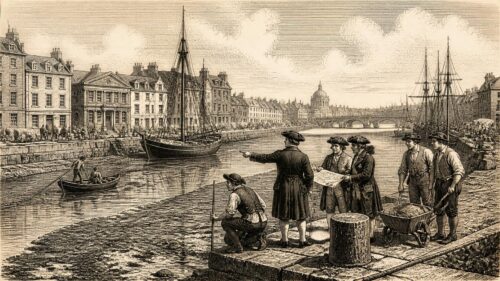
Molyneux also saw the scars of an earlier devastating fire at Lisburn. Its reconstruction in brick and slate demonstrated planned urban rebuilding, while the transfer of linen activity towards Lurgan and nearby places showed how disaster could alter local economic geography. Belfast, by contrast, impressed him as a thriving, populous port with new houses, shops, merchants and workers employed under them. He noted its small watercourse carrying goods to the quay with the tide, its barracks, and a locally made earthenware that he judged close in quality to Delft ware. Carrickfergus, although strongly sited and dominated by its castle, seemed to him less prosperous than Belfast.
Church and Learning
The established Church of Ireland supplied another firmly dated development. Thomas Milles, a scholar of Greek and editor of St Cyril of Jerusalem, became bishop of Waterford and Lismore in 1708 and was consecrated at St Patrick’s Cathedral, Dublin, on 18 April. His advancement linked an Irish bishopric to English university learning, patronage and the vice-regal household: he had come to Ireland in 1707 as Pembroke’s chaplain. Such appointments mattered beyond the pulpit. Bishops exercised authority over clergy, ecclesiastical property, schools and local influence in a confessional state.
The year’s surviving record is consequently a record of institutions as much as spectacle: a new property office, emergency proclamations, a destructive fire, a bishop’s consecration and a journey through changing towns and countryside. Together they show an Ireland being made more legible to government and investors, while remaining deeply unequal in religion, landholding and political power. Memorial No. 1 was only a single entry in March 1708; it marked the start of a system that would preserve evidence of those inequalities, transactions and ambitions for centuries.

Primary Sources
- Registration of Deeds Act 1707
- Introduction to the Memorials and Transcription Books at the Registry of Deeds
- Archive Collections
- Belfast Castle
- Journey to the North, August 7th, 1708
- Milles, Thomas
- Brodrick, Alan
- Wharton, Thomas
- The Making of a Penal Law (2 Anne, c.6), 1703–4
- The Penal Laws: Origins, Purpose, Enforcement and Impact
- Statute Law Revision Act 2015
- Jacobites: A Timeline
- “The Alarm from Dunkirk”, 1708
- The Early Modern Economy, 1600–1780
- History of the Commercial and Financial Relations Between England and Ireland from the Period of the Restoration, Part 8
- The Linen Industry
- The Second Year of Anne
- The British Monarchy and Ireland
- Enlightenment and Counter Enlightenment, 1690–1750
- A Jacobite Narrative of the War in Ireland
- Statute Law Revision (Ireland) Act, 1878, Section 2
- The Last Days of Belfast Castle