
Blood’s Unmade Coup1663 CE
In 1663, Ireland’s Restoration settlement remained unstable amid competing land claims, religious divisions and memories of war. Ormond’s administration faced Thomas Blood’s failed Protestant radical conspiracy to seize Dublin Castle and abduct the lord lieutenant, exposing divisions within Protestant interests. The Court of Claims issued 829 decrees, including 714 innocence declarations, but lacked land to reconcile restored Catholic proprietors with Cromwellian soldiers and adventurers. Government reinforced authority through registration rules, proclamations and Church of Ireland office requirements, while Margetson became primate. Dublin’s cultural life expanded with Katherine Philips’s Pompey. Trade continued amid imperial uncertainty, while property insecurity constrained uneven recovery.
Dateline
In 1663, Ireland’s Restoration settlement was tested not by a new national war but by the unresolved consequences of the old ones. Three years after Charles II returned to the throne, the country remained crowded with competing titles to land, unpaid expectations, religious distrust and memories of allegiances made during the Confederacy, Cromwellian conquest and exile. James Butler, duke of Ormond, lord lieutenant since July 1662, governed from Dublin Castle with the difficult task of making the king’s settlement work. The year’s most dramatic episode was the discovery of a conspiracy associated with Thomas Blood to seize the Castle and abduct Ormond. Yet the failed coup was only the sharpest expression of a deeper crisis: who was to possess Ireland, and on what terms?
A Settlement Put to the Test
The Act of Settlement, passed in 1662, supplied the legal framework, but not a painless solution. It confirmed many adventurers and soldiers in estates acquired after the parliamentary conquest, while offering restoration to specified groups of dispossessed proprietors, especially Catholics who could establish their “innocence” of participation in the rebellion that began in 1641. The word had a highly technical legal meaning. It did not simply distinguish a peaceful person from a violent one; it determined whether a claimant might recover land, house, income and local standing.
That task fell to the Court of Claims in Dublin. Its proceedings dominated 1663. Claimants and their attorneys assembled documents, summoned witnesses and reconstructed difficult personal histories amid the losses of war, transplantation and confiscation. Their cases concerned more than acreage. A successful decree could displace a current possessor, unsettle leases and tenants, alter patronage in a parish or borough, and reverse the prospects of a family that had thought its position secure. Conversely, failure could make dispossession effectively permanent.
The court’s work quickly revealed the settlement’s central impossibility: there was not enough available land to satisfy every interest recognised by the crown. Catholic proprietors judged innocent were, in principle, entitled to immediate restoration, while soldiers and adventurers already possessed estates and often had invested labour, stock and capital in them. The Act’s language acknowledged the practical hardship of turning established occupants out before equivalent compensation, or “reprisal”, had been found. In 1663 this was not an abstract constitutional difficulty. It was a source of anxiety in households across the landed and urban Protestant interest, and of frustrated hope among dispossessed Catholic families.
When the Court of Claims closed on 21 August, it had issued 829 decrees, 714 of them declarations of innocence. The figures should not be mistaken for a complete accounting of those who had lost property. Large numbers of potential claimants remained unheard. The closure therefore settled some individual cases while confirming a wider exclusion. Later legislation would attempt to explain and revise the arrangement, but in 1663 the immediate political effect was to make every concession appear, to someone else, a threat to security.
Thomas Blood and Dublin Castle
That atmosphere formed the background to the conspiracy conventionally called Blood’s Plot. Thomas Blood, a Meath-born Protestant with ties to the military world of the 1640s and 1650s, habitually styled himself Colonel Blood. By at least September 1662 he was involved in plans directed against the Restoration administration. The plot was not an Irish Catholic rising, although later retellings have sometimes blurred the point. It grew from radical Protestant and former Commonwealth discontent, especially fear that the land settlement and the regime’s religious policy would weaken those who had prospered under the Cromwellian order.
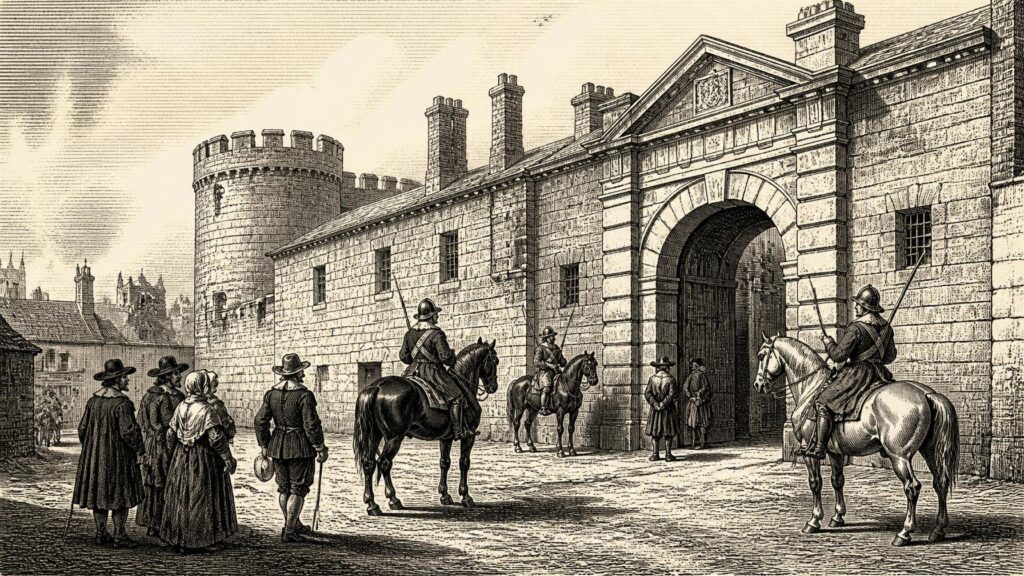
The intended coup was bold. Conspirators planned to surprise Dublin Castle, the administrative heart of government, and seize Ormond. Capturing both the lord lieutenant and the Castle would have paralysed the visible machinery of royal authority in Ireland. It also demonstrates the political importance of Dublin: government was concentrated there, and a small group acting at the right place might hope to make a provincial disturbance look like a change of regime.
The enterprise collapsed in May before it could be put into effect. Blood escaped arrest, while a number of alleged associates were taken into custody. Contemporary and later accounts differ in particulars, including the intended date and the full circle of participants; it is therefore safer not to supply a spurious day-by-day narrative. What is clear is that the plot was real enough to alarm Ormond’s government and that its exposure strengthened the administration’s hand. A proposal to clarify the land settlement had already encountered resistance in the Irish parliament. The revelation that disaffected Protestants had contemplated force made open opposition more difficult and shifted attention from the grievances of established settlers to the danger of disorder.
Blood’s escape gave the episode a long afterlife. He remained active in radical and conspiratorial politics in Britain and would achieve lasting notoriety for the attempted theft of the English crown jewels in 1671. In 1663, however, his significance lay in Ireland’s unsettled present. The plot exposed the limits of describing the Restoration simply as a Protestant triumph over Catholic loss. Protestant interests themselves were divided between those protected by royal settlement, those who feared it, and those prepared to challenge the government that had restored the monarchy.
Government, Church and Paper Authority
Ormond’s response to such pressures depended upon armed authority, but also upon administration. Proclamations, registrations, commissions, court orders, land surveys and petitions made government tangible. On 5 August 1663 a proclamation required grants under the Great Seal of England and orders of the Irish Council to be registered in Ireland. The measure was procedural, yet procedures mattered: in a country where title and entitlement were disputed, an unregistered grant could become another occasion for conflict.
Religious conformity was likewise embedded in public office. A proclamation of 4 September required justices of the peace to receive Holy Communion annually according to the discipline of the Church of Ireland. This did not describe the religious practice of the whole population, much less eliminate Catholic worship or Protestant nonconformity. It did, however, mark the established church as part of the state’s local governing structure. Holding magistracy required public participation in its sacramental order.
In August, James Margetson was translated from the archbishopric of Dublin to Armagh, becoming Church of Ireland primate. His advancement followed the death of John Bramhall, one of the foremost architects of the post-Restoration episcopal church. Margetson’s translation was a firmly dated institutional change rather than proof of religious tranquillity. The Church of Ireland was rebuilding authority, revenues and clerical structures after upheaval, but it did so in a society whose Catholic majority could not be incorporated into the established ecclesiastical settlement on equal terms.
A New Stage in Dublin
Political strain did not prevent cultural innovation. On 10 February, Katherine Philips’s English translation of Pierre Corneille’s Pompée, published as Pompey, was performed at the recently opened Smock Alley Theatre in Dublin. The occasion has an importance beyond theatrical novelty: Philips became the first woman known to have had an English-language play professionally staged. Her work was printed in Dublin later that year and then in London, connecting the city’s book trade and theatre to wider Restoration literary networks.
The performance also offers a rare glimpse of an urban public culture developing beside Dublin Castle. Smock Alley could draw office-holders, soldiers, lawyers, students, merchants and visitors into a shared commercial space of tickets, printing, taverns and sociability. That audience was limited in social reach and overwhelmingly English-speaking, but it was not insignificant. Dublin in 1663 was not solely a fortress of government or a courtroom for land claims; it was also a place where a newly revived theatre could present French classical drama in English verse.
Trade, Property and Uneven Recovery
On 27 July, the English parliament passed the Navigation Act commonly known as the Staple Act. It reinforced England’s attempt to channel colonial commerce through English shipping and ports. Ireland’s position within that system was constitutionally awkward. Ireland was not named in the Act, and a major study of Anglo-Irish commercial relations concludes that Irish trade with the plantations continued for the time being. It would be misleading to treat 1663 as the year in which Irish colonial trade was suddenly prohibited. The more responsible conclusion is narrower: Ireland’s merchants operated under an expanding English imperial regulatory system whose implications remained uncertain and would sharpen in later decades.
For most inhabitants, the more immediate economy was local and agricultural. The surviving evidence for 1663 is especially rich in claims, surveys and elite correspondence, and much poorer for the routines of labourers, servants, small tenants and women whose work sustained households. It would be wrong to invent a uniform everyday experience from those records. Still, the documents make one fact unavoidable: questions of rent, possession, stock, improvements and inheritance were inseparable from the politics of restoration. Ireland’s recovery was uneven because rights to the land beneath it remained unstable.
Thus 1663 ended without the seizure of Dublin Castle that Blood and his associates had envisaged. Ormond’s government had survived a dangerous challenge, the Court of Claims had concluded, and the Church of Ireland had renewed its senior leadership. None of these developments settled the larger argument. Instead, they fixed the terms on which it would continue: through law and paperwork, through parliament and proclamation, through religious exclusion, and occasionally through the threat of force.
Primary Sources
- State Papers Ireland 1509–1782: government papers on Irish affairs
- Act of Settlement [1662] and Act of Explanation [1665]
- The Irish Court of Claims of 1663
- Claims, Court of, Memoranda of decisions of, 1663
- Cromwellian Surveys
- Blood, Thomas
- Butler, James
- Margetson, James
- Irish Manuscripts Commission Catalogue 2013–14
- Papers of the Duke of Ormonde, chiefly concerning the land settlement of Ireland, 1660–73
- Add MS 72878
- Statute Law Revision Act 2015
- Katherine Philips
- CELM: Katherine Philips (Orinda)
- Writing before 1700
- Translation Strategies in Katherine Philips’s Pompey
- A History of Theatre 1601–2000
- Cromwell’s Legacy: The Social Memory of Oliver Cromwell in Ireland, c.1660s–c.1730s
- A Rage Without a Home
- Part 4 of History of the Commercial and Financial Relations between England and Ireland from the Period of the Restoration
- The horrid conspiragie [sic] of such impenitent traytors as intended a new rebellion in the kingdom of Ireland
- Blood’s Plot in 1663
- Surveys, particulars of rents, etc. appertaining to the lands of the Duke of Ormond in counties Kilkenny, Tipperary and Dublin, 1663–1673