

St Mary’s Abbey Renunciation1534 CE
In 1534, Thomas FitzGerald, vice-deputy and heir to Kildare, renounced Henry VIII at Dublin’s St Mary’s Abbey after his father Gerald was recalled and imprisoned in London. Claiming papal loyalty, Thomas besieged Dublin Castle, mobilised Geraldine, Gaelic and Pale support, and sought foreign aid, but faced opposition from towns, Butlers and royal officials. War brought raiding and devastation across surrounding regions; Archbishop John Alen was murdered after capture near Clontarf. Gerald died in the Tower in September, making Thomas earl. Sir William Skeffington’s October arrival with a royal army shifted the balance, leaving Thomas entrenched at Maynooth under a truce.
Dateline
In 1534 the political order that had long made the FitzGerald earls of Kildare the dominant power in the English lordship of Ireland broke apart in spectacular fashion. The crisis began as a struggle over the authority of one great dynasty and ended the year as a war centred on Dublin, the Pale and the approaches to Kildare. It was not simply an Irish echo of events in England. Thomas FitzGerald, Lord Offaly, drew strength from the interconnected world of the lordship: old English landowners, Gaelic allies, clerics, military households, walled towns and the royal administration at Dublin Castle. Yet the revolt also became entangled with Henry VIII’s breach with Rome, giving its participants and observers a language of religion as well as lordship.
The Recall of the Ninth Earl
Gerald FitzGerald, ninth earl of Kildare, had governed Ireland repeatedly as lord deputy and had built an extraordinary political reach. His estates, military retainers and alliances extended well beyond the Pale, the crown’s increasingly constricted zone of authority around Dublin. His household at Maynooth combined aristocratic display with a notably cosmopolitan culture: it contained a substantial library in Latin, English, French and Irish, while Gaelic poets, harpers, physicians and legal specialists appeared among his dependants. This was a lordship sustained by rents, food renders, hospitality, military service and personal connections, not by a modern central state.
That strength had enemies. The Butlers of Ormond and their allies, together with officials who wanted a more closely governed lordship, accused Kildare of maladministration and of ruling to his family’s advantage. Summoned to England, the earl left Ireland in February 1534. At a council at Drogheda he entrusted his son Thomas, then about twenty-one, with the king’s sword and authority as his vice-deputy. The appointment alarmed Kildare’s opponents. Thomas was young, but he was no merely passive heir: he had experience of campaigning and court life, command of his father’s affinity, and a political position that made him a plausible focus for both Pale and Gaelic supporters.
In London, however, Gerald was arrested and confined in the Tower. The speed with which news, warnings and rumours travelled across the Irish Sea was itself decisive. Later tradition made the revolt the impulsive response of a son falsely told that his father had been executed. Contemporary circumstances were more complicated. Gerald sent Thomas a warning not to follow hostile councillors’ advice, while the crown intended to announce its wishes through an Irish council meeting. Whether Thomas believed his father already dead, feared that he soon would be, or chose a dramatic gamble to secure the deputyship, cannot be reduced responsibly to one cause.
A Sword Laid Down
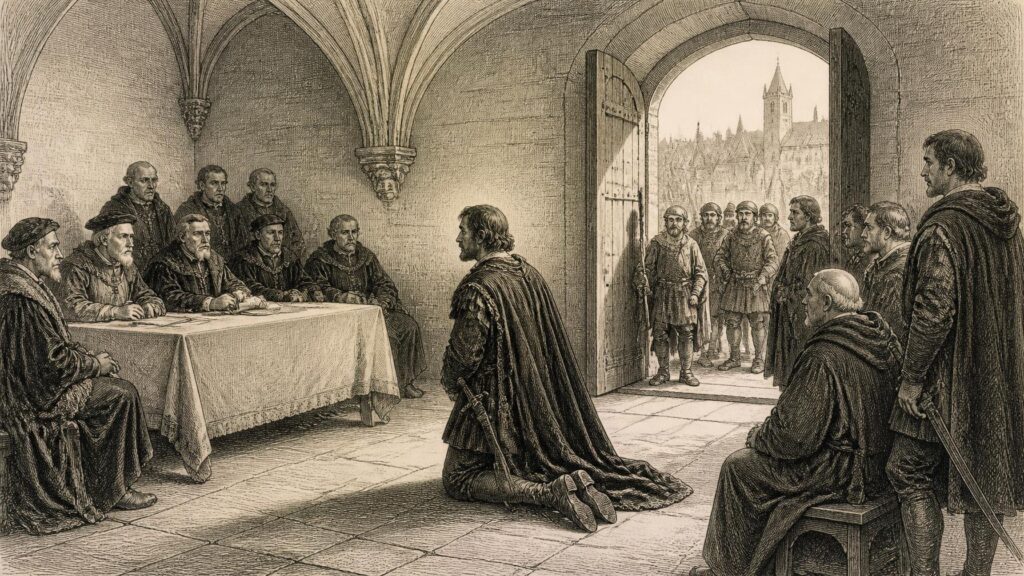
On 11 June Thomas rode to the council at the chapter house of St Mary’s Abbey in Dublin and publicly renounced his allegiance to Henry VIII. Accounts differ in colour and emphasis, but agree on the basic act: he returned or cast down the sword of state and declared rebellion. The nickname ‘Silken Thomas’ is traditionally linked to silk decoration worn by his mounted followers; it is safer not to treat the familiar image of extravagant silk-fringed helmets as a simple contemporary fact. What is beyond doubt is the deliberate theatre of the occasion. A royal office was repudiated in the very place where the Dublin administration met.
Thomas’s programme quickly acquired a religious language. His party denounced Henry as a heretic, declared for the pope, and sought the support of Emperor Charles V. This did not mean that Ireland had already undergone an official English-style Reformation. The English Act of Supremacy was passed in 1534, but the comparable remaking of ecclesiastical jurisdiction in Ireland belonged to later legislation. In this year Catholic loyalty offered Thomas a powerful argument against a king whose divorce and rejection of papal authority had unsettled many observers. It also gave an ostensibly local dynastic struggle an international dimension, even though no foreign rescue arrived in 1534.
Dublin Under Threat
The immediate military objective was the crown’s foothold in Dublin. Thomas entered the city’s environs with a substantial following and his forces besieged Dublin Castle, while allied bands operated in Louth and Wexford. The capital was not, however, simply captured by one side. Dublin Castle held out, and the three walled cities of Dublin, Waterford and Kilkenny remained important centres of opposition to the revolt. The conflict exposed the limits of both Geraldine and royal power: Thomas could intimidate districts and disrupt communications, but could not easily take a fortified administrative centre defended by a committed garrison.
For ordinary people in the contested country, the war was experienced less as constitutional argument than as insecurity. Contemporary and near-contemporary records speak of plundering, burning and the devastation of Fingal and parts of Meath and Kildare. Crops, livestock, stored food and buildings were military resources; destroying or seizing them weakened an enemy but placed tenants, labourers, town dwellers and religious communities at immediate risk. Roads between Dublin, Drogheda and the western marches became strategic routes. Markets, harvest work and the collection of rents could not be insulated from armed musters and raiding.
One extraordinary natural occurrence added to the sense of disorder. In July an earthquake, probably centred in north Wales, was felt in Dublin. The surviving evidence is thin, and the exact day is uncertain, but later reporting preserves the striking detail that it was noticed in the city around dawn. Earthquakes were rare enough in Irish experience to be remembered as wonders. It should not be made a cause of the rebellion; rather, it was an unsettling episode in a summer already dominated by flight, siege and rumour.
The Killing of Archbishop Alen
The most damaging single act of the rising was the death of John Alen, archbishop of Dublin and a leading royal administrator. Alen had served as chancellor of Ireland and represented precisely the kind of centralising, reform-minded government that the Kildare interest distrusted. As danger intensified in late July, he attempted to escape by sea from Dublin. His vessel ran aground near Clontarf, and he was captured at Artane. On 28 July he was killed by Thomas FitzGerald’s followers.
Later stories claimed that Thomas meant only that Alen should be taken away and that an Irish-language order was misunderstood. That explanation cannot be proven, and it cannot remove the political consequences. The killing of an archbishop made accommodation much harder, frightened officeholders and confirmed in London that the revolt was no routine baronial quarrel. It also revealed the vulnerability of churchmen in a conflict in which religious claims could be loudly proclaimed while a senior prelate was murdered. Alen’s register, with its record of diocesan business, is a reminder that the Dublin church was not an abstraction: it was an institution of courts, clergy, property and administration caught in the violence.
From Protest to Wider War
After the initial declaration, Thomas tried to turn defiance into durable control. He canvassed support among the gentry of the Pale and among Gaelic lordships. The Kildare network gave him considerable early advantages, and leading figures in the south-west, including the earls of Desmond and Thomond interests, were drawn into the wider alignment. Yet support was conditional and varied by locality. The Butlers stood against him, while towns calculated carefully where their security and trading privileges lay. Allies could supply kern, galloglass, horsemen, victuals or safe territory, but they were not necessarily committed to a long war against a king with far greater resources.
Gerald FitzGerald’s death in the Tower on 2 September ended any remaining hope that the old earl might return to restore the family’s position. Thomas now succeeded as tenth earl of Kildare, but inheritance did not solve his military problem. He renewed pressure on Dublin and, according to reports, commanded very large forces; numbers in campaigning accounts should nevertheless be treated cautiously. What mattered more was that he had failed to eliminate the royal centre before England could respond.
That response arrived in the autumn. Sir William Skeffington, appointed lord deputy, sailed from Chester on 14 October with an army of roughly 2,300 men, the largest royal force sent to Ireland for well over a century. After weather delayed and diverted the expedition, Skeffington reached Dublin later that month. His arrival changed the balance. Pale gentry who had hesitated or temporised had to reconsider their position, and at Drogheda Thomas was proclaimed a traitor. The royal army’s disciplined infantry, artillery resources and access to the city’s supply base were a different challenge from the divided local politics Thomas had hoped to exploit.
The Winter Position
By the close of 1534 the rebellion had not yet been crushed, and its most notorious later episodes—above all the fall of Maynooth Castle and Thomas’s eventual surrender—still lay ahead. But the direction was becoming clear. Thomas withdrew towards Maynooth, strengthened its garrison and concentrated munitions there, while royal forces established themselves around Dublin and the Pale. A truce from 19 December into early January 1535 marked neither peace nor reconciliation; it was a pause in a struggle whose resources were draining away.
The year therefore deserves to be remembered not as a neat revolt triggered by one report, but as a turning point created by the collision of dynastic power, crown reform, religious allegiance and military geography. The Kildare ascendancy had depended on mediating between English government and Gaelic Ireland. In 1534 its heir chose open resistance. That decision exposed the dynasty’s strength, but also its dependence on alliances that could fray when confronted by sustained royal intervention.
Primary Sources
- FitzGerald, Thomas (‘Silken Thomas’)
- FitzGerald, Gerald (Gearóid Óg, Garrett McAlison)
- Alen (Allen), John
- Skeffington, Sir William
- Nugent, Richard
- Cusack (Cusacke, Cusake), Thomas
- Grey (Gray), Lord Leonard
- The Annals of Ulster, Year U1534
- Annals of the Four Masters, Year M1534
- Annales Breves Hiberniae
- Annála Connacht, 1535 Entries
- Archbishop John Alen (c. 1476–1534) and his Register
- Act of Supremacy 1534
- The Reformation
- Historical Seismicity of the British Isles to 1600: 25 July 1534 North Wales
- Rebellion, State Paper Dark Age, 1534–40
- Rebel Women in Tudor Ireland—Some Case-Studies
- St Mary’s Abbey
- Handbook HI2112: Ireland 1534–1641
- List of Published Texts at CELT