

Kildare’s Omagh Campaign1509 CE
Henry VIII’s accession in 1509 prompted Ireland’s council to retain Gerald FitzGerald, eighth earl of Kildare, as temporary governor, preserving authority in the Pale. Kildare intervened in a disputed O’Neill conflict in Tyrone, campaigning with regional allies, capturing Omagh castle, taking prisoners and demolishing the fortress. Domhnall O’Neill died, and Art O’Neill was inaugurated, illustrating contested Gaelic succession. Uilleag Fionn Burke of Clanricard also died, without ending Burke power. Obituaries for church officers, an erenagh and a learned poet reveal enduring ecclesiastical, hospitable and literary institutions. The year demonstrated that royal change affected Ireland through local alliances, lordships and rivalries.
Dateline
In 1509, the death of Henry VII and the accession of his son Henry VIII did not produce a sudden remaking of Ireland. The lordship remained a patchwork of jurisdictions, alliances and rival lordships: the Dublin administration governed most directly within and around the Pale, while powerful Gaelic and Gaelicised dynasties exercised authority across much of the island. Yet the change of monarch created a moment of uncertainty. In Dublin, the leading men of the lordship moved quickly to preserve continuity by retaining Gerald FitzGerald, eighth earl of Kildare, at the centre of government. In Tyrone, meanwhile, a struggle within the O’Neill kindred drew Kildare’s force northwards, ending with the taking and demolition of the castle at Omagh.
A New King, an Interim Governor
Henry VII died on 21 April 1509. The Annals of the Four Masters, using their own chronological notice, record that Henry VIII was made king of England on 22 April. For Ireland, the important point was immediate: the lordship’s government depended heavily upon an experienced local governor who could command trust, men and resources more readily than the distant Crown could.
On 8 June, the lords and council of Ireland wrote from Dublin to the new king. They mourned Henry VII’s death, explained that Kildare had been preparing to go to his sovereign, and urged that he remain in Ireland. His absence, they said, would expose the land and the king’s loyal subjects to danger. Until Henry VIII made a formal appointment, they had elected Kildare justice, or temporary governor, according to what they described as ancient usage.
The wording was calculated to affirm royal loyalty, but it also acknowledged a hard political fact. Kildare was not merely an office-holder waiting upon instructions from England. Known in Irish as Gearóid Mór, the ‘Great Gerald’, he was the dominant magnate of the English lordship and the head of a vast family connection extending through Leinster, Meath and beyond. His authority depended on offices, estates, marriage ties, retainers and agreements with Gaelic lords. The council’s action ensured that the change of king did not leave Dublin, the Pale and its vulnerable frontier without an effective commander.
This was not a declaration of Irish independence from the Crown. It was a practical constitutional expedient within the lordship. Kildare continued to act in the king’s name, while the new Tudor regime had time to decide whether it would confirm him. The decision to entrust government to him also demonstrated the limits of direct English intervention: local political knowledge and local military capacity were indispensable.
Conflict Within Tyrone
The most substantial military event securely associated with the year occurred in Tyrone. It arose from an O’Neill quarrel, not from a simple confrontation between an English government and a united Irish population. Art, son of Conn O’Neill, was seized through treachery by a kinsman, Art of the Castle. The Four Masters stress the breach of personal trust involved: Art had been invited to his captor’s castle and was his gossip, a relationship created through sponsorship and spiritual kinship. Art’s son Niall and Felim O’Melaghlin were taken with him and delivered into the hands of Hugh Óg O’Donnell.
That episode shows how hostageship operated in high politics. A hostage was a means of securing loyalty, enforcing a settlement or gaining leverage in a dispute; he might be a close kinsman, and his fate could shape the calculations of an entire lordship. Art was later released, but only after his own son and his brother Brian were handed over in his place. The annals call the consequences of his original capture ‘great troubles’, a restrained phrase for a conflict that entangled several branches of the O’Neills and the neighbouring O’Donnells.
Kildare’s intervention was therefore an intervention in a shifting regional coalition. The Four Masters say that he led an army into Tyrone at the request of the sons of Conn O’Neill. The Annals of Ulster add further allies and interests, naming O’Donnell, Niall O’Neill and the descendants of Aodh O’Neill among those urging action. Such differences of emphasis are useful: they caution against treating any one annalistic account as a complete military dispatch. Together, however, the records agree on the campaign’s central outline.
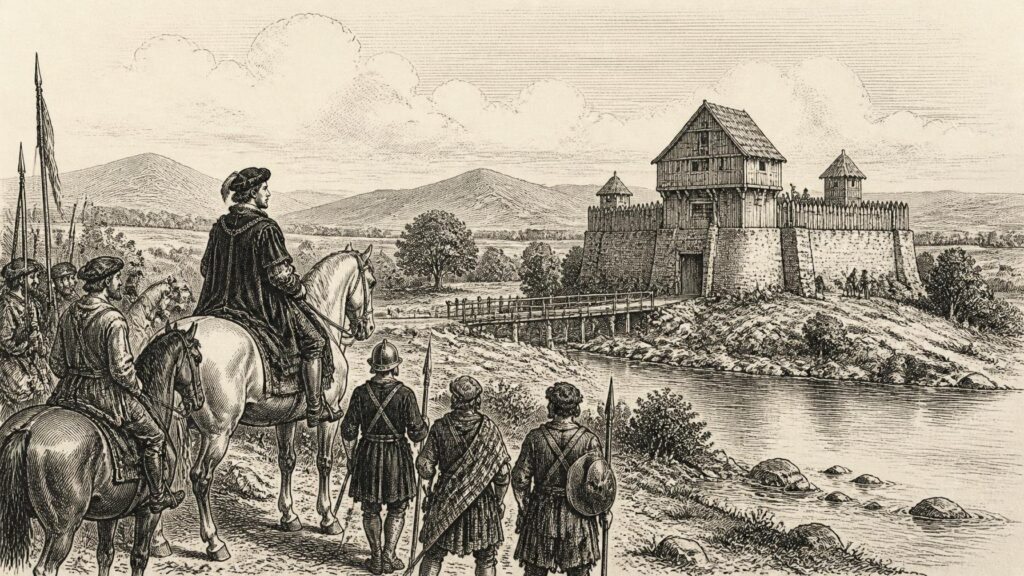
Before Kildare reached Dungannon, the sons of Conn had secured O’Neill’s castle there. Kildare then proceeded to Omagh, where he took the castle, captured Toirdelbach, son of Niall son of Art O’Neill, and Eoghan Ruadh Mac Suibhne, and had the fortress demolished before returning home. The destruction mattered as much as the capture. A late medieval castle was a residence, depot, symbol of lordship and place from which a district might be controlled. Knocking it down denied an opponent an immediate stronghold, even if it did not settle the deeper quarrel. Indeed, later annalistic entries show Omagh’s castle being rebuilt, underlining the provisional character of military success in this contested landscape.
Lordship and Succession
On 6 August, Domhnall O’Neill, lord of Tyrone, died. The Four Masters describe a career marked by repeated warfare and depredation in the struggle for the lordship, before he finally secured it. Art, son of Aodh son of Eoghan O’Neill, was inaugurated in his place. The use of ‘inaugurated’ is significant. O’Neill succession was not simply an automatic inheritance by the eldest son according to English primogeniture. It depended on the standing of eligible kinsmen, the support of leading families and the ability to uphold lordship. The political violence already visible in 1509 makes clear why succession could remain contested even after an inauguration.
The year also brought the death of Uilleag Fionn Burke, lord of Clanricard in south Connacht. His lordship had survived Kildare’s victory over him at Knockdoe in 1504 and remained a major regional power. His death did not end the Burke presence or transform Connacht’s balance of power; rather, it marked another transfer of leadership in a political world where dynastic continuity depended upon negotiation as well as descent. Kildare’s earlier victory had curtailed Clanricard’s expansion, but it had not eliminated the lordship.
Church, Learning and Hospitality
Military affairs dominate the surviving notices, but the year’s obituaries offer brief views of institutions that structured everyday life. Brian Mac Uinnseannáin, official of Clogher, died in 1509. An official was an ecclesiastical legal officer, and his commemoration points to the continuing operation of church jurisdiction in Ulster. Donnchadh Mac Ruaidhrí, erenagh of Machaire na Croise, also died. An erenagh held hereditary responsibilities connected with church land and local religious provision, an office embedded in both kinship and ecclesiastical life.
The annalist praised Donnchadh as humble and meek, and, more concretely, as a man who maintained a house of hospitality. This was not a decorative compliment. In an age of difficult travel, hospitality was an important social obligation and a practical resource for clerics, scholars, travellers, dependants and the poor. Its appearance alongside political deaths and campaigns reminds us that status was measured not only through armed followings, but also through the capacity to feed and receive others.
Gilchreest Mac an Fhilidh, described as a learned poet, died during the same year. Professional learned families sustained the literary culture of Gaelic Ireland: poetry, genealogy, praise, satire, legal learning and historical memory were cultivated skills with patrons among the great lordships. The annal gives no surviving poem by Gilchreest and no precise account of his career. Still, his notice is evidence that learned specialists remained visible enough within the social order to be recorded among the year’s consequential deaths.
A Year of Continuity and Exposure
1509 was thus defined less by a single island-wide turning point than by a conjunction of transitions. In Dublin, the death of one English king required the quick election of a temporary governor. In Tyrone, the imprisonment, exchange and replacement of O’Neill kinsmen exposed the fragility of lordship. Kildare’s march to Omagh showed the reach of the Dublin government when it worked through alliances, but also its dependence on those alliances. In Clogher and Machaire na Croise, the deaths of church officers and a hospitable erenagh reveal institutions that continued beneath the din of dynastic warfare.
The new king would eventually confirm Kildare in office, but that lay beyond this calendar year. What can firmly be placed in 1509 is the council’s decision to keep him in charge, the northern expedition and Omagh’s demolition, Domhnall O’Neill’s death on 6 August, Henry VIII’s accession, and the deaths of figures whose offices connected politics, religion and learning. Together they show an Ireland in which royal succession at Westminster mattered greatly, yet took effect through the contested local worlds of Dublin, Tyrone, Connacht and the churchlands.
Primary Sources
- Annals of the Four Masters, Volume 5
- Annals of the Four Masters, Part 1: Annal M1509
- The Annals of Ulster
- Annales Breves Hiberniae
- Calendar of State Papers, Ireland: Tudor Period, 1509–1547
- FitzGerald, Gerald (Gearóid Mór)
- Burke (de Burgh), Uilleag (‘Uilleag Fionn’)
- FitzGerald, Gerald (Gearóid Óg, Garrett McAlison)
- English Lordship of Ireland and the Irish Sea World: Re-assessing the Origins of the Kildare Ascendancy, c.1390–c.1513
- James IV, the O’Donnells of Tyrconnell and the Road to Flodden
- Ireland under the Tudors, Volume I
- The Red Book of the Earls of Kildare
- The Red Book of the Earls of Kildare (digital edition)
- Annals of Loch Cé A.D. 1014–1590
- Annals of Loch Cé, Volume 2
- Annála Connacht
- Annales Hiberniae
- Annales Hiberniae, Text 2
- Anglo-Irish Local Government, 1485–1534
- Annala Rioghachta Eireann: Annals of the Kingdom of Ireland, Volume 5