Galway Mayoralty1484 CE
In 1484, Ireland comprised the English lordship, autonomous towns, Anglo-Irish magnates and Gaelic dynasties, each governed through distinct but connected powers. Under Richard III, Gerald FitzGerald, earl of Kildare, dominated Dublin administration, while parliament regulated coinage, revenues, religious property, fortification and urban affairs. Galway strengthened its position when St Nicholas’s became collegiate and Richard granted the town a mayoralty. Elsewhere, insecurity persisted: northern war between O’Neill and O’Donnell coincided with a violent Maguire succession dispute in Fermanagh, involving murder, raids, captives and church attacks. Annals also record deaths, imprisonment and pastoral wealth, revealing fragmented political and social life across Ireland.
Dateline
In 1484 Ireland was not a single political arena but a set of overlapping worlds: the English lordship, most securely organised around Dublin and the Pale; powerful Anglo-Irish lordships; Gaelic kingdoms and client networks; and self-governing towns tied to seaborne commerce. The year’s surviving evidence is uneven. Government records illuminate legislation, offices and urban privileges in the lordship, while the Irish annals preserve sharply local accounts of killings, captivities, churches and successions. Taken together, they show a country in which royal authority, civic ambition and regional violence operated side by side.
Richard III and Kildare’s Government
Richard III was lord of Ireland throughout 1484, but the practical government of the lordship depended heavily on Gerald FitzGerald, eighth earl of Kildare, known later as Gearóid Mór. Kildare had been confirmed as deputy governor in 1483 and commanded an unusually strong position within the Irish council. His Yorkist loyalties linked the Dublin administration closely to the new king in England, although his authority rested at least as much on family connections, landed power and local alliances as on royal commission.
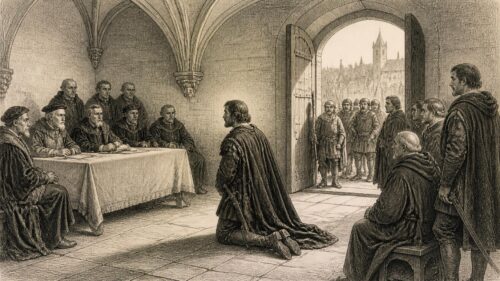
The English succession nevertheless mattered profoundly in Ireland. Richard’s seizure of the crown in 1483 had unsettled the wider political world of the Plantagenet dominions. Kildare travelled to the English court during the summer of 1484, and on 21 August Richard appointed his nephew, John de la Pole, earl of Lincoln, king’s lieutenant in Ireland. The appointment underlined the crown’s continuing claim to direct the lordship from England. It did not erase Kildare’s entrenched influence in Dublin and Leinster, nor did it make the areas beyond the Pale obedient to the king. Rather, it exposed the dual character of late medieval government: formal commissions issued across the Irish Sea, while day-to-day power depended on magnates who could command men, tenants and allies locally.
Parliament, Money and Defence
A parliament opened at Dublin on 19 March. It later met at Naas, though damage to the surviving statute roll means that the precise date of that later sitting is uncertain; it should not be assigned a confident day without qualification. Its legislation is unusually revealing. Parliament addressed private disputes and institutional privileges, but it also dealt with the mechanisms that enabled the lordship to function: the currency, royal revenues, courts, defence and corporate towns.
Coinage was a conspicuous concern. Acts required the acceptance throughout Ireland of the king’s coin minted at Dublin Castle and elsewhere, prescribed the making of groats, half-groats, pennies and halfpennies, assigned mint profits to the deputy lieutenant during his term, and tackled counterfeit money. An act resumed grants of mint office formerly made to Germyn Lynch and provided for the rejection of false coin and proceedings against counterfeiters. These measures do not prove that a single currency circulated evenly across every region of Ireland. They do show that government regarded trustworthy coin as important to taxation, payment and trade within the areas it could reach.
Other acts display a government concerned with material security. St Mary’s Abbey, Dublin, received exemption from certain subsidies and impositions in the diocese of Meath. Sir Thomas FitzGerald was granted £10 and cartage from County Kildare towards building a castle at Lackagh, a reminder that fortification was a practical local expense rather than merely a symbol of lordship. The parliament also protected the interests of the Dominican priory at Trim against unauthorised grants of its lands, and required Davy and Patrick Keating to account at Dublin Castle for royal service in the liberty of Wexford. Such business reveals an administration that was limited in geographical reach but still active in defending property, religious houses and revenue.
Urban and mercantile life appears in the same roll. Peter Lynch of Galway received licence connected with a disputed house and cellar, following an award involving the town’s sovereign and John Blake. Waterford’s mayor and bailiffs obtained leave to go on pilgrimage to Santiago de Compostela, while New Ross was licensed to pursue English rebels and Irish enemies and seize goods to compensate its losses. These were particular grants, not a national programme, but they reveal towns as places of legal procedure, property investment, pilgrimage, credit and defence.
Galway’s Enlarged Civic World
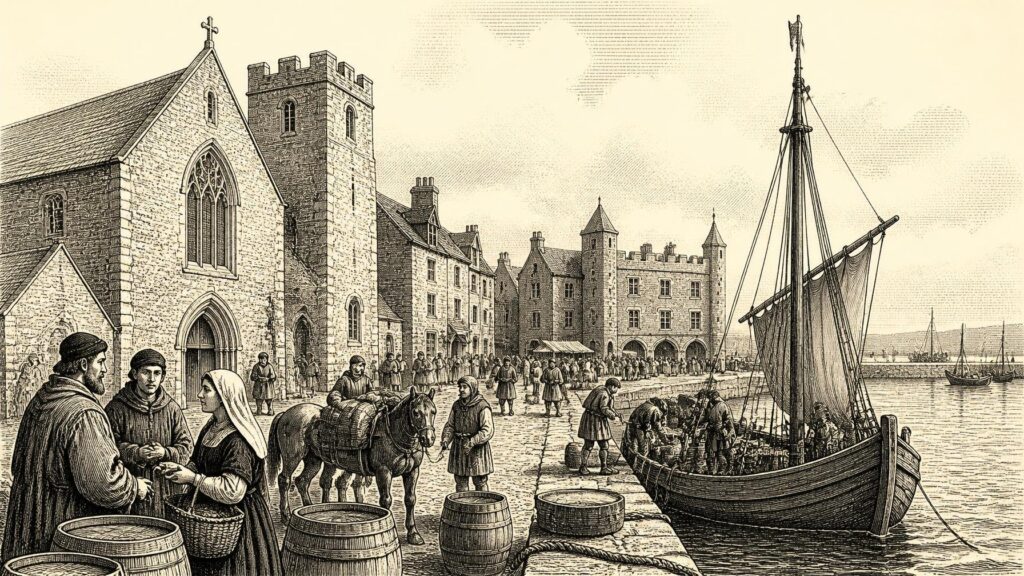
Galway provides the year’s clearest example of urban advancement. On 28 September Donatus Ó Muireadhaigh, archbishop of Tuam, issued letters raising the parish church of St Nicholas to collegiate status. A collegiate church was served by a permanent body of clergy under a warden rather than being simply an ordinary parish church. The development joined religious organisation to the civic life of a growing Atlantic port. St Nicholas, dedicated to the patron saint of sailors, stood at the centre of a town whose merchants looked west to the ocean and east through Irish and English trading connections.
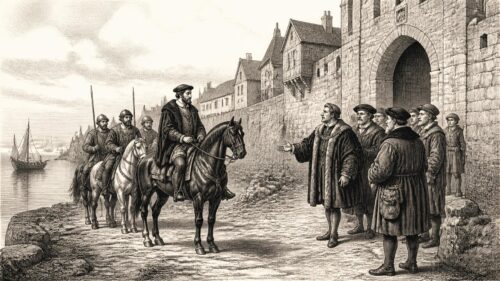
In December, Richard III granted Galway a royal charter establishing a mayoralty. The charter was a significant enhancement of the town’s standing, not a declaration that Galway had suddenly become politically independent of its hinterland or the wider lordship. Its importance lay in institutional recognition: merchants and leading burgesses gained a more prestigious civic framework through which to manage local government, privileges and collective interests. The coincidence of collegiate status and mayoral charter in the same year marks 1484 as an important point in Galway’s civic consolidation.
Yet Galway’s prosperity existed beside insecurity. The town’s elite included families such as Lynch and Blake, whose names occur in the legal business of the year, but its position on the western edge of the lordship required constant negotiation with neighbouring Gaelic and Anglo-Irish powers. The charter should therefore be understood as an effort to reinforce an established commercial community, not as evidence that violence and political competition had disappeared from Connacht.
War in the Northern Lordships
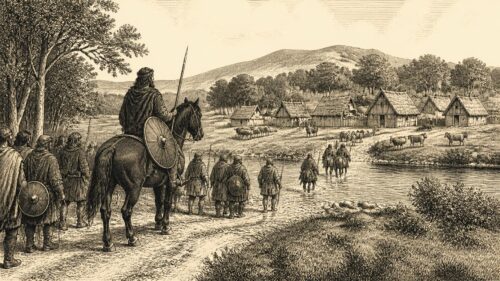
The annals record a great war during 1484 between Conn Ó Néill, son of Enrí Ó Néill and ruler in Tír Eógain, and Aodh Ruadh Ó Domhnaill of Tír Chonaill. They do not supply a full campaign narrative, but their wording makes clear that considerable injuries were inflicted on both sides. This was conflict among major northern dynasties, whose power rested on kinship, tribute, cattle, military followings and control of routes and client territories. It cannot be reduced to a struggle between neatly bounded modern counties.
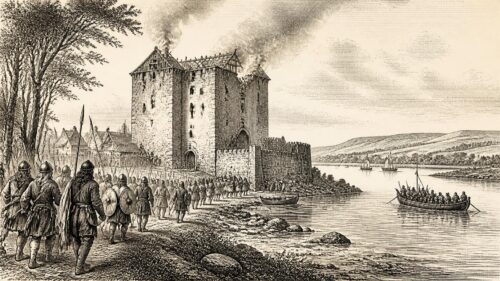
Fermanagh, ruled by the Maguires, suffered an especially destructive succession crisis. The Annals of Ulster give a firm date: on 6 April Gilla Pátraig Mag Uidhir was treacherously killed by five of his brothers at the foot of the altar in the church of Achadh Urchair, now Aghalurcher. The sacrilegious setting was clearly important to the annalist. Two rival Maguires, John son of Philip and Thomas son of Thomas Óg, were then proclaimed, showing that the murder created, rather than settled, a contest for authority.
Violence followed rapidly. On 20 August, according to the annal’s Roman dating, John Maguire carried out a raid against rival kinsmen, killing men, taking prisoners and returning with booty. The language of raid and spoil points to warfare in which livestock, captives and movable wealth were central prizes, and in which attacks on people could weaken a rival lineage’s resources as well as its prestige. On 24 September, the same source dates the defeat at Moin Ladhraighe. Twenty men were said to have been killed and ten captured. Medieval casualty totals should be read cautiously, but the detail conveys how closely chroniclers followed the human cost of a dynastic feud.
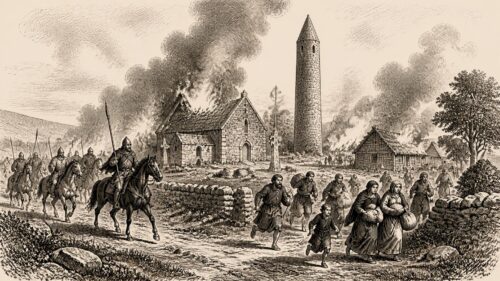
Churches were not detached from these struggles. The killing at Aghalurcher, the later burning of Cúil Maine church after Samhain, and the slaying of six men accused of disrespect towards the church of St Tigernach show ecclesiastical places and claims woven into local politics. At the same time, religious life reached far beyond local lordship: Niall, son of the coarb Mac Mahon, died while travelling home from Rome. His death preserves a small but important trace of the connections linking Irish clerical families to the papal centre.
Captivity, Death and Continuity
Captivity was another common instrument of power. Réamonn Mac Mathghamhna, king of Airgíalla, died at Drogheda after Samhain while in custody. The annals do not explain every circumstance of his confinement, and it would be unsafe to supply a motive. They do, however, place an Ulster ruler’s death in one of the lordship’s principal walled towns, demonstrating the practical links between northern political conflict and the urban centres of the Pale.
Deaths recorded in 1484 also reveal the social texture of the island. Nicholas Weston, bishop of Derry, died; so did clergy associated with Drumlane, including Brian O’Farrelly, who had begun an anchorite’s cell at the Great Church there. Donnell Mac Gorman of Ibrickan was remembered by the Annals of the Four Masters as exceptionally rich in livestock. That notice is not a statistical measure of Ireland’s pastoral economy, but it confirms the status attached to cattle and other animals as stores of wealth in western lordships. The violent death of Murchadh, son of Cathair Ó Conchobair Fhailí, struck by a javelin in Críoch na gCéadach, similarly shows how political competition extended into the Irish midlands.
Thus 1484 was not defined by one national turning point. It was a year in which royal officials in Dublin sought reliable currency and defensible institutions; Galway gained new religious and civic standing; Kildare’s political weight linked Irish government to Richard III’s precarious monarchy; and northern dynasties pursued war and succession through raids, captivity and killing. The surviving record is fragmented, but its fragments make the country’s variety unmistakable.
Source References
Hover over a number to see the source. Select it to open the source.

- [1] The Annals of Ulster: Year U1484
- [2] Annals of the Four Masters, Part 12: Annal M1484
- [3] Annals of Loch Cé, Part 7: Annal LC1484
- [4] Annála Connacht
- [5] Irish Statute Book: 1484 (1 Ric. 3)
- [6] Statute Law Revision Act 2007, Schedule 2
- [7] Statute Rolls of the Irish Parliament
- [8] FitzGerald, Gerald (Gearóid Mór)
- [9] FitzSimons, Walter
- [10] O'Donnell (Ó Domhnaill), Aodh Ruadh
- [11] O'Neill (Ó Néill), Conn
- [12] Fasti Ecclesiae Hibernicae: The Succession of the Prelates and Members of the Cathedral Bodies in Ireland, Volume 2
- [13] Fitzsimons, Walter, Dictionary of National Biography, 1885–1900
- [14] Galway/Gaillimh 19, Irish Historic Towns Atlas
- [15] Galway’s Quincentennial
- [16] St Nicholas’ Collegiate Church
- [17] Tudor Policy and the Kildare Ascendancy in the Lordship of Ireland, 1496–1534
- [18] English Lordship of Ireland and the Irish Sea World: Re-assessing the Origins of the Kildare Ascendancy, c.1390–c.1513
- [19] Richard III and Ireland
- [20] Taking a Long-term View: A Note on Richard III and Dublin
- [21] History of Parliament: Richard III and the Parliament of 1484
Primary Sources
- The Annals of Ulster: Year U1484
- Annals of the Four Masters, Part 12: Annal M1484
- Annals of Loch Cé, Part 7: Annal LC1484
- Annála Connacht
- Irish Statute Book: 1484 (1 Ric. 3)
- Statute Law Revision Act 2007, Schedule 2
- Statute Rolls of the Irish Parliament
- FitzGerald, Gerald (Gearóid Mór)
- FitzSimons, Walter
- O'Donnell (Ó Domhnaill), Aodh Ruadh
- O'Neill (Ó Néill), Conn
- Fasti Ecclesiae Hibernicae: The Succession of the Prelates and Members of the Cathedral Bodies in Ireland, Volume 2
- Fitzsimons, Walter, Dictionary of National Biography, 1885–1900
- Galway/Gaillimh 19, Irish Historic Towns Atlas
- Galway’s Quincentennial
- St Nicholas’ Collegiate Church
- Tudor Policy and the Kildare Ascendancy in the Lordship of Ireland, 1496–1534
- English Lordship of Ireland and the Irish Sea World: Re-assessing the Origins of the Kildare Ascendancy, c.1390–c.1513
- Richard III and Ireland
- Taking a Long-term View: A Note on Richard III and Dublin
- History of Parliament: Richard III and the Parliament of 1484