

Surrey’s Costly Parliament1521 CE
In 1521, Thomas Howard, earl of Surrey, sought to extend Henry VIII’s authority in Ireland, but inadequate money, troops and local support exposed the limits of Dublin government beyond the Pale. A June parliament regulated crop burning, wool exports and jury procedure, yet resisted the burdens of billeting and military finance. Surrey’s campaigns and negotiations in the midlands did not end shifting regional alliances. Annals recorded successions, killings, lordship disputes and ideals of hospitality across Ulster and Fermanagh. George Cromer received Armagh, while William Rokeby died. Surrey’s December recall confirmed that Tudor intervention remained costly, partial and showed dispersed power.
Dateline
In 1521, the English lordship of Ireland was being tested by an expensive attempt to make royal government more active. Thomas Howard, earl of Surrey, Henry VIII’s lord lieutenant, had arrived the previous year with instructions to restore order and to assess how far the king’s authority might be extended. The result was not a conquest of Ireland, nor even a durable strengthening of the Dublin administration. Instead, 1521 exposed the limits of a government whose effective reach remained concentrated in the Pale and whose ambitions outran its money, manpower and local alliances.
The year nevertheless left a clear record. A Dublin parliament met in June; legislation addressed burning crops, the export of wool and failures in jury procedure. Surrey’s correspondence set out the military resources he believed necessary for a much greater intervention. In the north and midlands, meanwhile, annalists recorded changes of lordship, killings and deaths that reveal a political order still rooted in kinship, land, military followings and the practice of hospitality. In October, George Cromer was provided to the archbishopric of Armagh. In November, William Rokeby, archbishop of Dublin and lord chancellor, died in England. These events belonged to different political worlds, but together they show how little Ireland could be governed from any single centre.
A Parliament With Limited Reach
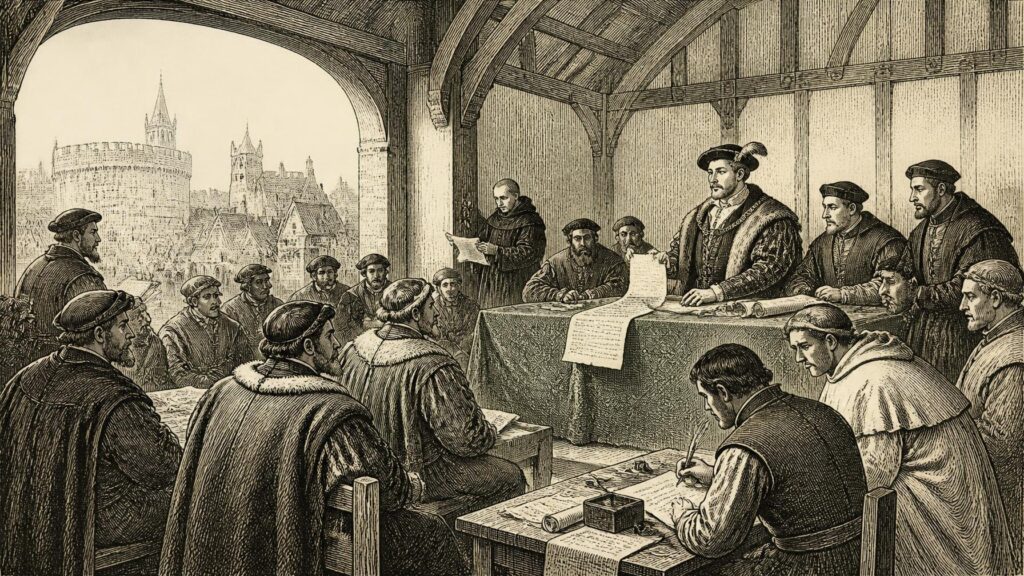
The firmly dated institutional event of the year was the Dublin parliament, which sat for ten days in June 1521. It was then repeatedly prorogued and was not finally dissolved until March 1522. The surviving record is frustratingly thin: the attendance of peers and the representation of boroughs are not securely known. That absence matters. Parliament was a real instrument of lawmaking within the lordship, but it did not speak for the whole island. Its practical constituency lay chiefly among the communities, landholders and officials tied to the Pale and the English-controlled towns.
Even so, the statutes enacted point to immediate concerns. One measure prohibited the burning of corn in ricks, fields, villages and towns. Another prohibited the transporting of wool and wool-flocks out of Ireland. A third addressed the process by which jurors might be challenged or punished for a false verdict. These were not grand constitutional declarations. They were attempts to protect harvest and property, safeguard local supply and employment, and keep the machinery of common-law justice operating. Their language is particularly revealing in the case of wool: the export of raw material was represented as contributing to a shortage of cloth and to idleness. The statute cannot by itself measure the size of Irish textile production, but it demonstrates official anxiety about the connection between rural resources, household work and social order.
The legislation also illustrates a wider contradiction. Surrey needed the cooperation of the landed political community around Dublin, yet his military demands and methods made that cooperation difficult. His government had resorted to billeting and to coign and livery, the compelled provision of food, lodging and other support for soldiers. Such burdens fell heavily on those expected to finance and sustain government. The Pale gentry resisted the lieutenant’s financial programme in the parliament of 1521–22. Thus the assembly that passed measures for order could not provide the dependable revenue that Surrey believed essential to enforce order beyond the Pale.
The Price of Royal Ambition
Surrey’s position in 1521 was shaped by the absence of Gerald FitzGerald, ninth earl of Kildare. Kildare, who had dominated the Dublin administration for decades, remained in England. The lieutenant was meant to govern without him while investigating the condition of the lordship and securing submissions from major Irish rulers. But Henry VIII’s interest in a more forceful Irish policy collided with other commitments, including mounting international and Scottish dangers. Ireland could not command unlimited English resources.
In July, Surrey reported his assessment of what intervention would require. A gradual extension of English authority, he calculated, needed an army of 2,500 men maintained from England; a complete conquest would require 6,000 men and at least a decade. Such estimates were also political arguments, designed to make the crown confront the scale of the undertaking. Yet they rested on a sound appreciation of the problem: spectacular campaigns and individual submissions could not substitute for permanent garrisons, paid troops, dependable supply and a functioning revenue system.
The money available fell far short of that vision. By late summer the Dublin exchequer was said to be habitually empty, while troops required pay, food and quarters. Sickness compounded the problem. Contemporary reporting from the administration described unhealthy conditions among the soldiery; Surrey himself suffered illness during his Irish service. It would be unsafe to turn such evidence into a precise national picture of disease or harvest conditions, but it does establish that the lieutenant’s government was strained by more than politics. Moving armed men, buying provisions and keeping servants alive were daily problems.
Conflict in the midlands reinforced the point. In 1521 Maolruanaidh O’Carroll of Éile was operating amid the competition of the O’Carrolls, O’Mores, O’Connors of Offaly, Kildare’s adherents and Piers Butler’s growing influence. In July, O’Carroll, the O’Mores and the O’Connors raided County Kildare, drawing Surrey into an inconclusive expedition; by mid-October they had again submitted. The sequence should not be mistaken for a simple rebellion-and-pacification story. Raiding, submission, hostage-taking and renewed alliance were normal instruments of regional politics. The crown’s intervention altered calculations, but it did not abolish the local rivalries that made those calculations necessary.
Lordships in the Annals
The Irish annals place these governmental difficulties alongside events in territories where Dublin’s authority was weak, intermittent or irrelevant. Their entries for 1521 are selective rather than comprehensive, and their emphases reflect the interests of learned writers and the communities they served. Nevertheless, they provide unusually vivid evidence of what contemporaries regarded as consequential: succession, kinship, killing, religious standing, wealth and hospitality.
In Monaghan, Redmond Mac Mahon died about Easter and his son Glasney Óg was made Mac Mahon. In the same broad northern region, Thomas O’Kane died after having earlier been captured and deprived of his lordship by Donough O’Kane. These notices show that leadership was not merely inherited automatically. A successor needed recognition, while rival members of a dynasty could take authority through force. The Annals of Ulster also record the deaths of two Magennis chiefs during the year and the elevation of Edmund Magennis, known as ‘the Tawny’, after the death of Feidhlimid Magennis around the feast of the Holy Cross.
Fermanagh and its neighbouring territories saw more violence. Donough Maguire, son of Rory Maguire, was killed by members of the Magauran family. The annalist’s praise of him as a man of exceptional hospitality is not ornamental detail. In Gaelic lordship, generous maintenance of retainers, guests, clerics, poets and dependants was a public measure of rank and legitimacy, supported by control of land and resources. The death of Gráinne, daughter of Thomas O’Hagan and mother of Cú Chonnacht Maguire, was likewise marked with praise for wealth, bounty and hospitality. Such descriptions bring women into view not simply as relatives of male rulers but as important managers and patrons within elite households.
Other notices hint at the connections between frontier politics and the lordship. Rory, son of Eigneachán O’Donnell, was killed at Dundalk by ‘the English’ while in the company of Con O’Neill. The annal gives no full narrative of the encounter, and it would be wrong to supply one. Yet the location is significant. Dundalk lay near the northern edge of the Pale’s political world, where Irish chiefs, town authorities and royal forces could meet in negotiation, alliance or violence. In Delvin, the lordship was divided between Ferdoragh, son of Fineen Roe Mac Coghlan, and his kinsman Cormac, through the intervention of Turlough O’Melaghlin and Mulrony O’Carroll. Here again authority emerged from settlement among powerful neighbours rather than from a uniform rule of succession.
Church Offices and Local Piety
Religion in 1521 was neither a separate sphere nor yet a Henrician reformation in Ireland. Henry VIII had published his defence of the seven sacraments that year and remained, formally, a papally loyal Catholic monarch. The major changes in royal religious policy still lay ahead. Irish ecclesiastical institutions, however, were already deeply entangled with politics, patronage and regional division.
On 2 October 1521, George Cromer was provided to the archbishopric of Armagh and the primacy of Ireland on the king’s recommendation. This was a significant appointment, though it should not be overstated as an immediate transformation on the ground: Cromer did not arrive in Ireland until before November 1523. Armagh’s province crossed a sharp political frontier. Its southern parishes included part of the anglicised Pale, while its cathedral and northern districts lay within the orbit of Tyrone. The appointment therefore linked the English crown, the papacy and an Irish ecclesiastical province whose practical administration required accommodation with both English and Gaelic elites.
On 29 November, William Rokeby died in Yorkshire. As archbishop of Dublin and lord chancellor of Ireland, he had joined senior church office to the central legal and political machinery of the lordship. His death removed an experienced figure at a moment when Surrey’s own tenure was nearing its end. The annals, meanwhile, record the death of Redmond, prior of Devenish, describing him as a humane and charitable cleric. Taken together, these notices show a church ranging from the administrative world of Dublin and royal service to religious houses embedded in local society around Lough Erne.
An Unfinished Intervention
Surrey was recalled to England in December 1521, leaving Piers Butler as his deputy. The recall was a judgement on costs as much as on ability. Surrey had demonstrated energy, negotiated with leading rulers and convened parliament, but he had also shown that sustained expansion of royal power would demand resources Henry VIII was unwilling to commit. His departure helped open a period in which Butler and Kildare would struggle for predominance in Irish government.
For Ireland, 1521 was consequently not a year of decisive national change but of revealing pressures. In Dublin, a parliament tried to regulate crops, wool and justice while failing to resolve the fiscal weakness of government. In the midlands, raiding and submission continued to reorder alliances. In Ulster and Fermanagh, succession, feud and patronage shaped political life. In Armagh and Dublin, ecclesiastical appointments and deaths affected the institutions through which authority was exercised. The year’s surviving evidence is fragmentary, but its message is consistent: Tudor intervention was real, yet Ireland remained a country of many centres of power.
Primary Sources
- Annals of the Four Masters: Annal M1521
- Annals of the Four Masters (Irish edition)
- CELT: Annals of the Four Masters
- The Annals of Ulster: Year U1521
- Annals of Ulster otherwise Annala Senait, Annals of Senat
- The Annals of Ulster
- Howard, Thomas
- Butler, Piers (‘Piers Ruadh’)
- O'Carroll (Ó Cearbhaill), Maolruanaidh
- Cromer, George
- Rokeby, William
- FitzGerald, Gerald (Gearóid Óg, Garrett McAlison)
- Mág Uidhir (Maguire), Cú Chonnacht Óg (‘an Comharba’)
- Darcy, Sir William
- State Papers Ireland 1509–1782: government papers on Irish affairs
- Calendar of the State Papers relating to Ireland, of the reigns of Henry VIII, Edward VI, Mary, and Elizabeth
- State Papers: King Henry the Eighth, Part III, Volume 2
- State Papers: Correspondence between the Governments of England and Ireland
- The Reemergence of English Policy as a Major Factor in Irish Affairs, 1520–34
- Ireland under the Tudors, Volume I
- History of the Commercial and Financial Relations between England and Ireland from the Period of the Restoration