

Carew’s Ulster Perambulation1611 CE
In 1611, Lord Carew’s tour of Ulster assessed the early Plantation, exposing uneven construction and the gulf between Crown plans and local realities. Commissioners inspected routes, settlements and estates, while Coleraine and Derry mobilised labour, timber and fortifications; Dunluce also attracted Scottish settlers. Plantation redistributed land, subordinating Irish proprietors through patents and conditional grants, yet native communities remained central to tenancy and labour. Religious tensions appeared in Bishop John Lynch’s conversion, Patrick O’Loughran’s arrest, and an Irish Catholic devotional book printed at Antwerp. Elsewhere, surrender-and-regrant extended Crown law, while preparations for Parliament revealed disputes over consultation, legislation and royal authority.
Dateline
In 1611, Ireland was not at war in the manner it had been during the Nine Years’ War, but the peace was being rebuilt on uncompromising new terms. The most consequential development of the year was an official inspection of the Plantation of Ulster, the great Crown-directed redistribution and settlement scheme begun after the Flight of the Earls in 1607. Lord Carew’s journey through the province turned an abstract programme of surveys, patents and conditions into a close view of roads, timber, labour, fortified houses and vulnerable communities. It also exposed the distance between the government’s designs and what had actually been built.
A Royal Inspection
George Carew, Lord Carew of Clopton, was commissioned in June to investigate Irish government and, especially, the progress of the Ulster Plantation. He arrived in Dublin on 11 July. The surviving state-paper calendar dates the commissioners’ formal Ulster circuit from 29 July; Carew and his colleagues travelled north by way of Newry, Carrickfergus and Dunluce, reached Derry on 14 August, and then moved through Donegal, Fermanagh, Tyrone and Armagh. They were back in Dublin early in September, although Carew’s wider Irish business continued into October.
The inspection was part audit, part intelligence-gathering and part warning. James I’s government had taken extensive lands into Crown hands after the collapse of the old Ulster lordships. The scheme was intended to establish loyal English and Scottish landholders, concentrate settlers in defensible places, build market towns and churches, introduce English common law and make the province more governable and profitable. Its stated assumptions were stark: security would be produced by changing landholding, settlement and political allegiance together.
Carew’s route mattered. It linked the eastern ports and garrison centres to the north-western coast and the interior valleys where land was being divided into ‘proportions’ for undertakers, servitors, church interests and selected Irish grantees. Yet this was no leisurely statistical survey. Cavan was missed altogether, and not every estate was visited. Much information came from governors, sheriffs and other local officials. The report is therefore exceptionally valuable evidence of official priorities in 1611, but its claims about buildings and people need to be read as hurried administrative testimony rather than a complete census.
Building a Settler Landscape
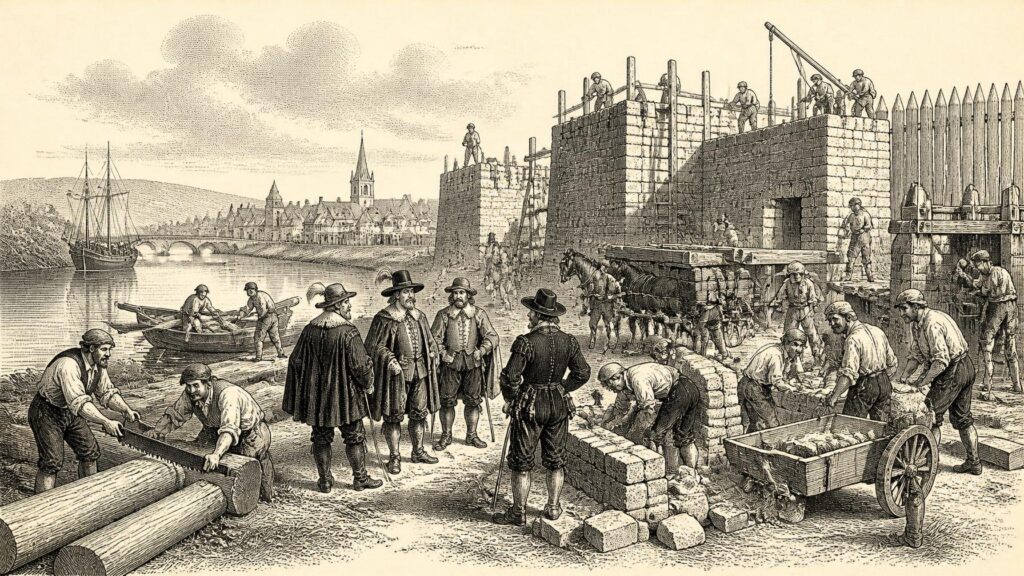
The most visible promise of the Plantation lay in construction. New houses, bawns, timber defences, churches, bridges and planned streets were supposed to make a formerly contested province legible to the state and habitable for migrants. At Coleraine, the 1611 return recorded a remarkably varied workforce: carpenters and sawyers, wheelwrights, bricklayers, masons, slaters, lime-burners, quarrymen, carters, boatmen and labourers working on fortifications. It also listed men felling, squaring and floating timber from the woods. Such detail shows that colonial settlement was not merely a transfer of title on parchment: it consumed woodland, quarry stone, river transport, specialised skills and large quantities of manual labour.
Coleraine and Derry were central to this project because they joined fortification to trade. The London livery companies had accepted major responsibilities in the north-west, with the expectation that investment in buildings, settlement and ports would create towns capable of sustaining themselves. The Crown’s planners wanted a network of concentrated, walled or defensible settlements rather than isolated gentlemen’s houses. In practice, work advanced unevenly. The record of busy building at Coleraine should not be mistaken for a finished town, still less for a settled countryside.
Outside the formal plantation counties, change was also visible. At Dunluce, Randal MacDonnell was reported in 1611 to have founded a village beside his castle, with many tenements in the style of the Pale and inhabitants predominantly Scots. This was not simply the Crown’s official scheme reproduced in miniature. It illustrates how powerful local figures used migration, estate management and settlement-building for their own purposes, while operating within a political environment transformed by royal power.
Land, Labour and Dispossession
The language of ‘plantation’ can conceal the fact that Ulster was already inhabited, cultivated and organised through dense local ties. Families did not disappear when patents were issued. The practical question in 1611 was who would hold land securely, who would pay rent, who could remain near their homes, and who would command labour and arms. Undertakers were normally expected to bring British tenants and to build defensible residences; the Crown feared that landlords who relied on the existing population might reproduce the dependencies it wished to break.
Reality was more complicated than a simple replacement of one population by another. The government made some provision for native Irish landholders and sought to draw them into a new system of tenure. In April 1611, for example, Feidhlimidh Mág Samhradháin received a grant covering lands associated with his family in the Templeport district of County Cavan. The grant was conditional upon building, and reflected the Crown’s wish to turn a Gaelic lord into a patent-holding proprietor subject to its rules. Such arrangements preserved limited local status, but only within a framework in which the Crown defined title, obligation and acceptable forms of residence.
For ordinary people, the transition was likely to be experienced through rent demands, movement between estates, access to pasture and woods, seasonal work on construction, and the arrival of strangers speaking Scots or English. The official aspiration to segregate British and Irish tenants was not consistently realised. Later investigations repeatedly found Irish tenants on plantation lands and undertakers who had not met their building or settlement obligations. That later evidence should not be projected mechanically back onto 1611, but Carew’s hurried inspection already marks the beginning of a continuing official anxiety: was the Plantation producing the controlled, Protestant and militarily reliable landscape imagined in London and Dublin?
Churches Under Pressure
Religion gave the year two sharply contrasting episodes. On 19 August John Lynch resigned as Church of Ireland bishop of Elphin, declaring himself a Roman Catholic. Edward King, an English cleric, had been nominated for the see in July and was consecrated in December. The succession was a small event beside the remaking of Ulster, yet it demonstrates a wider difficulty for the established church: formal diocesan structures did not ensure confessional conformity among clergy or lay people.
In June, Patrick O’Loughran landed at Cork after travelling from Rome and was arrested. He had links with Hugh O’Neill’s exiled household and came from an erenagh family long connected with the O’Neill lordship. His imprisonment during the remainder of 1611 is firmly dated; his trial and execution with Conor O’Devany occurred only in February 1612 and should not be folded into this year. Nevertheless, the arrest itself reveals how the Dublin administration treated overseas-trained Catholic clergy and connections with the exiled Gaelic leadership as matters of political as well as religious concern.
At the same time, Irish Catholic learning was finding a durable form beyond Ireland. Giolla Brighde Ó hEodhusa, the Franciscan Bonaventure O’Hussey, published An Teagasc Críostaidhe at Antwerp in 1611. It is generally regarded as the first printed Catholic devotional work in Irish and was rooted in Tridentine teaching. Its appearance abroad is itself significant: continental Irish colleges and religious houses supplied books, education and personnel to a Catholic community whose public position at home was precarious. Print allowed instruction in Irish to circulate across borders, connecting Ireland with Antwerp, Louvain, Rome and the wider Irish diaspora.
Law and Political Expectation
Government in 1611 was also preoccupied with law. On 18 February Sir Humphrey Winch, leaving office as Lord Chief Justice of Ireland, was sent to London with draft legislation. On 7 May, authority was given for surrender-and-regrant arrangements in Carlow, Wexford and Wicklow. These recorded acts belong to a broader Jacobean drive to convert layered and customary claims into titles recognised by Crown law. They indicate that the methods associated most dramatically with Ulster—investigation, legal surrender, patent and regrant—were relevant far beyond the north.
By the autumn, political expectations were tightening. A contemporary account of the Parliament soon called for 1613 states that around Michaelmas 1611 the king signified that a Parliament should be held to settle and reform Ireland, while new corporations were proposed to encourage plantation and population in strategically weak places. On 25 November, Ireland’s nobility and gentry asserted a right to see proposed bills in advance. The request anticipated a fundamental tension: the Crown viewed Parliament as an instrument for legal consolidation, while leading subjects expected consultation and a meaningful role in legislation.
Carew’s perambulation therefore captures Ireland at a threshold. There was no single dramatic battle in 1611. Instead, there were roads being travelled by commissioners, trees being cut for towns, churches contested in allegiance, a priest imprisoned after returning from Europe, an Irish devotional book printed overseas, and political elites asking how law would be made. The Plantation was neither complete nor uncontested. But in this year its physical, social and cultural consequences became harder to ignore.
Primary Sources
- Calendar of the State Papers Relating to Ireland of the Reign of James I, 1611–1614
- Calendar of the Carew Manuscripts, Preserved in the Archiepiscopal Library at Lambeth
- Plantation Sources
- Plantations in Ulster, 1600–41
- The Irish and the Plantation
- The Plantation in Omagh Barony
- The Plantation of Ulster
- The Plantation of Ulster, 1609
- The Plantation of Ulster: A Brief Overview
- Plantations in Early Modern Ireland
- Project of Plantation Booklet
- The Commonwealth of Ireland
- Brief Relation of the Passages in the Parliament Summoned in Ireland in 1613
- O'Loughran, Patrick
- Ó hEodhusa, Giolla Brighde
- An Teagasc Críostaighe
- The Irish Franciscan Contribution to Irish Book Production and the Culture of Books in the Seventeenth Century
- Vaughan, Sir John
- Proposition for the Increase of His Majesty's Revenue in Ireland, with the Attorney-General's Opinion How the Same May Be Put in Execution
- Letter from Sir A. Ingram to Lord Carew, Concerning the Customs of Ireland, 1611
- CIRCLE: A Calendar of Chancery Letters
- A Guide to the Records Deposited in the Public Record Office of Ireland