

Mellifont and the Towns1603 CE
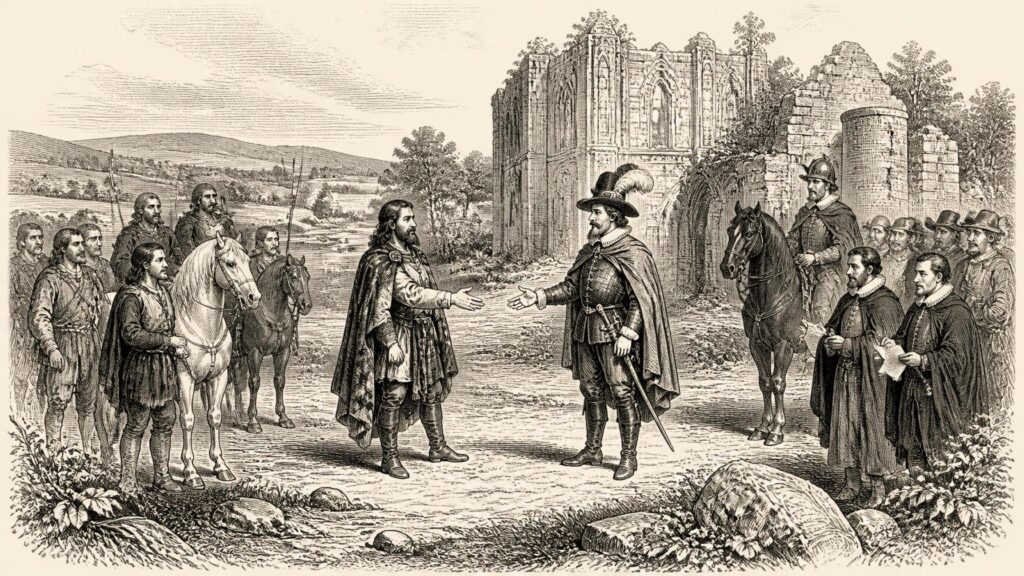
In 1603, Hugh O’Neill’s submission at Mellifont formally ended the Nine Years’ War, as James I succeeded Elizabeth I. O’Neill retained lands and title but surrendered key Gaelic powers, while Ulster faced recovery from severe military devastation and local rivalries. Southern and western Catholic towns, expecting religious toleration, resisted Protestant worship and delayed James’s proclamation; Crown forces compelled their submission without renewed general war. Royal patents in Ulster strengthened selected local lords directly under the Crown, weakening traditional overlordship. Trinity College’s expanding library reflected developing Protestant institutions. Peace ended major warfare but left land, religion, authority and political allegiance unresolved.
Dateline
In 1603, Ireland passed abruptly from exhausting war into an uncertain peace. The submission of Hugh O’Neill, earl of Tyrone, at Mellifont in County Louth brought the Nine Years’ War to its formal close, while the death of Elizabeth I and accession of James VI of Scotland as James I joined Ireland more closely to a monarchy now ruling England, Scotland and Ireland. Yet peace did not mean settlement. Ulster had been devastated, the authority of Gaelic lordship was being converted into Crown-recognised title, and Catholic towns in the south and west tested whether a new king might permit a different religious order. The year was therefore a hinge: the Tudor military conquest was completed, but the political and confessional consequences were only beginning.
Submission at Mellifont
On 30 March, Hugh O’Neill submitted to Lord Deputy Charles Blount, Lord Mountjoy, at Mellifont Abbey. The meeting is conventionally treated as the end of the Nine Years’ War, the long conflict in which O’Neill, Hugh Roe O’Donnell and their allies had contested the extension of English royal power across Ireland. It was not simply an abject capitulation. Mountjoy negotiated because continued war was expensive and hazardous, while O’Neill still possessed considerable standing among the people and lesser lords of Ulster. The settlement gave the earl a pardon and restored him to a substantial landed position, but only on terms that struck at the foundations of his Gaelic authority. He abandoned the title ‘The O’Neill’, renounced foreign alliances and surrendered his traditional superiority over dependent lesser lordships, the uirríthe.
The timing was extraordinary. Elizabeth I had died in England on 24 March, six days before the agreement, although Mountjoy did not disclose that fact during the negotiations. The secrecy was politically useful: it removed the possibility that O’Neill might postpone submission while awaiting directions from the incoming monarch. It also showed the practical continuity of government in a composite monarchy. The Crown had changed, but Mountjoy’s army, officials and authority in Ireland remained in place. James’s succession did not reopen the war; rather, it allowed the victors to present a negotiated ending as the first act of a new reign.
The concessions at Mellifont deserve emphasis because later developments can make them appear illusory from the outset. In 1603, the government did not confiscate Tyrone wholesale or immediately launch the great official plantation later associated with Ulster. It chose, at least for the moment, to retain powerful Irish and Gaelic magnates within a Crown framework. O’Neill’s earldom and much of his estate survived; Ruaidhrí O’Donnell, who had succeeded his brother Hugh Roe in Tír Chonaill, was likewise drawn into a settlement based on noble title and royal favour. The agreement was an attempt to make former enemies into landed subjects rather than to replace them at once.
A Country Scarred by War
That policy had to operate in a country badly damaged by the final campaigns. Mountjoy’s strategy in Ulster had relied on garrisons, raids and the systematic destruction of food supplies. In 1602 his forces penetrated Tyrone, seized Dungannon and destroyed the inauguration stone at Tullaghoge, a potent emblem of O’Neill rule. The human cost was grave. Contemporary claims about the scale of hunger must be treated cautiously, but there is no doubt that civilians, livestock, crops and settlements had suffered severely. O’Neill later asserted that famine had killed vast numbers; his figure cannot be accepted uncritically, yet it accords with the wider evidence for acute deprivation in the war’s closing phase.
For ordinary people, the peace therefore meant more than a change of allegiance. Dispersed tenants had to return, fields had to be cultivated again, and cattle stocks rebuilt. O’Neill himself later sought to keep or attract back agricultural tenants, described in English sources as ‘churls’, because lordship and revenue depended upon recovering a working rural population. This was not a recovery achieved in a single season. But 1603 ended the cycle in which food, labour and homes were repeatedly consumed by military movement and deliberate devastation.
Military resistance did not disappear everywhere at the instant of O’Neill’s submission. In the north-west, rivalry within the O’Donnell kindred remained dangerous. Niall Garbh O’Donnell, a Crown ally and rival of Ruaidhrí, proclaimed himself O’Donnell after news arrived of Hugh Roe’s death in Spain; Mountjoy moved against him, and Ruaidhrí and Crown forces pursued his supporters. Such episodes reveal that the end of confederate war did not settle local claims to land, cattle and leadership. The Crown could exploit those divisions, but it also inherited them.
James Proclaimed
Official confirmation of Elizabeth’s death reached Dublin on 5 April. The records of the new reign state that Mountjoy promptly ordered James to be proclaimed king of England, Scotland, France and Ireland. That ceremony mattered in a kingdom where royal government had recently been imposed by force over wide areas. It made public the principle that Ireland had a lawful monarch without a contested interregnum, and that James’s rule extended across the island.
James’s accession also brought new expectations. His Scottish background, his Catholic mother Mary Stuart, and rumours of greater toleration encouraged hope among many Irish Catholics that the religious rigours of Elizabeth’s later reign might be relaxed. Those expectations were not confined to Gaelic Ulster. They were especially strong among Old English merchant and governing families in the chartered towns of Munster and the south-east: communities long integrated into English law and trade, but overwhelmingly Catholic in religious attachment.
Civic Catholicism in the South
During April and May, that hope became a remarkable urban movement later called the recusancy revolt. In towns including Waterford, Cork, Limerick and Cashel, Catholic worship was openly reasserted and churches or civic spaces were reclaimed for it. Local corporations delayed or resisted the proclamation of James, often presenting their actions not as rebellion against monarchy but as a defence of ancient corporate liberties, Catholic worship and the town community. Waterford and Cork communicated with one another as they weighed the news and their response. The movement combined elite action with wider popular participation, making it more than a private refusal to attend Protestant services.
Cork showed both the intensity and the limits of the crisis. Sir Charles Wilmot, commanding Crown troops in Munster, arrived outside the city in April. The mayor refused to admit royal soldiers and complained of a fort outside the walls. On 28 April, some 800 townsmen attacked the fort, occupying and damaging part of it before being driven back; musket and artillery fire followed. Wilmot ordered the city shelled on 4 May. Mountjoy arrived with a larger force on 10 May, and Cork surrendered. The government used armed pressure, but it did not turn the town into another battlefield of the Nine Years’ War.
Elsewhere, Mountjoy’s progress through the region brought submissions, oaths of allegiance and the restoration of churches to Protestant use. Waterford’s citizens and clergy made professions of loyalty while seeking room for their faith. The contrast is important. Many participants were not advocating a simple transfer of Ireland to Spain, although some more radical voices invoked a Spanish alternative. Most civic leaders insisted that loyalty to the king and adherence to Catholicism could coexist. The Crown’s refusal to accept that proposition as a basis for public worship exposed a central fault-line of the new reign.
Patents, Boundaries and New Dependencies
The post-war settlement also began to redraw the political map by selective royal grants. These were not yet a comprehensive plantation scheme, but they diminished the scope of older overlordship. On 4 September, Cahir O’Doherty received a patent for Inishowen, separating his lordship from the estate granted to Ruaidhrí O’Donnell in Tír Chonaill. On 16 September, James granted the Fews to Sir Turlough MacHenry O’Neill and his heirs, confirming that this territory was no longer subject to Tyrone. In east Ulster, Randal MacDonnell received a royal patent in May for the Route and the Glens. Each grant made a local power-holder more directly dependent upon the king and less dependent upon a superior Gaelic lord.
These arrangements help explain why 1603 should not be reduced to a single surrender at Mellifont. The Crown’s victory rested not only on troops but on patents, rival claims, boroughs, sheriffs, courts and the ability to make one Irish magnate’s security conditional on royal favour. That process could offer protection and legal recognition, but it also transformed relationships that had previously been organised through kinship, customary obligation and layered lordship.
Learning After Conquest
Even amid these upheavals, institutional life continued. At Trinity College Dublin, the young scholar and clergyman James Ussher made a book-buying journey to England in 1603, one of the expeditions through which he began building the college’s library. It was a small event beside Mellifont or Cork, but it points to another Ireland taking shape: a Protestant educational institution in Dublin connected to English scholarly networks, intended to serve a reformed church and an increasingly centralised state.
By the end of the year, James I ruled an Ireland no longer divided by a major open war against the Crown. That achievement was real, and it was profound. But it had been won through destruction, negotiation and the manipulation of local rivalries. In Ulster, restored earls and newly favoured neighbours faced an unsettled coexistence. In the towns, public Catholic worship had briefly tested the promises people attached to a new monarch. The peace of 1603 ended one conflict; it did not resolve the contest over land, religion and political belonging that conquest had intensified.
Primary Sources
- Calendar of the State Papers, Relating to Ireland, of the Reign of James I, 1603–1625
- Annals of the Four Masters
- O'Neill, Hugh | Dictionary of Irish Biography
- Blount, Charles Brooke | Dictionary of Irish Biography
- O'Neill, Sir Toirdhealbhach | Dictionary of Irish Biography
- O'Donnell, Sir Niall Garvach | Dictionary of Irish Biography
- MacDonnell, Sir Randal mac Sorley | Dictionary of Irish Biography
- O'Doherty (Ó Dochartaigh), Cahir | Dictionary of Irish Biography
- Wilmot, Sir Charles | Dictionary of Irish Biography
- Ussher, James | Dictionary of Irish Biography
- Oviedo, Mateo (Matthew) | Dictionary of Irish Biography
- The ‘Recusancy Revolt’ of 1603 Revisited, Popular Politics, and Civic Catholicism in Early Modern Ireland
- The ‘Recusancy Revolt’ of 1603 Revisited, Popular Politics, and Civic Catholicism in Early Modern Ireland (repository PDF)
- Statute Law Revision Act 2015, Schedule 2
- Chapters towards a History of Ireland in the Reign of Elizabeth
- The Cambridge History of Ireland: Chronology
- Plantations in Early Modern Ireland
- Gaelic Lordship and Tudor Conquest: Tír Eoghain, 1541–1603
- After the Flight: the Plantation of Ulster
- France and the Fall-out from the Nine Years' War in Ireland, 1603–1610
- Hugh O'Neill & Faith and Fatherland