

Pynnar’s Winter Commission1618 CE
In 1618, Stuart government in Ireland used municipal law, land policy and inspection to reinforce royal authority, Protestant conformity and plantation. Waterford lost its charter after electing recusant civic officers, demonstrating that corporate liberties depended upon religious obedience. Commissioners examined plantation schemes in Longford and O’Carroll country, while an October order required native Irish occupiers to leave assigned Ulster plantation lands by May 1619. In November Captain Nicholas Pynnar was commissioned to inspect settlement, fortifications, tenants and arms in Ulster’s escheated counties. Aodh Mac Cathmhaoil’s Irish-language Catholic book, published at Louvain, and Richard Stanihurst’s death in Brussels highlighted Catholic connections.
Dateline
In 1618 the most consequential developments in Ireland did not take the form of a great battle or a meeting of parliament. They appeared instead in charters, orders, land surveys and a book printed far from Ireland. Together, these things reveal a kingdom in which the Stuart administration sought to make political obedience, Protestant conformity and secure landholding mutually reinforcing. The pressure was felt sharply in the old Catholic port of Waterford and, above all, in Ulster, where the Crown’s plantation was being tested against conditions on the ground.
James I was king of England, Scotland and Ireland, while Sir Oliver St John, Viscount Grandison, served as lord deputy in Dublin. His government inherited the work of the recent conquest: extending royal law, reorganising property and constructing a Protestant political order in a country where most inhabitants remained Catholic. By 1618, the official Plantation of Ulster was no longer a paper scheme. Settlers, landlords, soldiers, clergy, Irish tenants and displaced families were all living with its consequences. Yet the Crown still doubted whether its ambitious settlement was sufficiently populated, fortified or loyal.
Waterford’s Lost Charter
A firmly dated early event came in Waterford. On 23 January, the city’s charter was revoked after its citizens had repeatedly chosen recusants as civic officers. A recusant was a person who refused the religious conformity required by the established Church of Ireland, most often because he remained a Roman Catholic. Waterford was not merely a local corporation: it was one of Ireland’s principal ports, with a long tradition of municipal privilege, merchant government and overseas commerce. To remove its charter was therefore to challenge a corporate community that possessed both wealth and a strong civic identity.
The dispute had developed over years rather than suddenly in 1618. Waterford’s rulers had resisted the oath of supremacy and the admission of officeholders acceptable to the Crown. The forfeiture showed how religious policy could be enforced through municipal law. A charter gave a town authority to elect officers, hold courts, regulate markets and manage corporate property. Its loss placed those powers in jeopardy and made civic self-government conditional upon obedience to the king’s religious settlement. The measure was not the suppression of Catholic life in Waterford; the city remained overwhelmingly Catholic in culture and population. But it was a pointed demonstration that confessional dissent could bring constitutional punishment.
The episode also exposes a limit in the reach of Dublin Castle. A government could obtain a legal forfeiture, but it could not easily replace the local networks of merchants, guildsmen, officeholders and kin through which an old port functioned. Waterford’s charter would eventually be restored under Charles I in 1626. That later restoration should not soften the meaning of 1618. For the people then living through it, the loss of the charter made clear that the Crown could interrupt ancient liberties when civic election and religious conformity collided.
Land Policy Beyond Ulster
Plantation was not confined to the northern province. In July 1618, the lord deputy and commissioners for wards produced a report for the king concerning the plantation of County Longford and O’Carroll country. Its survival is a reminder that the government’s attention to land titles, surveys and planned settlement extended across the island. The policy rested upon a powerful assumption: territories considered inadequately documented, forfeited, escheated or otherwise vulnerable in law might be reorganised under Crown authority and granted on new terms.
Such proceedings affected everyday security as much as high politics. Land was the foundation of status, subsistence, rents and local influence. To establish a title or to fail to establish one could determine whether a family kept an inherited holding, became a tenant, moved elsewhere, or entered a new relationship with a landlord. The documentary record of 1618 should not be mistaken for evidence that all inhabitants were simply swept aside. Arrangements varied between regions and estates, and some Irish landholders received grants or leases. Nevertheless, inquiries into title and plantation altered the balance of power decisively in favour of the Crown, its officials and those able to obtain patents.
An Order to Leave
The hardest edge of policy appeared in Ulster. On 1 October, native Irish people were ordered to leave lands assigned within the British Plantation of Ulster by 1 May 1619, on pain of fines. The order belongs securely to 1618, though its deadline lay in the following year. It must be understood within the plantation’s official design. Following the Flight of the Earls and the subsequent confiscations, six counties—Armagh, Cavan, Donegal, Fermanagh, Tyrone and the new County Londonderry—were divided among English and Scottish undertakers, servitors, the established church, native grantees and the London companies.
Undertakers received estates on conditions. They were expected to bring in British tenants, build defensible houses and bawns, establish villages and exclude Irish tenants from specified proportions. In practice, profit, labour needs and local realities complicated those rules. Irish people had agricultural knowledge, livestock and local connections; landlords could find their rents useful, even where the official scheme wished to substitute a settler population. The October order was thus not only an act of displacement. It was also an admission that the social landscape of plantation did not yet match the Crown’s intended map.
For Irish families, the command carried a threat far beyond a monetary penalty. Removal from a holding could break access to pasture, tillage, neighbours, customary arrangements and protection. For incoming English and Scottish tenants, it advertised the state’s determination to create room for a new settler society, while also signalling that their security depended on forts, arms and official favour. The directive did not eradicate the Irish population of Ulster, nor did it make the province uniformly British or Protestant. Rather, it sharpened the divisions built into the plantation: between proprietor and tenant, newcomer and long-established inhabitant, official rule and practical necessity.
Pynnar Takes the Road
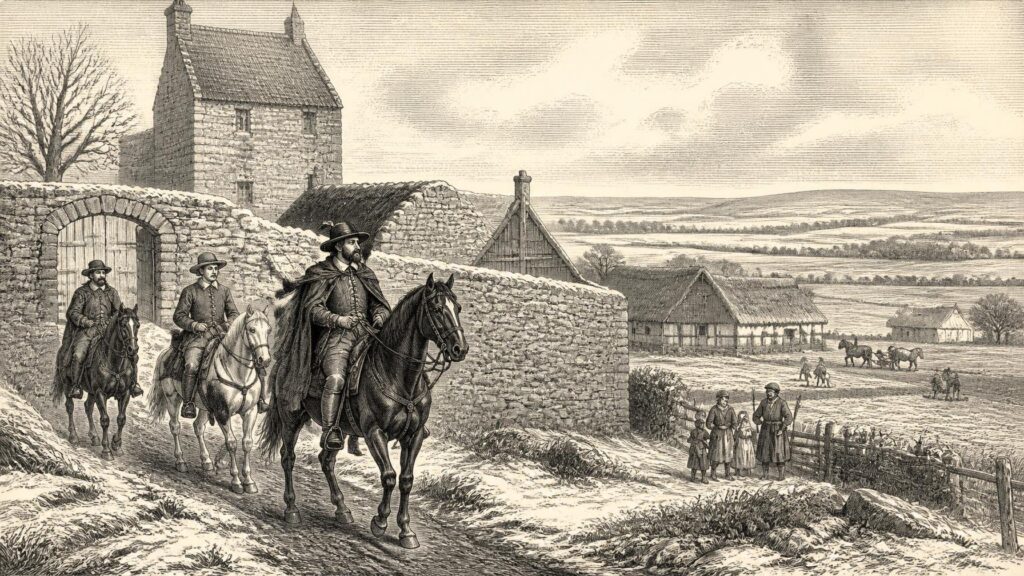
Late in the year the Crown moved from instruction to inspection. Captain Nicholas Pynnar received a commission on 28 November to survey the plantation in the escheated counties. His investigation began on 1 December and continued into 1619, ending on 28 March. This distinction matters. The commission and the opening of the survey belong to 1618; many of the detailed findings for which Pynnar is famous were recorded during the winter journey and reported after the new year.
Pynnar was well suited to the task. An experienced official associated with fortifications and surveying, he was to inspect the material evidence of settlement: castles, stone houses, bawns, villages, mills, churches, tenants, arms and the presence of Irish occupiers. The enquiry was not a neutral census. It measured estates against the Crown’s contractual and military expectations. A substantial house could count as improvement, but a plantation was meant to be more than a landlord’s residence. It was supposed to contain resident British households capable of farming, defending themselves and supporting a new political order.
That purpose helps explain the prominence of walls and weapons in Pynnar’s later descriptions. A bawn—an enclosing defensive wall or court around a house—was both a practical refuge and a visible declaration that a new estate had been planted under royal protection. Yet military architecture alone could not create a settled countryside. The inspection sought people as well as masonry: families in houses, labour in fields, ministers, schools, mills and the means to turn land into dependable income.
The journey beginning in December therefore offers a rare point at which the plantation can be seen as an unfinished process rather than a later historical outcome. Some proprietors had made striking investments; others had delayed, economised or adapted the rules to local circumstances. The survey’s mixed picture should not be projected wholly backwards onto the first day of December, but the decision to commission it shows official anxiety in 1618. The Crown required proof that its great northern experiment was taking root.
Faith in Print
Political pressure on Catholics coexisted with a resilient and international Catholic intellectual culture. In 1618 the Franciscan Aodh Mac Cathmhaoil, also known as Hugh MacCaghwell or Hugo Cavellus, published Scáthán Shacramuinte na hAithridhe, ‘Mirror of the Sacrament of Penance’, at Louvain. Written in Irish for lay readers, it explained the Tridentine teaching on confession, penance and indulgences with particular attention to Irish circumstances.
The place of publication is crucial. Louvain was a major continental centre for Irish Catholic clergy, scholarship and printing, connected to Ireland by students, religious orders, manuscripts and books. The appearance of a substantial Irish-language devotional work there demonstrates that the language of the majority was also a language of learned theology and disciplined religious instruction. Irish Catholic life was not simply private survival beneath an official Protestant establishment; it was sustained by transnational institutions capable of producing sophisticated vernacular literature.
Mac Cathmhaoil’s book also complicates any simple picture of political separation. It upheld Catholic doctrine while acknowledging James I as legitimate king. That position reflected the difficult calculations open to Irish Catholics: fidelity to Rome and the Catholic sacraments did not automatically mean rebellion against the Crown. In a year when Waterford’s civic leaders were punished for recusancy, the book offered readers a religious vocabulary through which Catholic practice, repentance and loyalty could be considered together.
An Irish Life Abroad
Another death in 1618 belonged to this wider European world. Richard Stanihurst, the Dublin-born historian, translator and controversial writer, died in Brussels. His career had carried him from the political and literary world of sixteenth-century Dublin to the Spanish Netherlands, where he served in Habsburg circles and continued to write. His death did not constitute a turning point in government, but it marks the passing of a figure formed by the upheavals that preceded the Stuart settlement.
Stanihurst’s life and Mac Cathmhaoil’s publication illuminate an important condition of the year: Irish history was being made not only in Dublin, Waterford and Ulster, but also in the Catholic cities of continental Europe. Exile, education, print and patronage linked Ireland to Louvain and Brussels even as the Crown sought more exact control over towns and territories at home.
Thus 1618 was a year of administrative pressure and quiet but consequential beginnings. Waterford lost the legal protection of its charter; Irish occupiers in plantation Ulster faced an order to depart; and Pynnar set out to inspect whether the new northern order existed in fact as well as on paper. Against those instruments of government stood the persistence of local civic society, Irish landholding, Catholic devotion and an Irish-language print culture sustained across the sea. The year’s documents record no settled resolution. They show instead a kingdom being measured, disciplined and remade—unevenly, and with consequences that would endure.
Primary Sources
- A New History of Ireland, Volume VIII: A Chronology of Irish History
- Calendar of the State Papers Relating to Ireland of the Reign of James I, 1603–1625
- Nicholas Pynner: Survey of the Counties of Cavan, Fermanagh, Donegall, Tyrone, Armagh and Derry, 1618
- The Lord Deputy (St John) and Commissioners’ Report to the King Concerning the Plantation of Longford and O’Carroll’s Country, 1618
- Sources: Ulster Plantation
- The Irish and the Plantation
- Plantations in Ulster, 1600–41
- The New Boroughs and the Ulster Plantation
- A Description of Ireland: A.D. 1618
- Mac Cathmhaoil (Mac Aingil), Aodh (MacCaghwell, Hugh; Cavellus, Hugo)
- Briefe Relation of Ireland, and the Diversity of Irish in the Same [and] Priests in Ireland and Gentlemen Gone Abroad
- Stanihurst, Richard
- The Great Parchment Book of Waterford
- The ‘Recusancy Revolt’ of 1603 Revisited, Popular Politics, and Civic Catholicism in Early Modern Ireland
- Studies in Irish History, 1603–1649
- Add MS 4780: Description of Ireland with Account of the Ironmongers’ Plantation of Ulster, circa 1618
- Plantation People
- Pynnar’s Survey of 1619
- GCE History Assessment Unit: Extract from Nicholas Pynnar’s Survey
- Kindred Lines: Tracing People on the Land in the Tudor and Jacobean Plantations
- The Plantation of Ulster: A Brief Overview
- Ireland Under the Stuarts and During the Interregnum, Volume I