

George’s Hill and Boroughs1612 CE
In 1612, Ireland’s post-conquest settlement advanced through coercion, plantation, incorporation and commerce. Catholic bishop Conor O’Devany and priest Patrick O’Loughran were executed in Dublin for treason, exposing official fears of Gaelic exile and foreign Catholic links, while Catholic practice endured. In Ulster, Arthur Chichester’s Plantation redistributed forfeited land, but inadequate building, settlement and defence prompted an inquiry. Dungannon’s charter began a drive creating boroughs to impose English institutions and secure Protestant parliamentary representation; Baltimore and Roscommon reflected its reach. New port books documented trade. John Davies defended conquest, law, property reform and Protestant governance as foundations of lasting English rule.
Dateline
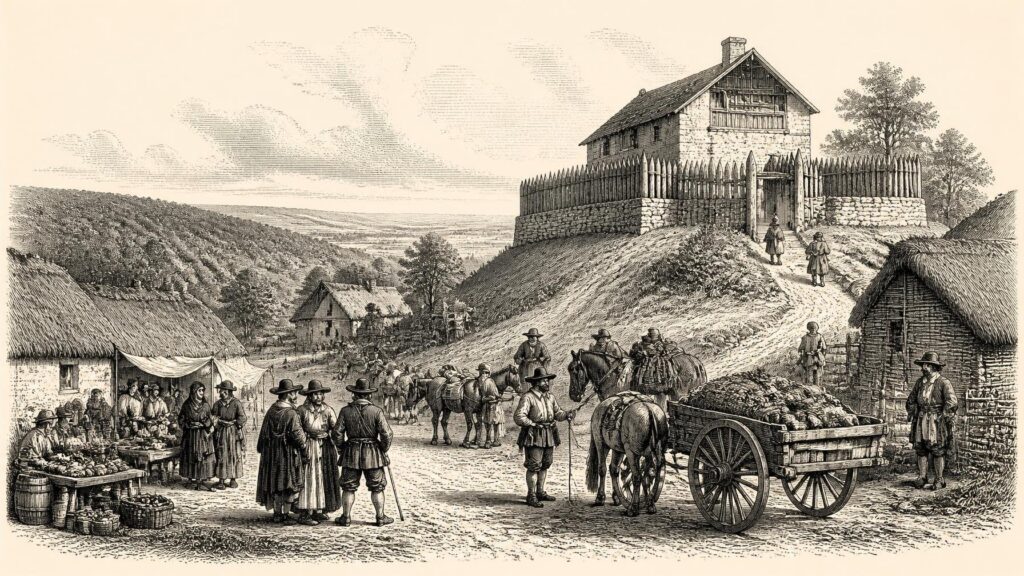
Ireland in 1612 was not marked by a single battle or a meeting of parliament, yet it was a consequential year in which government policy became painfully visible. The military conquest of the previous reign had ended, but its political settlement was still being made: through confiscated land, new towns, courts, charters, religion and a tightening administrative presence. In Ulster especially, the Plantation was no longer merely a scheme drawn up in London and Dublin. It was becoming a lived, uneven and contested alteration of ownership, settlement and authority. Elsewhere, Crown government prepared boroughs whose importance would become unmistakable when parliament assembled in 1613.
Execution at George’s Hill
The most sharply dated Irish event of the year occurred in Dublin on 1 February. Conor O’Devany, Roman Catholic bishop of Down and Connor, and Patrick O’Loughran, a priest associated with the archdiocese of Armagh, were executed at George’s Hill after conviction for treason. They had been tried on 28 January. The prosecution linked them to the Flight of the Earls of 1607 and alleged dealings with the pope and Spain; O’Loughran’s past service to the exiled Hugh O’Neill, earl of Tyrone, made him particularly vulnerable. The charges made the two clerics symbols of a state still anxious about foreign intervention and the displaced Gaelic leadership.
O’Devany’s position made the episode especially significant. He was one of only two Catholic bishops then resident in Ireland, a Franciscan with long experience of imprisonment and of operating under pressure. The English administration did not regard Catholic allegiance as a purely private matter: clerical contact with continental colleges, Irish émigrés and great Gaelic families could be treated as a political danger. Yet the affair also demonstrates the resilience of Catholic life. O’Loughran had returned to Ireland only in 1611 after time in the Spanish Netherlands and Rome, while O’Devany had continued to exercise authority despite earlier arrests. Their deaths were intended to intimidate, but contemporary Catholic memory honoured them as martyrs. The Annals of the Four Masters, compiled within a Catholic scholarly world, recorded O’Devany’s death with evident reverence.
It would be misleading, however, to treat 1612 as a year in which Catholic practice suddenly ceased. The established Church of Ireland possessed the legal advantages of the Crown, and officials hoped to consolidate a Protestant political order. But parish provision was patchy, clergy were thinly spread in many districts, and the great majority of the population remained Catholic. The execution at George’s Hill reveals both the coercive capacity of government and the limits of religious conformity as a practical reality.
A Plantation Under Scrutiny
Sir Arthur Chichester, lord deputy since 1605, remained the central figure in Dublin government. His administration had used the forfeitures following the Flight of the Earls and the rebellion of Sir Cahir O’Doherty in 1608 to refashion much of Ulster. The formal Plantation covered the escheated counties of Armagh, Cavan, Donegal, Fermanagh, Tyrone and the former county of Coleraine. Land was divided among English and Scottish undertakers, Crown servitors, selected Gaelic Irish grantees, bishops and church institutions, and Trinity College Dublin. This was not an empty landscape awaiting occupation. It was a region of established communities, farms, woods, routes, ecclesiastical sites and lordly claims, now subjected to a radically new framework of title and settlement.
By 1612, the practical results fell short of official hopes. Undertakers were expected to bring British tenants, construct defensible houses or bawns, establish farms and avoid leasing substantial holdings to the native Irish. Such conditions were difficult and expensive to fulfil. Building materials, labour, capital, security and willing tenants did not appear simply because acreage had been granted on paper. Indigenous inhabitants, meanwhile, faced displacement, altered rents and the loss of political protection formerly supplied by their own lords. Some secured leases or grants and remained integral to the local economy; others were pushed onto less favourable land or into more precarious dependence.
Concern in the Crown’s councils became sufficiently serious in December 1612 for the king to order a further examination of the Plantation’s progress. The inquiry itself was conducted in the following spring by Sir Josias Bodley, so it must not be dated to 1612. But the decision to investigate belongs firmly to this year and is revealing. Bodley, already experienced in surveying Ulster and in military engineering, was also appointed director-general of fortifications late in 1612. The coming review would measure actual houses, settlers, tenants and defences against promises. Thus the year closed with the Plantation acknowledged as a project that required inspection, not celebration.
Charters as Instruments of Rule
Urban incorporation was another means of making conquest durable. On 27 November 1612 Dungannon became the first of thirteen places in the six planted counties to receive a charter during the sequence that ran into June 1613. The choice was highly charged. Dungannon had been associated with the O’Neills and with the political centre of Tyrone; its incorporation signalled the intended replacement of Gaelic lordship by an English-style borough, governed through officers, burgesses, courts and market privileges.
The new corporations had local purposes. Their patrons were expected to bring in tradesmen, provide houses and leases, and reserve space for communal needs. In principle, a town required not simply a charter but a population able to buy and sell, work, worship, attend courts and maintain streets. In practice, some boroughs were still very small, and their named burgesses might be landlords or grantees with little everyday connection to the settlement. This should temper any picture of instantaneous urban growth. Nonetheless, markets, corporate jurisdiction and planned streets gave the state useful points of authority in a formerly thinly urbanised province.
They also had a constitutional purpose. Each corporate town could return two members to the Irish House of Commons. The creation of boroughs in Ulster and across the island therefore helped shape the electorate and representation before the parliament intended for 1613. Many new corporations were expected to return Protestant members loyal to the Crown’s programme. Catholic Old English peers had already protested against the multiplication of corporations in places they considered no more than poor villages. Their complaint grasped the political calculation: the borough was at once a settlement project, a legal entity and an electoral device.
Developments outside Ulster show that this policy was national in scope. Baltimore in west Cork received its official borough charter on 26 September 1612. Its harbour, existing market rights and English settler community made incorporation commercially as well as politically useful. At Roscommon, an order of 15 October directed preparation of a fiant for the town’s incorporation, with parliamentary representation explicitly in view. These actions were parts of the wider rush of borough-making, rather than evidence that every new corporation immediately became a substantial town.
Ports, Goods and Daily Exchange
1612 is also important because the surviving Ulster port books begin in this year. Covering Londonderry, Coleraine, Carrickfergus and the Lecale ports of County Down, they record merchants, shipmasters, routes and cargoes moving through the region. They are administrative documents, not a full account of every transaction, but they bring the economy closer than proclamations and plantation plans can do. They show an Ulster connected by sea to Britain and wider trading networks, while also revealing the emergence of merchant communities around old ports and new plantation centres.
For ordinary people, the changes behind such records were material. New households needed food, tools, cloth, salt, timber, livestock, transport and credit. Farmers supplied produce; boatmen, labourers, craftsmen, servants and small traders found opportunities as settlements expanded; landlords and officials sought rents, customs and fees. Yet commerce did not erase inequality. The same plantation economy that encouraged markets and shipping rested on a transfer of land and power whose burdens fell heavily on many Gaelic Irish families. The port books offer no simple story of prosperity: they instead show a society becoming more commercially integrated while remaining socially divided.
Davies’s Argument
Late in the year, Sir John Davies, attorney general for Ireland, entered print with A Discoverie of the True Causes why Ireland was never entirely subdued. Entered in December and published in London in 1612, it offered an influential explanation of Ireland’s past and a justification for the new order. Davies argued that previous English governments had failed because they had not completed conquest through regular law, secure landholding, settlements and institutions. Under James I, he claimed, Ireland had finally been brought into obedience.
The book was neither a detached history nor a neutral guide to Irish society. It was an official-minded defence of conquest and reform, written by a man deeply involved in the legal and political transformations he described. Yet its publication matters because it articulated the assumptions behind policy in 1612: that common law, shire government, towns, Protestant officeholders and redefined property could make the island governable. For Irish people living through eviction, incorporation, surveillance or religious pressure, these ideas were not abstract. They were being translated into the ground beneath their feet.
By year’s end, Ireland stood between implementation and reckoning. The state had executed two prominent Catholic clerics, initiated a new round of borough charters, gathered evidence from expanding ports and ordered closer scrutiny of the Ulster Plantation. None of these measures resolved the tensions created by conquest. Together, however, they made clear the kind of kingdom Chichester’s government intended to build: more urban, more surveyed, more parliamentary and more closely tied to Protestant British power.
Primary Sources
- O'Devany, Conor | Dictionary of Irish Biography
- O'Loughran, Patrick | Dictionary of Irish Biography
- Chichester, Arthur | Dictionary of Irish Biography
- Davies, Sir John | Dictionary of Irish Biography
- Annals of the Four Masters, Part 23
- A discouerie of the true causes why Ireland was neuer entirely subdued, nor brought vnder obedience of the crowne of England
- Calendar of the State Papers, Relating to Ireland, of the Reign of James I, 1611–1614
- Calendar of the Carew Manuscripts, Preserved in the Archiepiscopal Library at Lambeth: 1603–1624
- State Papers Ireland 1509–1782: Government Papers on Irish Affairs
- Plantation People
- Sources: Ulster Plantation
- Corporate Towns in the Plantation Counties
- The Ulster Port Books 1612–1615
- The Ulster Port Books, 1612–15
- Plantations in Ulster, 1600–41
- The Greatest Gerrymander in Irish History? James I's 40 Boroughs of 1612–13
- County Down: Constituencies and Elections
- Newry Town Charter
- Roscommon Town
- The Sack of Baltimore
- The New Colonial City of London/Derry
- Survey by Sir J. Bodley of the Undertakers and Servitors Planted in Ulster, February–April 1613